

Summary
If your dog follows you everywhere suddenly, it could be caused by a wide range of factors — from natural pack instincts and learned attachment to underlying medical conditions, anxiety, cognitive decline, or environmental changes. While shadowing behavior is often a sign of a loving bond, a sudden shift in your dog’s clinginess deserves close attention. This comprehensive guide covers every angle of the topic: the psychological, behavioral, and physiological reasons behind the behavior, how to distinguish healthy bonding from problematic dependency, what specific breeds are prone to it, and practical strategies to restore a healthy balance between closeness and independence in your dog.
OUTLINE
- Dog Follows You Everywhere Suddenly: Why It Happens and What You Should Do
- What Does It Mean When Your Dog Follows You Everywhere?
- Top Reasons Your Dog Follows You Everywhere Suddenly
- Dog Suddenly Clingy: Behavioral vs. Medical Causes
- Breed Predispositions — Which Dogs Are More Likely to Shadow You?
- How to Tell If the Behavior Is Normal or a Problem
- What to Do When Your Dog Follows You Everywhere
- Related Canine Behavioral Patterns You Should Know
- FAQs About Dogs Following Their Owners
- Conclusion
What Does It Mean When Your Dog Follows You Everywhere?
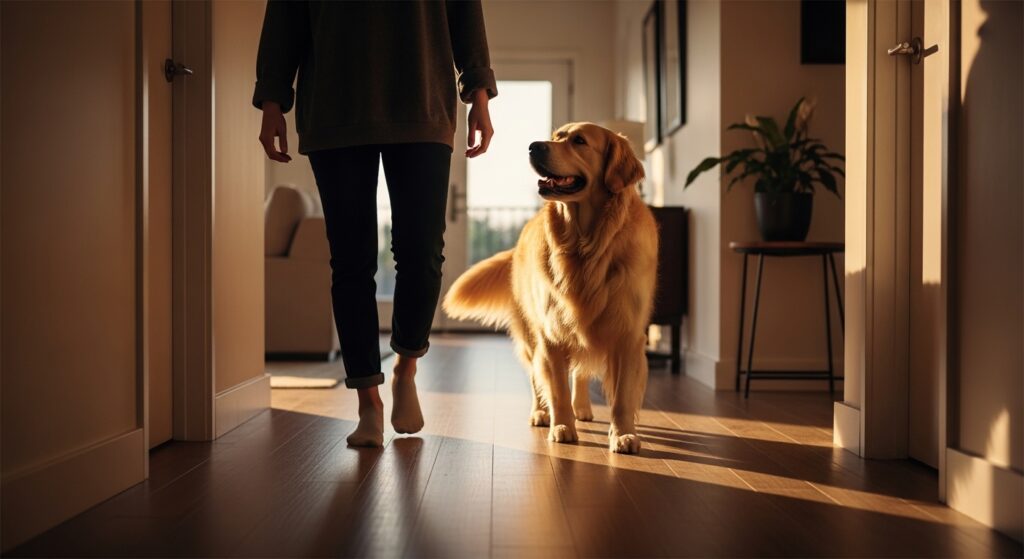
Dogs are social animals wired for companionship. But when your dog starts trailing your every step — from room to room, to the kitchen, even to the bathroom — it raises a natural question: why now, and why so intensely?
Understanding the “why” requires looking at your dog not just as a pet but as a sentient being with emotional states, physical needs, and deep-rooted behavioral programming.
The Velcro Dog Phenomenon
Animal behaviorists and veterinary professionals use the term “Velcro dog” to describe a canine that sticks to their owner’s side with unusual persistence. This term captures both the endearing and potentially concerning nature of the behavior. A Velcro dog isn’t merely affectionate — they experience distress when separated, show hypervigilance to their owner’s movements, and may exhibit compulsive following patterns.
Is It Normal for Dogs to Follow Their Owners?
Yes — to a degree. Dogs evolved alongside humans over thousands of years, developing what ethologists call proximity-seeking behavior. This is a social bonding mechanism rooted in survival. In the wild, staying close to the group meant safety, food, and warmth.
However, sudden changes in this behavior — particularly if your dog wasn’t previously clingy — are the critical signal. A shift in following intensity is a behavioral red flag that warrants investigation.
Top Reasons Your Dog Follows You Everywhere Suddenly
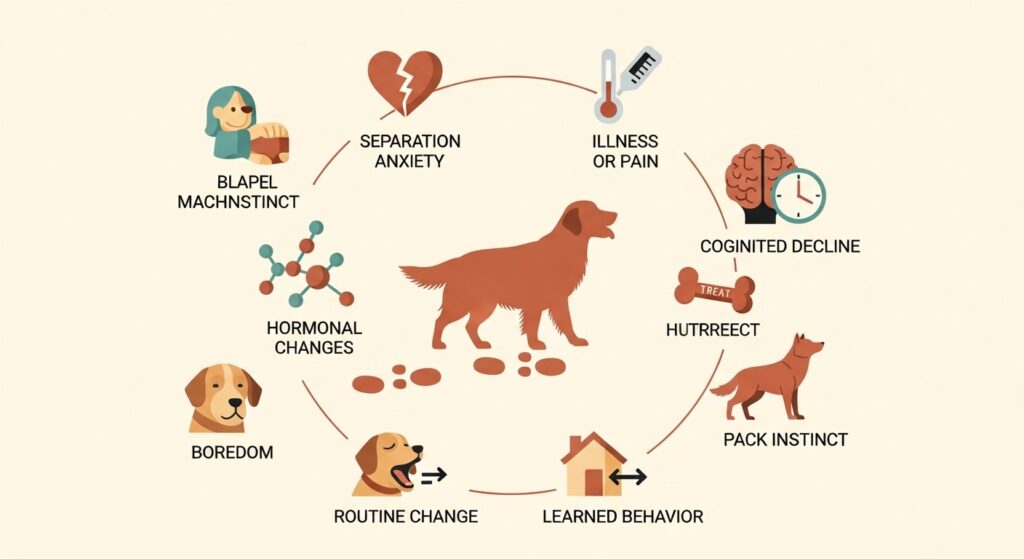
1. Separation Anxiety and Fear-Based Attachment
Separation anxiety is one of the most common and clinically recognized reasons a dog suddenly becomes a shadow. According to the American Veterinary Medical Association (AVMA), separation anxiety affects an estimated 14–20% of dogs in the United States.
Dogs with separation anxiety follow their owners as a pre-emptive coping mechanism — staying close reduces the anticipatory stress of being left alone. Triggers often include:
- A change in the owner’s work schedule (returning to the office after remote work)
- A new baby or pet in the household
- A move to a new home
- Loss of another pet or family member
When the following behavior is anxiety-driven, you’ll often see accompanying signs: pacing, whining, destructive behavior when alone, excessive drooling, and loss of appetite.
2. Illness or Physical Discomfort
One of the most important — and frequently overlooked — reasons for sudden clinginess is underlying illness or pain. Dogs are instinctively programmed to hide vulnerability (a survival adaptation), but they also seek comfort from their trusted humans when they feel unwell.
If your dog suddenly starts following you everywhere and exhibits any of the following, a vet visit is essential:
- Changes in appetite or water intake
- Lethargy or unusual tiredness
- Limping, stiffness, or reluctance to move
- Vomiting or diarrhea
- Restlessness or inability to settle
Conditions that commonly trigger sudden clingy behavior include pain from arthritis, gastrointestinal issues, neurological changes, endocrine disorders (like hypothyroidism or Cushing’s disease), and even early-stage vision or hearing loss.
3. Hormonal Changes and Heat Cycles
Intact female dogs going into estrus (heat) often show marked behavioral changes, including increased following. The surge in reproductive hormones causes emotional instability, restlessness, and a heightened need for social contact.
Similarly, phantom pregnancies (pseudopregnancy) — a hormonally-driven condition in unspayed females — can cause a dramatic uptick in clingy, nurturing behavior directed at owners.
Even male dogs can become more velcro-like during periods when they detect a nearby female in heat, driven by hormonal stress and arousal.
4. Sensory Changes — Old Age and Cognitive Dysfunction
Senior dogs (typically 7+ years for large breeds, 10+ for small breeds) can develop Canine Cognitive Dysfunction Syndrome (CCDS), often compared to Alzheimer’s disease in humans. One of the hallmark symptoms is increased attachment and following behavior.
As spatial awareness diminishes and familiar environments become confusing, dogs anchor themselves to the one constant they trust — you. Other signs of CCDS include:
- Disorientation or getting “stuck” in corners
- Disrupted sleep cycles (nighttime restlessness)
- House soiling despite prior training
- Staring blankly at the walls
- Reduced interest in play or social interaction
If your senior dog is suddenly glued to your side, cognitive decline should be high on your differential list.
5. Boredom and Under-Stimulation
A mentally and physically under-stimulated dog will gravitate toward their owner as the most interesting thing in their environment. Following you becomes a form of self-generated enrichment — hoping that wherever you’re going, something interesting might happen.
This is especially common in high-energy, working-breed dogs (Border Collies, German Shepherds, Belgian Malinois) that aren’t receiving adequate mental engagement. The behavior isn’t rooted in anxiety here but in cognitive need.
6. Positive Reinforcement (Learned Behavior)
Has your dog learned that following you results in treats, belly rubs, walks, or playtime? If so, the behavior is likely operantly conditioned. Every time you rewarded the dog for being nearby — even inadvertently through affectionate glances, verbal praise, or food — you reinforced the proximity behavior.
This is not harmful in itself, but it can escalate into problematic dependency if boundaries aren’t established.
7. Changes in Household Routine or Environment
Dogs are creatures of routine with an extraordinary sensitivity to environmental shifts. Any of the following can trigger sudden following behavior:
- A family member leaving (going to college, divorce, death)
- Moving to a new home
- New pets or people joining the household
- Rearranging furniture
- Loud construction or external stressors (thunderstorms, fireworks)
- The owner’s changed work schedule
In canine behavioral science, this is linked to what’s known as contextual disruption — when the predictable structure of a dog’s world is altered, they seek proximity to their attachment figure for social buffering.
8. Instinctual Pack Behavior
At the most fundamental level, dogs follow their owners because they are pack animals who view their human family as their social group. The leader or most trusted member of the group is naturally tracked, monitored, and followed. This is hardwired behavior going back tens of thousands of years of domestication and co-evolution with humans.
Dog Suddenly Clingy: Behavioral vs. Medical Causes
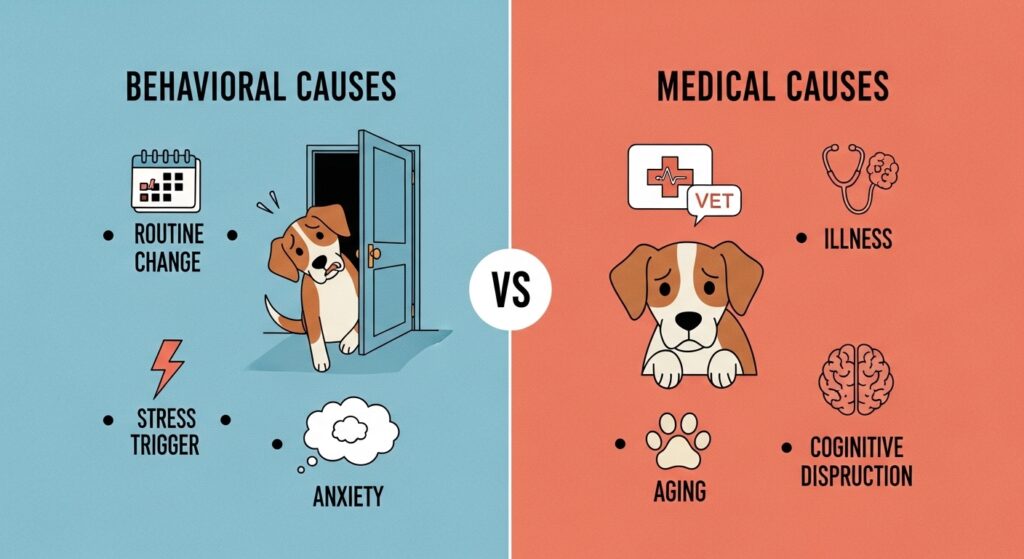
Understanding whether your dog’s sudden following is behavioral or medical in origin is the most important diagnostic step.
Behavioral Triggers
Behavioral causes tend to develop gradually, often in response to environmental changes or reinforcement patterns. Key indicators:
- Behavior began around a specific life event or change
- The dog shows other anxiety markers (destructive behavior, excessive barking)
- The dog is physically healthy otherwise
- Behavior improves with enrichment or training
Medical and Health-Related Triggers
Medical causes tend to appear more abruptly and with accompanying physical symptoms. Key indicators:
- No obvious environmental trigger
- Accompanied by physical changes (lethargy, appetite shifts, changes in gait)
- Senior dog showing personality change
- Rapid onset — went from independent to clingy overnight
Breed Predispositions — Which Dogs Are More Likely to Shadow You?
While any dog can become velcro-like, certain breeds are genetically predisposed to strong human attachment:
High-attachment breeds:
- Labrador Retrievers — bred for close human cooperation
- Golden Retrievers — emotionally attuned, people-oriented
- Border Collies — hyper-vigilant, track owner movements as part of their herding instinct
- Vizslas — nicknamed “Velcro Vizslas” for their legendary clingy nature
- Shetland Sheepdogs (Shelties) — loyal, bonded, shadow their person
- Chihuahuas — small dog anxiety often manifests as extreme attachment
- German Shepherds — loyal and protective, closely monitor their owners
If you have one of these breeds and your dog has suddenly intensified this behavior, the genetic baseline makes the threshold for concern slightly different from what it would be for a naturally independent breed like a Basenji or Chow Chow.
How to Tell If the Behavior Is Normal or a Problem
Signs It’s Healthy Bonding
- The dog follows you but settles calmly when you stop
- A dog can stay alone without destructive behavior or excessive distress
- Following is context-appropriate (after meals, during walks)
- The dog is otherwise happy, healthy, and playful
Signs It Could Be Anxiety or a Health Issue
- The dog panics when you close a door between you
- Following is relentless — even into the bathroom, every single time
- The dog shows trembling, panting, or whining when you prepare to leave
- Behavior started suddenly with no clear trigger
- Accompanied by physical symptoms
If your dog is showing signs of anxiety around bathroom habits or outdoor routines as well, you might also find value in understanding why dogs develop conflicting indoor/outdoor bathroom preferences, as these anxiety patterns are often interconnected.
What to Do When Your Dog Follows You Everywhere
When to See a Veterinarian
If the clinginess is sudden, severe, and unexplained — see your vet first. Rule out medical causes before addressing behavior. A complete physical exam, bloodwork panel, urinalysis, and (if appropriate) neurological screening can provide critical information.
For senior dogs, ask specifically about cognitive dysfunction screening.
Training Techniques to Encourage Independence
1. Place Training: Teach your dog a “go to your place” command, rewarding them for staying on their bed while you move around. Gradually increase the distance and duration.
2. Graduated Desensitization. For anxiety-driven following, systematically desensitize your dog to your movements. Start by rewarding calm behavior as you take just one step away. Build up incrementally.
3. “Stay” Practice Reinforce the “stay” command in low-stakes environments before applying it to the moments your dog is most prone to following.
4. Avoid Accidental Reinforcement Stop rewarding following behavior with attention. If your dog follows you and you respond with praise or pets, you reinforce the behavior. Ignore calm following; reward settling.
5. Confidence-Building Exercises Use puzzle feeders, sniff walks, and independent play sessions to build your dog’s ability to self-soothe and self-entertain.
Environmental Enrichment Strategies
- Snuffle mats and food puzzles to occupy the dog when you need space
- Calming pheromone diffusers (Adaptil/DAP) — clinically studied for anxiety reduction
- Regular exercise to reduce anxiety-driven energy
- Consistent daily routine to rebuild predictability and reduce stress
For dogs with severe separation anxiety, a certified applied animal behaviorist (CAAB) or a veterinary behaviorist may recommend a structured behavior modification protocol. In some cases, anti-anxiety medications (fluoxetine, clomipramine) prescribed by a veterinarian may be part of a comprehensive treatment plan.
According to the ASPCA’s behavioral science resources, combining medication with behavioral modification yields significantly better outcomes for dogs with true separation anxiety than either approach alone. You can explore more on canine anxiety and behavioral management through the ASPCA’s professional animal behavior resources.
Related Canine Behavioral Patterns You Should Know
Why Does My Dog Follow Me to the Bathroom?
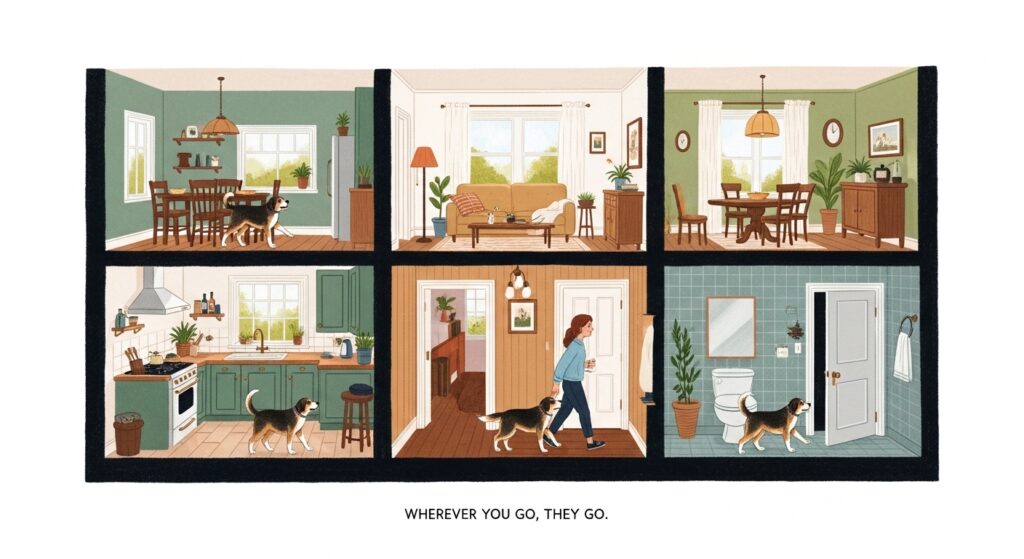
This is one of the most searched variations of this topic — and for good reason. The bathroom presents a unique challenge for velcro dogs because the closed door creates an involuntary separation. For dogs with anxiety, this brief barrier can trigger significant distress.
The behavior is rooted in the same attachment and pack-following instincts discussed above. Your dog isn’t being weird — to them, losing sight of you (even briefly) activates a mild threat response.
Why Does My Dog Follow Me and Not My Partner?
Dogs form primary attachment bonds — similar to a child’s bond with a primary caregiver. The person who feeds them, trains them, and spends the most consistent time with them typically becomes the primary attachment figure. This preference can also shift with life changes — if you’ve recently started working from home, for example, you may have become the new “primary” by sheer time investment.
Why Does My Dog Follow Me More at Night?
Increased nighttime following can indicate cognitive dysfunction (disorientation at night is common with CCDS), anxiety (quiet, low-stimulus environments can heighten hypervigilance), or simply temperature-seeking behavior (your dog is cold and finds warmth near you). It can also be a sign that your dog’s natural circadian rhythm is disrupted, which is worth discussing with your vet.
FAQs About Dogs Following Their Owners
Q: My dog suddenly started following me everywhere — should I be worried? A: Not necessarily, but sudden changes always warrant attention. Rule out medical causes first, then assess behavioral triggers.
Q: Is it bad to let your dog follow you everywhere? A: Mild following is healthy and normal. It becomes a problem when the dog cannot function independently or shows signs of distress when separated.
Q: Can you train a dog to stop following you? A: Yes. Through consistent training, enrichment, and sometimes professional support, most dogs can learn to be more independent without losing their bond with you.
Q: My female dog is following me everywhere — is she pregnant? A: Possibly, or she may be experiencing a phantom pregnancy or heat cycle. A vet exam can clarify.
Q: Why does my rescue dog suddenly follow me everywhere? A: Rescue dogs often have histories of instability. Once they form an attachment bond with a new owner, following can intensify as a security behavior. This typically improves with time, routine, and positive reinforcement. For further reading on canine behavior in rescue contexts, the RSPCA’s behavioural advice for rescue dog owners is an excellent resource.
Conclusion
A dog that follows you everywhere is, at its core, a dog that loves and trusts you. But when that behavior emerges suddenly or intensifies dramatically, it’s your dog’s way of communicating something worth listening to. The causes range from simple boredom and learned behavior to serious medical conditions and significant emotional distress. By understanding the full spectrum of reasons — from pack instinct and breed predisposition to separation anxiety, hormonal changes, and cognitive decline — you’re better equipped to respond in a way that truly serves your dog’s wellbeing. Observe, investigate, and when in doubt, consult your veterinarian. The goal isn’t to push your dog away, but to help them feel safe enough that they don’t need to follow you everywhere — and that’s a beautiful kind of confidence to build.