


Summary: If your puppy wakes up too early every morning, you’re not alone — this is one of the most common behavioral challenges new dog owners face. Early waking in puppies is driven by a mix of circadian rhythm immaturity, insufficient physical and mental stimulation, environmental triggers, separation anxiety, and hunger cues. This comprehensive guide covers every aspect of why puppies wake at dawn and beyond, walking you through proven behavioral training methods, sleep environment optimization, feeding schedule adjustments, crate training strategies, and long-term habit formation — so both you and your puppy can finally enjoy a full night’s sleep.
Outline
- Puppy Wakes Up Too Early Every Morning: How to Fix It (Complete Guide)
- Why Does My Puppy Wake Up So Early? Understanding the Root Causes
- How Much Sleep Does a Puppy Actually Need?
- Crate Training and Sleep Space Optimization
- Adjusting Your Puppy’s Feeding Schedule to Prevent Early Waking
- Exercise, Mental Stimulation, and the Sleep Connection
- Building a Consistent Bedtime Routine
- Behavioral Training Methods to Stop Early Morning Wake-Ups
- Environmental Adjustments to Discourage Early Waking
- When Early Waking Is a Sign of a Deeper Issue
- Age-Specific Strategies: From 8 Weeks to 6 Months
- Common Mistakes That Make Early Waking Worse
- Frequently Asked Questions
Why Does My Puppy Wake Up So Early? Understanding the Root Causes
Before you can fix the problem, you need to understand what’s driving it. Puppies don’t wake up at 4:30 AM out of spite — there are real physiological and behavioral reasons behind it. Early rising in puppies is a multi-factorial issue involving biology, environment, conditioning, and developmental stage.
Immature Circadian Rhythms and Sleep Cycles in Puppies
Just like newborn humans, young puppies have not yet developed fully regulated circadian rhythms — the internal biological clock that governs sleep-wake cycles. In the canine world, this clock is heavily influenced by light exposure, routine, and social cues from their pack (in a domestic setting, that means you and your family).
Puppies in the 8–16 week range are especially susceptible to erratic sleep patterns because their suprachiasmatic nucleus (SCN) — the brain region that regulates circadian timing — is still maturing. This means their internal clock doesn’t yet strongly anchor sleep to nighttime darkness or wakefulness to daytime light. As a result, even minor environmental light changes at dawn — such as the sun rising at 5:30 AM — can be enough to flip the “awake” switch in a young pup’s brain.
Hunger and Feeding Schedule Misalignment
Puppies have small stomachs and high metabolic rates. If the last meal of the day is too early — say, 4 PM for a puppy that wakes at 5 AM — hunger becomes a powerful biological driver of early waking. Blood glucose dips during overnight fasting can trigger alertness and restlessness, causing your puppy to cry or bark for food before you’re ready to start the day.
This is a common and fixable issue. Many owners unknowingly train their puppies to expect food at dawn by rushing to feed them the moment they wake up, reinforcing the early-morning alarm clock behavior.
Environmental Noise and Light Triggers
Dogs are far more sensitive to environmental stimuli than humans. Their hearing range extends well beyond ours (up to 65,000 Hz compared to our 20,000 Hz), meaning early morning sounds — garbage trucks, birds, neighbors leaving for work, traffic — register as significant auditory stimuli for a puppy. Combined with the photosensitivity of their circadian system, even the faintest grey light of pre-dawn can begin signaling “morning” to a puppy’s brain.
Separation Anxiety and Attention-Seeking Behavior
Some puppies wake early not because of hunger or light, but because they experience distress when separated from their owners at night. Separation-related behaviors in dogs are among the most clinically studied areas of canine behavioral science. A puppy that barks or whines repeatedly at 5 AM and immediately settles when you appear is often displaying separation distress rather than a true biological need.
If your Dog Afraid of Loud Noises Inside House and also wakes early, anxiety may be a shared underlying thread in their behavioral profile worth addressing holistically.
Excess Energy from Under-Stimulation
A puppy that hasn’t received enough physical exercise and cognitive enrichment during the day will have surplus energy to burn. This can lead to hyperarousal — a state where the nervous system remains activated even during rest periods — resulting in lighter, more fragmented sleep and earlier waking. The relationship between daytime activity levels and nighttime sleep quality is well-established in both canine behavioral science and veterinary sleep research.
How Much Sleep Does a Puppy Actually Need?
Understanding typical sleep requirements helps you set realistic expectations and spot abnormalities.
Sleep Requirements by Age
Puppies sleep considerably more than adult dogs. Here’s a general breakdown:
- 8–12 weeks: 18–20 hours per day (including naps)
- 3–4 months: 16–18 hours per day
- 5–6 months: 14–16 hours per day
- Adult dogs: 12–14 hours per day
The critical insight here is that while puppies sleep a lot in total, they do so in multiple shorter bouts throughout the day and night — not in one consolidated block. This natural polyphasic sleep pattern is a major reason why nighttime waking feels so disruptive.
The Difference Between Naps and Nighttime Sleep
Puppies rely on both slow-wave sleep (SWS) and rapid eye movement (REM) sleep for healthy development. Daytime naps contribute to overall sleep homeostasis, but consolidated nighttime sleep is particularly important for memory consolidation, immune function, and neurological development. Puppies that nap too much in the late afternoon may not build enough sleep pressure to sustain a long nighttime sleep bout.
Signs Your Puppy Is Sleep-Deprived vs. Overtired
A sleep-deprived puppy often displays increased irritability, difficulty focusing during training, excessive mouthing, and hyperactive bursts followed by sudden crashes. An overtired puppy — paradoxically — may also show hyperactivity, as cortisol spikes from fatigue can override sleepiness. Learning to read your puppy’s sleep signals (yawning, slow blinking, seeking quiet spots) is key to building an effective sleep schedule.
Crate Training and Sleep Space Optimization
One of the most effective tools for regulating puppy sleep — and preventing early waking — is proper crate training.
Why Crate Training Helps with Early Waking
A crate mimics the den environment that dogs are instinctively drawn to. When properly introduced, a crate becomes a place of safety and calm rather than confinement. Crucially, it also limits your puppy’s ability to self-reward upon waking — a puppy that wanders freely at 5 AM can find its own entertainment (destroying furniture, chewing, scratching doors), which reinforces the early rising. A crate-trained puppy, by contrast, learns that waking up early results in… more crate time, not a party.
According to the American Kennel Club’s puppy crate training guidelines, consistency and positive association are the two pillars of effective crate training.
Choosing the Right Crate Size and Location
The crate should be large enough for your puppy to stand, turn around, and lie down comfortably — but not so large that they have enough room to eliminate in one corner and sleep in another. If you’re using a large crate for a growing breed, use a divider to reduce the usable space.
Location matters enormously. Placing the crate in your bedroom — or at minimum near a room where they can hear ambient human breathing and movement — significantly reduces nighttime distress vocalization. Many behaviorists recommend keeping the crate in the bedroom during the early months and gradually transitioning it to a preferred permanent location.
How to Make the Crate a Positive Sleep Environment
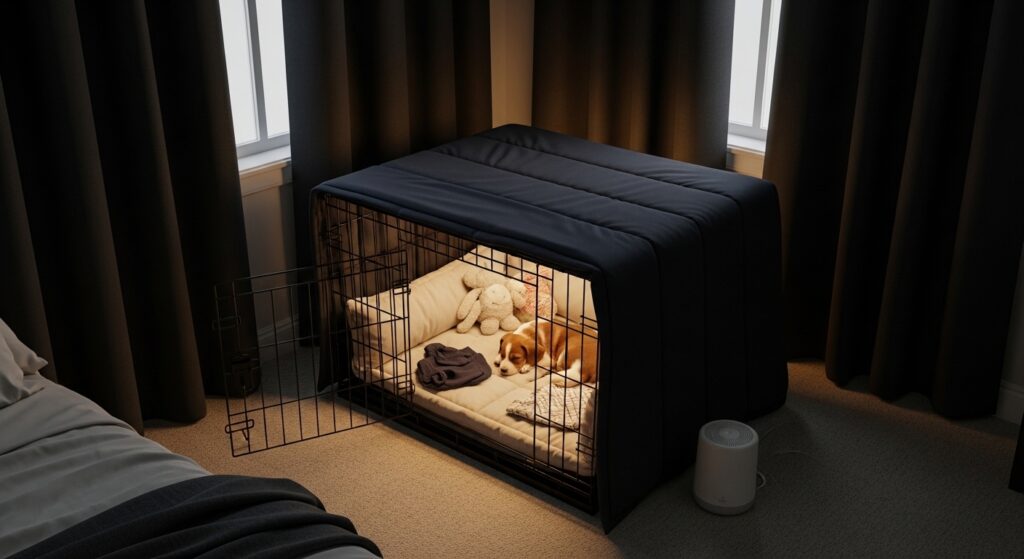
- Use a crate cover (blanket or purpose-built cover) to block dawn light
- Place a worn T-shirt or item of your clothing inside for olfactory comfort
- Add a “heartbeat toy” or low-frequency white noise device nearby
- Ensure the bedding is appropriately cushioned and thermally comfortable
- Never use the crate as punishment
Adjusting Your Puppy’s Feeding Schedule to Prevent Early Waking
Last Meal Timing and Its Impact on Sleep
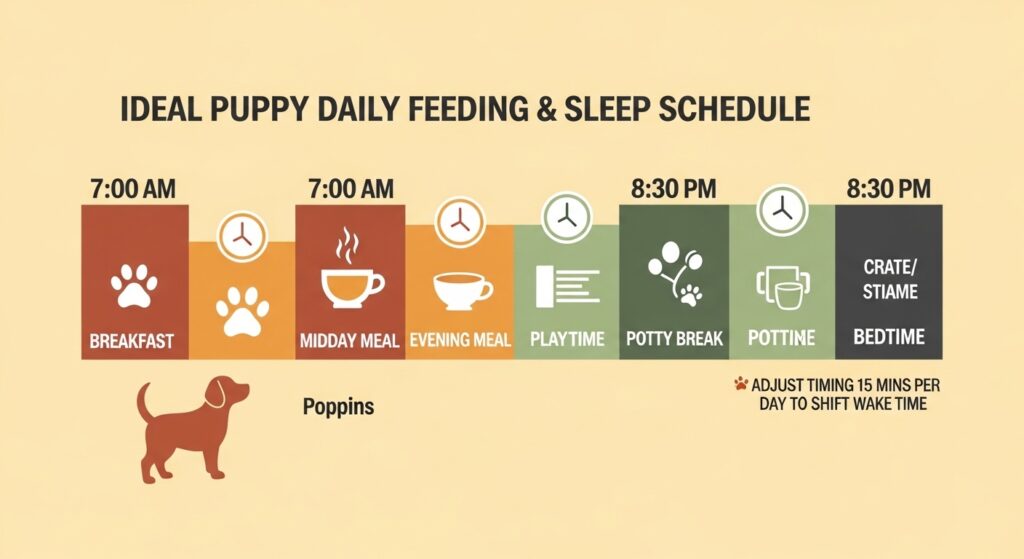
One of the most actionable changes you can make immediately is adjusting when your puppy eats their last meal. Moving the final meal of the day closer to your desired bedtime — ideally within 1.5 to 2 hours — helps ensure your puppy isn’t waking from hunger. For a puppy with an 8 PM bedtime, a last meal at 6:30–7 PM is ideal.
Avoiding Hunger-Driven Wake-Ups
If your puppy consistently wakes at the same time each morning and immediately goes to their bowl or paws at you, hunger is likely the trigger. Try incrementally pushing the last meal later by 15 minutes every few days until you find the window that prevents the early hunger signal.
Avoid leaving food down all day (ad libitum feeding), as this makes it impossible to strategically time nutrient intake relative to sleep.
Water Access During the Night
Fresh water should be available to your puppy at all times, including overnight. However, puppies younger than 16 weeks may need a nighttime bathroom break regardless of water access. Factor this into your expectations — a 10-week-old puppy genuinely cannot hold their bladder for 8 hours. What you’re working toward is eliminating unnecessary early waking, not ignoring genuine physiological needs.
Exercise, Mental Stimulation, and the Sleep Connection
Evening Exercise Routines That Promote Better Sleep
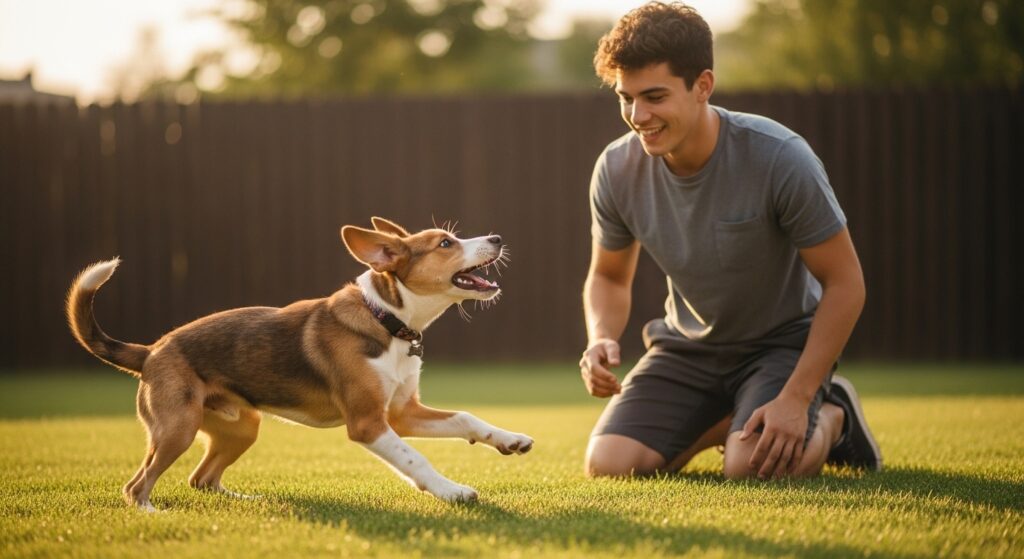
Aim for a moderate-intensity play or exercise session 1–2 hours before bedtime. This gives your puppy time to physically wind down before sleep while ensuring they’ve adequately depleted their energy reserves. Examples include a brisk 10–15 minute walk, a game of fetch in the yard, or structured tug-of-war.
Avoid very high-intensity play in the 30 minutes immediately before bed, as this can cause arousal that delays sleep onset.
Mental Enrichment Activities Before Bedtime
Physical exhaustion alone isn’t always enough — puppies also need cognitive depletion to sleep soundly. Mental enrichment activities like puzzle feeders, sniff mats, Kong stuffed with frozen food, and training sessions using positive reinforcement all engage the prefrontal cortex and produce the kind of neural tiredness that promotes deep sleep.
A 10-minute training session before bed — working on sit, stay, down, or name recognition — can be more sleep-inducing than 20 minutes of running.
The Role of Play in Regulating Puppy Sleep
Play serves a dual function in sleep regulation: it builds physical fatigue and also reinforces the human-canine bond, reducing nighttime separation distress. Puppies that have had high-quality social play time with their owners during the evening are less likely to whine for attention during the night. According to research published in Applied Animal Behaviour Science, play-based social bonding is a key moderating variable in canine sleep quality.
Building a Consistent Bedtime Routine
Routine is one of the most powerful tools in canine behavioral science. Dogs are creatures of habit — their hypothalamic-pituitary-adrenal (HPA) axis responds strongly to temporal cues, meaning that consistent sequences of events at the same time each evening can physiologically prime your puppy for sleep.
Step-by-Step Puppy Bedtime Routine
Here’s an effective evidence-based bedtime routine template:
- 6:30–7:00 PM — Final meal of the day
- 7:00–7:30 PM — Moderate outdoor exercise and final potty break
- 7:30–8:00 PM — Calm indoor play or light training session
- 8:00–8:15 PM — Mental enrichment (Kong, puzzle feeder)
- 8:15 PM — Final potty break outside
- 8:30 PM — Crate time with cue word (“bedtime,” “kennel up”)
- Lights low, white noise on, crate covered
Repeat this sequence in the same order every night. Within 1–2 weeks, most puppies begin anticipating sleep at the routine’s end.
Using Calming Signals and Sleep Cues
Dogs communicate using a sophisticated system of calming signals — subtle body language cues that signal intent and emotional state. You can leverage this by introducing deliberate pre-sleep cues: lowering your voice, moving more slowly, dimming lights, and using a consistent verbal cue like “settle” or “sleep time.” Over repetitions, these cues become conditioned stimuli associated with the relaxation response.
What to Do If Your Puppy Whines at Night
The hardest part of puppy sleep training is resisting the urge to respond to whining. Responding — even to tell them to be quiet — can inadvertently reinforce the behavior. The behavioral principle at work here is intermittent reinforcement: responding sometimes but not always actually makes the behavior more persistent, not less.
If your puppy whines, wait. If they continue for more than a few minutes and you suspect a genuine need (bladder), take them out calmly, without praise or play, then return them directly to the crate. If it’s attention-seeking, ignore until quiet, then calmly reward the silence.
Behavioral Training Methods to Stop Early Morning Wake-Ups
Positive Reinforcement and Ignoring Undesired Behavior
The core principle here is simple: behavior that is reinforced is repeated; behavior that is not reinforced extinguishes. If your puppy learns that barking at 5 AM gets you out of bed, they will continue barking at 5 AM. If barking at 5 AM results in absolutely nothing happening, the behavior will — after a temporary increase called an extinction burst — decline.
This requires consistency. Even one or two instances of going to your puppy when they cry early will reset the behavior pattern.
Teaching a “Go Back to Sleep” Cue
Once your puppy reliably settles when placed back in their crate, you can begin pairing the settling behavior with a cue word. After returning them to the crate during any brief nighttime check, say “sleep” or “rest” softly and reward the subsequent quiet with a small treat placed through the crate door. Over time, this cue becomes a conditioned response associated with returning to rest.
Managing Your Own Response to Early Rising
This is often the hardest part for owners. Consider: do you immediately get up and feed your puppy the moment they wake early? Do you bring them into bed? Do you start your own day early because it feels pointless to try going back to sleep? Each of these responses communicates to your puppy that early waking is productive and worthwhile.
Set a firm target wake time — say, 7 AM — and commit to not acknowledging the puppy or beginning your routine before that time, unless there’s a genuine elimination need.
Environmental Adjustments to Discourage Early Waking
Blackout Curtains and Light Management
Since dawn light is one of the most powerful circadian triggers, investing in blackout curtains for the room where your puppy sleeps is one of the highest-impact environmental changes you can make. These curtains block the gradually brightening morning sky that signals “morning” to your puppy’s photoreceptors, delaying the circadian activation that promotes waking.
This single change can shift a puppy’s wake time by 30–90 minutes in some cases.
White Noise Machines and Sound Management
White noise machines or apps generate a consistent broadband sound that masks the variable environmental noises — birds, traffic, neighbor activity — that trigger alert responses in light-sleeping puppies. Place the device near the crate at a moderate volume (not loud enough to cause hearing stress, but sufficient to obscure ambient sounds).
Pink noise (slightly bass-heavy) has shown promise in sleep research for its particularly soothing effect on the nervous system and may be worth trying over standard white noise.
Temperature and Comfort Optimization
Dogs sleep most soundly within their thermoneutral zone — the temperature range requiring minimal metabolic effort to maintain body heat. For most breeds, this is between 65–72°F (18–22°C). Puppies, especially small breeds, are less efficient at thermoregulation and may benefit from a self-warming pad or snuggle-safe heat disc in their crate during cooler months.
Ensure the crate is not placed near heating or air conditioning vents, which can cause temperature fluctuations that disrupt sleep.
When Early Waking Is a Sign of a Deeper Issue
Medical Causes of Disrupted Sleep in Puppies
Some early waking is not behavioral but medical. Conditions that can disrupt sleep in puppies include gastrointestinal discomfort, urinary tract infections (which cause urgency and frequent waking), parasitic infections (intestinal worms causing hunger and discomfort), pain from orthopedic conditions in large breeds, or neurological issues. If early waking is sudden in onset, accompanied by other symptoms (vomiting, excessive thirst, limping, unusual elimination), a veterinary evaluation is warranted.
Puppies that excessively lick themselves at night — for example, those that display Dog Licking Private Area Excessively — may be experiencing discomfort or anxiety that also affects sleep quality.
Anxiety Disorders and Sleep Disruption
Subclinical and clinical anxiety in puppies can manifest as fragmented sleep, hypervigilance, night waking, and early morning distress. Risk factors include inadequate early socialization, traumatic early experiences (puppy mill origins), or genetic predisposition in certain breeds. If anxiety seems to be a driving factor, a veterinary behaviorist consultation can provide access to behavioral modification protocols and, where appropriate, pharmacological support.
When to See a Veterinarian
Consult your vet if: early waking is sudden and new (not since puppyhood), your puppy seems disoriented or confused upon waking, waking is accompanied by excessive vocalization suggesting pain, or if behavioral interventions over 4–6 weeks produce no improvement.
Age-Specific Strategies: From 8 Weeks to 6 Months
8–12 Week Old Puppies
At this age, realistic expectations are everything. A puppy this young genuinely cannot hold their bladder for more than 3–4 hours overnight and has minimal circadian rhythm development. Focus on: short, dark crate environments, nighttime bathroom breaks without stimulation, and avoiding any reinforcement of 4–5 AM social engagement. Don’t try to push for a full 8-hour sleep — 5–6 consecutive hours is a great win at this stage.
3–4 Month Old Puppies
By 12–16 weeks, bladder capacity has improved and circadian rhythms are strengthening. This is the ideal window to begin solidifying the bedtime routine, introducing a firm target wake time, and beginning consistent ignoring of early barking (assuming genuine needs have been ruled out). Puppies at this age respond very well to routine-based training.
5–6 Month Old Puppies
At this stage, most puppies are physiologically capable of sleeping through the night. Persistent early waking at 5–6 months is almost always a learned behavioral pattern rather than a physiological necessity. This is the point to be most firm about not responding before your target wake time. Consistency over 2–3 weeks at this stage will typically resolve the issue. For information on breed-specific sleep variations and how to manage ongoing behavioral issues, resources like PetMD’s behavioral sleep guide offer veterinarian-reviewed supplemental reading.
Common Mistakes That Make Early Waking Worse
Even well-intentioned owners can accidentally reinforce the behavior they’re trying to eliminate. Here are the most common errors:
Feeding immediately upon waking. If your puppy wakes at 5 AM and you feed them at 5:05 AM, you’ve confirmed that 5 AM is breakfast time. Push the feeding to at least your target wake time, even if that means waiting an uncomfortable few minutes.
Letting the puppy into your bed. Bed-sharing isn’t inherently bad, but using it as a response to early-morning whining teaches the puppy that whining produces a comfortable reward.
Inconsistent wake times on weekends. If you allow your puppy to sleep until 9 AM on weekends, you’re resetting their circadian anchor point and making weekday 7 AM waking harder.
Too-late or too-long afternoon naps. A puppy that naps from 4–6 PM has depleted sleep pressure and may not be ready to sleep through until 6 AM. Cap late afternoon naps and keep them short.
Skipping the exercise step. On busy days when evening exercise is skipped, expect a more restless night. Physical depletion is non-negotiable for sound puppy sleep.
Frequently Asked Questions
Q: Is it normal for a puppy to wake up at 5 AM every day? Yes, it’s common — especially in puppies under 4 months — but it’s not something you have to simply accept. With consistent training and environmental adjustment, most puppies can be guided to a more reasonable wake time.
Q: Should I ignore my puppy when they cry in the morning? If you’ve confirmed there’s no genuine need (bathroom urgency, illness), yes. Ignoring is the most effective behavioral intervention for attention-seeking early waking. It requires consistency and patience during the extinction phase, but it works.
Q: How long will it take to fix my puppy’s early waking? Most puppies show meaningful improvement within 2–4 weeks of consistent application of the strategies in this guide. Puppies over 4 months with no medical issues may respond even faster.
Q: Can I use melatonin to help my puppy sleep longer? While melatonin is sometimes used in dogs under veterinary guidance for anxiety-related sleep disruption, it should never be self-administered without veterinary consultation. Dosing, formulation (avoid xylitol-containing products), and appropriateness vary significantly by weight, age, and health status.
Q: My puppy sleeps fine, but wakes at exactly the same time every morning. Why? Circadian precision — where a puppy wakes at nearly the same minute each morning — suggests a strongly conditioned routine response (possibly to a regular environmental cue like a neighbor’s car or a feeding schedule) rather than a random sleep disruption. Identify and address the environmental anchor, or shift your entire routine by 30-minute increments.