
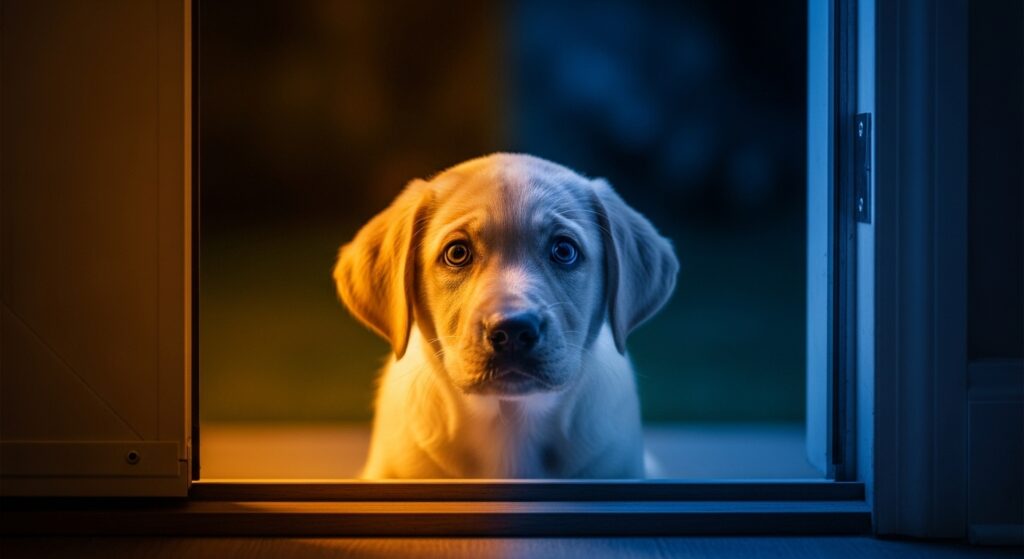

Summary: A puppy that refuses to go outside at night is experiencing a normal but addressable fear response rooted in heightened sensory perception, lack of environmental familiarity, and underdeveloped confidence. This comprehensive guide covers every aspect of canine nocturnal anxiety — from understanding the psychological and neurological triggers behind nighttime fear to step-by-step desensitization techniques, positive reinforcement training strategies, safe outdoor setup tips, and when to seek veterinary or professional behavioral support. Whether your pup trembles at the door, refuses to potty after dark, or barks at shadows, this guide gives you the tools to help your dog feel safe, secure, and confident under the night sky.
Table of Contents
- Why Is My Puppy Scared to Go Outside at Night?
- Common Signs Your Puppy Is Afraid of the Dark or Night
- Identifying the Root Cause of Your Puppy’s Night Fear
- How to Help a Puppy Who Is Scared to Go Outside at Night
- Creating a Safe and Comfortable Nighttime Outdoor Environment
- Managing Nighttime Potty Training With a Fearful Puppy
- Tools, Products, and Aids That Help Fearful Puppies at Night
- When to See a Vet or Professional Dog Trainer
- Frequently Asked Questions About Puppies Scared at Night
- Final Thoughts
Why Is My Puppy Scared to Go Outside at Night?
The Science Behind Puppy Fear Responses
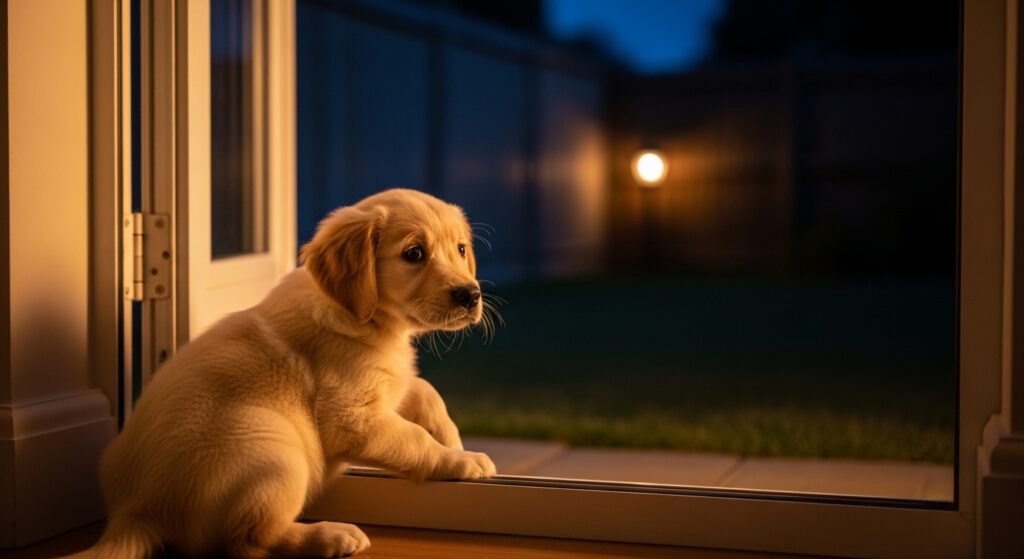
When a puppy refuses to step outside after dark, it isn’t stubbornness — it is a neurologically driven survival response. Young dogs have immature limbic systems, which means the brain regions responsible for regulating fear and emotional response are still developing. The amygdala, the brain’s fear-processing center, is hyperactive in juvenile animals, making puppies far more reactive to perceived threats than adult dogs.
This biological reality means that novel, unpredictable stimuli — like the sounds, smells, and visual environment of nighttime — can trigger a genuine fight-or-flight response in your puppy. Cortisol (the stress hormone) floods the body, heart rate rises, muscles tense, and the puppy instinctively tries to avoid or escape the feared environment. Understanding this as a physiological event rather than a behavioral choice is the first step toward compassionate, effective training.
Sensory Overload: How Dogs Perceive the Night Differently
Dogs have sensory capabilities far beyond human capacity, and nighttime activates several of these intensely:
Vision: While dogs see better in low-light conditions than humans (thanks to a higher density of rod cells and a reflective layer called the tapetum lucidum), they also perceive motion much more acutely. Shadows shifting, leaves blowing, or distant figures moving become dramatically amplified visual stimuli after dark.
Smell: The cooler, more humid nighttime air carries scent molecules more efficiently. This means your puppy’s already extraordinary nose (which can be up to 100,000 times more sensitive than a human’s) detects a vastly richer and more complex olfactory landscape at night — including predator scents, unfamiliar animals, and decomposing organic matter.
Hearing: Night is rarely silent. Crickets, nocturnal animals, distant traffic, wind through trees, and strange environmental sounds create an acoustic environment that differs dramatically from the daytime. For a puppy still mapping their world, these sounds are unpredictable and potentially alarming.
Fear Periods in Puppy Development
Veterinary behaviorists have identified critical fear imprint periods in canine development — windows of time during which negative experiences are more deeply encoded in memory:
- First Fear Period: Approximately 8–11 weeks of age
- Second Fear Period: Approximately 6–14 months of age (varies by breed)
If your puppy has a frightening nighttime experience during one of these periods — such as encountering a loud noise outside, a strange animal, or being startled in the dark — the resulting fear memory can become persistent and generalized. This is one reason why puppy nighttime phobia can sometimes seem to appear suddenly and intensify quickly.
Common Signs Your Puppy Is Afraid of the Dark or Night
Behavioral Indicators of Nighttime Anxiety
Recognizing fear early is critical to intervention. Watch for these behavioral cues when attempting to take your puppy outside at night:
Refusal to exit: Your puppy plants their paws, sits down, or actively pulls toward the door when you attempt to go outside. This is perhaps the most common indicator of a dog scared of going outside at night.
Excessive vocalization: Whimpering, whining, barking, or howling at the threshold or once outside.
Clinginess and shadowing: The puppy stays pressed against your leg, seeks physical contact constantly, or refuses to move away from you.
Hypervigilance: Scanning the environment rapidly, ears rotating, tail tucked, eyes wide — the classic freeze-and-scan posture of a fear response.
Sudden elimination: Urinating or defecating immediately upon stepping outside, not because they need to go, but because fear triggers the elimination reflex. This is called stress-induced elimination and is a recognized component of canine anxiety disorders.
Redirected behavior: Sniffing the ground intensely, circling, or engaging in displacement behaviors to avoid confronting the scary stimulus.
Physical Symptoms of Fear in Puppies
Beyond behavior, fear manifests physically. A frightened puppy may show:
- Trembling or shaking
- Panting despite cool temperatures
- Dilated pupils
- Piloerection (hackles raised)
- Yawning excessively (a calming signal and stress indicator)
- Lip licking or nose licking
- Tucked tail
- Crouched, low body posture
Identifying the Root Cause of Your Puppy’s Night Fear
Environmental Triggers at Night
Every puppy’s nighttime fear has a specific trigger landscape. Common environmental causes include:
Darkness itself: Some puppies are genuinely startled by low-visibility conditions, especially if their outdoor space transitions abruptly from a bright interior to a pitch-dark yard.
Unfamiliar wildlife: Raccoons, possums, owls, bats, and other nocturnal animals create sounds and smells that are entirely absent during the daytime and can be deeply alarming to a young dog.
Ambient noise changes: Construction sounds stopping at night, HVAC systems cycling, distant trains or emergency vehicles — all of these become more prominent in the quiet of the night and may startle sensitive puppies.
Shadow and light anomalies: Streetlights, car headlights, and porch lights create moving shadows that can look threatening to a puppy’s motion-sensitive visual system.
Noise Phobia and Sound Sensitivity After Dark
Noise phobia in puppies is a clinically recognized condition and a major driver of nighttime fear in dogs. Research published by the American Veterinary Society of Animal Behavior identifies noise sensitivity as one of the most common anxiety disorders in domestic dogs, affecting an estimated 25–49% of all dogs to varying degrees.
Nighttime amplifies this because background noise is reduced, making loud sounds feel more sudden and jarring. Thunderstorms, fireworks, backfiring cars, neighbors arguing, and even wildlife sounds can trigger acute noise phobia responses that your puppy associates with being outside after dark. Over time, your puppy can develop a conditioned fear response — meaning the association “outside at night = scary sound” becomes deeply encoded even in the absence of the original trigger.
Lack of Socialization and Early Exposure
One of the most significant risk factors for puppy’s fear of going outside at night is insufficient socialization during the critical window between 3 and 14 weeks of age. The socialization period is when puppies form their foundational understanding of what is safe and normal in their world.
Puppies who are not exposed to varied environments — including outdoor spaces at different times of day — during this window have fewer neural pathways associated with “outdoors = safe.” As a result, the nighttime outdoor environment feels profoundly foreign and threatening.
This is particularly common in puppies adopted from environments with limited outdoor exposure: indoor-only breeders, rescue situations with restricted movement, or urban apartment settings where nighttime outdoor time was minimal before adoption.
How to Help a Puppy Who Is Scared to Go Outside at Night
The Foundation: Building Trust and Security
Before any training technique will work, your puppy needs to trust that you are a safe, reliable source of security. This means:
Never forcing the puppy outside. Carrying a resistant puppy into a dark yard and leaving them there is not “exposure therapy” — it is flooding, and it can dramatically worsen fear and damage your bond. Research in veterinary behavioral science consistently shows that forced exposure without gradual desensitization increases the severity and persistence of fear responses.
Stay calm yourself. Dogs are exquisitely sensitive to human emotional states. If you become anxious, frustrated, or apologetic during nighttime outings, your puppy reads your stress as confirmation that the outdoor environment is dangerous. Maintain a calm, cheerful demeanor even when you are internally frustrated.
Using your presence as an anchor. Initially, you should be the reason going outside at night feels safe — not rewards alone. Sit with your puppy at the threshold, let them observe the night from a position of safety, and reward any forward movement without pressure.
Step-by-Step Desensitization Training
Desensitization involves gradual, controlled exposure to the feared stimulus at an intensity below the threshold that triggers fear. For nighttime outdoor fear, this process looks like:
Step 1 — Daytime outdoor confidence building. Ensure your puppy has strong, positive associations with the outdoor space during daylight hours. Play games, scatter treats, do training sessions outside. The space itself should feel joyful and safe.
Step 2 — Dusk exposure. Begin taking your puppy outside as daylight fades — not full dark, but twilight. Keep sessions short (2–5 minutes), playful, and heavily rewarded. End before the puppy shows any stress signals.
Step 3 — Outdoor threshold at night. Open the back door at night, but don’t require the puppy to exit. Stand at the threshold together, treat and praise for any calm observation. Do this multiple times over several days.
Step 4 — One step out. Encourage (never force) the puppy to step one paw, then two paws, over the threshold. Jackpot reward (multiple high-value treats) for any exit, no matter how small.
Step 5 — Short nighttime missions. Build gradually to full potty trips outside, keeping them brief, positive, and ending with indoor play or cuddle time as a reward.
This process may take days to weeks, depending on the puppy’s baseline anxiety level and the severity of the fear.
Positive Reinforcement and Counter-Conditioning
Counter-conditioning pairs the fear-inducing stimulus (the nighttime outdoor environment) with something the puppy loves (food, play, praise) to change the emotional association from negative to positive.
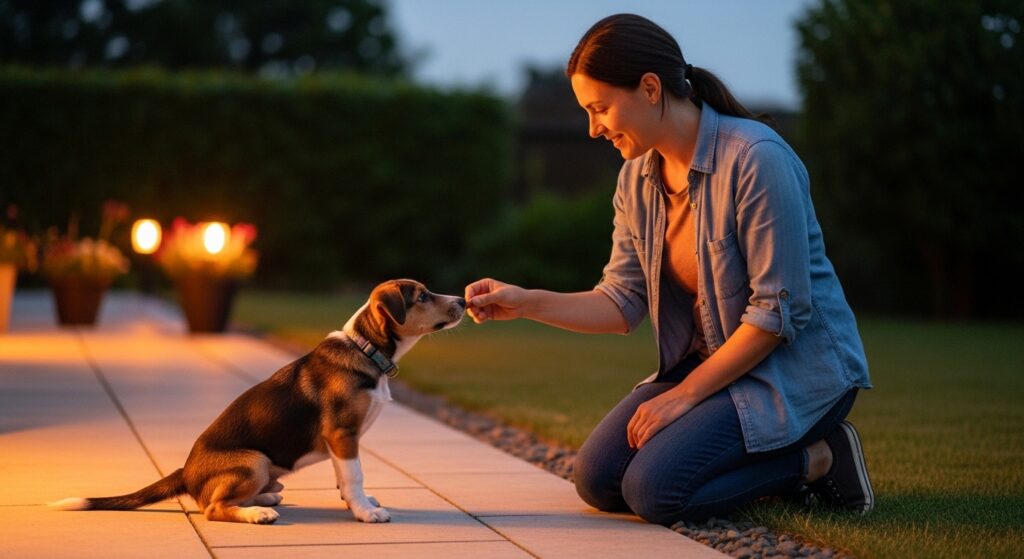
Use high-value treats — pieces of chicken, cheese, or freeze-dried liver — that your puppy doesn’t get at any other time. These should be reserved exclusively for nighttime outdoor training, creating a powerful “night outside = amazing things happen” neural association.
According to the American Kennel Club’s guidance on fear and anxiety in dogs, consistent positive reinforcement paired with patient desensitization is the gold standard approach for resolving fear-based behavioral issues in puppies and adult dogs alike.
Keep training sessions short: 3–5 minutes maximum. End every session on a success, even if that success is simply standing at the open door without retreating. Progress is not linear, and some nights will be harder than others — this is normal.
Creating a Safe and Comfortable Nighttime Outdoor Environment
Lighting Solutions for Night Potty Trips
One of the simplest and most effective interventions is improving outdoor lighting. A well-lit outdoor space removes one of the most significant sensory unknowns — visual ambiguity — that drives nighttime fear.
Motion-activated LED lights are ideal. They illuminate the potty area immediately when you step outside, eliminating the abrupt darkness transition. Choose warm-toned bulbs (2700K–3000K color temperature) rather than harsh white or blue-spectrum LEDs, as warm light is less startling.
Pathway lighting along your regular potty route helps define a familiar, lit corridor that your puppy can navigate predictably. Solar-powered stake lights are inexpensive, require no wiring, and can be repositioned easily.
Avoid strobe or flashing lights — these activate the puppy’s motion-sensitive visual system and can increase arousal rather than reducing it.
Choosing the Right Outdoor Space
For fearful puppies, the nighttime potty area should be:
- Enclosed or clearly bounded. Fencing or clear boundaries reduce the puppy’s sense of exposure to an open, unknown space.
- Close to the door. Minimize the distance between the safety of the interior and the potty spot, especially during early training.
- Free of overhanging vegetation that creates unpredictable shadow movement in the wind.
- Consistent. Use the same spot every time. Familiar scents from previous elimination give the puppy a signal that “this is what we do here” and reduce anxiety.
Leash Walking at Night: Tips for Nervous Pups
If your puppy needs to be walked (rather than let into a yard) for nighttime bathroom trips, a few strategies help:
Keep the initial route short and familiar — ideally, the same path walked during daylight training. Carry a small flashlight or wear a headlamp, but direct the beam at the ground rather than sweeping it around, as moving light creates moving shadows that can startle.
A front-clip harness rather than a collar gives you better control if the puppy tries to bolt in fear, and is less likely to cause injury during a panicked pull. The front clip redirects the puppy’s body toward you rather than allowing them to charge away from a perceived threat.
Managing Nighttime Potty Training With a Fearful Puppy
Establishing a Consistent Night Routine
Routine is one of the most powerful anxiety-reduction tools available to dog owners. Puppies thrive on predictability because it reduces cognitive load — when your puppy knows exactly what happens next, the uncertainty that drives anxiety is reduced.
A consistent nighttime routine might look like: indoor quiet time → treat-based training session → final meal/water cutoff → a specific outdoor potty trip → a predictable sleep space. The more ritual and consistency you bring to this process, the more your puppy’s nervous system learns to expect rather than fear what comes next.
Note: if your puppy’s nighttime disruptions extend to early morning waking and restlessness, you may also want to read our guide on Puppy Wakes Up Too Early for strategies to establish a healthy overnight sleep schedule that complements your nighttime outdoor training.
Handling Accidents Caused by Night Fear
If your puppy refuses to go outside at night and has an indoor accident as a result, never punish them. Punishment for fear-based behavior is not only ineffective — it actively worsens anxiety by adding an additional aversive (the threat of punishment) to an already stressful experience.
Instead, clean accidents with an enzymatic cleaner to fully neutralize odor (which would otherwise attract the puppy to eliminate in the same spot again), and revisit your desensitization protocol to ensure you are not moving too quickly.
Connection Between Sleep Disruption and Outdoor Fear
There is a meaningful bidirectional relationship between puppy sleep quality and anxiety-driven behaviors, including nighttime outdoor fear. Puppies who are overtired or sleep-deprived have lower stress thresholds — meaning they reach fear responses faster and recover more slowly. Ensuring your puppy gets adequate daytime rest (puppies need 16–18 hours of sleep per day) will make nighttime training significantly more effective.
Tools, Products, and Aids That Help Fearful Puppies at Night

Calming Wraps and Anxiety Vests
Products like the Thundershirt apply gentle, constant pressure across the puppy’s torso, mimicking the calming effect of being held or swaddled. Multiple peer-reviewed studies have investigated pressure wraps for canine anxiety, with results suggesting meaningful anxiety reduction in a subset of dogs — particularly those with situational fears.
While not a substitute for training, calming wraps can reduce baseline anxiety enough to make desensitization training more accessible, since a moderately anxious puppy is far easier to work with than one in full panic.
Pheromone Diffusers and Sprays
Dog-appeasing pheromone (DAP) products — marketed as Adaptil — synthetically replicate the calming pheromone produced by mother dogs during nursing. Plug-in diffusers can be used near the exit door your puppy uses for nighttime potty trips, and spray versions can be applied to a bandana worn during outdoor outings.
According to veterinary behavior research covered by VCA Animal Hospitals, DAP products have demonstrated efficacy in reducing anxiety-related behaviors, including fear of new environments, noise phobia, and separation anxiety — all conditions that overlap meaningfully with nighttime outdoor fear.
Natural Supplements and Veterinary Options
Several nutritional supplements have supporting evidence for mild-to-moderate canine anxiety:
L-theanine: An amino acid found in green tea, available in dog-specific formulations (Zylkene, Anxitane). Works by modulating glutamate receptor activity, producing a calming effect without sedation.
Melatonin: May help with anxiety and sleep regulation in dogs. Dosing should be confirmed with your veterinarian based on your puppy’s weight and health status.
Casein hydrolysate: Derived from milk proteins, found in products like Zylkene. Clinically studied for situational anxiety in dogs.
For severe cases, your veterinarian may recommend short-term anxiolytic medications (such as gabapentin or trazodone) to reduce baseline anxiety during the active training period, making behavior modification more effective.
When to See a Vet or Professional Dog Trainer
Distinguishing Normal Fear From Phobia
Not all nighttime nervousness requires professional intervention — many puppies go through a phase of night hesitancy that resolves with consistent, patient training over a few weeks. However, some signs suggest the issue has moved beyond normal developmental fear into clinical anxiety or phobia:
- Fear responses that are escalating in intensity rather than improving with training
- Refusal to eat or drink in association with nighttime outings
- Self-injurious behavior (excessive paw licking, flank biting) triggered by nighttime anxiety
- Complete inability to eliminate outdoors at night regardless of effort
- Generalized anxiety spilling into daytime behavior
- Nighttime fear that persists beyond 4–6 weeks of consistent desensitization training
Professional Behavioral Support
A certified applied animal behaviorist (CAAB) or a veterinary behaviorist (Dip ACVB) can conduct a structured behavioral assessment, identify specific triggers and maintaining factors, and design a customized behavior modification protocol far more targeted than general advice can provide.
Certified professional dog trainers (CPDT-KA) with specific experience in anxiety and fear-based behaviors are also an excellent resource and are generally more accessible and affordable than board-certified specialists.
When choosing a trainer or behaviorist, look for those who explicitly use force-free, positive reinforcement-based methods. Aversive techniques (punishment, intimidation, flooding) are contraindicated for fear-based issues and will worsen your puppy’s anxiety.
Medical Causes of Nighttime Anxiety
In a small but significant subset of cases, nighttime anxiety has an underlying medical component that must be addressed before behavioral training can succeed:
Vision problems: Puppies with progressive retinal atrophy or other visual impairments may see dramatically worse at night, making outdoor spaces genuinely more dangerous to navigate. An ophthalmologic examination can rule this out.
Vestibular issues: Inner ear problems affecting balance can make uneven outdoor terrain — particularly in low light — genuinely disorienting and frightening.
Pain: A puppy experiencing musculoskeletal pain may dread the physical act of navigating outdoor spaces, particularly if cold night air exacerbates discomfort.
Neurological conditions: Though rare in puppies, certain neurological issues can produce heightened anxiety and sensory sensitivity.
A thorough veterinary examination should always be the first step when nighttime fear is severe, sudden in onset, or accompanied by other unusual symptoms.
Frequently Asked Questions About Puppies Scared at Night
Q: Is it normal for a puppy to be scared to go outside at night? Yes, it is extremely common, particularly in puppies between 8 weeks and 6 months of age. Nighttime fear is driven by sensory unfamiliarity, developmental fear periods, and incomplete socialization — all normal features of early puppyhood. Most puppies respond well to patient desensitization training.
Q: How long does it take for a puppy to get over nighttime fear? With consistent training, many puppies show meaningful improvement within 2–4 weeks. More severe cases or those involving specific trauma or phobia may take 2–3 months. Progress is rarely perfectly linear.
Q: Should I carry my scared puppy outside at night? Occasionally, carrying a puppy outside — particularly to a brightly lit, familiar potty spot — can be a practical short-term solution for necessary elimination. However, it should not replace desensitization training, as it does not help the puppy build independent confidence.
Q: Can I use a pee pad instead of going outside at night? Indoor elimination aids (pee pads, puppy grass patches) can be useful short-term management tools while you work on nighttime outdoor confidence. Be aware that extended indoor elimination training can complicate outdoor training, so aim to transition fully outdoors as quickly as your puppy’s confidence allows.
Q: Does getting another dog help a fearful puppy go outside at night? A confident, friendly adult dog can serve as a social referent — helping a puppy “read” that the nighttime environment is safe. If you have access to such a dog (a friend’s well-adjusted adult dog, for instance), brief side-by-side nighttime outings can accelerate confidence-building.
Q: My puppy was fine at night and suddenly became scared — why? Sudden onset nighttime fear often indicates the puppy has entered a secondary fear period (common around 6–14 months) or experienced a single frightening event that created a lasting conditioned fear response. Review recent nighttime experiences for potential triggers and consult a professional if the change is dramatic.
Final Thoughts
A puppy scared to go outside at night is not a broken dog or a behavioral failure — they are a young, sensitive animal encountering a world that is genuinely more complex and unpredictable than anything their developing nervous system has mapped before. With patience, consistency, and an understanding of canine fear psychology, the vast majority of puppies can learn to navigate nighttime outdoor spaces with confidence and ease.
The keys are clear: never force, always reward, go at the puppy’s pace, and create a nighttime environment that communicates safety rather than threat. Every small step forward is progress worth celebrating, and your calm, steady presence is the most powerful tool you have.