


Summary: Dogs bark at TV animals because their brains are wired to respond to visual and auditory stimuli that mimic real-world triggers — movement, animal sounds, and unfamiliar creatures. This behavior, rooted in instinct and sensory perception, can range from mildly amusing to genuinely disruptive. This comprehensive guide covers why dogs react to animals on television, the science behind canine visual processing, which breeds are most reactive, and — most importantly — a full toolkit of training techniques, desensitization strategies, and environmental management tips to stop your dog from barking at the TV for good.
Table of Content
- Why Do Dogs Bark at Animals on TV?
- Which Dogs Are Most Likely to Bark at the TV?
- Is It Normal — or a Problem?
- How to Stop Your Dog from Barking at TV Animals
- Advanced Training Methods for Persistent Barkers
- Environmental and Lifestyle Adjustments
- When to Seek Professional Help
- Frequently Asked Questions
Why Do Dogs Bark at Animals on TV?
Understanding why your dog goes wild whenever a deer appears on your nature documentary — or loses their mind at a cartoon dog — starts with understanding how the canine brain interprets the world.
How Dogs Process Visual Information Differently Than Humans
Dogs do not see the world the way we do. Their visual cortex processes images differently, and for many years, researchers believed dogs simply could not recognize images on television screens. However, modern high-definition screens have changed all of that. Today’s 4K displays refresh at a rate fast enough that dogs no longer see the flickering effect that older screens produced, and studies now confirm that dogs can indeed recognize animals, people, and moving objects on television.
Dogs have a higher flicker-fusion rate than humans — meaning they need images to update faster than older TV technology allowed. With modern screens, dogs are now fully capable of identifying animal shapes, movement patterns, and even specific species. This is why your dog may have started reacting to the TV more intensely in recent years.
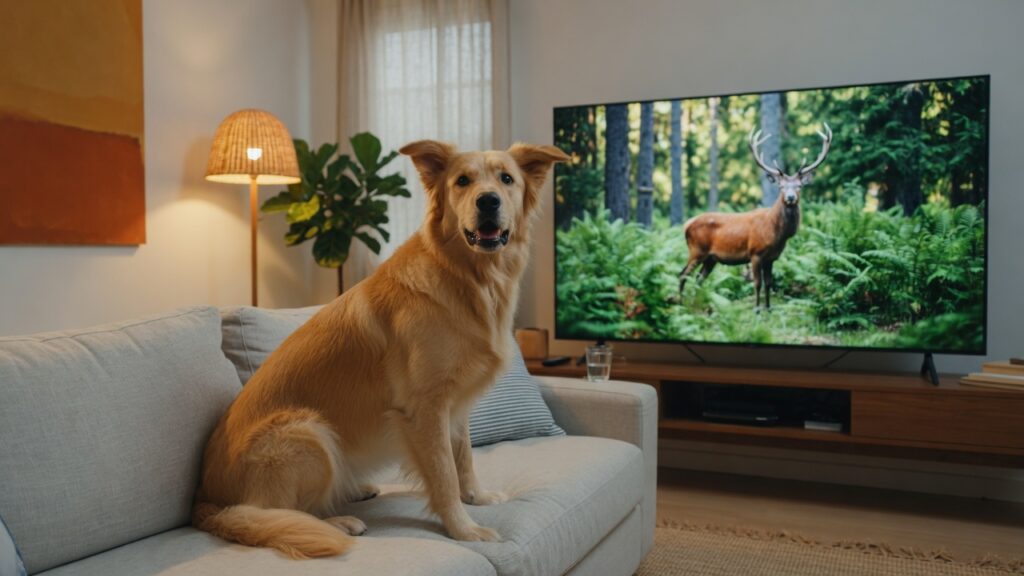
From a neurological standpoint, the dog’s visual processing is particularly sensitive to motion. Moving animals on a screen activates the same neural pathways that would fire if those animals were physically present in the room. To your dog’s brain, the deer on BBC Earth is not an image — it is a deer.
The Role of Sound and Motion in Triggering Barking
Sound is often the primary trigger before vision even comes into play. Dogs have an auditory range far superior to humans — they can hear frequencies between 40 Hz and 65,000 Hz compared to the human range of 20 Hz to 20,000 Hz. When a TV plays the sound of birds chirping, other dogs barking, or prey animals rustling, your dog’s auditory system registers it instantly.
The combination of realistic animal sounds paired with on-screen motion creates a powerful multisensory stimulus. This is why nature documentaries, wildlife programs, and animated films with animal characters tend to generate the strongest reactions. The dog hears the sound, orients toward the screen, sees movement matching that sound, and the brain reaches a conclusion: there is an animal here that requires a response.
This reaction is not random or misbehavior — it is a deeply embedded neurological response to environmental cues. Understanding this helps owners respond with compassion rather than frustration.
Prey Drive, Territorial Instincts, and Social Behavior
Dogs bark at TV animals for several distinct motivational reasons, and identifying which applies to your dog is key to choosing the right intervention.
Prey drive is the instinctual urge to chase and catch. Dogs with high prey drive — such as sighthounds, terriers, and working dogs — are especially likely to react intensely to fast-moving animals on screen. They may launch at the TV, spin in circles, or sprint around the room.
Territorial behavior occurs when a dog perceives the on-screen animal as an intruder in their home. This is common with other dogs appearing on TV. The dog on screen is, from your dog’s perspective, an unknown dog entering their living space. This same impulse explains why dogs bark at other dogs on walks — the territorial and social response is consistent regardless of whether the stimulus is real or digital.
Social reactivity is about communication. Dogs are highly social animals, and when they see another dog or hear vocalization on TV, they may bark as a form of social response — essentially trying to communicate with the animal they perceive.
Frustration barking can also occur when a dog is aroused by the animal on screen but cannot reach it. This barrier frustration is similar to what happens when a dog sees a squirrel through a window.
Which Dogs Are Most Likely to Bark at the TV?
While any dog can react to television animals, certain dogs are far more prone to this behavior based on genetics, history, and individual temperament.
Breed Predispositions and Herding/Hunting Instincts
Breeds selectively developed for visual tracking, herding, or hunting tend to be most reactive to on-screen animals. Border Collies, Australian Shepherds, and Belgian Malinois were bred to track and respond to movement — a skill that does not switch off when the movement is on a TV screen. Sighthounds like Greyhounds and Whippets are similarly wired for motion detection and chase.
Terrier breeds, historically bred to hunt small prey, often react intensely to small animals like squirrels, rabbits, or cats on screen. Herding breeds may even attempt to “herd” the TV, running back and forth in front of it. Sporting breeds and scent hounds may react strongly to audio cues from birds or game animals even before they see the image.
That said, breed alone does not determine everything. Individual dogs within any breed can show a wide range of reactivity.
Age and Socialization History
Puppies and adolescent dogs tend to be more reactive to novel stimuli, including TV. Their brains are still building associations between stimuli and appropriate responses, and a screen full of moving animals is genuinely novel and exciting. Older dogs who were not exposed to television during their critical socialization window (3–14 weeks) may also react more strongly, as the experience was never normalized.
Dogs who had limited socialization — exposure to varied sights, sounds, and experiences during puppyhood — are generally more reactive across the board. This overlaps with other behaviors, such as bedwetting in anxious puppies; anxiety and poor socialization can manifest in multiple behavioral ways. Understanding why your puppy exhibits anxious behaviors often starts with examining their early socialization history.
Individual Personality and Anxiety Levels
Dogs with naturally high arousal levels, anxious temperaments, or a history of reactivity in other contexts are more likely to bark at the TV. Dogs prone to hypervigilance — always scanning the environment for threats — will naturally extend this vigilance to the TV screen.
Conversely, calm, confident dogs who have been well-socialized and have low arousal thresholds are far less likely to react to TV animals, even in high-prey-drive breeds.
Is It Normal — or a Problem?
When TV Barking Is Harmless
Occasional mild interest in on-screen animals — a few barks, a brief stare, then disengagement — is completely normal and not a behavioral problem. Many dogs glance at the TV, register that an animal is present, and then look to their owner or return to resting. This low-level reactivity requires no intervention.
Some dogs enjoy watching certain programs, and pet owners who embrace this often play animal-centric content intentionally. There is an entire genre of YouTube content now specifically designed for dog enrichment. As long as the behavior is brief, calm, and your dog can redirect easily, there is nothing to worry about.
Warning Signs: It Has Become a Behavioral Issue
The behavior becomes a concern when:
- Your dog cannot disengage from the screen without significant distress
- Barking escalates into lunging, spinning, or destructive behavior
- The behavior is so intense that it disrupts your household or the dog’s ability to settle
- Your dog becomes reactive to residual sounds or images long after the TV is off
- The arousal from TV barking spills over into other aggressive or anxious behaviors
- You feel you cannot watch TV comfortably in your own home
If any of these apply, it is time to implement a structured training plan.
How to Stop Your Dog from Barking at TV Animals
This is the core of what most dog owners need: practical, evidence-based techniques to reduce or eliminate TV barking. The most effective approaches combine operant conditioning (rewarding desired behaviors) with classical conditioning (changing emotional responses to stimuli).
The “Quiet” Command — Teaching Controlled Silence
The “quiet” cue is one of the most useful tools for managing barking of any kind. To teach it effectively, you first need the behavior to occur so you can interrupt and redirect it.
Step-by-step:
- When your dog barks at the TV, calmly say “quiet” in a firm but neutral tone — not angry, not panicked.
- Hold a high-value treat close to their nose. Most dogs will stop barking to sniff.
- The moment silence occurs — even for one second — say “yes” or click, and deliver the treat.
- Gradually increase the required duration of silence before rewarding: 1 second, then 2, then 5, and so on.
- Practice consistently every time barking occurs.
The key is consistency and calm delivery. Yelling “quiet!” in frustration does not teach the cue — it adds energy to an already aroused dog and often makes barking worse.
Desensitization and Counterconditioning
Desensitization involves gradually exposing your dog to the trigger at low intensity until it no longer provokes a reaction. Counterconditioning changes the emotional association with the trigger from negative/arousing to positive/neutral.
Together, these form the gold standard of behavioral intervention for reactive dogs — and they work exceptionally well for TV barking.
Protocol:
- Start with the TV volume very low and/or the screen brightness dimmed, or use a smaller screen further away.
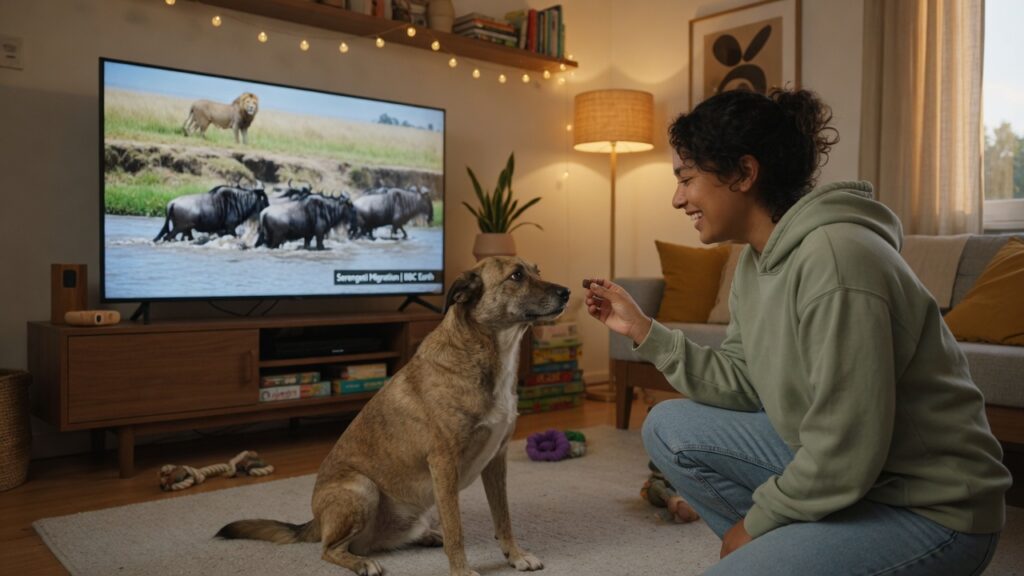
- When animal content plays and your dog notices but does not bark, immediately reward with high-value treats and calm praise.
- Over multiple sessions (days or weeks), very gradually increase the volume, screen size, or proximity.
- Never progress faster than your dog can handle. If barking occurs, you have moved too quickly — drop back to a lower intensity.
The goal is to reach a point where your dog sees an animal on TV and looks at you for a treat rather than launching into a barking episode.
Redirecting Attention with High-Value Rewards
Redirection is a practical, in-the-moment tool. Before your dog reaches the point of barking — ideally, the moment you see their body stiffen, ears perk, or gaze lock onto the screen — call their name or use a “watch me” cue.
When they look at you, reward instantly. You are teaching them that ignoring the screen and engaging with you produces something wonderful. Over time, the sight of an animal on TV becomes a cue to look at you rather than to bark.
This requires timing. If you wait until your dog is already deep in a barking episode, redirection is much harder. Learn to read your dog’s pre-bark body language and intervene early.
Management Strategies to Reduce Exposure
Management is not training — it does not change behavior, but it prevents rehearsal of the unwanted behavior. Every time a dog practices barking at the TV, that behavior is being reinforced and strengthened. Reducing opportunities to rehearse gives training space to work.
Management strategies include placing your dog in a calm room away from the TV during high-stimulus programs, using a crate or pen in a location where the screen is not visible, playing calming background music instead of TV when alone, and choosing lower-stimulus content (news, talk shows) over nature documentaries.
Management and training must work together. Management alone is not a long-term solution, but training alone without preventing rehearsal is an uphill battle.
Ignoring the Behavior — When It Works and When It Doesn’t
Some trainers advocate simply ignoring TV barking, operating on the principle that attention from the owner reinforces the behavior. This works when barking is attention-seeking — your dog has learned that barking brings you to engage with them.
However, for most dogs barking at TV animals, the reinforcement is not your attention — it is the intrinsic arousal of the response itself. The behavior is self-reinforcing. In these cases, ignoring does nothing to reduce it. Worse, allowing the dog to bark intensely and repeatedly strengthens the behavioral pattern over time.
Ignoring is appropriate only for mild, brief reactions when your dog can naturally disengage. For persistent or escalating TV reactivity, active training is necessary.
Advanced Training Methods for Persistent Barkers
For dogs with entrenched TV reactivity, basic redirection may not be enough. These dogs need a more systematic approach.
Systematic Desensitization Protocol
A formal desensitization protocol involves creating a hierarchy of trigger intensity and working through it methodically over weeks or months.
Hierarchy example (lowest to highest intensity):
- TV off, playing animal sounds from a phone at low volume
- TV on with volume muted, animal images visible
- TV on with very low volume, still images
- TV on low volume with slow-moving animals
- TV on moderate volume with fast-moving animals
- TV on full volume with nature documentary content
Start at level one. Reward calm behavior. Only advance when your dog is fully relaxed at the current level — defined as able to settle, look away from the trigger, and respond to cues. This may take weeks at each level.
Using Thresholds and Distance to Build Tolerance
Every reactive dog has a “threshold” — the point at which the stimulus becomes too intense for them to think clearly and respond to training. Below threshold, the dog can engage, learn, and respond to cues. Above threshold, they are flooded and cannot learn.
For TV barking, the threshold is influenced by volume, motion speed, animal type, and how close the dog is to the screen. Working below threshold at all times is the cardinal rule of desensitization. This might mean starting with a tablet screen across the room, then a small TV at low volume, progressing slowly.
Certified applied animal behaviorists and certified professional dog trainers who use positive reinforcement methods are the best resource for building a custom threshold-based protocol for your dog. The American Kennel Club’s behavioral resources offer solid foundational guidance.
Clicker Training for Calm TV Behavior
Clicker training provides precise, consistent positive reinforcement that is especially effective for shaping calm behavior. The click marks the exact moment of correct behavior — in this case, calmness or disengagement from the TV — and is always followed by a reward.
A useful exercise is “engage-disengage” training: click and reward any moment your dog glances at the TV animal and then looks away voluntarily. You are capturing and reinforcing the natural behavior of checking and disengaging, building it into a reliable pattern.
Over time, this becomes your dog’s automatic response: see animal on screen → glance → look away → receive reward. The emotional association with the trigger becomes positive and calm rather than aroused and reactive.
Environmental and Lifestyle Adjustments
Training addresses the behavior directly, but environmental changes support and accelerate the process.
Physical Exercise and Mental Enrichment
A dog who is physically and mentally fulfilled is dramatically less reactive than an under-stimulated one. Excess energy has to go somewhere — and if it does not go into appropriate outlets, it goes into reactivity. Ensure your dog receives adequate daily exercise appropriate for their breed and age.
Mental enrichment — puzzle feeders, scent games, training sessions, and interactive toys — tires the brain in a way that physical exercise alone does not. A mentally tired dog is a calm dog. Many owners find that simply adding 15–20 minutes of sniff work or training before TV time significantly reduces barking.
Safe Spaces and Relaxation Training
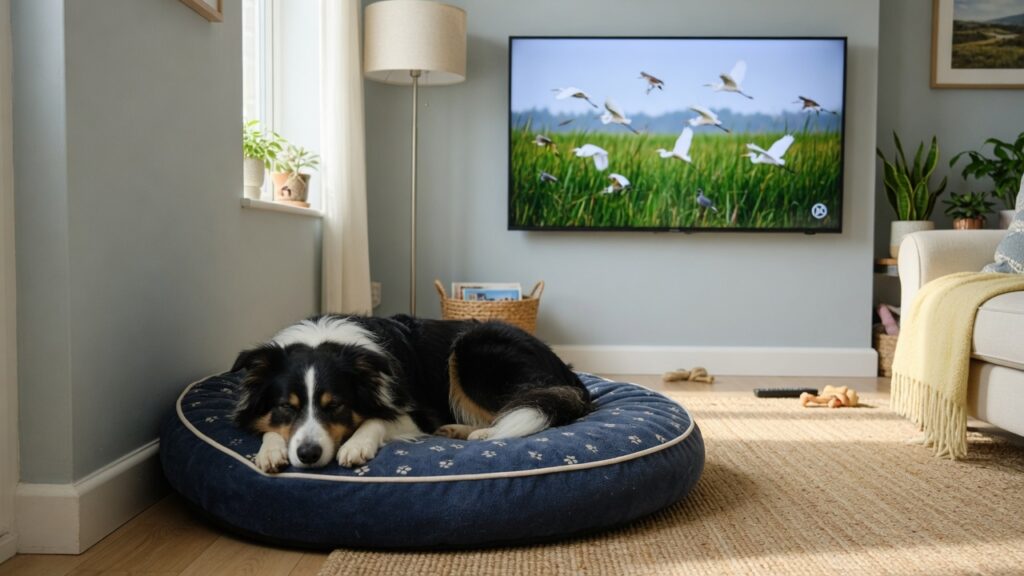
Teaching your dog to relax on a designated mat or bed is a powerful tool. A dog who can settle on cue in the presence of mild stimulation can eventually generalize that calm state to higher-level triggers like TV animals.
Place the mat at a distance from the TV where your dog can see the screen but remains below the threshold. Reward duration of calm relaxation on the mat. Gradually move the mat closer over time.
Additionally, ensure your dog has a retreat — a crate, a quiet room, or a corner behind furniture — where they choose to go when overstimulated. Forcing a dog to remain in an arousing environment with no escape option escalates reactivity.
TV Habits That Unintentionally Reinforce Barking
Well-meaning owners often inadvertently make TV barking worse through common habits. Calling the dog to watch animal content because they think it is entertaining, laughing at the barking, picking the dog up when they react, or using an excited voice when animals appear — all of these communicate to the dog that the reaction is appreciated or that the on-screen animal is indeed something exciting and worth responding to.
Be neutral and calm when animal content plays. Avoid pointing at the screen or drawing your dog’s attention to animals. If your dog barks and you immediately turn the TV off, you may also be reinforcing the behavior by providing relief through the removal of the stimulus — inadvertently teaching your dog that barking makes the scary thing go away.
According to guidance from the ASPCA on managing canine reactivity, consistency in how you respond to the behavior is one of the most critical factors in successful training outcomes.
When to Seek Professional Help
Signs You Need a Dog Trainer or Behaviorist
Most cases of TV barking can be addressed by a consistent owner using the techniques above. However, some dogs require professional support. Seek help from a certified professional dog trainer (CPDT-KA) or a board-certified veterinary behaviorist (DACVB) if:
- Your dog’s TV reactivity has escalated into aggression (snapping, growling, biting)
- The behavior is worsening despite consistent training efforts over several weeks
- Your dog cannot settle or relax, even without the TV on
- The reactivity is part of a broader pattern of fear, anxiety, or aggression
- You feel unsafe or overwhelmed managing the behavior
A qualified professional can assess whether the behavior is rooted in anxiety, excitement, prey drive, or fear — and design a protocol tailored to your specific dog.
Anxiety-Related Reactivity and Medication
For some dogs, reactivity to TV animals is one expression of broader anxiety. In these cases, behavioral training may need to be supported by veterinary intervention. Anti-anxiety medications — such as SSRIs or situational anxiolytics — can lower a dog’s baseline arousal to a level where training can be effective.
This is not a shortcut or a substitute for training; rather, medication can create the neurological space for learning to occur in dogs who are otherwise too anxious or reactive to respond to conditioning. Always consult your veterinarian or a veterinary behaviorist before pursuing any pharmacological intervention.
Frequently Asked Questions
Why does my dog only bark at certain animals on TV and not others? This reflects your dog’s individual history, prey drive, and arousal triggers. Dogs with high prey drive typically react most strongly to small, fast-moving prey animals like squirrels and rabbits, while socially motivated dogs may react primarily to other dogs. Some dogs respond to specific sounds — bird calls, animal vocalizations — more than visual content.
Should I let my dog watch animal TV shows? For dogs who react mildly and disengage easily, there is no harm. For reactive dogs, limiting this exposure while training is advisable to prevent rehearsal of the unwanted behavior.
Will my dog grow out of barking at the TV? Unlikely without intervention. Behaviors that are self-reinforcing tend to strengthen over time, not diminish. Proactive training is far more effective than waiting.
Can TV barking be a sign of aggression? In some cases, yes. If your dog’s barking is accompanied by a stiff body, hard stare, raised hackles, or growling, it may reflect territorial aggression or fear-based reactivity rather than simple excitement. A professional assessment is warranted in these cases.
Does the size of the TV affect how much my dog reacts? Yes — larger screens with more realistic images tend to provoke stronger reactions, particularly in highly visual dogs. Starting desensitization on a smaller screen or tablet can be a helpful first step.