


Summary: Rescue dogs that bark specifically at men are exhibiting a deeply rooted fear response shaped by past trauma, lack of early socialization, and acute sensory sensitivity to the physical characteristics men present — including deeper voices, larger frames, and distinct scent profiles. This comprehensive guide Why Does My Rescue Dog Bark at Men explores the behavioral science, psychological triggers, and evidence-based training strategies that will help you understand your rescue dog’s reactive behavior and build a lasting foundation of trust, safety, and confidence so your dog can thrive in every environment.
Table of Contents
Understanding Fear-Based Behavior in Rescue Dogs
- What Is Fear Aggression in Dogs?
- How Trauma Shapes Canine Behavior
Why Do Rescue Dogs Bark at Men Specifically?
- The Role of Past Abuse or Neglect
- Sensory Triggers — Appearance, Voice, and Scent
- Lack of Early Socialization with Men
The Science Behind Gender-Specific Reactivity
- How Dogs Perceive Gender Differences
- Body Language and Posture Cues Men Emit
- Olfactory Signals — Testosterone and Pheromones
Reading Your Dog’s Body Language When Barking at Men
- Fear Signals vs. Territorial Barking
- Displacement Behaviors and Stress Indicators
Is It Barking, Aggression, or Something Else?
- Dog Barking as a Sign of Pain or Illness (internal link)
- Reactivity vs. True Aggression — Key Differences
How to Help a Rescue Dog Who Barks at Men
- Desensitization and Counter-Conditioning
- Building Positive Associations with Male Figures
- The Role of Consistency and Patience
- Why Does My Dog Bark When I Hug Someone Else (internal link)
Training Techniques and Behavior Modification
- Threshold Training
- “Look at That” (LAT) Protocol
- Calm-Energy Approach for Men
When to Seek Professional Help
- Signs You Need a Certified Dog Behaviorist
- What to Expect from Professional Training
Preventing Setbacks and Building Long-Term Confidence
- Managing the Environment
- Progress Tracking and Milestone Rewards
Frequently Asked Questions
Understanding Fear-Based Behavior in Rescue Dogs

Rescue dogs carry invisible luggage. Unlike puppies raised in stable, enriched environments, many rescue dogs have experienced neglect, abuse, inconsistent handling, or simply a critical absence of positive human contact during their developmental windows. These experiences don’t just leave emotional scars — they literally reshape the neural architecture of a dog’s brain, altering how they process threat, safety, and social cues for the rest of their life.
What Is Fear Aggression in Dogs?
Fear aggression is one of the most misunderstood behavioral patterns in domestic dogs. It occurs when a dog perceives a stimulus — a person, sound, or object — as a direct threat to their safety and responds with defensive behaviors including barking, growling, lunging, or snapping. Critically, the dog is not being “dominant” or “bad.” They are reacting from a place of profound anxiety.
In the language of animal behavior science, this is governed by the fight-or-flight-or-freeze response — the autonomic nervous system’s hardwired survival mechanism. When a rescue dog barks at a man approaching, the amygdala (the brain’s threat-detection center) has already fired before the prefrontal cortex — responsible for reasoning and impulse control — even has a chance to process the situation. This is why commands like “sit” or “stay” often fail in these high-arousal moments.
How Trauma Shapes Canine Behavior
The socialization window in dogs — the critical period during which they learn what is safe and what is dangerous — runs primarily from 3 to 14 weeks of age. Dogs that were not consistently exposed to men during this window often develop an implicit association between male figures and uncertainty or threat. When compounded by abuse at the hands of a male owner or handler, this response becomes deeply conditioned.
Neurologically, repeated aversive experiences with men create learned fear associations stored as long-term emotional memory. Even sensory fragments — a cologne, a hat, a beard, a deep laugh — can trigger a full-blown stress cascade because the dog’s brain has learned to treat these cues as danger signals. This is often called stimulus generalization, where the fear spreads from one specific person to a broader category of people sharing similar characteristics.
Why Do Rescue Dogs Bark at Men Specifically?
The gender-specific nature of this reactivity is not random. It has identifiable roots that, once understood, become the roadmap for rehabilitation.
The Role of Past Abuse or Neglect
Statistics on animal abuse consistently indicate that men are overrepresented as perpetrators of direct physical harm to animals. While this is not a statement about all men — the vast majority of men are kind, gentle, and excellent dog owners — it does mean that rescue dogs entering shelters often carry negative conditioning specifically tied to male handlers.
Neglect is equally impactful. A dog raised primarily by a woman and left isolated when a man is present learns to associate male presence with the removal of comfort, attention, or safety. The barking, in this case, is an anxious protest — not an attack.
Sensory Triggers — Appearance, Voice, and Scent
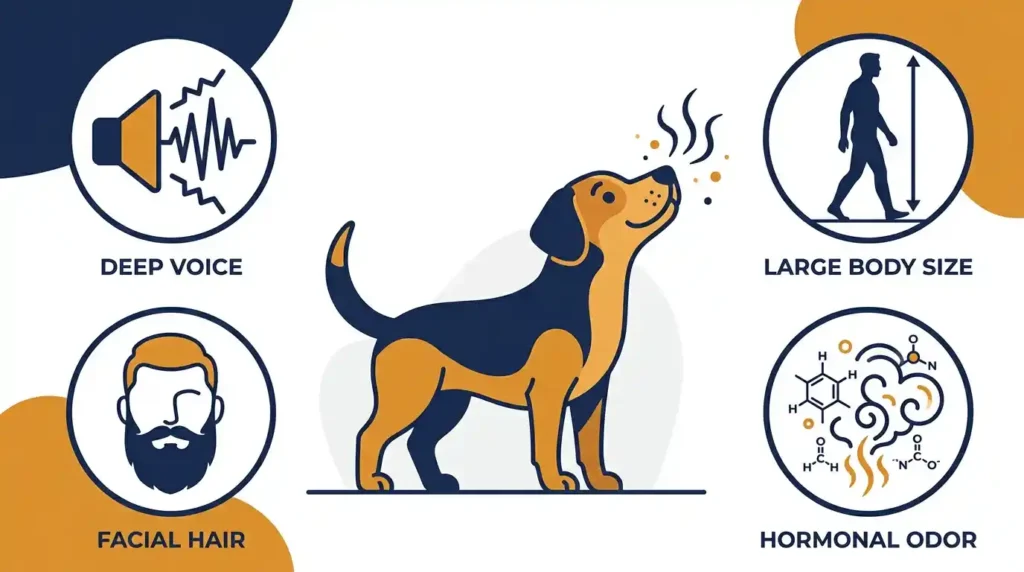
Men present a genuinely different sensory profile than women, and dogs — with their extraordinary perceptual capabilities — detect every distinction:
- Physical size and gait: Men tend to be taller, broader-shouldered, and often walk with a heavier, more direct stride. A dog that has been hurt by someone large perceives these physical signals as threat predictors.
- Vocal tone: Men’s voices fall in a lower frequency range. Dogs with auditory trauma from yelling or intimidation often associate lower-frequency voices with danger.
- Scent profile: The hormonal chemistry between male and female humans differs measurably. Testosterone-influenced body odor presents a scent signature that is distinctly male, and dogs — with a nose 10,000 to 100,000 times more sensitive than humans — pick this up immediately, even before visual contact is made.
- Facial hair: Beards alter the silhouette of the human face dramatically. Since dogs read facial expressions as communication cues, an obscured or unfamiliar face shape can trigger uncertainty and alarm.
Lack of Early Socialization with Men
Even without any history of abuse, a dog raised primarily around women and children may develop gender-specific neophobia — a fear of unfamiliar social categories. If men were simply absent during the critical socialization window, the dog would have no framework for interpreting male behavior as safe. The barking is the dog’s way of saying: I don’t know what you are, and I don’t trust what I don’t know.
The Science Behind Gender-Specific Reactivity
How Dogs Perceive Gender Differences
Dogs do not categorize the world using human social constructs. Their perception is multisensory and associative. Research in canine cognition confirms that dogs recognize patterns of movement, sound frequency, silhouette, and smell as distinct “social fingerprints.” Men and women present reliably different fingerprints across all these channels simultaneously, making gender one of the most consistent and recognizable social categories dogs can distinguish.
Body Language and Posture Cues Men Emit
Many men, particularly those unfamiliar with dog behavior, instinctively approach dogs in ways that are perceived as threatening:
- Direct eye contact — interpreted as a dominance challenge or threat in canine communication
- Frontal approach — walking straight toward a dog rather than at an angle
- Reaching over the head — a common affectionate gesture that dogs often find intimidating
- Loud, booming greetings — vocal energy that registers as an alarm signal
These behaviors, even when entirely well-intentioned, are experienced by a trauma-sensitized rescue dog as a cascade of simultaneous threat cues.
Olfactory Signals — Testosterone and Pheromones
Emerging research in canine olfactory cognition suggests dogs may be capable of detecting not just biological sex through scent, but also emotional states carried within human perspiration. A man who is nervous, excited, or assertive emits a distinct chemical signature that a dog can detect and interpret. In a dog already primed to associate male scent with threat, even a calm man’s natural odor may trigger a preconditioned alert response.
Reading Your Dog’s Body Language When Barking at Men
Understanding what your dog is communicating through its barking requires reading the full behavioral package — not just the sound.
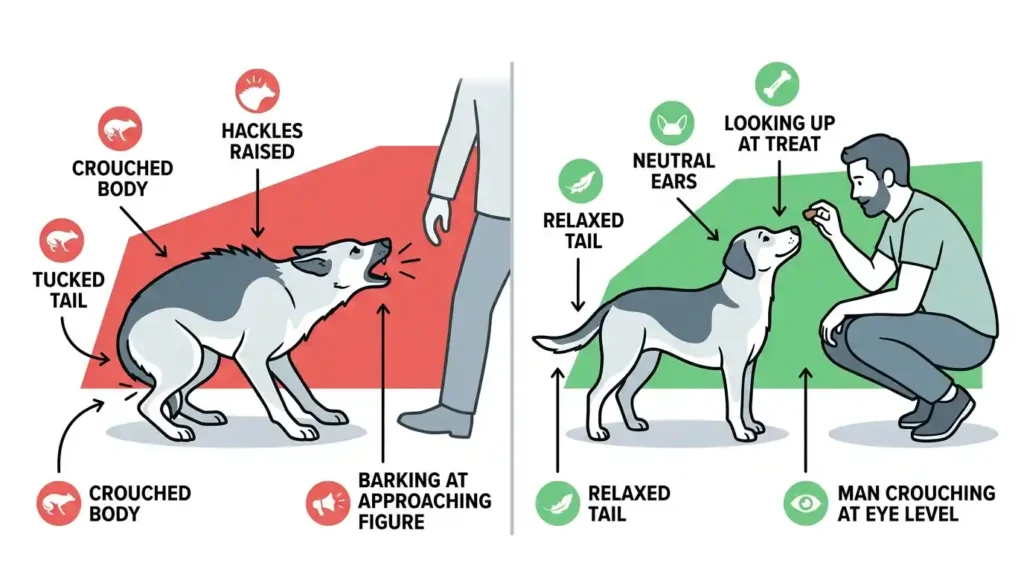
Fear Signals vs. Territorial Barking
| Signal | Fear-Based Barking | Territorial Barking |
| Body posture | Low, crouched, tail tucked | Upright, forward-leaning |
| Ear position | Pinned back or sideways | Erect, forward |
| Movement | Backing away while barking | Moving toward the stimulus |
| Eye shape | Wide, whale-eye visible | Hard, direct stare |
| Hackles | May be raised | Often fully raised |
Fear barking is often high-pitched, rapid, and accompanied by attempts to create distance. The dog may bark and then immediately retreat — a classic approach-avoidance conflict where the dog is simultaneously drawn toward and repelled by the stimulus.
Displacement Behaviors and Stress Indicators
Beyond barking, watch for displacement behaviors — seemingly out-of-place actions that signal internal stress: sudden sniffing of the ground, yawning, lip-licking, shaking off as if wet, or sudden scratching. These are the dog’s nervous system attempting to self-regulate in an overwhelming moment.
Is It Barking, Aggression, or Something Else?
Not all barking at men is fear-driven. Before committing to a behavior modification program, it’s worth ruling out physical causes.
Dog Barking as a Sign of Pain or Illness
Sometimes unexplained or sudden changes in barking behavior have a medical root. If your rescue dog has recently developed reactivity toward men after a period of relative calm, it’s worth consulting your veterinarian. Conditions involving chronic pain, neurological disruption, or hormonal imbalance can lower a dog’s arousal threshold dramatically, making previously manageable stimuli suddenly intolerable. For a detailed look at how physical discomfort manifests as vocalization, read this in-depth resource on Dog Barking as a Sign of Pain or Illness.
Reactivity vs. True Aggression — Key Differences
Reactivity is an overreaction to a stimulus that exceeds what the situation warrants, driven by anxiety. Aggression involves intentional behavior oriented toward causing harm. The majority of rescue dogs that bark at men are reactive, not aggressive — a critical distinction because reactivity is highly treatable with the right approach, while true aggression requires a more structured clinical intervention. Mislabeling a reactive dog as aggressive frequently leads to abandonment or euthanasia for animals that could otherwise thrive.
How to Help a Rescue Dog Who Barks at Men
Rehabilitation is entirely possible. The core mechanism for change is rewiring the dog’s emotional association with men from danger to good things happening.
Desensitization and Counter-Conditioning

Desensitization involves gradually exposing your dog to men at a distance and intensity level so low that it does not trigger the fear response — what trainers call staying below threshold. Counter-conditioning pairs this exposure with something the dog loves intensely — high-value treats, a favorite toy, or praise.
The process is methodical:
- Identify the threshold distance — the point at which your dog notices a man but hasn’t yet begun barking. This might be 50 feet. Start here.
- When a man appears at that distance, immediately deliver high-value treats in a rapid, joyful sequence.
- When the man disappears or moves away, the treats stop.
- Over many repetitions, the dog’s brain begins to rewrite the association: Man appears = amazing things happen.
- Gradually, incrementally, decrease the distance as the dog demonstrates comfort.
This process cannot be rushed. Flooding — forcing a dog into overwhelming proximity with their fear trigger — causes severe psychological harm and dramatically worsens the prognosis.
Building Positive Associations with Male Figures
Enlist trusted men — friends, family members — to participate in structured, positive interactions:
- Men should ignore the dog entirely at first. No eye contact, no reaching out. Let the dog set the pace.
- Men can drop high-value treats on the floor without looking at the dog — appearing as a magical treat dispenser.
- Men should move slowly, speak softly, and crouch sideways rather than facing the dog directly.
- Gradually, over multiple sessions, men can begin to offer a hand for sniffing before any petting is attempted.
Patience here is not optional. Rushing the contact phase can set back weeks of progress in a single interaction.
The Role of Consistency and Patience
Every household member needs to be aligned on the approach. Inconsistency — where one person uses counter-conditioning while another forces interaction — creates confusion and prolongs recovery. Think of the rehabilitation process as building a new emotional vocabulary for your dog: it happens one small, safe experience at a time.
Interestingly, rescue dogs that become reactive to the presence of men also frequently show related anxious behaviors in other social situations. If you’ve noticed your dog acting out during moments of human affection, you might find answers in this helpful guide: Why Does My Dog Bark When I Hug Someone Else — a behavior that often shares the same root anxiety as gender-specific reactivity.
Training Techniques and Behavior Modification
Threshold Training
The concept of the threshold is foundational to all reactivity work. Your dog has a distance from a stimulus at which they can observe and process without reacting. Below this threshold, learning can occur. Above it, the dog is in survival mode — no learning happens, and the fear is reinforced.
Always train at or just above threshold (far enough away that the dog notices but doesn’t react), then build closer over time. This requires excellent spatial awareness on your part and calm, consistent management.
“Look at That” (LAT) Protocol
Developed by renowned trainer Leslie McDevitt and detailed in her book Control Unleashed, the Look at That protocol teaches dogs to voluntarily observe their trigger and then look away — replacing anxious fixation with calm acknowledgment.
The steps:
- When your dog notices a man in the distance, say “Yes!” or click (if using a clicker) the instant they look toward him.
- Deliver a treat.
- Repeat until the dog begins to look at the man and then immediately glance back at you — as if to say, “I saw him, where’s my treat?”
- This reframes the trigger from threat to opportunity for reward.
This is one of the most powerful and scientifically validated protocols in modern applied animal behavior science. For further reading on evidence-based canine behavior modification, the American Veterinary Society of Animal Behavior (AVSAB) publishes accessible position statements on fear, punishment-free training, and behavior wellness at avsab.org.
Calm-Energy Approach for Men
Coach the men in your dog’s life on a specific greeting protocol:
- Arrive calmly — no rushing, no loud greetings
- Turn slightly sideways — less threatening silhouette
- Avoid direct eye contact initially
- Let the dog approach first, always
- First contact: scratch the chest or side, never the top of the head
This simple behavioral script, consistently applied, can transform your dog’s experience of encountering men from a threat activation to a predictable, safe routine.
When to Seek Professional Help
Signs You Need a Certified Dog Behaviorist
Seek professional guidance if:
- Your dog has made contact (bite) or has escalated to snapping
- Progress stalls completely after 4–6 weeks of consistent work
- The dog’s reactivity is generalizing to more triggers beyond men
- You feel unsafe managing the dog in public
Look specifically for a Certified Applied Animal Behaviorist (CAAB), a Veterinary Behaviorist (Dip ACVB), or a Certified Professional Dog Trainer — Knowledge and Skills Assessed (CPDT-KSA). Avoid trainers who rely on punishment, prong collars, or alpha-dominance frameworks — these approaches are contraindicated for fear-based reactivity and are condemned by every major veterinary behavior organization.
The International Association of Animal Behavior Consultants (IAABC) maintains a directory of certified professionals at iaabc.org, searchable by location and specialty.
What to Expect from Professional Training
A qualified behaviorist will conduct a thorough behavioral history intake, observe the dog in controlled conditions, and design a behavior modification protocol tailored to your dog’s specific trigger profile and arousal threshold. Many cases of gender-specific reactivity show meaningful improvement within 8–16 weeks of consistent, structured work — though the timeline varies with the severity of the dog’s history and the consistency of the home environment.
Preventing Setbacks and Building Long-Term Confidence
Managing the Environment
Management is not training — it’s preventing rehearsal of the problem behavior while training is underway. Every time a reactive dog successfully barks a man away, the behavior is reinforced (the threat disappeared — it worked!). Preventing these repetitions is as important as active training.
Practical management tools include:
- Visual barriers — frosted window film to reduce street reactivity
- Baby gates and crates — creating safe zones during initial introductions
- Leash and distance protocols — always keeping enough space to stay below threshold in public
- Muzzle training — for dogs with a bite history, a well-fitted, properly introduced basket muzzle is a safety tool, not a punishment
Progress Tracking and Milestone Rewards
Behavioral change in trauma-affected dogs is rarely linear. Document weekly progress: What was the threshold distance this week compared to last? Can the dog now eat treats in the presence of a man at 20 feet when previously 50 feet was the limit? These granular measurements reveal progress that day-to-day observation misses, keeping you motivated and your approach calibrated.
Celebrate small milestones. Your dog sniffed a man’s hand for the first time? That is a profound act of courage from an animal that once associated that hand with fear.
Frequently Asked Questions
Q: Will my rescue dog ever stop barking at men completely? Many rescue dogs achieve full, relaxed comfort around men with consistent rehabilitation. Others may always require some management in novel situations. Either outcome is a success — the goal is a dog that feels safe, not a dog that performs neutrality under duress.
Q: Should I punish my dog for barking at men? No. Punishment — including shouting, leash corrections, or spray bottles — suppresses the visible behavior while intensifying the underlying fear. A dog that learns it will be punished for showing fear stops showing the signals before biting. This is neurologically accurate and practically dangerous.
Q: How long does rehabilitation take? Mild cases with consistent counter-conditioning show improvement in 4–8 weeks. More deeply conditioned fear responses may take 6–12 months of structured work. There is no shortcut, and there should not be one — you are rebuilding a neurological pathway, not training a trick.
Q: Is my dog’s reactivity my fault? No. The experiences that shaped your rescue dog’s fear predate your relationship. Your role now is simply to be the consistent, patient, trustworthy human they need to finally learn that men — and the world — can be safe.