


Summary
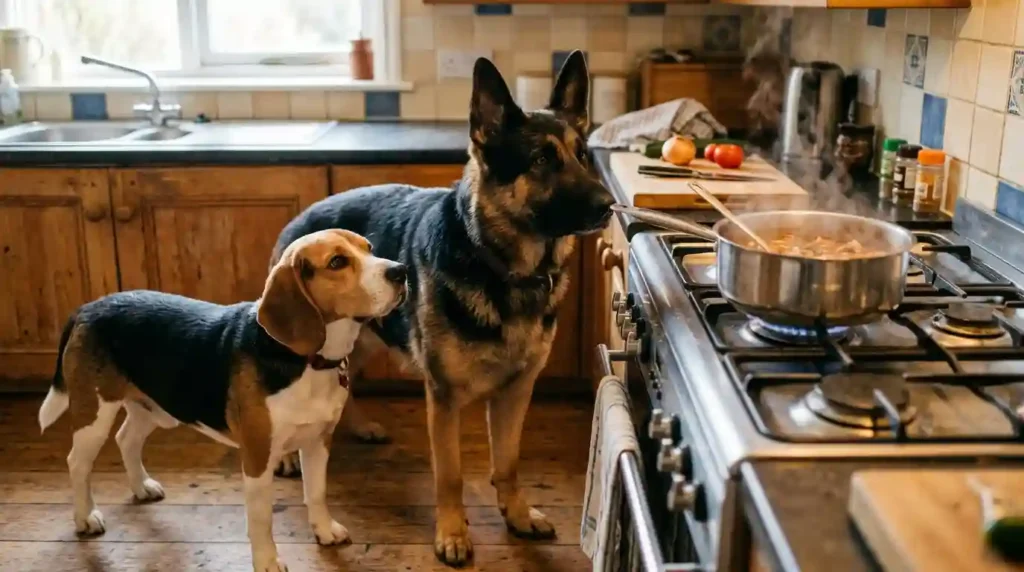
If your dog bark every time I cook situation feels all too familiar, you’re not alone. Thousands of dog owners deal with this exact behavior daily. Whether it’s the sizzle of a pan, the smell of meat, or simply the excitement of watching you move around the kitchen, dogs have very specific reasons for vocalizing during meal prep. This guide dives deep into the psychology, sensory triggers, and behavioral roots behind kitchen barking — and gives you actionable, vet-approved strategies to manage it effectively.
Table of Contents
- Understanding Why Dogs Bark in the Kitchen
- The Role of Scent: How Your Dog’s Nose Drives the Bark
- Why Does My Dog Bark Every Time I Cook? The Core Reasons Explained
- Attention-Seeking Behavior and Conditioned Responses
- Anxiety, Excitement, and Overstimulation in Dogs
- Breed Tendencies and Vocal Personalities
- How to Stop Your Dog From Barking Every Time You Cook
- Training Techniques That Actually Work
- Environmental Management Tips for the Kitchen
- When to Consult a Veterinarian or Animal Behaviorist
- Conclusion
- FAQs
Understanding Why Dogs Bark in the Kitchen
The kitchen is one of the most stimulating rooms in your home — at least from your dog’s perspective. Every time you step into that space, a symphony of sensory signals fires off: heat radiating from the stove, the crackling of oil, the aromatic release of proteins and spices, and your focused, purposeful movement. For a species hard-wired to pay close attention to food sources, this environment is practically an alarm bell.
Dogs are opportunistic foragers by nature. Even domesticated breeds retain ancestral instincts that drive them to alert, position themselves near food, and vocalize when a feeding opportunity arises. Barking during cooking is often a combination of instinct, learned behavior, and emotional arousal — and understanding which factor dominates in your dog’s case is the first step toward solving it.

The Role of Scent: How Your Dog’s Nose Drives the Bark
To understand your dog’s kitchen behavior, you first need to appreciate the extraordinary power of the canine olfactory system. Dogs possess up to 300 million olfactory receptors in their noses — compared to roughly 6 million in humans. Their brain’s smell-processing region is proportionally 40 times larger than ours.
When you begin cooking, volatile organic compounds released from food enter your dog’s nose at intensities you simply cannot perceive. The smell of chicken roasting, garlic sautéing, or beef browning isn’t a mild background scent for your dog — it’s a powerful, attention-commanding signal.
What Smells Trigger the Most Barking?
- Meat and poultry (high protein scent triggers prey drive)
- Fish (intensely aromatic to canine senses)
- Eggs and dairy (familiar, calorie-dense food smells)
- Baked goods (sweet, warm aromas from the oven)
- Bones or broth (deeply instinctual response)
This scent-driven arousal elevates your dog’s emotional state before you’ve even made eye contact with them. The barking that follows is often just the verbal overflow of that internal excitement.
Why Does My Dog Bark Every Time I Cook? The Core Reasons Explained
Let’s break down the primary psychological and behavioral explanations:
1. Food Anticipation and Classical Conditioning
If you’ve ever tossed your dog a treat while cooking — even once — you may have accidentally created a conditioned response. Just like Pavlov’s famous dogs salivated at the sound of a bell, your dog has learned to associate the sounds and smells of cooking with the reward of food. Barking becomes the behavior that “works” to get that reward.
This is classical conditioning at its most practical. The stove turning on becomes a cue. The sizzle becomes a trigger. And barking becomes the rehearsed behavior that your dog believes accelerates the arrival of a treat or table scrap.
2. Attention-Seeking Behavior
Dogs are highly social animals. When you enter the kitchen and become absorbed in a task, your attention shifts away from them. For a dog that craves interaction and proximity, this shift can trigger demand barking — a vocal strategy to pull your focus back.
If you’ve ever turned around to scold your dog, told them to be quiet, or even looked at them while they barked in the kitchen, you’ve reinforced the behavior. From your dog’s perspective, barking = your attention, and negative attention is still attention.
3. Excitement and Emotional Overstimulation
Some dogs bark during cooking simply because they are overwhelmed with positive arousal. The anticipation of food, combined with visual stimulation (your movement), auditory stimulation (sounds of cooking), and olfactory stimulation, creates a perfect storm of excitement.
This is especially common in high-energy breeds and puppies who haven’t yet learned how to regulate their emotional responses.
4. Territorial and Protective Instincts
A smaller subset of dogs barks in the kitchen due to resource guarding instincts. They may perceive the food being prepared as a resource they need to claim or protect. This behavior often comes with tense body language, stiffness, and refusal to move away from the kitchen space.
5. Anxiety and Uncertainty
For rescue dogs or dogs with trauma histories, the sounds of cooking — pots clanging, pressure cookers releasing steam, smoke alarms — can trigger noise-related anxiety. What looks like excitement barking may actually be a stress response.

Attention-Seeking Behavior and Conditioned Responses
The distinction between attention-seeking and food-seeking is subtle but important for training purposes. An attention-seeking barker will usually:
- Make eye contact while barking
- Pause briefly after barking, as if waiting for a response
- Escalate barking when ignored
- Stop barking if you leave the kitchen entirely
A food-conditioned barker, on the other hand, may:
- Bark while staring at the stove or food
- Position themselves near where food is being prepared
- Increase barking as cooking smells intensify
- Show signs of salivation or licking of lips
Identifying which pattern your dog follows helps you choose the most effective intervention strategy.
It’s also worth noting that if your dog engages in barking after you attempt to discipline them, this can create a secondary behavioral loop. You can read more about managing vocal responses in dogs who react to correction in this helpful guide on Dog Barking After Being Scolded.
Anxiety, Excitement, and Overstimulation in Dogs
Canine emotional regulation is a developing field in veterinary behavioral science. Dogs, like humans, have a threshold for stimulation — beyond which they struggle to make calm decisions. This threshold is sometimes called the stress/arousal threshold, and cooking environments can push many dogs past it.
Signs Your Dog Is Overstimulated (Not Just Hungry)
- Rapid, continuous barking without pausing
- Jumping, spinning, or pacing
- Inability to respond to known commands
- Dilated pupils and panting
- Whining mixed in with barking
When a dog is over threshold, no amount of command-giving will land effectively. Your first job is to reduce arousal before attempting any behavioral redirection.
Stress Triggers Hidden in Kitchen Sounds
| Sound | Why It Can Trigger Dogs |
| Pressure cooker hissing | High-pitched, unpredictable noise |
| Smoke detector beeping | Piercing frequency causes distress |
| Blender/food processor | Startling, loud, sudden noise |
| Oven timer | Repetitive beep associated with activity |
| Knife on cutting board | Rhythmic tapping, unfamiliar sound |
Breed Tendencies and Vocal Personalities
Not all dogs bark equally. Understanding your dog’s breed heritage gives you important context for their kitchen behavior.
Naturally Vocal Breeds
- Beagles — bred to bark while tracking prey
- Siberian Huskies — highly vocal, expressive communicators
- Chihuahuas — alert barkers with strong opinions
- German Shepherds — protective and reactive to stimuli
- Miniature Schnauzers — territorial and noise-responsive
If your dog belongs to one of these breeds, kitchen barking may require more consistent and patient training compared to naturally quiet breeds like Basenjis or Greyhounds.
How to Stop Your Dog From Barking Every Time You Cook
Here’s where this guide becomes genuinely useful. The strategies below are grounded in positive reinforcement training, behavioral management, and environmental modification.
Step 1: Stop Accidentally Rewarding the Behavior
The very first thing to do is audit your own behavior. Have you ever:
- Given your dog food while cooking?
- Talked to them or looked at them while they barked?
- Moved them out of the kitchen after they barked?
All of these responses — even negative ones — reinforce the barking loop. Begin practicing strategic non-response: no eye contact, no words, no physical contact when the barking starts.
Step 2: Teach a “Place” Command
The “place” or “go to your mat” command is one of the most powerful tools for kitchen barking. Here’s a simplified training roadmap:
- Choose a specific mat, bed, or area outside the kitchen
- Lure your dog to the spot with a high-value treat
- Reward them for lying down on the mat
- Gradually increase duration before rewarding
- Begin practicing the command while you cook
Over time, your dog learns that their place is where good things happen — not in front of the stove.
Step 3: Use Desensitization and Counter-Conditioning
If your dog reacts to cooking sounds specifically, run a desensitization protocol:
- Play recordings of kitchen sounds at low volume while your dog is calm
- Pair the sounds with high-value treats
- Gradually increase the volume over days or weeks
- Eventually, your dog associates the sounds with a calm reward rather than excitement
This technique is particularly effective for noise-anxious dogs.
Step 4: Provide Pre-Cooking Exercise
A tired dog is a quiet dog. Aerobic exercise before cooking — a 20-30 minute walk or play session — reduces baseline arousal and makes your dog far less likely to bark reactively in the kitchen.
Step 5: Use Food Puzzles and Enrichment Toys
Redirect your dog’s energy with a frozen Kong, lick mat, or puzzle feeder placed in their designated area before you start cooking. This gives them a food-related outlet that satisfies the anticipatory urge without reinforcing barking.

Training Techniques That Actually Work
Beyond the foundational steps above, here are more advanced behavioral tools:
Clicker Training in the Kitchen
Clicker training creates precise communication between you and your dog. Use it to mark and reward calm behavior the moment your dog chooses silence over barking. The key is catching the quiet — clicking and treating the instant your dog pauses a bark.
Differential Reinforcement of Incompatible Behavior (DRI)
This technique involves rewarding a behavior that physically cannot coexist with barking — such as lying down calmly, chewing a toy, or looking away from you. DRI is highly effective and widely recommended by certified applied animal behaviorists (CAABs).
Management Tools: Gates and Barriers
Sometimes the simplest solution is physical management. A baby gate or pet gate at the kitchen entrance removes your dog from the overstimulating environment while still keeping them nearby. This isn’t a training solution, but it’s a humane and immediate management tool.
If you’re exploring other tools and want to understand the full scope of bark intervention devices, it’s worth reading about How Anti-Bark Collars Work and Are They Safe before making any device-related decisions.
Environmental Management Tips for the Kitchen
Small changes to your kitchen environment can reduce the frequency and intensity of barking significantly:
- Use exhaust fans to minimize cooking smells reaching your dog’s nose earlier than needed
- Maintain consistent feeding times to reduce food-anticipation anxiety
- Keep your dog’s routine predictable — dogs bark more when their schedule is disrupted
- Avoid cooking odors near their sleeping area, which can create anticipatory arousal at rest time
- Introduce a white noise machine near their resting spot to buffer kitchen sounds
According to the American Kennel Club, consistent, calm responses to barking — paired with proactive redirection — are the most effective long-term strategies for managing vocal dogs.
When to Consult a Veterinarian or Animal Behaviorist
Most kitchen barking is behavioral and manageable through training. However, you should seek professional help if:
- The barking is accompanied by aggression, growling, or snapping
- Your dog shows signs of severe anxiety (trembling, self-harming, inability to settle)
- The barking has intensified suddenly without explanation
- Multiple training approaches have failed over several months
- Your dog is resource guarding food in a threatening way
A veterinary behaviorist or a certified trainer using force-free methods can create a personalized behavior modification plan for your dog.
Conclusion
The reason your dog bark every time I cook is rarely one-dimensional. It’s a blend of primal food drive, learned behaviors, sensory overstimulation, and sometimes anxiety. The good news? It’s one of the most trainable behaviors in the canine behavioral toolkit.
By understanding the root cause specific to your dog — whether it’s conditioning, attention-seeking, or arousal — and applying consistent, compassionate training strategies, you can transform your kitchen from a chaos zone into a calm, structured space for both of you.
Start small. Teach the “place” command. Reward silence. Stay consistent. Most dogs improve significantly within four to six weeks of dedicated training. And remember: your dog isn’t trying to frustrate you — they’re just communicating the only way they know how.
FAQs
Q1: Is it normal for dogs to bark when you cook?
Yes, it’s very common. Dogs are stimulated by smells, sounds, and the anticipation of food. As long as the behavior isn’t aggressive, it’s a normal — though manageable — canine response.
Q2: Why does my dog bark specifically when I fry or grill food?
High-heat cooking releases stronger, more pungent aromatic compounds. Frying and grilling produce protein-rich smells that are especially stimulating to a dog’s olfactory system.
Q3: Will my dog grow out of kitchen barking?
Not without training. The behavior tends to intensify if it’s been reinforced — even accidentally. Puppies who aren’t redirected early often become chronic kitchen barkers as adults.
Q4: Should I feed my dog before I cook to reduce barking?
Feeding your dog before you cook can reduce food-motivated barking in some dogs. However, it won’t address attention-seeking or anxiety-driven barking. Combine this with behavioral training for the best results.
Q5: Can I use a bark collar to stop kitchen barking?
Bark collars should only be considered as a last resort and after consulting a professional. Most certified trainers recommend positive reinforcement approaches first. Learn more about device safety in our detailed guide on anti-bark tools.
Q6: My dog only barks in the kitchen at night — why?
Nighttime cooking may coincide with your dog being more alert or the house being quieter, making kitchen sounds more noticeable. It can also relate to your dog’s internal feeding schedule or habitual patterns tied to evening routines.
Q7: How long does it take to train a dog to stop barking while cooking?
With consistent daily training, most owners see meaningful improvement within 3 to 6 weeks. High-drive or anxious dogs may take longer and benefit from professional guidance.