


Summary
Dog barking after eating is a surprisingly common behavior that puzzles many pet owners, but it almost always has a clear root cause — from excitement and resource guarding to gastrointestinal discomfort, attention-seeking habits, or underlying medical issues. Understanding the specific trigger behind your dog’s post-meal vocalization is the first step toward resolving it. This comprehensive guide explores every dimension of this behavior: the behavioral science behind it, the medical explanations, breed-specific tendencies, environmental factors, and evidence-based training strategies to help your dog develop calm, quiet mealtime habits for good.
Table of Content
- Dog Barking After Eating: What It Means, Why It Happens & How to Stop It
- Understanding Post-Meal Barking in Dogs: An Overview
- The Behavioral Science Behind Dog Barking After Meals
- Top Reasons Why Dogs Bark After Eating
- Medical Reasons Your Dog Might Bark After Eating
- Decoding the Type of Bark: What Your Dog Is Communicating
- Breed-Specific Tendencies for Post-Meal Barking
- Environmental and Routine Factors That Trigger Post-Meal Barking
- How to Stop Your Dog From Barking After Eating: Proven Training Methods
- When to See a Veterinarian
- Preventing Post-Meal Barking: Long-Term Management Tips
- Frequently Asked Questions About Dog Barking After Eating
Understanding Post-Meal Barking in Dogs: An Overview
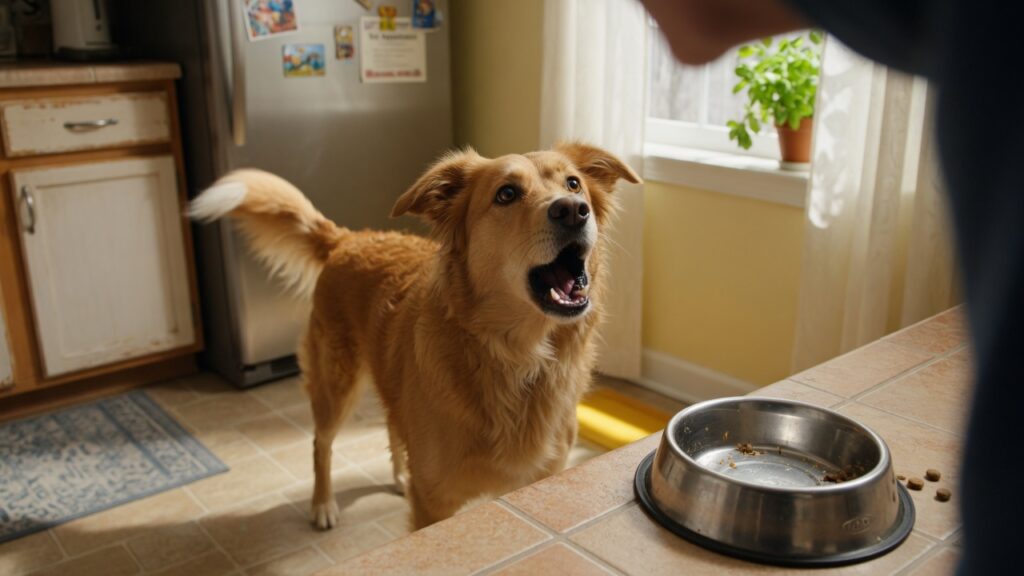
Every dog owner has experienced the moment: the bowl hits the floor, your dog finishes their meal in record time, and then — bark, bark, bark. It can feel bewildering, even frustrating, especially when you have no idea what your dog is trying to communicate. Yet this behavior is far more layered than it might initially appear.
Dog barking after eating encompasses a wide spectrum of motivations, from purely emotional and behavioral causes to genuine physical discomfort. Decoding which category your dog falls into requires careful observation of context, body language, bark type, and timing.
Is It Normal for Dogs to Bark After Eating?
In short: it depends. Occasional vocalizations after meals — especially in young or highly excitable dogs — are generally within the range of normal canine behavior. Dogs are expressive animals, and food is one of their primary motivators. A burst of joyful barking after a satisfying meal is akin to a child cheering after dessert.
However, persistent, repetitive, or distressed-sounding barking after meals is not something owners should simply accept or ignore. It often signals an unmet need — whether that’s more food, physical discomfort, a learned habit, or an emotional state that deserves attention.
How Common Is This Behavior Across Dog Breeds?
Post-meal barking is observed across virtually all breeds but occurs at higher rates in high-energy working breeds, vocal hound breeds, and dogs with strong food motivation. According to the American Kennel Club’s dog behavior resources, barking itself is a primary form of canine communication, and food-related contexts are among the most emotionally charged moments in a dog’s day.
The Behavioral Science Behind Dog Barking After Meals
To truly understand why your dog barks after eating, it helps to look through the lens of behavioral science — the same framework professional dog trainers and veterinary behaviorists use.
Classical Conditioning and Food-Related Excitement
Pavlov’s famous experiments showed that dogs develop powerful conditioned responses to feeding. Over time, everything associated with mealtime — the sound of kibble in a bowl, the opening of a cabinet, the sight of a food container — becomes a trigger for excitement and arousal. Once the meal ends, some dogs continue in that heightened physiological state, and barking becomes the natural outlet for that residual arousal energy.
Operant Conditioning: When Barking Gets Rewarded
Many cases of persistent post-meal barking are inadvertently trained into dogs by their owners. If a dog barks after eating and the owner responds — even to scold them, look at them, or give extra food — the dog learns that barking produces a result. This is operant conditioning at work. The behavior gets reinforced, and the dog repeats it with increasing frequency and intensity. This is a core concept in understanding demand barking behavior in dogs.
The Role of Arousal States After Feeding
Dogs experience a significant elevation in their sympathetic nervous system activity during and immediately after eating, particularly when they eat quickly or consume highly palatable food. Elevated arousal manifests through physical outlets — pacing, spinning, and barking. This is especially pronounced in young dogs, puppies, and breeds with high baseline energy levels. Understanding arousal regulation is key to managing this behavior long-term.
Top Reasons Why Dogs Bark After Eating
There is rarely a single universal reason for this behavior. Here are the most well-documented causes, organized from the most common to the more nuanced.
Food Excitement and Post-Meal Euphoria
The simplest explanation is often the correct one: your dog is just happy. Food triggers the release of dopamine in the brain, and the post-meal period can feel like a euphoric rush. Barking, jumping, and spinning are all expressions of that joy. This type of barking is usually brief, high-pitched, and accompanied by loose, wagging body language.
Hunger — Is Your Dog Still Not Full?
One of the most overlooked explanations is that your dog is still hungry. If the portion size is insufficient for your dog’s size, age, activity level, or metabolic rate, they may vocalize their continued desire for food. This is especially common in growing puppies, pregnant or nursing females, and highly active working dogs. Consulting your veterinarian about appropriate portion sizes is an important step if this is suspected.
Resource Guarding and Territorial Vocalization
Resource guarding is a deeply instinctive behavior in dogs, rooted in their ancestral need to protect food sources from competitors. Even after finishing a meal, some dogs may bark at other pets, children, or even adults who approach the feeding area. This behavior can escalate if not addressed early and is considered a form of aggression-adjacent vocalization that warrants professional behavioral guidance. If your dog also shows signs of aggression toward other animals in other contexts — for example, if they bark at cats on the street — resource guarding tendencies may be part of a broader reactivity pattern.
Gastrointestinal Discomfort, Bloating, or Nausea
Physical discomfort is a frequently missed cause of post-meal barking. When dogs eat too quickly, swallow air, or consume food their digestive system struggles with, they may experience gas, bloating, cramping, or nausea — and they vocalize that discomfort. This type of barking is typically more whiny, urgent, or anxious in tone, and is often paired with pacing, licking of lips, or attempts to vomit.
Attention-Seeking Behavior
Dogs that have learned that barking produces human attention will deploy this behavior consistently in high-motivation moments — including after meals, when they are already in a stimulated, engaged state. This is a learned habit, not an instinctive response, and it responds well to structured training interventions.
Anxiety, Stress, or Separation After Meals
For dogs with underlying anxiety disorders, the post-meal period can trigger distress if it signals the owner is about to leave, move to another room, or change the routine. Dogs may bark as a protest response or as an anxious vocalization. This is commonly observed in dogs with separation anxiety and is worth discussing with a veterinary behaviorist.
Cognitive Dysfunction in Senior Dogs
In older dogs, barking after eating — especially when it seems disconnected from any clear stimulus — can be a symptom of canine cognitive dysfunction syndrome (CDS), the dog equivalent of dementia. Disorientation, disrupted circadian rhythms, and increased vocalization, especially at unusual times, are hallmark signs of CDS and should be evaluated by a veterinarian.
Medical Reasons Your Dog Might Bark After Eating
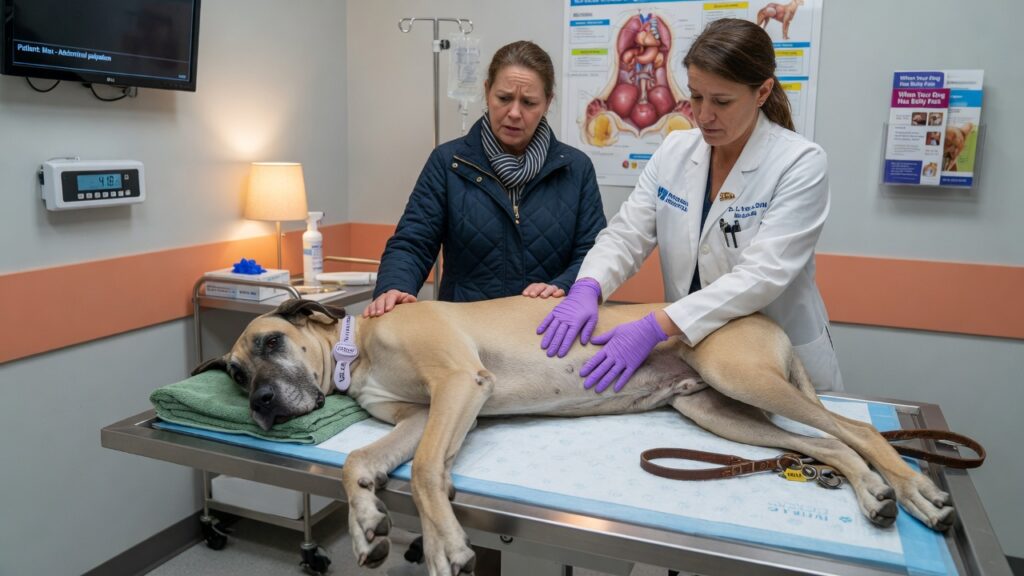
While behavioral causes are the most common, several medical conditions can manifest as post-meal barking.
Gastric Dilatation-Volvulus (GDV/Bloat) — A Medical Emergency
GDV, commonly called bloat, is a life-threatening condition in which the stomach fills with gas and twists on itself. It is most common in large, deep-chested breeds such as Great Danes, German Shepherds, and Standard Poodles. A dog developing GDV may bark, whine, pace, attempt to vomit without success, and have a visibly distended abdomen. This is a veterinary emergency requiring immediate intervention. If your dog barks with visible abdominal distension after eating, go to an emergency vet immediately.
Food Allergies and Sensitivities
Allergic reactions and food intolerances can cause significant post-meal discomfort, including skin irritation, gut inflammation, and oral itching. Dogs with food sensitivities may bark out of discomfort or anxiety triggered by the physical reaction to their meal. Common allergens include beef, dairy, wheat, chicken, and soy.
Acid Reflux and Esophageal Issues
Gastroesophageal reflux in dogs causes a burning sensation in the esophagus, which can prompt vocalization, lip-licking, and grass-eating behavior after meals. Dogs with megaesophagus or esophageal strictures may also vocalize due to difficulty swallowing or regurgitation discomfort.
Pain From Dental Problems While Eating
Dental disease, fractured teeth, or oral ulcers can make eating painful, and a dog may continue to vocalize after a meal as a response to lingering oral pain. Regular dental checkups are an important part of ruling this out.
Decoding the Type of Bark: What Your Dog Is Communicating
Not all post-meal barks are created equal. The acoustic profile of a dog’s bark carries meaningful communicative information that trained owners can learn to interpret.
Excited Barking vs. Distress Barking
Excited barking after meals tends to be high-pitched, repetitive, and fast. The dog’s body will appear loose and bouncy, tail wagging broadly. Distress barking, by contrast, may be more monotone, persistent, or lower in pitch, and is accompanied by anxious body language such as tucked tail, flattened ears, or pacing.
Demand Barking vs. Alert Barking
Demand barking — the type aimed at obtaining more food or human attention — is often direct, sustained, and accompanied by eye contact with the owner. Alert barking is triggered by something in the environment (another pet, a sound, movement near the food bowl) and will have the dog oriented toward that stimulus rather than toward the owner.
Whining Combined With Barking After Meals
When barking is mixed with whining, it typically indicates frustration, discomfort, or a strong unfulfilled want. This combination is particularly meaningful if it occurs consistently after meals and is worth tracking as a potential symptom of digestive issues or continued hunger.
Breed-Specific Tendencies for Post-Meal Barking
High-Energy and Working Breeds
Breeds like Border Collies, Belgian Malinois, Huskies, and Jack Russell Terriers have naturally high arousal baselines. Their post-meal energy needs an outlet, and barking is often the easiest one available. These breeds benefit especially from structured post-meal activities that redirect that energy productively.
Scent Hounds and Their Vocal Nature
Breeds such as Beagles, Basset Hounds, and Bloodhounds are selectively bred for vocal communication. Their instinct to “speak” in emotionally charged moments — including after meals — is deeply wired into their genetics. Owners of these breeds should have realistic expectations and focus on management rather than complete elimination.
Small Breeds and Terriers
Chihuahuas, Yorkshire Terriers, and Fox Terriers are known for their outsized vocal personalities. Post-meal barking in these breeds often combines excitement, demand behavior, and a low threshold for arousal. Consistency in training is particularly important with small breeds, as their size makes it tempting for owners to accommodate the behavior rather than address it.
Environmental and Routine Factors That Trigger Post-Meal Barking
Feeding Location and Bowl Placement
Dogs fed in high-traffic areas of the home may bark after eating in response to environmental stimuli — foot traffic, other pets, noises — that were present during the meal. A quieter, designated feeding space can significantly reduce stimulus-driven post-meal vocalization.
Multi-Dog Households and Competition
In homes with multiple dogs, post-meal barking can be competition-driven. One dog may bark to signal continued interest in another dog’s bowl, or to communicate ownership of the feeding space. Feeding dogs in separate rooms or with visual barriers can help reduce this dynamic considerably.
Feeding Schedule Inconsistencies
Dogs thrive on predictability. Irregular feeding schedules create chronic low-grade anxiety around mealtimes. When dogs are uncertain whether or when they will be fed, they become hypersensitive to food-related cues and more likely to vocalize before, during, and after meals.
How to Stop Your Dog From Barking After Eating: Proven Training Methods
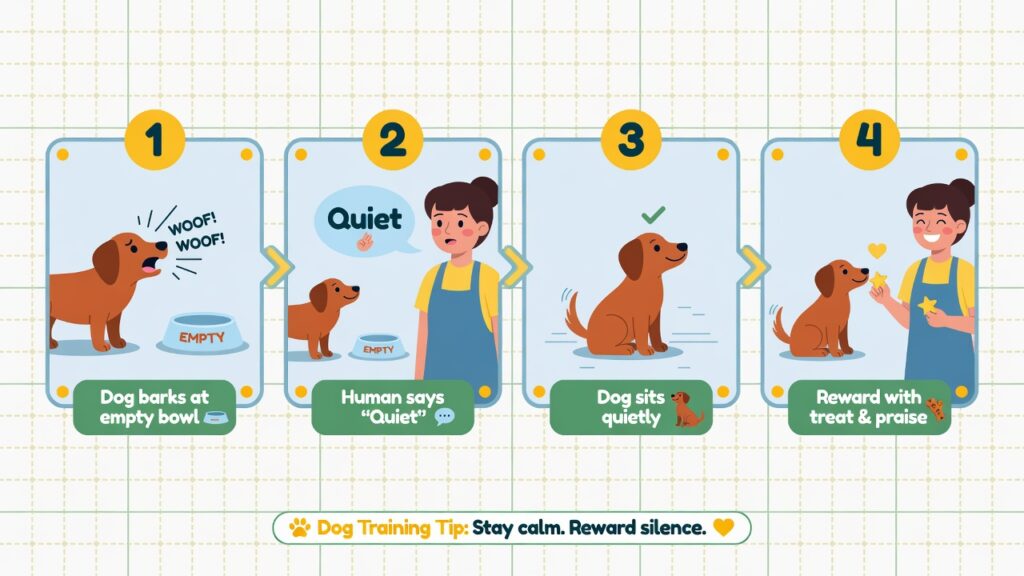
Behavioral modification is the most reliable long-term solution for post-meal barking that is rooted in habit or learned behavior.
The “Quiet” Command and Positive Reinforcement
Teaching a reliable “quiet” cue is one of the most effective tools in a dog owner’s training arsenal. The method involves allowing the dog to bark briefly, then giving the “quiet” cue in a calm, firm voice, and rewarding silence with a high-value treat the moment it occurs. If you’re interested in the broader context of bark training, learning how to train a dog to bark on command first can actually make teaching “quiet” significantly easier, as the dog learns to associate barking with a specific verbal cue and can then be taught its opposite.
Consistency is non-negotiable. Every family member must use the same cue and follow the same protocol.
Structured Post-Meal Routines
Dogs benefit from knowing what comes next. Establishing a consistent post-meal routine — such as a brief 10-minute rest period followed by a short walk or play session — gives the dog a predictable framework and reduces the free-floating arousal energy that leads to barking. The routine itself becomes calming over time through classical conditioning.
Slow Feeder Bowls and Puzzle Feeders
For dogs whose post-meal barking is driven by fast eating, excess air swallowing, and the subsequent discomfort or residual excitement, slow-feeder bowls, lick mats, and snuffle mats are highly effective interventions. These tools extend meal duration, reduce gulping, and shift the feeding experience from a brief burst of excitement to a sustained, calmer activity. According to veterinary behavioral guidelines from the ASPCA, managing the eating pace is one of the simplest environmental modifications available to pet owners.
Ignoring Demand Barking Effectively
If the barking is purely demand-driven (asking for more food or attention), the most powerful intervention is systematic extinction: completely removing the reward by giving zero attention — no eye contact, no verbal response, no touch — until the dog is quiet. When silence occurs, immediately reward with calm praise. This technique requires patience and consistency, as extinction bursts (a temporary increase in barking before the behavior decreases) are common and expected.
Counter-Conditioning and Desensitization
For dogs whose post-meal barking is anxiety-driven, counter-conditioning involves pairing the post-meal moment with something positive — a calming activity, a safe space, gentle interaction — to change the emotional association. Desensitization gradually reduces the dog’s reactive response to post-meal triggers through repeated, low-intensity exposure.
When to See a Veterinarian
Red Flag Symptoms Alongside Barking
Certain combinations of symptoms alongside post-meal barking should prompt an immediate or urgent veterinary visit:
- Visible abdominal distension or rigidity
- Repeated unproductive retching or vomiting
- Extreme restlessness, inability to settle
- Pale or white gums
- Excessive drooling after meals
- Blood in stool or vomit
- Sudden onset of post-meal barking in a dog with no prior history of this behavior
Any of these symptoms alongside vocalization warrants urgent evaluation, as they may signal GDV, pancreatitis, intestinal obstruction, or other serious conditions.
Behavioral Consultations and Professional Help
When behavioral modification strategies fail to produce improvement within four to six weeks of consistent application, a referral to a Certified Applied Animal Behaviorist (CAAB) or a veterinary behaviorist (Dip ACVB) is appropriate. These professionals can offer individualized assessment and, where necessary, discuss pharmacological support alongside behavioral therapy.
Preventing Post-Meal Barking: Long-Term Management Tips
Prevention is always easier than correction. Here are sustainable management practices that reduce the likelihood of post-meal barking developing or persisting:
Feed on a consistent schedule at the same time each day. Use portion sizes appropriate to your dog’s weight, age, breed, and activity level — consult your veterinarian for personalized guidance. Provide adequate exercise and mental enrichment throughout the day so post-meal energy levels are manageable. Use slow feeders from puppyhood to establish calm eating habits early. Create a quiet, low-stimulation feeding environment. Avoid feeding immediately before or after vigorous exercise. Reinforce calm post-meal behavior proactively — rewarding a dog that settles quietly after meals teaches them that calm is what earns positive attention.
Frequently Asked Questions About Dog Barking After Eating
Why does my dog bark immediately after finishing his food? This is most commonly excitement or demand barking. If it’s brief and paired with happy body language, it’s likely residual food excitement. If it’s persistent and directed at you, demand barking for more food or attention is the probable cause.
My dog barks after eating, but only at night — why? Nighttime post-meal barking in older dogs can signal cognitive dysfunction. In younger dogs, it may relate to boredom or a disrupted sleep-feeding routine.
Is barking after eating a sign of pain? It can be. If the bark sounds distressed, whiny, or is accompanied by restlessness, lip-licking, or physical discomfort, a veterinary exam to rule out GI issues is warranted.
Should I give my dog more food when he barks after eating? No. Feeding in response to barking reinforces the behavior. If you suspect genuine hunger, consult your veterinarian about whether your current portions are appropriate — but never use barking as the trigger for providing extra food.
How long does it take to train a dog to stop barking after meals? With consistent training, most dogs show significant improvement within two to four weeks. Deeply ingrained habits in older dogs may take longer to benefit from professional guidance.
This article is intended for informational and educational purposes. Always consult a licensed veterinarian for medical concerns related to your pet’s health.