
Summary
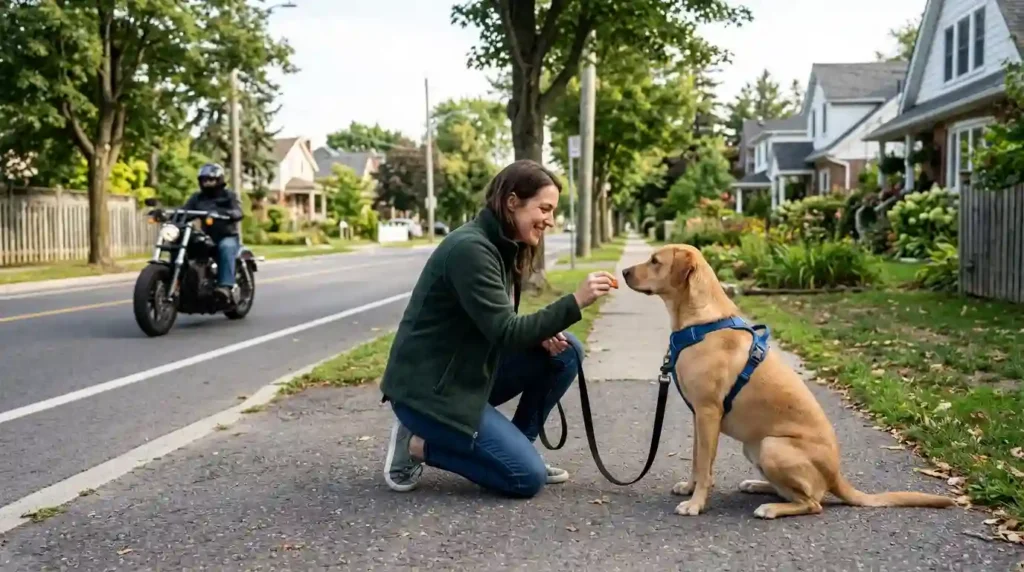
If you are wondering why is your Dog Barking at Motorcycles, the answer usually involves fear, noise sensitivity, excitement, frustration, or an instinctive desire to chase fast-moving objects. A motorcycle combines a loud engine, sudden movement, unfamiliar smell, and unpredictable approach—all powerful triggers for a reactive dog.
The good news is that vehicle reactivity can often be improved through distance management, desensitization, counterconditioning, and reward-based training. This guide explains how to recognize your dog’s emotional response, prevent dangerous chasing behavior, and gradually teach calm behavior around parked and passing motorcycles.
Table of Contents
- Why Do Dogs Bark at Motorcycles?
- What Your Dog’s Body Language Reveals
- Why Motorcycle Reactivity Can Be Dangerous
- How to Stop a Dog From Barking at Motorcycles
- Why Do Dogs Bark at Motorcycles During Training?
- Useful Commands for Motorcycle Reactivity
- Equipment and Environmental Management
- Common Training Mistakes
- Dogs Barking at Bikes, Scooters, and Other Objects
- When to Contact a Professional
- Conclusion
- Frequently Asked Questions
Why Do Dogs Bark at Motorcycles?
A motorcycle can affect several of a dog’s senses simultaneously. It moves quickly, produces an intense sound, creates vibration, and carries unusual odors from fuel, hot metal, rubber, and exhaust. For some dogs, that combination is simply too much to process calmly.
Although the behavior may appear aggressive, dog barking is not always a sign that a dog wants to attack. Barking and lunging are often distance-increasing behaviors. In other words, the dog is saying, “That thing makes me uncomfortable, and I want it to go away.”
Because the motorcycle continues down the road after the dog reacts, the dog may believe that barking successfully chased it away. Every repetition can strengthen the habit.
Motorcycle noise and noise sensitivity
Motorcycle noise is louder and less predictable than the sound produced by many cars. The engine may rev suddenly, change pitch, backfire, or become dramatically louder as the motorcycle approaches.
Dogs have sensitive hearing, so sounds that seem merely annoying to people may be overwhelming to them. A dog with noise sensitivity may show a fear response before the motorcycle is even visible. It may freeze, scan the road, lower its body, pull toward home, or begin growling.
Noise-related reactions can also become generalized. A dog that first reacted only to motorcycles may eventually bark at trucks, buses, lawn equipment, or other loud moving vehicles.
Fast motorcycle movement
Motorcycle movement can activate a dog’s chase instinct. Motorcycles approach rapidly, pass close by, and disappear within seconds. To a dog that notices motion easily, they may resemble fast-moving prey.
Prey drive and predatory instinct are not limited to traditionally recognized hunting breeds. Many dogs experience some desire to track, pursue, or intercept movement. Herding breeds may respond through herding instinct, attempting to control the motorcycle’s direction by barking, running, or cutting across its path.
This does not necessarily mean that the dog believes the motorcycle is an animal. The speed and movement can activate an automatic response before the dog has time to assess what it is seeing.
Fear, anxiety, and uncertainty
A dog may bark because it does not understand motorcycles or has not learned that they are harmless. Lack of socialization around traffic is particularly relevant when a dog has lived in a quiet rural area, stayed mainly indoors, or was not gradually introduced to moving vehicles during early development.
A fearful experience can also create a negative association. For example, a motorcycle might have passed extremely close, backfired near the dog, or startled the dog during a walk. Afterward, the sight, smell, or distant sound of another motorcycle may trigger anxiety and stress.
Uncertainty frequently appears as defensive behavior. The dog may lean forward and bark while simultaneously trying to move backward. That conflicting body language suggests the dog wants information or distance—not necessarily a confrontation.
Excitement, frustration, and overarousal
Some dogs are not afraid of motorcycles. Instead, they become intensely excited by movement. A leash prevents them from investigating or chasing, and that restriction creates frustration.
This is a common form of leash reactivity. The dog sees a trigger, becomes overstimulated, pulls against the leash, and cannot reach it. Frustration then turns into barking and lunging.
Overarousal may be more likely when the dog:
- Has received too little physical exercise
- Lacks mental stimulation
- Has been indoors for a long time
- Already feels excited at the beginning of the walk
- Frequently chases objects in the yard
- Has repeatedly practiced reacting to traffic
Exercise and enrichment cannot cure fear or vehicle reactivity on their own. However, a dog whose physical and mental needs are met may have more capacity for learning and impulse control.
Motorcycle smell and vibration
Dogs experience the environment mainly through scent. Motorcycle smell—including fuel, exhaust, hot rubber, oil, leather, and metal—may be unfamiliar or associated with a previous stressful event.
Vibration can matter too. A powerful engine may be felt through the pavement before the motorcycle reaches the dog. A dog that reacts “without seeing anything” may have heard, smelled, or felt the motorcycle first.
What Your Dog’s Body Language Reveals
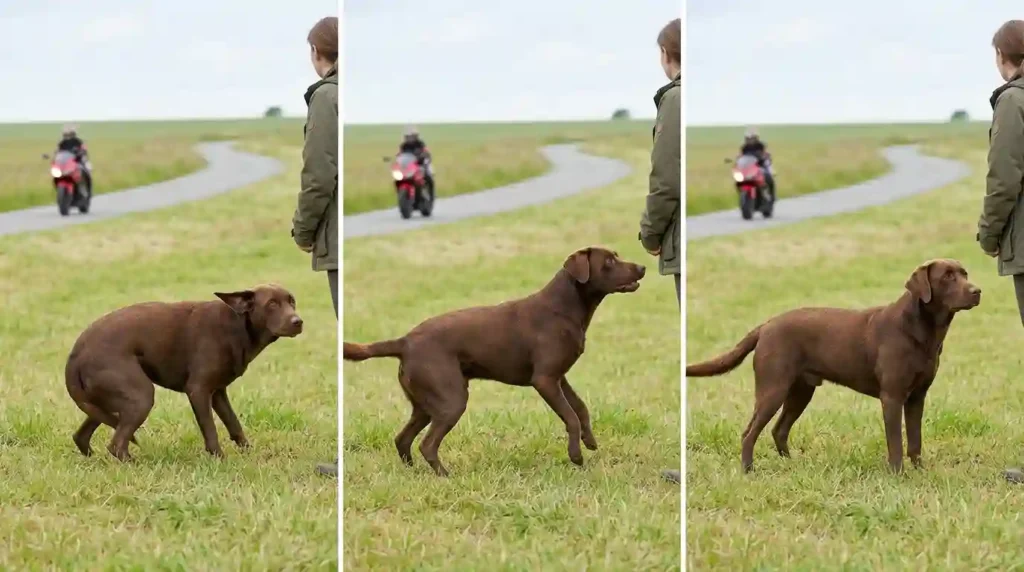
The best training plan depends on the emotional response behind the barking. Pay attention to the dog’s entire body rather than judging the bark alone.
Signs of fear or anxiety
A fearful dog may display:
- Ears pinned backward
- Tail tucked or carried low
- Crouched posture
- Trembling or panting
- Repeated lip licking
- Attempts to hide or escape
- Refusal to eat treats
- Barking while moving backward
These signs suggest that the motorcycle is too close or intense. Increase the safe distance immediately instead of asking the dog to remain near the trigger.
Signs of chase-based excitement
A dog motivated by movement may show:
- A tall, forward-leaning posture
- Intense visual fixation
- Weight shifted toward the motorcycle
- Rapid pulling or jumping
- A high or fast-moving tail
- Whining before barking
- Attempts to run after the vehicle
Chasing behavior may look playful, but it presents a serious road safety risk. It must be prevented even when the dog does not appear frightened.
Signs the dog is below threshold
The reaction threshold is the point at which a dog can no longer respond thoughtfully. A dog below threshold notices the motorcycle but can still:
- Accept high-value treats
- Respond to its name
- Make eye contact
- Follow a familiar focus command
- Turn away from the trigger
- Walk without pulling uncontrollably
- Display relatively loose body language
Training works best inside this comfort zone. If the dog is growling, lunging, screaming, or refusing food, learning is unlikely to occur. Create more distance first.
Why Motorcycle Reactivity Can Be Dangerous
A dog barking from inside a secure home may be disruptive, but a dog lunging at motorcycles outdoors can cause serious injury.
A strong dog may pull the handler into traffic or cause a handler to fall. A loose dog may run in front of the motorcycle, collide with it, or force the rider to swerve. Even a normally reliable recall can fail during intense fixation.
There is also an escape risk if the dog backs out of its collar, breaks equipment, slips through a gate, or pulls the leash from the handler’s hand. Follow local leash laws and do not allow a reactive dog to practice chasing motorcycles along an unsecured boundary.
Motorcyclists can also be startled by a dog charging toward the road. Responsible management protects the dog, handler, rider, passengers, and other road users.
How to Stop a Dog From Barking at Motorcycles
Learning how to stop a dog from barking at motorcycles requires two connected strategies: preventing unsafe rehearsals and creating a more positive emotional response to motorcycles.
The objective is not to silence the dog through punishment. It is to help the dog feel safer, remain below threshold, and perform an alternative behavior.
Step 1: Prevent rehearsal of the reaction
Every successful chase or explosive barking episode can make the behavior more established. Rehearsal prevention, therefore, begins immediately.
Use environmental management to reduce uncontrolled encounters:
- Choose a quiet walking route
- Walk during low-traffic periods
- Start in a low-traffic area
- Cross the road before a motorcycle arrives
- Turn into a driveway or side street
- Block window access if indoor barking is severe
- Use visual barriers around a securely fenced yard
- Avoid walking immediately beside busy roads
Trigger avoidance is not the complete treatment, but it protects everyone while training is underway.
If apartment sounds contribute to the problem, the guide to Stop Excessive Barking in Apartment Dogs explains additional methods for managing noise-triggered barking indoors.
Step 2: Determine the dog’s safe distance
Find a location where motorcycles can occasionally be observed from far away. The dog should notice a passing motorcycle without immediately barking or lunging.
Your starting safe distance might be 30 feet, 100 feet, or much farther. There is no universal number because volume, speed, environment, and the dog’s history all affect the reaction threshold.
If the dog will not take food or respond to a familiar cue, move farther away. Distance management is a training tool, not a failure.
Step 3: Begin with a parked motorcycle
A parked motorcycle removes speed and much of the noise, making it useful for gradual exposure. Work with a motorcycle whose owner has given permission and begin far enough away that the dog remains relaxed.
In a short training session:
- Allow the dog to notice the parked motorcycle.
- Use a marker signal such as “yes” or a clicker.
- Immediately provide a high-value treat.
- Walk away before the dog becomes anxious or fixated.
- Repeat only a few times.
Do not force the dog to approach, sniff, or sit beside the motorcycle. The aim is to create a positive association while respecting the dog’s comfort zone.
Step 4: Use desensitization and counterconditioning
Desensitization means exposing the dog to a mild version of the trigger that does not produce an overwhelming reaction. Counterconditioning means pairing that trigger with something the dog values.
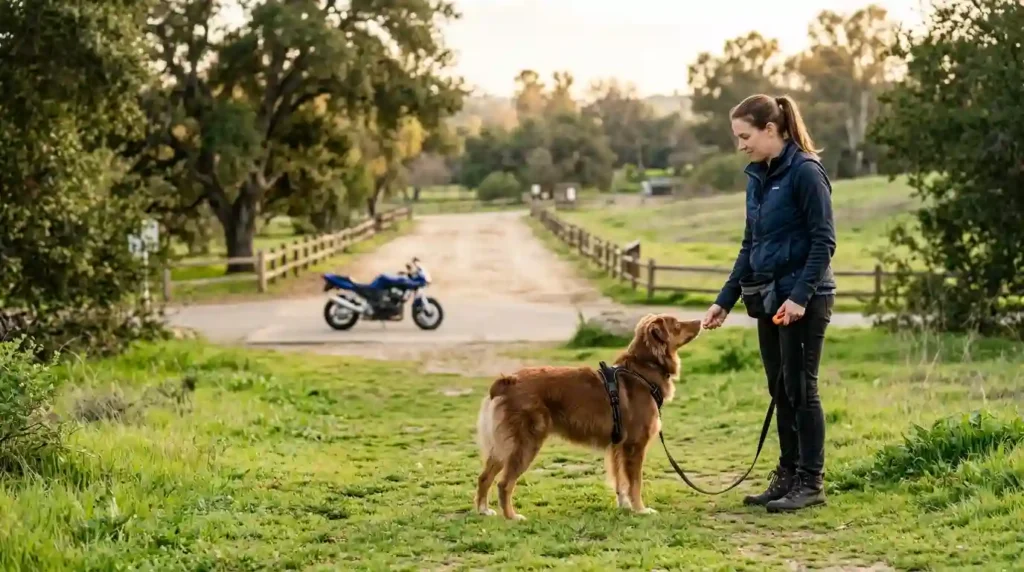
When a distant motorcycle appears:
- The dog sees or hears the motorcycle.
- Mark the moment calmly.
- Feed several small high-value treats.
- Stop feeding after the motorcycle passes.
- Increase the distance if barking begins.
With consistent practice, the appearance of a motorcycle can predict food rather than danger or frustration. This changes the underlying emotional response instead of merely suppressing its outward expression.
The ASPCA describes using counterconditioning and desensitization to reduce reactive barking and lunging, including rewarding attention toward the handler and gradually increasing exposure.
Step 5: Progress to a controlled passing motorcycle
A staged scenario can provide more control than random roadside traffic. Ask an experienced adult to help only if there is a large, safe training space away from public traffic.
The motorcycle should initially remain far away, move slowly, and avoid revving. Reward the dog for calm observation and attention redirection. Across separate sessions, the motorcycle may pass at a slightly closer distance or at normal speed.
Change only one element at a time. Do not increase speed, engine volume, and proximity during the same structured training session.
Step 6: Teach an alternative behavior
“Do not bark” is not a clear action for a dog. An alternative behavior gives the dog something specific to do when a motorcycle appears.
Useful alternatives include:
- Looking at the handler
- Touching the handler’s hand
- Moving behind the handler
- Walking in the opposite direction
- Holding a sit at a safe distance
- Finding scattered treats on the ground
- Following a “let’s go” cue
Reward calm behavior, voluntary eye contact, and the ability to disengage from the trigger. Positive reinforcement makes those responses more likely in the future.
Why Do Dogs Bark at Motorcycles During Training?
A dog may bark during training because the exposure progressed too quickly. Even if the previous session went well, a closer, faster, or louder motorcycle may push the dog over the threshold.
Progress is rarely perfectly linear. Stress from other events can also accumulate. A dog that slept poorly, encountered an off-leash dog, heard construction noise, and then saw a motorcycle may react at a greater distance than usual.
When barking occurs:
- Do not punish or jerk the leash.
- Create distance promptly.
- Use a practiced “let’s go” command.
- Allow the dog time to recover.
- Make the next repetition easier.
One reaction does not erase previous progress. It provides information about the difficulty level the dog can currently manage.
Useful Commands for Motorcycle Reactivity
Obedience training supports behavior modification, but commands should not be used to trap a frightened dog near a trigger.
Watch-me cue or focus command
Teach the watch-me cue in a quiet room first. Mark and reward brief eye contact, then gradually practice in environments with mild distractions.
Eventually, the focus command can help the dog look away from a distant motorcycle. Do not repeatedly say the cue after the dog has crossed its reaction threshold.
Let’s go command
A fast, cheerful U-turn is one of the most practical road safety skills. Say “let’s go,” turn away, and reward the dog for following. Practice when no motorcycle is present before using it during a real encounter.
Leave-it command
The leave-it command can help interrupt mild fixation, but it should not replace counterconditioning. Reward the dog generously for disengaging rather than treating the cue as a warning.
Sit, stay, heel, and recall
A sit command or heel command may provide structure when the trigger is distant. Stay and recall can improve general impulse control, but they are not guarantees during intense chasing behavior.
Always keep the dog physically secured near traffic, regardless of its obedience level.
Quiet command
A quiet command can be useful after the dog understands it in easier situations. However, repeatedly saying “quiet” while the dog is barking uncontrollably may add more noise and frustration.
First, reduce the trigger’s intensity. Mark a brief pause in barking, then reward it with treats or verbal praise.
Clicker training and marker signals
Clicker training can precisely identify the desired moment: seeing a motorcycle without reacting, looking back at the handler, or choosing to move away.
A verbal marker signal works too. Consistent timing is more important than whether you use a clicker or a word.
Equipment and Environmental Management
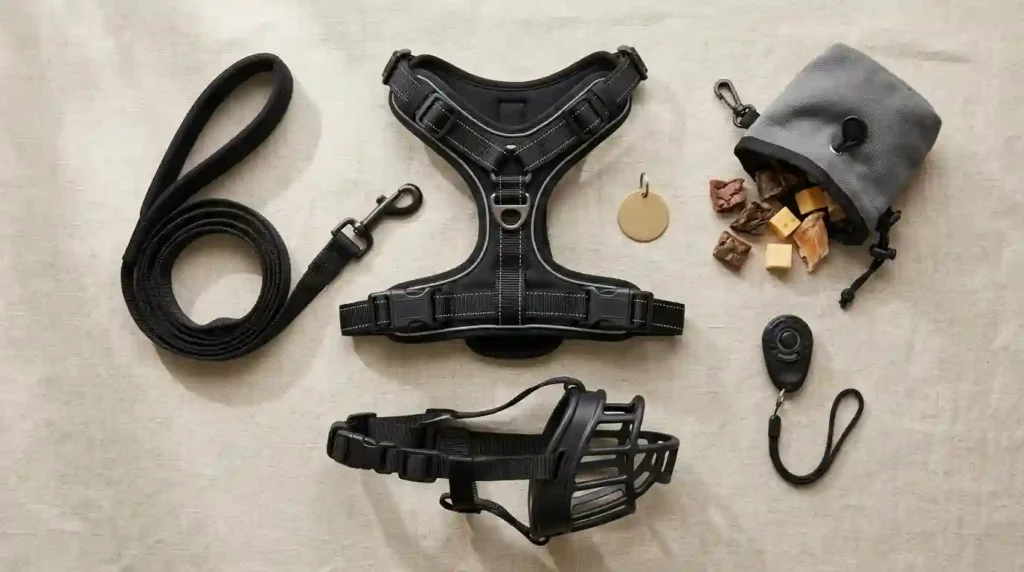
The right equipment increases handler control, but no collar or harness can replace training.
Leash and harness selection
A sturdy six-foot leash usually provides a useful balance between freedom and control. Avoid retractable leashes near traffic because they allow the dog to build speed and can be difficult to shorten quickly.
A properly fitted front-clip harness or no-pull harness may reduce pulling power. Check the fit carefully so the dog cannot back out.
A hands-free leash can provide added security in some situations, but it may also pull the handler off balance if a powerful dog lunges suddenly. Consider the dog’s size, strength, and behavior before using one near moving vehicles.
When a muzzle may help
A basket muzzle may be appropriate if the dog redirects frustration toward people or other animals. It must allow panting, drinking, and treat delivery.
Muzzle training should be gradual and positive. A muzzle does not prevent pulling, chasing, or escape, so it should be used as one part of a broader safety plan.
Indoor and yard management
If the dog barks at motorcycles through a window, apply opaque window film, close curtains, move furniture away from the window, or use white noise. In a yard, install a secure visual barrier and supervise outdoor time.
These steps reduce daily rehearsal while behavior modification is taking place.
Common Training Mistakes
Punishing barking and lunging
Yelling, leash corrections, shock collars, or physical punishment can make the motorcycle predict pain or conflict. This may increase fear, anxiety, and negative association.
Punishment may temporarily reduce sound while leaving the emotional cause unchanged. Reward-based training is a safer and more informative approach.
Working too close to traffic
Repeatedly exposing a dog to intense motorcycle noise does not guarantee that it will “get used to it.” Uncontrolled exposure may instead cause sensitization, making the reaction stronger.
Successful gradual exposure begins below the threshold.
Asking for too much attention
A dog does not need to stare continuously at the handler. Calmly looking at the motorcycle and then disengaging is valuable progress.
The goal is not to prevent the dog from noticing its environment. It is to help the dog process the trigger without losing behavioral control.
Using ordinary food around a powerful trigger
Dry kibble may not compete with an intense fear response or chase instinct. Use small high-value treats such as chicken, cheese, or another veterinarian-approved food the dog loves.
If the dog normally values the food but refuses it, the trigger is probably too close.
Conducting sessions that are too long
Several short training sessions are often more productive than one exhausting session. End while the dog is still successful.
Consistency and patience matter more than rapidly increasing difficulty.
Dogs Barking at Bikes, Scooters, and Other Objects
Owners searching “dog barks at bikes” or “why do dogs bark at bikes?” are often dealing with the same basic combination of movement, uncertainty, and chase instinct.
A dog may react to:
- Bicycles
- Scooters
- Skateboards
- Cyclists
- Runners
- Delivery carts
- Cars or trucks
- Children running or playing
Do not assume that progress around motorcycles will immediately transfer to all fast-moving objects. Dogs do not always generalize lessons automatically. Practice at a safe distance with each trigger.
If your dog also reacts to canine triggers, read Dog Barking at Other Dogs on Leash for strategies focused specifically on leash reactivity around other dogs.
What does “dog barking at motorcycle thief” mean?
The phrase “dog barking at motorcycle thief” often refers to videos or stories in which a dog alerts people to someone approaching or attempting to steal a motorcycle. That behavior is different from routinely barking at every motorcycle.
Alert barking at suspicious activity can be context-specific. A dog that reacts to all passing motorcycles is more likely to be experiencing fear, excitement, territorial behavior, or movement-related reactivity rather than identifying criminal intent.
When to Contact a Professional
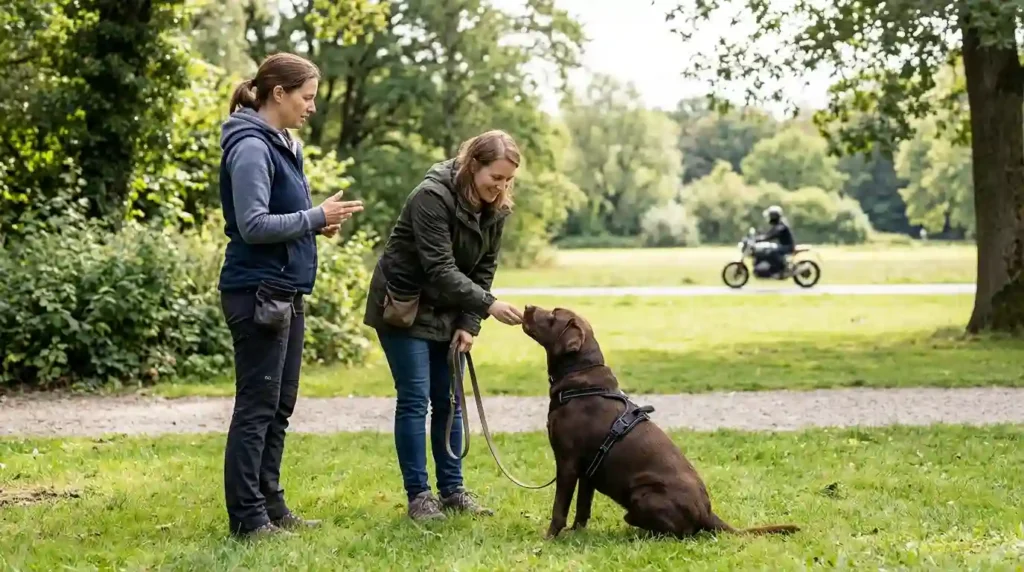
Consult a qualified force-free dog trainer or behavior professional if:
- The dog has escaped or entered the road
- Barking and lunging are becoming more severe
- You cannot physically maintain handler control
- The dog redirects bites toward the leash, handler, or nearby animals
- Motorcycle reactions have spread to most moving objects
- The dog remains distressed long after the trigger disappears
- You are unsure how to keep training below the threshold
A veterinarian should also evaluate sudden or extreme behavior changes. Pain, hearing changes, cognitive problems, or other medical conditions may affect reactivity. In severe anxiety cases, a veterinarian or veterinary behaviorist can determine whether medical support should accompany training.
Conclusion
Dogs may bark at motorcycles because of motorcycle noise, rapid movement, unfamiliar smell, fear, frustration, prey drive, herding instinct, or a previous negative experience. The outward behavior may look similar, but the underlying emotional cause can differ from one dog to another.
The safest plan combines environmental management with desensitization, counterconditioning, attention redirection, and positive reinforcement. Begin with enough distance to keep the dog below threshold, reward calm observation, and increase difficulty gradually.
Prevent uncontrolled chasing, use secure equipment, and avoid punishment. With structured practice, realistic expectations, and patience, many dogs can learn to notice motorcycles without barking, lunging, or putting themselves and others in danger.
Frequently Asked Questions
How to stop a dog barking at motorcycles?
Create distance, keep the dog below threshold, and pair distant motorcycles with high-value treats. Gradually reduce the distance only while the dog remains calm.
Why does my dog bark at motorcycles?
Your dog may be reacting to loud noise, fast movement, fear, excitement, frustration, prey drive, or a previous frightening experience.
Why do dogs bark at bikes?
Bikes are fast, quiet, and unpredictable. Their movement can trigger fear, herding behavior, fixation, or a natural chase instinct.
Can I let my dog watch motorcycles to get used to them?
Yes, but only from a safe distance where the dog can remain relaxed and take treats. Forced close exposure can worsen reactivity.
Should I punish my dog for barking at motorcycles?
No. Punishment may increase fear and negative associations. Use distance, positive reinforcement, and gradual behavior modification instead.
How long does motorcycle-reactivity training take?
Mild cases may improve within weeks, while established fear or chasing behavior can take months. Progress depends on history, frequency, and consistency.
Why does my dog chase motorcycles but not cars?
Motorcycles have a different sound, smell, size, and movement pattern. These features may activate the dog’s chase instinct more strongly.
What should I do if a motorcycle suddenly approaches?
Move away from the road, use your practiced “let’s go” cue, maintain a secure grip, and reward the dog after reaching a safer distance.
Will a no-pull harness stop motorcycle reactivity?
A harness may improve physical control, but it will not change the underlying emotional response. Training and safe-distance exposure are still necessary.
When should I hire a dog trainer?
Contact a force-free trainer if your dog enters the road, is difficult to control, redirects aggression, or continues getting worse despite careful training.