
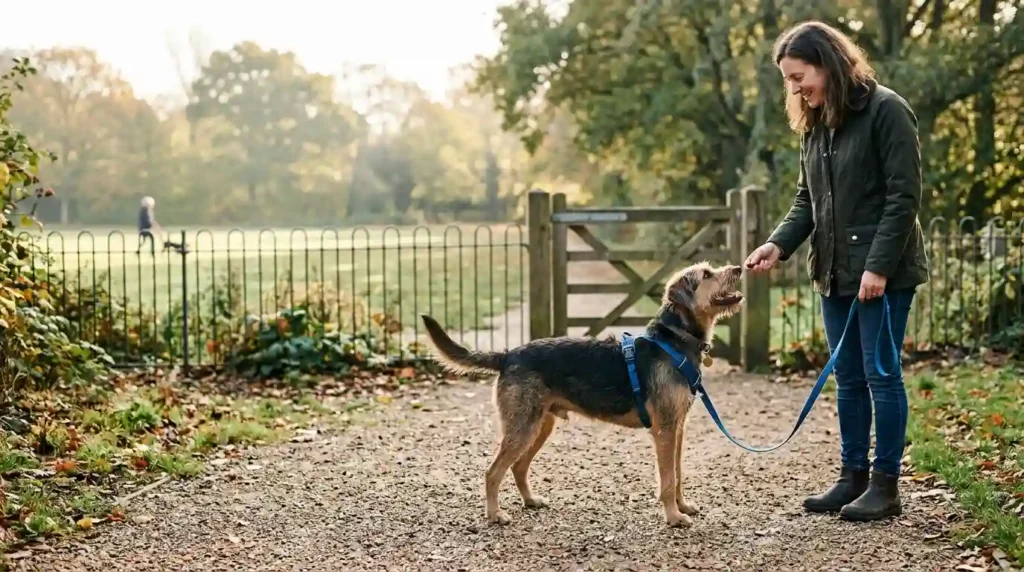

Summary
Dog Barking When Tied Up or Restrained is rarely a dog being stubborn or “bad.” More often, the leash, tie-out, fence, gate, crate, or other barrier has removed an option the dog feels it needs: moving closer, moving away, following a caretaker, or investigating a trigger. That conflict can produce frustration-induced barking, fear, overexcitement, or separation-related distress. This guide shows you how to read the behavior, reduce risk, identify the real cause, and build calmer responses through environmental management, controlled desensitization, counterconditioning, and positive reinforcement.
Table of Contents
- Understanding Dog Barking When Tied Up or Restrained
- Why Restraint Changes a Dog’s Response
- Frustration, Fear, or Separation Anxiety?
- Cobbing and Chuffing in Dogs
- Reading Canine Body Language
- How to Stop Dog Barking When Tied Up or Restrained
- Equipment and Environmental Management
- Mistakes That Can Make Barking Worse
- Common Restraint Scenarios
- When to Get Professional Help
- Conclusion
- FAQs
Understanding Dog Barking When Tied Up or Restrained
A dog can behave calmly when free to choose a path and then bark, pull, or lunge the moment a leash becomes tight. That change is important information. The restraint has altered the situation.
When movement is unrestricted, a social dog can approach another dog in an arc, pause, sniff, or disengage. A worried dog can increase distance. A dog attached to its caretaker can follow that person. Once tied up or held in place, those choices disappear. The dog may experience blocked access, a blocked greeting, or an inability to flee. Barking becomes an attempt to change what is happening.
This is why restraint-related dog barking should be understood as communication before it is treated as a training failure. The sound may be asking for access, requesting distance, expressing distress, or releasing arousal. If you suppress the sound without addressing the motivation, you may quiet the warning while leaving the underlying emotion untouched.
Readers exploring other vocal behaviors can find additional context in the site’s broader Dog Barking resources. The key in every case is the same: identify what happens immediately before the bark and what the dog gains or avoids afterward.
Why do dogs bark when tied up?
Dogs commonly bark when tied up because restricted movement prevents them from doing what feels necessary in that moment. A friendly dog may want to reach a person or potential playmate. A fearful dog may want to retreat from strangers, other dogs, passing vehicles, environmental sounds, or moving objects. A dog worried about its caretaker’s absence may want to follow its person.
Several motivations can look almost identical:
- Barrier frustration: The dog wants access but cannot get it. This is common in a frustrated greeter who whines, jumps, pulls, and barks when a leash blocks a greeting.
- Fear-based leash reactivity: The dog wants more space but cannot move away. Barking and lunging may have worked before by making a perceived threat retreat.
- Separation anxiety or isolation anxiety: The dog becomes distressed when a specific caretaker leaves or when the dog is alone, even if no outside trigger is present.
- Confinement anxiety: The physical restriction itself causes panic or distress, whether the dog is tethered, crated, penned, or held behind a gate.
- Attention-seeking barking: Barking has repeatedly brought the person back, started play, earned eye contact, or caused the leash to be released.
- Alarm or territorial barking: A dog restrained near a yard, fence, door, or window may respond to people, animals, and noises moving through what it considers familiar territory.
- Boredom and unmet needs: Lack of exercise, social contact, rest, sniffing, or mental enrichment can lower tolerance and increase repetitive vocal behavior.
The label matters because the training plan for a dog that wants to greet is not identical to the plan for a dog that feels trapped by an approaching stranger. Both may bark, but one needs help tolerating delayed access while the other needs safety and distance.
Why Restraint Changes a Dog’s Response
The fight-or-flight response loses an exit
Fear is not always dramatic. A dog may simply stiffen, close its mouth, lean forward, or stare. If a trigger continues to approach while the dog cannot leave, arousal rises. The normal fight-or-flight response has lost the flight option, so the dog may escalate to growling, barking, lunging, snapping, or biting.
That does not automatically mean the dog is aggressive in every context. Leash reactivity and barrier reactivity describe responses that occur around restrictions. A dog who reacts behind a fence may be social off-leash. A dog who appears threatening on a tight leash may choose to avoid conflict when given space. Still, the behavior must be taken seriously because repeated high-arousal episodes can lead to aggression escalation, redirected aggression toward the handler, damaged equipment, or a bite.
Frustration builds when access is blocked
Frustration is the emotional gap between what a dog expects and what it can obtain. A puppy allowed to greet every dog may learn that seeing another dog predicts immediate social access. Later, when the handler stops those greetings, the same dog may become a frustrated greeter. Whining becomes pulling; pulling becomes jumping; jumping becomes dog barking and lunging.
A similar pattern occurs when a dog can see family members playing but cannot join them, watches a squirrel through a fence, or is secured outside while its caretaker enters a building. The trigger is visible, the desired action feels urgent, and the barrier blocks completion.
Every full reaction can become a behavior rehearsal. Rehearsed behavior becomes faster and more automatic, especially when barking sometimes works. If the other dog eventually passes, the fearful dog may conclude that barking successfully drove it away. If the caretaker returns, the frustrated or anxious dog may conclude that barking brought the person back.
Human tension travels down the leash
Owner anxiety is understandable. After several embarrassing or frightening incidents, a person may scan constantly for triggers, shorten the leash, hold their breath, or jerk the dog backward. The dog feels the tight leash and sees the handler’s changed posture just as another dog approaches. Those signals can make the event seem more threatening.
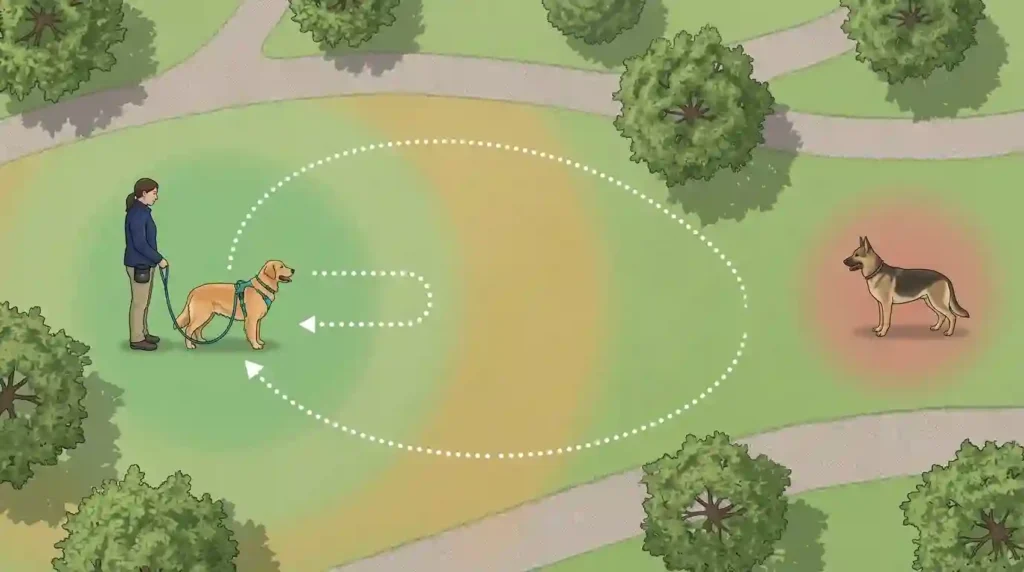
The goal is not to blame the handler. It is to replace an involuntary pattern with a prepared one: notice the trigger early, exhale, keep the leash as loose as safety permits, create distance, and guide the dog through a practiced U-turn or check-in behavior.
Frustration, Fear, or Separation Anxiety?
Accurate trigger identification prevents wasted training. Record what the dog sees, where the caretaker is, how far away the trigger is, what the leash feels like, and how quickly the dog recovers.
| Pattern | Likely motivation | Common clues | Helpful first response |
| Barking when another dog is visible but unreachable | Barrier frustration or blocked greeting | Whining, bouncing, pulling forward, loose body after access | Increase distance, stop automatic greetings, reinforce check-ins |
| Barking when a person or dog approaches | Fear or desire for distance | Freezing, stiff body, closed mouth, intense staring, raised hackles | Create distance, prevent head-on approaches, begin counterconditioning |
| Barking after a caretaker walks away | Separation anxiety or attachment-related distress | Pacing, howling, destruction, elimination, inability to settle | Avoid planned absences that trigger panic; seek a tailored separation plan |
| Barking whenever physically confined | Confinement anxiety | Escape attempts, panting, distress in a crate, pen, or tie-out | Change the confinement setup and introduce it gradually below threshold |
| Barking that reliably produces attention or release | Learned attention-seeking barking | The dog pauses to monitor the person; the behavior stops after access | Meet needs proactively and reinforce an alternative request |
| Barking along a property boundary | Territorial barking or fence frustration | Fence running, repetitive route, reactions to passersby | Block visual access, supervise, interrupt early, train away from the fence |
Clues that suggest separation-related distress
True separation anxiety is more than disliking a tie-out. It usually appears when the caretaker is absent and may include pacing, whining, howling, destruction near exits, indoor elimination, drooling, depression, or frantic escape behavior. Some dogs experience isolation anxiety when left without any person; others panic only when a particular person leaves.
Do not test severe distress by repeatedly leaving “to see whether the dog gets over it.” Panic is not productive exposure. A veterinarian or board-certified veterinary behaviorist can rule out medical contributors and create a behavior plan. Medication may be appropriate in some serious cases, but that decision belongs to a veterinarian.
Rule out pain and sensory changes
A sudden increase in barking or reactivity warrants a veterinary check. Pain, injury, hearing loss, and other health changes can reduce a dog’s tolerance. A dog that hurts when a collar presses the neck may react on leash. A dog with hearing loss may startle when approached. Medical assessment should come before assuming the behavior is purely disobedience.
Cobbing and Chuffing in Dogs
The People Also Ask questions “What is cobbing in dogs?” and “What is chuffing in dogs?” appear near barking topics, but they describe different behaviors. Neither should automatically be interpreted as restraint frustration.
What is cobbing in dogs?
Cobbing is gentle nibbling with the front teeth, resembling the small bites a person takes from corn on the cob. Dogs may cob a person, another animal, a toy, a blanket, or their own coat. In a relaxed context, it often functions as social grooming, affection, play, attention seeking, or self-soothing.
Look at pressure and canine body language. Soft nibbling from a loose, relaxed dog is different from biting accompanied by a stiff body, hard stare, growl, or raised hackles. Repeated self-cobbing that damages skin, appears suddenly, or occurs with signs of pain should be discussed with a veterinarian.
What is chuffing in dogs?
Owners often use “chuffing” for a short, forceful exhale, soft huff, snort, or muffled pre-bark sound. A dog may chuff when alert, excited, uncertain, or mildly frustrated. Context matters: one dog may use it as a low-level alarm before barking at a window, while another may huff during play or when seeking attention.
Chuffing should not be confused with persistent coughing, wheezing, gagging, reverse sneezing, or labored breathing. If the sound is new, frequent, associated with exercise intolerance, blue or pale gums, collapse, nasal discharge, or breathing difficulty, contact a veterinarian promptly.
Reading Canine Body Language
Barking volume alone does not reveal intent. Watch the whole dog before, during, and after the trigger appears.
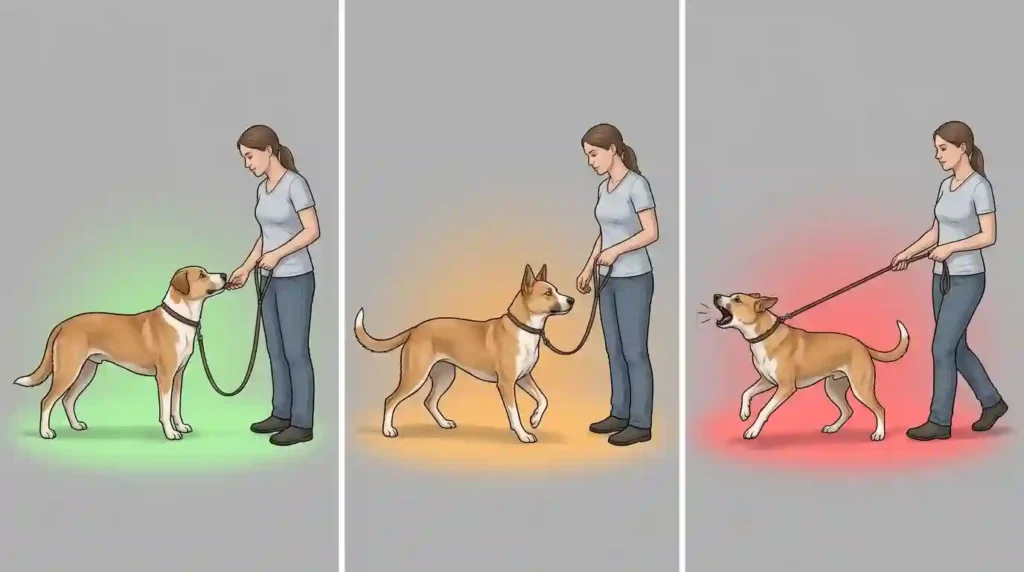
Green-zone behavior: able to learn
Below the reaction threshold, a dog can notice the trigger and still eat a high-value treat, sniff, respond to its name, turn with the handler, or perform a simple cue. The leash may remain loose. The dog’s body can shift rather than lock into place. Training belongs in this zone.
Yellow-zone behavior: create distance now
Early warning signs include a closed mouth, pricked ears, intense staring, slower responses, a forward-leaning posture, faster scanning, or increased leash pressure. Some dogs begin whining or taking food roughly. These signals mean arousal is rising. Use a practiced U-turn, move behind a visual barrier, or increase distance before barking begins.
Red-zone behavior: prioritize safety and recovery
When a dog is lunging, growling, barking continuously, spinning, freezing completely, or unable to take food, learning is limited. Do not demand obedience or continue an approach. Leave the situation safely, allow recovery, and adjust the next setup. The lesson is in preventing the next explosion, not winning a confrontation during this one.
Visual triggers can be surprisingly specific. Reflections, shadows, or movement behind glass can produce alarm barking or barrier frustration; the guide to Dog Barking at Reflections explains that pattern in more detail. At night, distant wildlife, neighbors, wind-blown objects, and unfamiliar environmental sounds can seem invisible to people but obvious to a dog. See Dog Barking at Nothing for that closely related situation.
How to Stop Dog Barking When Tied Up or Restrained
The most effective plan combines safety, environmental management, distance management, and carefully arranged learning. Do not begin with the dog tied at full intensity while the trigger passes nearby. Start where the dog can succeed.
Step 1: Stop preventable rehearsals
For now, avoid leaving the dog tied outside unattended. If a fence, gate, door, or window triggers barrier reactivity, reduce access when you cannot supervise. Use curtains, privacy material, a solid visual barrier, soothing music, or white noise to reduce visual and audio stimulation.
Choose quieter walking times and routes with escape options. Cross the street before the dog reaches the threshold. Step behind a parked car or hedge. These choices are not failures; they protect the learning process by preventing repeated explosions.
Step 2: Meet physical and emotional needs
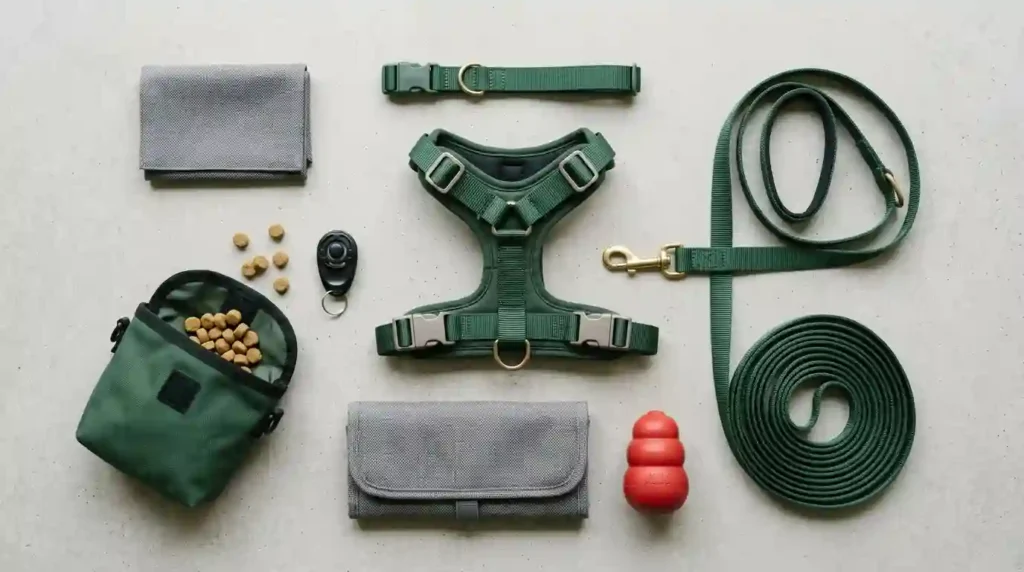
Training works better when the dog has an appropriate, consistent daily routine. Provide species-appropriate exercise, sleep, social contact, sniffing, chewing, and mental enrichment. A puzzle toy, stuffed Kong toy, scatter feeding, or sniffing games can reduce boredom and help the nervous system settle.
Enrichment is support, not a cure for panic. A food toy will not resolve severe separation anxiety, and a highly aroused dog may be unable to eat. Use the dog’s response to food as information about stress, not as proof of stubbornness.
Step 3: Find the reaction threshold
Arrange a controlled setup with a neutral helper and a calm dog or person. Begin at a distance where your dog notices the trigger but can still orient back to you. This is the working distance. It may be 20 feet for one dog and 200 feet for another.
Avoid a head-on approach. Parallel movement or a gentle arc approach is less confrontational than direct eye contact on a narrow path. If the dog stiffens or stares, increase distance immediately. Short training sessions of three to five minutes are often more effective than one long session that ends in overstimulation.
Step 4: Use mark-and-reward training
The moment the dog sees the trigger while remaining below threshold, mark that observation with a calm “yes” or a clicker. Then deliver a high-value treat. After several repetitions, the appearance of the trigger should begin to predict good outcomes and a check-in with the handler.
This process combines controlled desensitization—exposure at an intensity the dog can handle—with counterconditioning, which changes the emotional association. Over time, reduce the distance gradually. If barking returns, the setup becomes too difficult; move farther away rather than adding pressure.
The American Veterinary Society of Animal Behavior recommends reward-based methods for behavior modification in its humane dog training position statement. That guidance supports positive reinforcement and rejects training based on force, pain, intimidation, or emotional discomfort.
Step 5: Teach practical replacement behaviors
Build these skills first in a calm environment, then practice around mild distractions:
- Check-in behavior: Reward the dog for voluntarily looking back at you.
- Look at That (LAT): Mark a calm glance toward the trigger and reward disengagement.
- U-turn: Teach a cheerful cue such as “this way” and move away together.
- Recall training: Practice coming away from low-level distractions using a long line where appropriate.
- Go-to-mat cue: Reinforce settling on a portable mat, especially near household barriers.
- Quiet cue: Capture a brief pause in barking, say “quiet” calmly, and reward the silence. Teach this outside the crisis first.
- Sit-stay or wait: Use impulse-control exercises before access to doors, greetings, play, and walks.
- Loose-leash walking: Reinforce movement near the handler without constant leash pressure.
These are replacement behaviors, not commands used to overpower fear. A dog beyond the threshold may be unable to respond. Increase distance first; cue second.
Step 6: Generalize carefully
Dogs do not automatically transfer a skill from the living room to a busy sidewalk. Practice with different trigger distances, directions, and environments while protecting the dog from surprise encounters. Change one variable at a time.
Keep a simple reaction log: trigger, distance, early body-language signs, behavior, and recovery time. Progress may look like a quieter bark, a faster check-in, less pulling, or quicker recovery—not immediate silence. Training consistency matters more than dramatic tests.
Equipment and Environmental Management
Equipment should increase safety without adding pain or fear. It does not replace behavior modification.
Leashes, harnesses, and collars
A sturdy six-foot leash offers more predictable control than a retractable leash in reactive situations. A long line can support recall training in an open, supervised space, but it should not be wrapped around hands or attached where it can entangle the dog.
A well-fitted harness can reduce pressure on the neck. A flat collar may carry identification, but a dog that lunges hard may need a secure harness-and-collar backup connection. A properly conditioned head halter can help some handlers manage pulling, yet it must be introduced gradually and used without sharp leash jerking because sudden neck rotation can cause injury.
Crates, pens, and mats
A crate or pen can be safer than an outdoor tie-out for some dogs, but confinement anxiety changes that calculation. Never force a panicking dog into a crate and assume it will feel like a den. Introduce confinement in small, positive steps and monitor behavior.
A portable mat gives the dog a predictable station for calm behavior. Pair it with low-arousal chews, a puzzle toy, or quiet reinforcement before using it near a challenging door, gate, or window.
Visual and sound management
Visual access reduction can immediately lower trigger exposure. Use an opaque fence section, privacy panel, curtain, or removable window film where appropriate. Soothing music or white noise can soften sudden sounds. Management is especially valuable while training is new and fragile.
Mistakes That Can Make Barking Worse
Punishing the warning
Yelling often sounds like joining the barking. Harsh correction, leash jerking, or other punishment can add fear and pain to an already difficult trigger. A dog may associate aversive stimulation with the approaching dog, stranger, or handler, increasing anxiety and aggression risk.
An anti-bark collar does not identify whether the dog is frightened, frustrated, lonely, or in pain. Citronella collars and shock collars may interrupt vocalization, but silence is not the same as emotional safety. Suppressing barking can also remove a warning before biting.
Waiting for a full reaction before acting
Once the dog is barking, lunging, and unable to eat, the useful training window has passed. Watch for the stiff body, pricked ears, closed mouth, forward lean, and intense staring that occur earlier. Distance is most effective before the explosion.
Forcing greetings
Do not drag a dog toward a trigger to “prove” it is safe. Likewise, do not allow every on-leash greeting. Repeated direct approaches and tight-leash interactions can create conflict, especially when dogs cannot use a natural arc approach or move away.
Releasing the dog during barking
If barking reliably produces access, the behavior can strengthen. When it is safe and the dog is not panicking, wait for a brief moment of calm, mark it, and then provide the desired outcome or a suitable alternative. Severe distress is different: do not prolong panic to avoid “rewarding” it. Change the setup so panic does not occur.
Using a muzzle as a silencer
Muzzle safety matters. A basket muzzle can be a valuable bite-prevention tool when properly fitted and positively conditioned, but it is not a treatment for barking. Never tie a dog’s muzzle closed or leave a muzzled dog unattended. The dog must be able to pant, drink, and take treats as appropriate.
Common Restraint Scenarios
Tied outside a shop
Leaving a dog tied outside a shop creates more than a noise problem. The dog may face strangers, children, other dogs, traffic, theft, escape, entanglement, or unwanted touching without its caretaker. A dog that barks, lunges, freezes, or shows distress is not ready for that situation. The safer alternative is usually to leave the dog securely at home or bring another person who can remain with it.
Tied in a yard
A supervised tie-out may be used briefly in some households, but it should not substitute for exercise, companionship, or secure fencing. Check for entanglement hazards, weather, access to water and shade, nearby animals, and the dog’s emotional response. If fence running, pacing, compulsive barking, or escape behavior appears, end the setup and reconsider it.
Restrained at night
Night can amplify unfamiliar sounds and moving shadows. A dog left outside may react to wildlife, neighbors, passing vehicles, or noises that people cannot hear. Outdoor restraint also reduces supervision. A safe indoor sleeping area is generally more appropriate, especially for a dog showing alarm barking, fear, isolation distress, or territorial behavior.
On-leash reactions during walks
For leash reactivity, prioritize distance and predictable routes. Use a harness, regular leash, high-value treats, and a rehearsed U-turn. Avoid narrow paths and surprise head-on encounters while the dog is learning. Reward calm observation and voluntary disengagement rather than demanding prolonged eye contact with the handler.
Behind a fence, gate, door, or window
Barrier reactivity can become self-reinforcing because triggers repeatedly appear and disappear while the dog barks. Prevent unsupervised rehearsal. Block the view, call the dog away before arousal peaks, reward recall, and practice the go-to-mat cue at a manageable distance from the barrier.
When to Get Professional Help
Seek help promptly if the dog has bitten, snapped, redirected aggression toward a person, broken equipment, injured itself, or escalated despite careful management. Professional support is also appropriate for panic, persistent howling, destruction, elimination, compulsive pacing, severe confinement anxiety, or reactions that make daily life unsafe.
Start with a veterinarian to rule out pain, injury, hearing loss, or another medical contributor. For complex anxiety or aggression, ask for a board-certified veterinary behaviorist or a Certified Applied Animal Behaviorist (CAAB). A qualified behavior consultant or Certified Professional Dog Trainer (CPDT) can help with implementation; look for transparent, reward-based methods and relevant reactivity experience.
Avoid anyone who guarantees a rapid cure, recommends flooding the dog with triggers, dismisses fear as dominance, or relies on intimidation. A good professional explains the plan, tracks threshold and recovery, protects welfare, and adjusts the environment as well as the behavior.
Conclusion
Restraint frustration is not simply a loud habit. It is a conflict created when a dog sees a meaningful trigger but cannot approach, retreat, follow, or investigate. The same outward dog barking can arise from barrier frustration, fear, separation anxiety, confinement anxiety, territorial motivation, boredom, pain, or a learned request for attention.
The humane path begins with observation. Identify the barking trigger, read early canine body language, prevent behavior rehearsal, and create enough distance for the dog to think. Then use positive reinforcement, controlled desensitization, counterconditioning, and practical replacement behaviors to build a different response.
Progress is measured in safer choices: a looser leash, a voluntary check-in, a quieter response, a successful U-turn, or a faster recovery. When risk or distress is high, involve a veterinarian and a qualified behavior professional early. The objective is not merely a silent dog—it is a dog that feels safer and has better ways to cope.
FAQs
Why do dogs bark when tied up?
Restricted movement can create frustration, fear, blocked access, or separation-related distress. The dog may be trying to approach, escape, or regain contact.
Do dogs get aggressive when tied up?
Restraint can intensify reactivity because the dog cannot flee or control distance. Not every barking dog is aggressive, but escalation and biting are possible.
How long can I keep my dog tied up?
Use restraint only briefly and under active supervision; stop if the dog shows distress, entanglement risk, or escalating reactivity. A secure alternative is usually safer.
Is it okay to tie my dog up at night?
It is generally safer to provide a secure indoor sleeping area. Nighttime tethering reduces supervision and can increase alarm barking, fear, and exposure risks.
Is it okay to tie up your dog outside a shop?
It is risky because of theft, escape, traffic, strangers, other dogs, and unwanted contact. Leaving the dog safely at home is usually the better option.
Is leaving a dog outside all day neglect?
Long periods outside can fail to meet needs for safety, shelter, exercise, social contact, and supervision. Welfare requirements also depend on the conditions and local rules.
What is a good command for a dog to stop barking?
Teach a calm “quiet” cue by marking and rewarding brief silence in easy situations. Address the trigger and emotional cause rather than relying on the word alone.
Can barking be trained out of a dog?
Barking is normal communication and should not be eliminated entirely. Training can reduce excessive barking and teach safer alternative behaviors.
What do vets recommend to stop barking?
Veterinarians typically begin by identifying behavioral and medical causes, then recommend management and reward-based training; severe anxiety may need specialist care.