
Summary
To stop dog barking in a hotel room, identify what is triggering the barking, reduce the sights and sounds reaching your dog, create a familiar resting space, and reward quiet behavior. Exercise, sound masking, a well-practiced quiet command, and careful acclimation can prevent most hotel barking. If your dog has separation anxiety, however, leaving them unattended may make the problem worse. This guide explains what to do before the trip, after check-in, during a barking episode, and whenever you need to leave the room.
Table of Contents
- Why dogs bark in hotel rooms
- How to stop dog barking in a hotel room before it begins
- Choosing the best hotel and room
- Helping your dog acclimate after check-in
- How to stop dog barking in a hotel room immediately
- Reducing hallway noise and other triggers
- Teaching quiet and settle cues
- Leaving a dog alone in a hotel room
- Barking tools, products, and safety considerations
- When to choose another accommodation
- Conclusion
- Frequently asked questions
Why Do Dogs Bark in Hotel Rooms?
A pet-friendly hotel may allow dogs, but that does not mean every hotel room feels safe or comfortable to them. Dogs enter a strange space filled with unfamiliar scents, unpredictable sounds, and people moving outside the door. Even a normally relaxed dog can become watchful or restless.
Understanding the reason for the barking is the first step toward stopping it. Barking is communication, not simply disobedience. Your response should depend on whether your dog is afraid, alerting you to a noise, seeking attention, feeling bored, or distressed because you left.
An unfamiliar environment can put a dog on alert
A hotel room does not smell, sound, or function like home. Your dog may hear footsteps above the ceiling, luggage rolling across the floor, voices through the walls, doors closing, or an elevator arriving down the hall. These sounds may be routine to people, but they can signal possible danger to a dog.
An unfamiliar environment may produce:
- alert barking at footsteps or voices;
- reactive barking when another guest passes the door;
- pacing, panting, or restlessness;
- difficulty sleeping;
- Repeated checking of the entrance;
- anxious chewing or other destructive behavior.
Dogs with a naturally vigilant temperament may react more strongly. Herding dogs, guardian breeds, terriers, and dogs already sensitive to external noise can find a busy hotel especially challenging.
Hallway noise is one of the biggest barking triggers
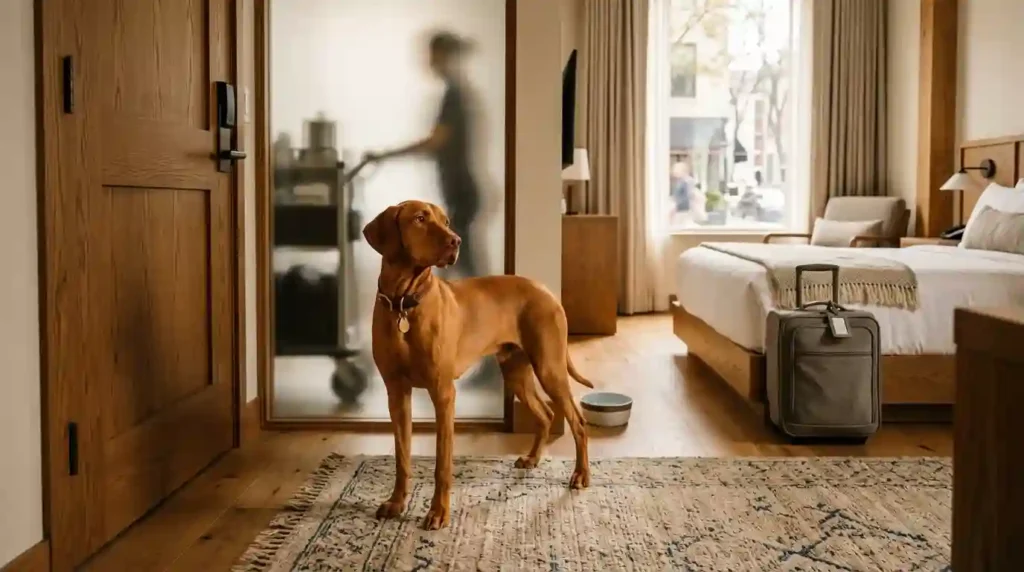
Hallway noise often sounds as though it is happening inside the room. Foot traffic, housekeeping carts, elevators, neighboring guests, children, and other dogs can all activate alert barking.
Knocking and surprise entry are even more intense triggers. A housekeeper opening the door may create fear, territorial behavior, or an escape risk. This is why communication with the front desk and use of a do-not-disturb sign are essential parts of managing a hotel stay with a dog.
Visual triggers can be just as powerful
An open window or uncovered window may give your dog a direct view of people, cars, animals, and activity outside. Reflections in mirrors or glass can also become triggers in an unfamiliar room.
If your dog repeatedly reacts to movement in glass, the guidance in Dog Barking at Reflections can help you understand why closing curtains or changing the viewing angle may reduce the behavior.
Some dogs also bark when a person suddenly rises from a chair or bed. If changes in human posture trigger your dog, read Dog barks when someone stands up for more targeted behavioral guidance.
Separation anxiety is different from ordinary hotel barking
A dog that barks only after you leave may be experiencing isolation distress or separation anxiety. Look for additional signs such as:
- barking or howling that continues for long periods;
- scratching or biting at the door;
- drooling, panting, or frantic pacing;
- refusal to eat a treat after you leave;
- attempts to escape a dog crate;
- indoor accidents despite reliable house training;
- damage near doors or windows.
Separation anxiety cannot be solved by tiring the dog out or turning on a television. Those measures may provide support, but the dog’s underlying distress still needs to be addressed.
Routine disruption, boredom, and overstimulation
Travel changes meal times, walking schedules, sleep, and access to familiar places. This routine disruption can create uncertainty. At the same time, a dog may receive too much stimulation during the journey and too little appropriate activity after reaching the hotel.
Overstimulation can make it difficult for a dog to settle, while boredom may lead to barking, chewing, and attention-seeking. A consistent routine that includes physical exercise, rest, and mental enrichment helps regulate both problems.
How to Stop Dog Barking in a Hotel Room Before It Begins
The most effective hotel-barking plan begins at home. A dog cannot be expected to learn every necessary skill after arriving in a stimulating new environment.
Review the hotel pet policy
Call the hotel directly before booking or arrival. Online listings can be incomplete or outdated, so confirm the current hotel pet policy with the front desk.
Ask:
- Are dogs allowed to remain in the room unattended?
- Must an unattended dog be inside a crate?
- Are there breed, size, or number restrictions?
- Is a pet fee or refundable deposit required?
- What happens if the hotel receives noise complaints?
- Can you request a quiet room?
- Does the hotel require a vaccination record?
- Are there designated dog-walking or potty areas?
- Is housekeeping optional or available by appointment?
These details matter because a barking complaint can lead to extra charges, room damage fees, or eviction. Some properties require the owner to return immediately if a dog creates a guest disturbance.
Practice useful skills before traveling
Your dog should know several basic behaviors before the trip:
- relaxing on a dog bed or mat;
- entering and resting inside a dog crate;
- responding to a quiet command;
- following a settle cue;
- remaining calm when someone knocks;
- tolerating short departures;
- disengaging from sounds and looking toward you.
Use positive reinforcement and reward-based training. Treats, praise, and access to relaxing activities teach the dog what to do instead of barking.
The ASPCA’s barking guidance also emphasizes identifying why a dog barks and matching training to the motivation behind the behavior.
Begin noise desensitization at home
Noise desensitization prepares your dog for sounds such as doors closing, people talking, luggage rolling, knocking, and elevator bells.
Play recordings at a very low volume while your dog is relaxed. Give treats or start a calm food activity. Gradually raise the volume over multiple sessions, stopping before your dog becomes distressed.
This process is often combined with counterconditioning:
- A quiet version of the trigger occurs.
- Something pleasant immediately follows.
- The trigger ends before the dog becomes overwhelmed.
- The process is repeated gradually.
The purpose is to change the dog’s emotional response. Instead of predicting danger, hallway-type sounds begin to predict calm behavior and rewards.
Build positive crate training
A dog crate can provide a familiar safe space, but only when the dog has already learned to enjoy it. Do not introduce confinement for the first time in a hotel.
Place comfortable bedding inside the crate and reward voluntary entry. Feed treats or a food-stuffed toy inside while leaving the door open. Gradually practice closing the door for short periods while you remain nearby.
If restraint or confinement causes barking, lunging, or panic, review Dog Barking When Tied Up or Restrained before relying on a crate during travel.
A crate should not be used to contain a panicking dog. Frantic escape attempts can result in damaged teeth, broken nails, or other injuries.
Pack items that support calm behavior
Bring more than food and a leash. Helpful hotel items include:
- your dog’s usual bed;
- a familiar blanket carrying a familiar scent;
- a familiar toy;
- a collapsible dog crate, if crate trained;
- an optional breathable crate cover;
- a white noise machine;
- a food-stuffed toy;
- a puzzle toy;
- a lick mat;
- a long-lasting chew appropriate for your dog;
- regular food and water bowls;
- high-value training treats;
- waste bags and cleaning supplies;
- medications;
- an extra leash;
- vaccination records;
- Your veterinarian’s contact details.
Avoid testing several new foods, supplements, or toys during the trip. Familiar items are usually more settling than novelty.
Choose the Right Hotel and Room
Room selection can determine how difficult the stay becomes. A dog placed beside an elevator or busy stairwell must cope with a constant stream of sounds.
Request a quiet room
Ask for a quiet room away from:
- elevators;
- vending and ice machines;
- stairwell doors;
- housekeeping storage areas;
- the lobby;
- restaurants or bars;
- pools;
- conference spaces;
- exterior doors with heavy foot traffic.
A room at the end of a hallway may receive fewer passing guests. However, consider the length of the walk to the exit if your dog is elderly, has limited mobility, or needs frequent potty breaks.
Consider a top-floor room or suite
A top-floor room eliminates overhead footsteps, rolling suitcases, and furniture movement. It may be especially helpful in hotels with hard flooring or limited sound insulation.
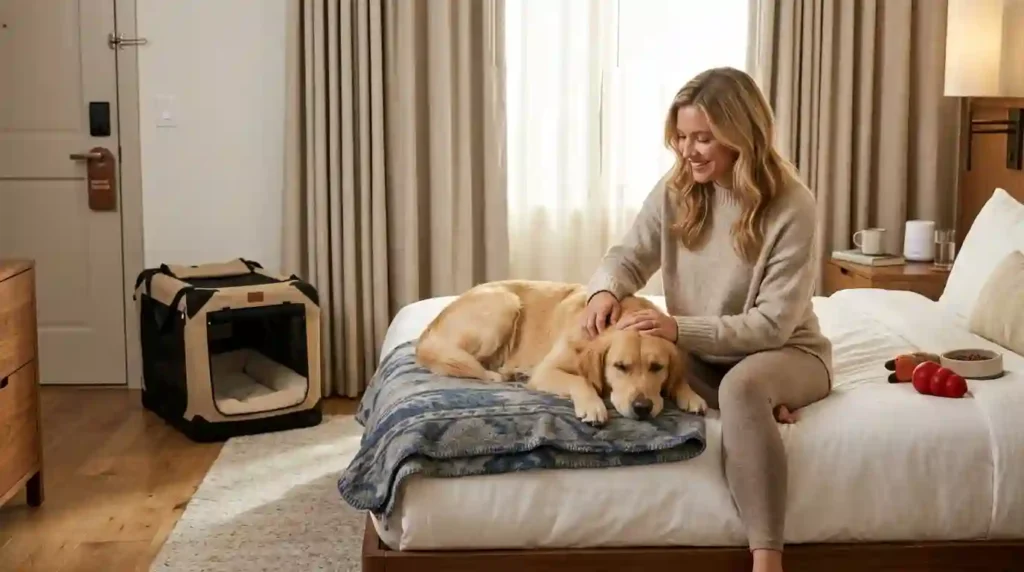
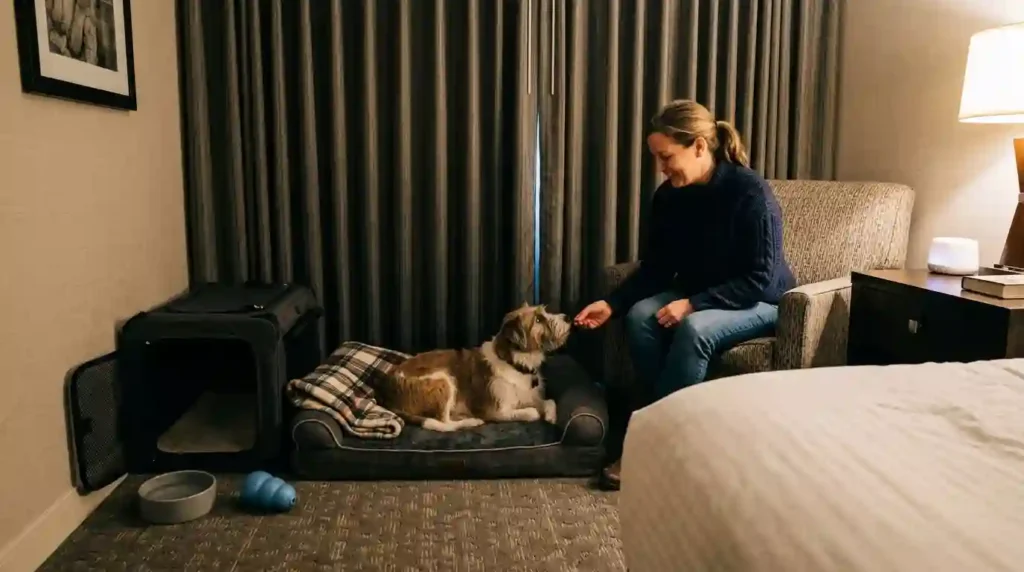
A suite can provide an additional buffer between the hallway and your dog’s resting area. Set up the safe space in the bedroom or the room farthest from the entrance.
Room availability varies, so make these requests early. If your assigned room is unusually noisy, politely ask for a room change before unpacking completely.
Help Your Dog Acclimate After Check-In
Do not rush into the room and immediately leave for dinner. Acclimation requires time.
Start with a long walk and a potty break
Before entering the hotel, take your dog for a calm, long walk. Allow time for sniffing and a complete potty break. Physical exercise reduces pent-up energy, while sniffing can help a dog process the new environment.
Avoid exhausting your dog through frantic exercise. A dog that is physically tired but emotionally overstimulated may remain reactive.
Introduce the room gradually
Walk through the hotel’s common areas calmly. Keep your dog on a secure leash near the lobby, elevators, and hallways.
Once inside the room:
- Check for unsafe food, cleaning products, electrical cords, or open windows.
- Keep your dog on a leash during the initial inspection.
- Allow a few minutes of calm sniffing.
- Place the dog bed or crate in the quietest available location.
- Set down water.
- Offer a familiar toy, chew, or a few treats.
- Practice the settle cue.
- Keep your own movements quiet and predictable.
Your emotional state matters. Frantic unpacking, repeated corrections, or anxious monitoring can make the room feel unsafe.
Create a safe space away from the door
Maximize the distance from the door. The entrance is where hallway sounds, light changes, knocking, and surprise entry occur.
Place the dog bed or crate behind a piece of furniture if the layout permits, but do not block ventilation or create an unsafe enclosure. A crate cover may soften visual stimulation for a dog that already enjoys covered rest spaces.
Keep the area comfortable and accessible. The goal is to give your dog a predictable place to relax, not to isolate or punish them.
Use first-night supervision
If possible, plan to remain with your dog throughout the first night. Follow your normal evening routine, including the usual meal, potty walk, and bedtime.
First-night supervision gives you a chance to identify barking triggers and address them before considering an absence. Some dogs settle quickly after sleeping in the room, while others need more time.
How to Stop Dog Barking in a Hotel Room Immediately
If barking begins, stay calm. Shouting can sound like you are joining the noise and may increase excitement or fear.
Identify the immediate trigger
Look and listen before responding. Is someone walking past the door? Did housekeeping knock? Can your dog see movement through a window? Did you just leave and return? Is the dog barking because they need a potty break?
Once the trigger is identified, choose the simplest appropriate response.
Interrupt without frightening the dog
Use your dog’s practiced quiet command or call them away from the trigger. Keep your voice calm and neutral.
A useful sequence is:
- Allow a brief alert if necessary.
- Say the quiet command once.
- Move away from the door or window.
- Reward the first moment of silence.
- Guide the dog to their bed.
- Give the settle cue.
- Continue reinforcing calm behavior at short intervals.
Avoid repeating “quiet” over and over while the dog continues barking. The word can become meaningless if it is not connected to a behavior the dog understands.
Block the trigger
Management produces faster relief than training during an active episode.
Depending on the cause:
- close the curtains;
- move the dog away from the door;
- turn on a fan or white noise machine;
- increase the distance from neighboring guests;
- Place a towel near the bottom of the door to reduce light and some noise;
- Ask housekeeping not to enter;
- Take the dog outside for a calm potty break;
- Request a room change if the location is unreasonably noisy.
Darkening the room can encourage rest at night, but do not make the space so dark that your dog becomes disoriented.
Redirect the mouth and mind
A dog cannot bark continuously while calmly licking or chewing. Once the dog is under control, offer a lick mat, safe long-lasting chew, or food-stuffed toy.
Mental enrichment should encourage decompression, not frantic excitement. Select activities that match your dog’s size, chewing style, and food tolerance. Supervise items that could break or become a choking hazard.
Reward genuine calm behavior
Do not wait only for barking so you can correct it. Quietly reward your dog while they are resting, looking away from the door, or ignoring a passing sound.
Positive reinforcement teaches the behavior you want repeated. Over time, the dog learns that lying quietly in the safe space is more rewarding than patrolling the entrance.
For additional training topics and trigger-specific guidance, explore the Dog Barking resource collection.
What Noise Cancels Out Dog Barking?
No sound completely cancels a dog’s bark inside a hotel. The practical goal is sound masking: reducing the contrast between sudden hallway sounds and the room’s background environment.
White noise machine
A white noise machine provides a steady sound that can mask footsteps, voices, door latches, and elevator activity. Place it between your dog and the room entrance, while keeping the volume comfortable.
Do not place the machine directly beside your dog’s head or use it at an extreme volume. It should soften triggers, not overpower the entire room.
Fan or hotel HVAC
A fan or the hotel’s heating and cooling system can create a consistent background sound. This is often the easiest option because it requires no additional equipment.
Check that the airflow is not blowing directly onto the dog for long periods and that the room remains at a safe temperature.
Television and background music
A television at low volume can disguise speech and irregular hallway sounds. Calm programs with steady dialogue may be less stimulating than shows featuring animals, doorbells, shouting, or sudden sound effects.
Soft background music or classical music can also help. Choose an even volume and avoid tracks with abrupt transitions.
Sound masking should be paired with training and environmental management. It will not resolve separation anxiety or prevent a dog from reacting to visible triggers.
Teach a Reliable Quiet Command and Settle Cue
The quiet command and settle cue perform different jobs. “Quiet,” the dog was told to stop vocalizing. “Settle” asks for a relaxed posture and reduced activity.
How to teach the quiet command
Practice at home under controlled conditions:
- Create a mild trigger that produces one or two barks.
- Hold a treat near your dog’s nose.
- When the dog pauses to sniff, say “quiet.”
- Mark the silence with “yes” or a clicker.
- Give the treat.
- Gradually increase the required quiet time.
- Practice with different low-intensity triggers.
Do not create intense barking sessions just to train. Work below the level at which your dog loses the ability to respond.
How to teach a settle cue
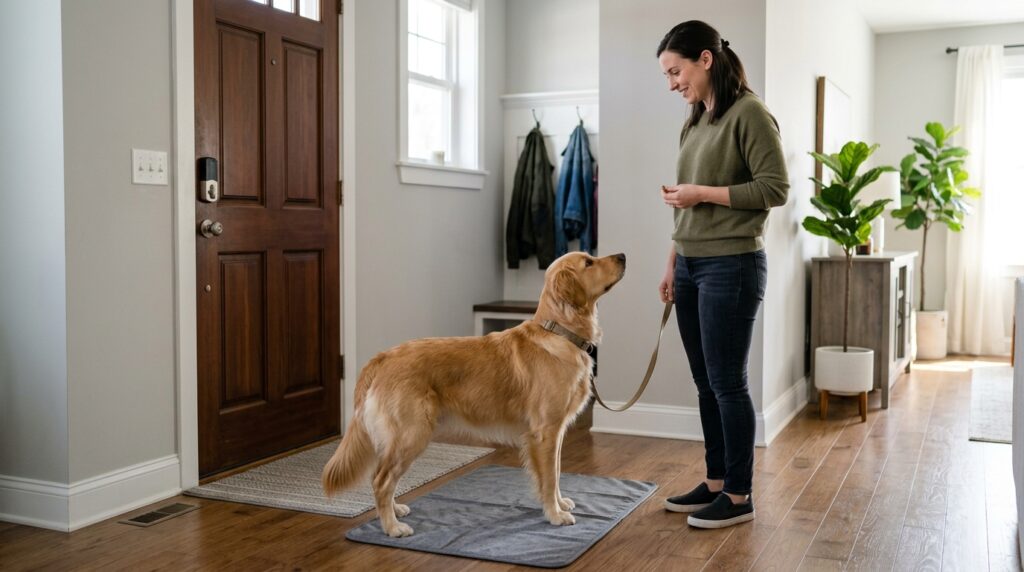
Place a mat or dog bed in a quiet area. Reward your dog for looking at it, stepping onto it, sitting, and eventually lying down.
Once the dog regularly relaxes there, add the verbal settle cue. Practice while you read, work, or watch television so the dog learns that the cue predicts a period of calm inactivity.
Take the same mat or bed to the hotel. The familiar scent and training history make it easier for the skill to transfer to the new setting.
Practice with realistic distractions
Dogs do not automatically generalize behavior. A quiet command learned in the kitchen may not work beside a noisy hotel door.
Before traveling, practice around:
- recorded hallway sounds;
- knocking;
- doorbells;
- suitcases rolling;
- people walking past a window;
- doors opening and closing;
- family members entering unexpectedly.
Increase difficulty gradually. Desensitization works through manageable exposure, not by overwhelming the dog until they stop responding.
Can You Leave a Dog Alone in a Hotel Room?
Whether you can leave your dog depends on the hotel’s pet policy and your dog’s behavior. Permission from the hotel does not mean every dog will cope well.
Do not leave a distressed or destructive dog
Do not leave the room if your dog:
- has known separation anxiety;
- barks whenever left at home;
- attempts to escape confinement;
- engages in anxious chewing;
- damages doors or windows;
- cannot settle in the unfamiliar environment;
- refuses food when you prepare to leave;
- has not completed acclimation.
An unattended dog that panics may disturb guests, damage the room, escape when staff enter, or injure themselves.
Test gradual absences
If the hotel permits unattended dogs and your dog is normally comfortable alone, begin with gradual absences.
Step outside for a few seconds and return while the dog is quiet. Slowly progress to one minute, then several minutes. Use a pet camera if available so you can observe behavior rather than assuming silence means relaxation.
These short departures should remain easy. If your dog begins barking, pacing, scratching, or panting, reduce the duration. Do not keep extending the absence in the hope that the dog will “get used to it.”
Prepare before every departure
Before leaving:
- provide physical exercise and a potty break;
- close the curtains;
- activate sound masking;
- place the dog in the practiced safe space;
- provide water;
- offer a safe enrichment item;
- display the do-not-disturb sign;
- Use a pet-in-room sign if the hotel supplies one;
- notify the front desk;
- confirm that staff have your cell phone number;
- Keep the departure short.
Return immediately if the hotel contacts you about barking. Continuing to leave after a complaint risks extra charges or eviction and increases the dog’s distress.
Arrange a pet sitter when necessary
A local pet sitter can remain in the room or care for your dog elsewhere while you attend a non-dog-friendly event. Ask the hotel whether it maintains a list of insured local sitters.
Other options include dog-friendly activities, takeout meals, outdoor dining where dogs are permitted, or traveling with another adult who can supervise the dog.
Tools and Products: What Helps and What to Avoid
Management tools can support a training plan, but no product replaces understanding the cause of barking.
Helpful tools
A white noise machine, fan, familiar dog bed, puzzle toy, lick mat, long-lasting chew, crate, crate cover, and pet camera can all be useful when chosen appropriately.
A calming treat may help some dogs, but ask your veterinarian before using supplements, especially if your dog takes medication or has a health condition. Test any veterinarian-approved product at home rather than trying it for the first time during travel.
Anti-bark collars and dog whistles
An anti-bark collar may use vibration, sound, spray, or electric stimulation. These devices can suppress vocalization without changing the fear, anxiety, or environmental trigger causing it. In some dogs, punishment can increase distress or create negative associations with the hotel room, neighboring guests, or other dogs.
A dog whistle is also not a reliable hotel solution. It may interrupt some dogs temporarily, while others ignore it or become more aroused.
Do not use aversive tools as a shortcut for separation anxiety, fear, or reactive barking. Consult a qualified dog trainer or veterinary behavior professional for humane, individualized guidance.
Never punish panic
If a dog is barking because it is afraid of being alone, punishment does not teach safety. It may reduce warning signals while intensifying the underlying emotion.
Focus on distance from triggers, gradual training, environmental control, and professional support.
Common Mistakes That Make Hotel Barking Worse
Leaving too soon after arrival
Entering the room, dropping off luggage, and leaving immediately gives the dog no time for acclimation. Spend several hours together and, when possible, provide first-night supervision.
Choosing convenience over quiet
A room beside the elevator may be convenient for potty trips, but difficult for a sound-sensitive dog. Balance easy outdoor access with exposure to foot traffic.
Correcting every small sound
Hypervigilant owners can accidentally teach dogs that every hallway noise matters. Stay relaxed, reward calm behavior, and respond only as needed.
Shouting over the barking
Yelling adds noise and arousal. Use a practiced cue, create distance, and reward silence.
Relying only on exercise
A long walk helps, but exhaustion does not cure fear or separation anxiety. Combine physical exercise with mental enrichment, rest, and behavior training.
Leaving a dog loose when staff may enter
An unattended loose dog can escape, frighten housekeeping, or react defensively to a surprise entry. Coordinate service with staff and keep the do-not-disturb sign visible.
Using a crate without crate training
Confinement can magnify distress in a dog that has not learned to rest in a crate. Build crate training at home well before the trip.
When a Hotel Is Not the Right Choice
A hotel may not suit every dog. Consider a vacation rental, cabin, ground-level motel room with an exterior entrance, or staying with a trusted family if your dog cannot tolerate hallway activity.
A vacation rental may offer:
- more distance from neighboring guests;
- fewer shared walls;
- easier outdoor access;
- more room for a safe space;
- Greater control over noise and routine.
A different accommodation is not a training failure. It is responsible management when the environment exceeds your dog’s current abilities.
When to Consult a Veterinarian or Dog Trainer
Seek professional help if barking is intense, persistent, worsening, or connected to signs of panic.
A veterinarian can rule out pain, cognitive changes, hearing problems, medication effects, and other medical factors. They can also assess whether anxiety treatment is appropriate.
A qualified reward-based dog trainer can help with alert barking, noise desensitization, quiet-command training, and controlled departures. For severe separation anxiety, ask your veterinarian about a board-certified veterinary behaviorist or another credentialed behavior professional.
Professional support is especially important when the dog:
- injures themselves during escape attempts;
- cannot remain alone for even a few seconds;
- shows aggression toward staff or guests;
- stops eating or drinking;
- experiences sudden behavior changes;
- remains distressed despite careful management.
Conclusion
Learning how to stop barking when staying in a hotel with your dog begins with recognizing that barking has a cause. A dog may be reacting to hallway noise, unfamiliar people, visible movement, boredom, routine disruption, or genuine separation anxiety.
Prepare before traveling by reviewing the hotel pet policy, practicing crate training, teaching a quiet command and settle cue, and gradually desensitizing your dog to realistic sounds. At the hotel, request a quiet room, allow time for acclimation, create a familiar safe space, use sound masking, and reward calm behavior.
Most importantly, do not leave an unattended dog that is distressed or likely to bark. Use gradual absences only when your dog is comfortable, remains reachable by the front desk, and arrange a pet sitter or alternative accommodation when necessary. Thoughtful preparation protects your dog, neighboring guests, hotel staff, and your ability to enjoy the trip together.
Frequently Asked Questions
How do I get my dog to stop barking in a hotel room?
Block hallway and window triggers, use white noise, guide your dog away from the door, give a quiet cue, and reward silence.
How to calm a dog down in a hotel room?
Take a calm walk, create a familiar sleeping area, maintain the usual routine, reduce noise, and provide a relaxing chew or lick mat.
What happens if your dog barks in a hotel?
The hotel may contact you, receive guest complaints, charge extra fees, or ask you to leave if the barking continues.
Is it okay to leave a dog in a hotel room?
Only if the hotel permits it and your dog is comfortable alone. Do not leave a dog with barking tendencies or separation anxiety unattended.
How to make a dog comfortable in a hotel room?
Bring a familiar bed, blanket, toys, food, and bowls. Position the resting space away from the door and allow time for acclimation.
What noise cancels out dog barking?
No sound completely cancels barking, but white noise, a fan, television, or steady background music can mask triggering hallway sounds.
What is the command to tell a dog to stop barking?
“Quiet” is the most common command. Teach it through positive reinforcement rather than shouting or punishment.
Can barking be trained out of a dog?
Barking is natural and cannot be eliminated completely, but excessive barking can often be reduced through training, management, and trigger control.
Does ignoring barking work?
Ignoring may help attention-seeking barking, but it is inappropriate for fear, alert barking, medical needs, or separation anxiety.
What do vets recommend to stop barking?
Veterinarians generally recommend identifying the cause, using reward-based behavior modification, increasing appropriate enrichment, and treating medical or anxiety problems.