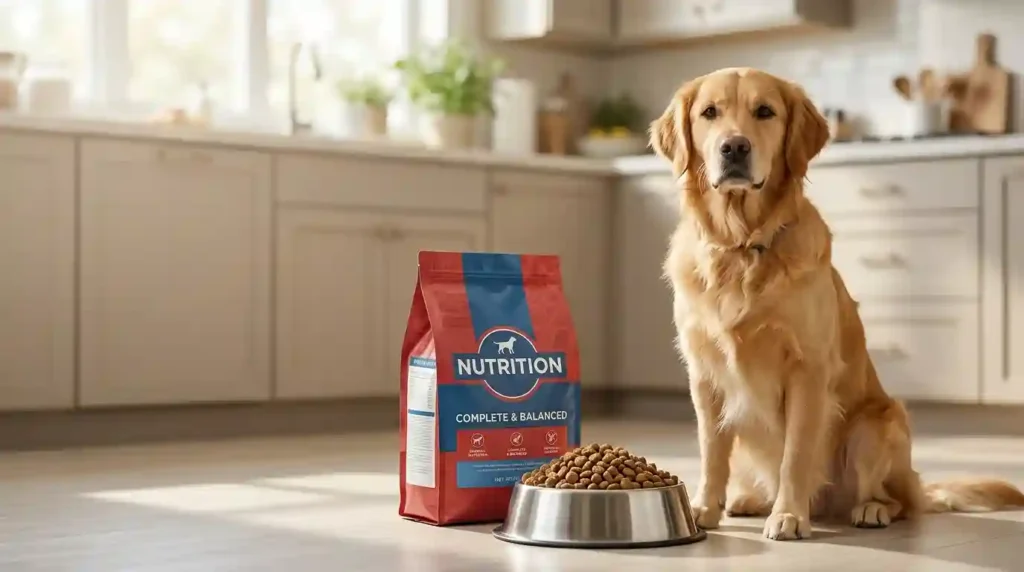

Is Purina Dog Chow good? Yes, Purina Dog Chow can be a good, affordable dog food for many healthy adult dogs. Manufactured by Nestlé Purina PetCare, this long-established American brand provides complete and balanced nutrition, uses ingredients that supply essential proteins, fats, vitamins, and minerals, and benefits from Purina’s extensive manufacturing and nutritional research capabilities. Popular formulas such as Dog Chow Complete Adult and Dog Chow High Protein meet AAFCO nutrient profiles for adult maintenance, making them practical choices for everyday feeding.
However, Purina Dog Chow is not without drawbacks. Several recipes contain corn, meat and bone meal, poultry by-products, plant-based protein concentrates, and artificial colors. These ingredients can raise questions about ingredient quality, digestibility, and nutritional value compared with more expensive dog foods. Some formulas may also be unsuitable for puppies, dogs with diagnosed food allergies, or pets requiring specialized veterinary diets.
This detailed Purina Dog Chow review examines its ingredients, nutritional analysis, recall history, safety standards, individual formulas, veterinary considerations, feeding recommendations, and overall value. You’ll also learn how Dog Chow compares with Purina ONE, Pro Plan, and other alternatives before deciding whether it deserves a place in your dog’s bowl.
Table of Contents
- Is Purina Dog Chow Good? Quick Overview
- Purina Dog Chow Brand History and Manufacturing
- Purina Dog Chow Product Range and Formulas
- Purina Dog Chow Ingredients Analysis
- Purina Dog Chow Nutritional Analysis
- Purina Dog Chow Safety, Recalls, and Quality Control
- What Do Veterinarians Say About Purina Dog Chow?
- Is Purina Dog Chow Good for Different Dogs?
- How to Choose the Best Purina Dog Chow Formula
- Purina Dog Chow Feeding Guide
- Purina Dog Chow Storage, Shelf Life, and Freshness
- Purina Dog Chow Customer Reviews and Real-World Experiences
- Purina Dog Chow Pricing and Value for Money
- Purina Dog Chow vs. Other Dog Food Brands
- Purina Dog Chow Sustainability and Ethical Considerations
- Why Do Purina Dog Chow Reviews and Ratings Disagree?
- How Purina Dog Chow Was Evaluated
- Frequently Asked Questions About Purina Dog Chow
- Final Verdict: Is Purina Dog Chow Worth Buying?
- Final Thoughts
1. Is Purina Dog Chow Good? Quick Overview
1.1 Is Purina Dog Chow a Good Dog Food? Quick Verdict
Purina Dog Chow is a reasonable budget dog food for healthy adult dogs, provided the chosen formula matches their nutritional requirements. Its greatest strengths are affordability, nutritional adequacy, widespread availability, and the research and manufacturing infrastructure of Nestlé Purina PetCare.
Purina Dog Chow Complete Adult Chicken Flavor is formulated to meet the Association of American Feed Control Officials (AAFCO) Dog Food Nutrient Profiles for adult maintenance. That means it is designed to provide the essential nutrients required by healthy adult dogs when fed appropriately.
However, the ingredients differ from those commonly emphasized in premium dog foods. Whole grain corn, meat and bone meal, corn gluten meal, and soybean meal feature prominently in the Complete Adult recipe. These ingredients can contribute nutrients, but the formula offers less immediately identifiable animal-protein sourcing than some higher-priced alternatives.
For owners primarily concerned about price, Dog Chow can be a practical choice. Those seeking a greater selection of specialized formulas or different ingredient profiles may prefer Purina ONE or Pro Plan.
If you’re comparing different diets, explore our Dog Food guides to understand what matters when assessing nutritional adequacy, ingredients, and feeding costs.
1.2 What Is Purina Dog Chow?
Purina Dog Chow is a long-established commercial dog food brand produced by Nestlé Purina PetCare.
Introduced in 1926, Dog Chow was developed to make nutritionally complete feeding more accessible to American dog owners.
Today, the brand primarily offers affordable dry kibble alongside selected high-protein wet foods and formulas with different flavors, protein levels, and textures.
Dog Chow is positioned as a budget-friendly alternative to more expensive dog foods. Rather than focusing on exotic ingredients or elaborate marketing claims, the brand emphasizes complete nutrition, convenience, and value.
1.3 Purina Dog Chow at a Glance
| Feature | Purina Dog Chow |
| Brand owner | Nestlé Purina PetCare |
| First introduced | 1926 |
| Country of manufacture | United States for U.S.-market Dog Chow |
| Product category | Budget-friendly dog food |
| Main formats | Dry kibble and wet food |
| Popular formulas | Complete Adult, High Protein, Little Bites |
| Typical grain ingredients | Corn, wheat, and other cereal ingredients |
| Common protein ingredients | Meat and bone meal, poultry by-product meal, chicken, beef |
| Nutritional adequacy | Adult maintenance for representative adult formulas |
| Protein in Complete Adult Chicken Flavor | 21% minimum |
| Protein in High Protein Chicken | 27% minimum |
| Recall record | No Dog Chow-specific recall identified in reviewed records through October 2026 |
| General recommendation | Suitable for many healthy adults, with limitations |
1.4 Overall Purina Dog Chow Rating
Our editorial evaluation considers nutritional adequacy, ingredient transparency, research support, manufacturing quality, affordability, and suitability for different dogs.
| Evaluation Factor | Editorial Score |
| Nutritional adequacy | 4/5 |
| Ingredient quality and transparency | 3/5 |
| Manufacturing oversight | 4/5 |
| Research support | 4/5 |
| Formula variety | 3.5/5 |
| Affordability | 5/5 |
| Suitability for healthy adults | 4/5 |
| Overall editorial rating | 3.9/5 |
This score is an editorial judgment, not an independent laboratory rating or clinical assessment. It reflects the brand’s ability to provide affordable adult maintenance nutrition while acknowledging ingredient and product-range limitations.
1.5 Key Benefits, Drawbacks, and Pros and Cons
| Pros | Cons |
| Affordable compared with many premium foods | Corn is prominent in several recipes |
| Complete and balanced adult nutrition | Meat and bone meal may have less specific animal-source identification |
| Established American manufacturing | Some formulas contain artificial colors |
| Available in different flavors and protein levels | Limited specialized medical nutrition |
| Convenient dry and wet formats | Adult formulas are not appropriate as the sole diet for growing puppies |
| Supported by Purina’s research infrastructure | Ingredients may not suit certain allergies |
| Widely sold through major retailers | Some older advertised formulas are no longer easily available |
| Practical for multi-dog households | Higher protein is not automatically higher nutritional quality |
The most important takeaway is that Dog Chow’s budget positioning does not automatically make it nutritionally inadequate. Its suitability depends on the exact formula and the individual dog.
2. Purina Dog Chow Brand History and Manufacturing
2.1 History of Purina Dog Chow
Purina Dog Chow was introduced in 1926 and became an influential product in the development of commercial dog food.
The brand’s name traces back to the era when Purina founder William H. Danforth associated the word “chow” with American military meals.
Dog Chow became known for offering convenient, nutritionally formulated food at a time when many household dogs were fed table scraps.
During the 1950s, Purina helped popularize extrusion technology for making dry kibble. This process allowed ingredients to be cooked and shaped into consistent, shelf-stable pieces.
In 2001, Nestlé acquired Ralston Purina, bringing Dog Chow under the Nestlé Purina PetCare business.
The brand reached its 100th anniversary in 2026, reflecting its unusually long history in the American pet food market.
2.2 Who Owns and Makes Purina Dog Chow?
Purina Dog Chow is owned and manufactured by Nestlé Purina PetCare, a division of Nestlé.
The business also produces Purina ONE, Purina Pro Plan, Beneful, Puppy Chow, and other pet food products.
Although these brands share a parent company, they have different nutritional formulations and market positions.
Dog Chow emphasizes cost-effective everyday nutrition, while Purina ONE and Pro Plan provide additional formula options and specialized nutritional features.
For a broader brand-level evaluation, our article on is purina good for dogs examines how these product ranges differ.
2.3 Where Is Purina Dog Chow Manufactured?
Purina states that Dog Chow is manufactured in Purina-owned facilities in the United States.
The company’s January 2026 manufacturing information also states that approximately 99% of Purina pet food products sold in the U.S. are made domestically.
However, American manufacturing does not necessarily mean every ingredient originates in the United States.
Manufacturers may source certain vitamins, minerals, and other materials internationally.
Owners concerned about a particular ingredient’s country of origin should contact Purina with the exact product and lot information.
2.4 Purina Manufacturing Facilities and Ingredient Sourcing
Nestlé Purina PetCare operates a substantial U.S. manufacturing network.
According to Purina, its domestic facilities include on-site quality assurance staff and laboratories.
Ingredient sourcing involves raw material specifications, supplier controls, and procedures intended to maintain consistency.
Dog Chow ingredients commonly include grains, rendered animal proteins, fats, and vitamin-mineral premixes.
The use of economical ingredients contributes to its budget-friendly pricing, but sourcing quality should be evaluated separately from ingredient cost.
2.5 Purina Dog Chow Quality Assurance and Testing Standards
Purina reports conducting more than 100,000 quality checks daily across its wider manufacturing network.
These checks may involve raw materials, product processing, packaging, nutrient composition, and microbiological safety.
Quality systems aim to reduce risks involving contaminants, manufacturing errors, and inconsistent nutrient levels.
However, company-wide testing statistics should not be interpreted as a verified number of tests performed specifically on each Dog Chow production batch.
Even a manufacturer with extensive quality controls can experience product defects.
2.6 Purina Animal Feeding Research and Testing Practices
Purina conducts nutritional research, animal feeding studies, and investigations into long-term canine health.
Its research history includes an influential study evaluating calorie restriction and body condition in Labrador Retrievers.
However, a company-wide research program is not equivalent to proof that every Dog Chow recipe has undergone an individual AAFCO feeding trial.
The reviewed Complete Adult and High Protein labels use formulation-based nutritional adequacy statements.
That distinction matters when evaluating the evidence supporting the individual product.
2.7 Manufacturing Reliability and Product Consistency
A reliable dog food manufacturer aims to maintain consistent nutrient composition and food safety between production batches.
Purina’s size, manufacturing infrastructure, and nutritional expertise provide advantages in this area.
Still, individual bags may show variations in kibble appearance or aroma because of ingredients, production differences, or packaging changes.
Significant changes in smell, visible mold, moisture damage, or unusual contamination should be reported rather than assumed normal.
3. Purina Dog Chow Product Range and Formulas
Dog Chow includes several product styles, but historical recipe lists are broader than the current official U.S. assortment.
The following sections distinguish established current formulas from products appearing in older reviews whose present availability may be limited or unconfirmed.
3.1 Purina Dog Chow Complete Adult
Complete Adult is designed for healthy adult dogs requiring everyday maintenance nutrition.
The range offers familiar flavor choices with grain-based ingredients, animal protein sources, fats, and added vitamins and minerals.
Complete Adult Chicken Flavor
Complete Adult Chicken Flavor is one of Dog Chow’s best-known formulas.
Its published label lists whole grain corn, meat and bone meal, corn gluten meal, beef fat, and soybean meal among the first five ingredients.
The recipe contains at least 21% crude protein and 10% crude fat, with approximately 405 calories per cup.
It is formulated to meet AAFCO adult maintenance nutrient profiles.
Best suited for: Healthy adult dogs whose owners want affordable, grain-inclusive dry food.
Complete Adult Beef Flavor
The Beef Flavor version offers a different flavor profile within the Complete Adult range.
Its nutritional purpose is similar: providing complete adult maintenance nutrition at an accessible price.
Owners should not assume beef is necessarily the first ingredient simply because the flavor name includes beef.
Best suited for: Healthy adult dogs that prefer the flavor and tolerate the full ingredient list.
Complete Adult Lamb Flavor
Complete Adult Lamb Flavor provides another option within the same general nutritional category.
Like other Complete Adult recipes, it should be evaluated through its actual ingredients, guaranteed analysis, and calorie declaration.
Best suited for: Dogs whose owners want another flavor option without moving to a specialized premium diet.
3.2 Purina Dog Chow High Protein
Dog Chow High Protein contains more guaranteed protein than the standard Complete Adult Chicken Flavor formula.
Its established dry chicken and beef recipes provide at least 27% crude protein and 14% crude fat.
This makes them more protein- and fat-concentrated than the standard adult example.
High Protein With Real Chicken
The High Protein Chicken formula includes whole grain corn, poultry by-product meal, corn protein meal, animal fat, meat and bone meal, soybean meal, and chicken.
It provides approximately 431 calories per cup.
Despite its “real chicken” claim, chicken is not the first ingredient on the reviewed label.
Best suited for: Healthy adult dogs whose nutritional requirements justify the higher protein and energy content.
High Protein With Real Beef
The High Protein Beef formula includes beef alongside poultry by-product meal, corn protein meal, and other ingredients.
Its published label lists 27% minimum crude protein, 14% minimum crude fat, and approximately 436 calories per cup.
It is marketed toward adult dogs requiring complete nutrition with additional protein.
Best suited for: Active adult dogs needing the specific formula’s calorie and macronutrient profile.
High Protein With Real Lamb
A High Protein Lamb formula appears in historical Purina labeling and third-party reviews.
The older version combined lamb with other animal and grain ingredients.
Its current U.S. retail availability should be confirmed before purchase, and older labels should not be assumed to describe a current formulation.
3.3 Purina Dog Chow Little Bites for Small Dogs
Dog Chow Little Bites is formulated with smaller kibble pieces for dogs that prefer or require a more manageable bite size.
The current U.S. product range includes a Little Bites recipe featuring chicken and beef.
Smaller kibble can improve feeding convenience for some small-breed dogs.
However, kibble size alone does not determine nutritional quality.
3.4 Purina Dog Chow Tender & Crunchy
Tender & Crunchy combines different textures to make meals more appealing.
A Lamb and Turkey Flavor adult dry recipe appears in the current Dog Chow assortment.
The combination of crunchy pieces and softer components may improve palatability for some dogs.
Owners should still evaluate ingredients, nutrient guarantees, and calories rather than choosing the food solely for its texture.
3.5 Purina Dog Chow Natural Plus Vitamins & Minerals
Natural Plus Vitamins & Minerals appears in some historical Dog Chow product catalogs and reviews.
The name emphasizes selected ingredient and nutritional marketing characteristics.
However, the formula could not be confirmed as part of the current official U.S. assortment during this review.
Treat older product information as historical until verified against a current label and retailer listing.
3.6 Purina Dog Chow Soft Bites
Soft Bites products have appeared in third-party recipe directories.
These foods are associated with softer textures and flavor-focused feeding experiences.
Soft Bites Grilled Steak
Grilled Steak appears in historical Dog Chow recipe listings.
Its current availability and formulation were not independently confirmed.
Soft Bites Smoked Chicken
Smoked Chicken is another historically listed Soft Bites variety.
As with Grilled Steak, buyers should verify whether it remains available before relying on older nutritional descriptions.
3.7 Purina Dog Chow Wet Food
Dog Chow also offers high-protein canned foods.
Wet food supplies considerably more dietary moisture than dry kibble and may appeal to dogs preferring soft textures.
High Protein Real Chicken in Savory Gravy
The chicken wet formula provides animal ingredients in a moist texture.
A previously published label lists at least 11% crude protein, 4% crude fat, and approximately 408 calories per can.
These figures should be checked against the specific current package.
High Protein Real Beef in Savory Gravy
The beef variety provides an alternative flavor with similar feeding convenience.
Wet food may help increase dietary water intake, although total calories still require control.
High Protein Real Lamb in Savory Gravy
The lamb variety offers another protein flavor option.
Owners managing food allergies should examine every animal ingredient rather than relying on the flavor name.
High Protein Real Turkey in Savory Gravy
Turkey in Gravy is another variety appearing in the current Dog Chow wet range.
It may appeal to owners who want a different wet-food flavor or practice mixed feeding.
3.8 Purina Puppy Chow
Purina Puppy Chow is a separate but related product line specifically intended for growing dogs.
Puppy Chow Complete With Real Chicken and Rice
Puppy Chow Complete Chicken and Rice is designed to provide growth-stage nutrition.
Puppies require carefully balanced nutrients for bone growth, muscle development, and other physiological processes.
Adult-maintenance-only Dog Chow should not replace a growth-appropriate food during puppyhood.
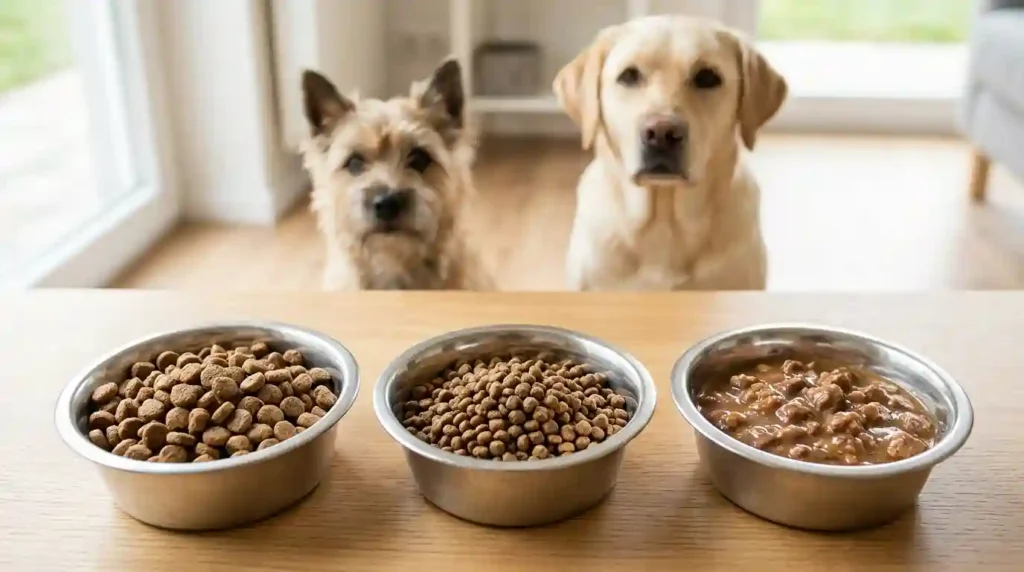
3.9 Purina Dog Chow Dry vs. Wet Dog Food
| Feature | Dry Dog Chow | Wet Dog Chow |
| Moisture | Low | High |
| Texture | Crunchy or mixed | Soft, gravy-style |
| Typical calorie concentration per gram | Higher | Lower |
| Convenience | Easy to measure and store | Easy to portion by can |
| Storage after opening | Keep sealed and dry | Refrigerate leftovers |
| Palatability | Depends on dog | Often appealing to picky eaters |
| Typical cost per calorie | Lower | Often higher |
Neither feeding format is inherently healthier.
Complete nutritional adequacy and suitability for the dog remain the most important considerations.
3.10 Comparison of Purina Dog Chow Formulas
Protein, Fat, and Fiber Differences
Standard Complete Adult Chicken Flavor has a lower guaranteed protein percentage than the reviewed High Protein formulas.
High Protein Chicken and Beef provide at least 27% crude protein compared with 21% in Complete Adult Chicken Flavor.
However, this difference does not establish that High Protein is automatically better.
Calories and Feeding Requirements
Higher-calorie foods may require smaller serving volumes to deliver the same amount of energy.
For example, the reviewed Complete Adult Chicken Flavor contains approximately 405 calories per cup, compared with 431 calories per cup for High Protein Chicken.
Serving amounts should therefore not be switched cup-for-cup without checking calorie content.
Ingredients and Recipe Variations
Complete Adult and High Protein formulas differ in the proportions and types of protein sources, fats, and other ingredients.
Both can use corn and rendered animal proteins.
A higher protein guarantee does not necessarily mean a higher proportion of fresh chicken or beef.
Choosing Between Complete Adult and High Protein
Choose based on body condition, energy needs, and overall nutrient requirements.
A healthy adult dog with moderate activity may do well on Complete Adult.
An active dog may benefit from a higher-protein, higher-energy formula, although many active dogs can also thrive on an appropriate standard maintenance diet.
3.11 Purina Dog Chow Recipe and Packaging Changes
Can Purina Change Dog Chow Ingredients Without Changing the Product Name?
Yes. Manufacturers can revise recipes, ingredient sources, and packaging while retaining a recognizable product name.
The current package is more reliable than an older online review.
How to Compare Old and New Dog Chow Ingredient Lists
Compare the first five ingredients, major animal protein sources, preservatives, color additives, and any ingredients relevant to diagnosed allergies.
A change in ingredient order may indicate a formulation adjustment, but does not reveal exact ingredient percentages.
How to Check Changes in Calories and Guaranteed Analysis
Compare crude protein, crude fat, crude fiber, moisture, and metabolizable energy.
Even modest changes in calories per cup can affect daily feeding amounts.
What to Do if Your Dog Reacts to a Reformulated Product
Stop and consult a veterinarian if significant symptoms develop.
Retain the packaging and record the lot number.
Mild digestive changes can have multiple causes, so a suspected reformulation should not automatically be considered responsible.
3.12 Purina Dog Chow Kibble Size, Texture, and Dental Health
Kibble Size Differences Between Complete Adult and Little Bites
Little Bites is designed with smaller pieces.
This may be more convenient for small dogs, although individual chewing preferences vary.
Is Purina Dog Chow Easy for Small and Senior Dogs to Chew?
Many small and senior dogs can eat ordinary kibble comfortably.
However, animals with missing teeth, periodontal disease, or oral pain may benefit from a softer texture.
Persistent chewing difficulty requires veterinary examination.
Does Crunchy Dog Chow Kibble Help Clean Dogs’ Teeth?
Crunchy kibble may produce some mechanical contact with teeth.
However, ordinary dry dog food is not equivalent to a clinically tested dental diet and should not replace toothbrushing or professional dental care.
When Softer Food May Be More Appropriate
Wet food or moistened kibble may be useful for dogs with chewing difficulties.
Softening kibble with clean water can change texture without substantially changing its original calorie content.
Moistened food should be served promptly.
4. Purina Dog Chow Ingredients Analysis
4.1 What Ingredients Are in Purina Dog Chow?
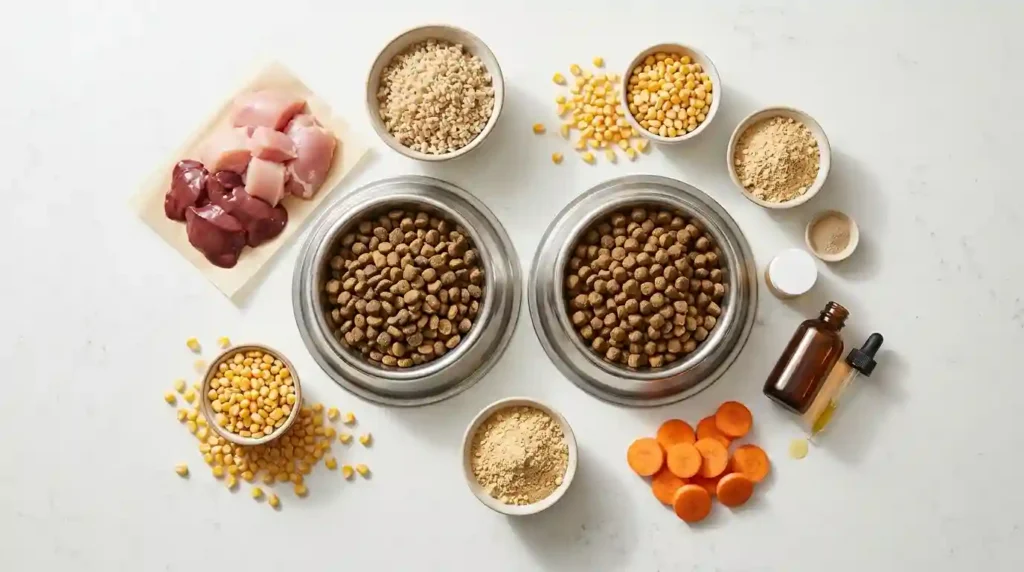
Dog Chow uses a combination of cereal grains, rendered animal proteins, plant protein sources, fats, vitamins, and minerals.
The ingredients vary by formula.
The reviewed Complete Adult Chicken Flavor contains whole grain corn, meat and bone meal, corn gluten meal, beef fat, soybean meal, and chicken by-product meal.
These ingredients can provide energy, essential amino acids, fats, and minerals.
However, the recipe’s nutritional adequacy should be evaluated separately from the attractiveness of its ingredient list.
4.2 First Five Ingredients Breakdown
First Five Ingredients in Dog Chow Complete Adult
The reviewed Complete Adult Chicken Flavor label lists:
| Order | Ingredient | Main Nutritional Function |
| 1 | Whole grain corn | Energy, some protein, fiber, fatty acids |
| 2 | Meat and bone meal | Animal protein and minerals |
| 3 | Corn gluten meal | Concentrated plant protein |
| 4 | Beef fat preserved with mixed tocopherols | Energy and dietary fat |
| 5 | Soybean meal | Protein and other nutrients |
These ingredients represent the major components by weight before processing.
However, the list does not reveal exact amounts or protein digestibility.
First Five Ingredients in Dog Chow High Protein
The reviewed High Protein Chicken label lists:
| Order | Ingredient | Main Nutritional Function |
| 1 | Whole grain corn | Energy and plant nutrients |
| 2 | Poultry by-product meal | Concentrated animal protein |
| 3 | Corn protein meal | Concentrated plant protein |
| 4 | Animal fat preserved with mixed tocopherols | Dietary energy and fat |
| 5 | Meat and bone meal | Animal protein and minerals |
Chicken appears later in the reviewed ingredient declaration.
Therefore, “with real chicken” should not be interpreted as “chicken is the first ingredient.”
4.3 Animal Protein Sources and Meat Ingredients
Animal proteins supply essential amino acids needed for muscle maintenance, tissue repair, enzyme production, and normal metabolism.
Dog Chow uses a combination of named and less specifically identified animal ingredients.
Meat and Bone Meal
Meat and bone meal is a rendered ingredient containing animal tissues and bone.
It can contribute protein, calcium, phosphorus, and other nutrients.
Its quality depends on raw materials, processing methods, nutrient composition, and manufacturing controls.
The term does not identify a single animal species.
Poultry By-Product Meal
Poultry by-product meal can contain nutritious poultry tissues such as organs and other permitted parts.
These ingredients may supply usable protein and micronutrients.
However, the label provides less specific information than an ingredient naming a particular animal tissue.
Named vs. Unnamed Animal Ingredients
Named ingredients identify the animal source more precisely.
For example, chicken meal specifies chicken, while a broader term such as meat and bone meal does not identify one particular species.
This distinction is especially important for dogs with diagnosed allergies.
Are Meat By-Products Bad for Dogs?
No. Properly processed by-products are not inherently harmful.
Organ tissues can be nutritionally valuable.
The primary questions concern quality control, nutrient consistency, digestibility, and the finished food’s adequacy.
4.4 Grains and Carbohydrate Sources
Whole Grain Corn
Corn is a major ingredient in several Dog Chow formulas.
It provides digestible energy when appropriately processed, along with some protein, fiber, and essential fatty acids.
Corn is not inherently toxic or nutritionally useless for dogs.
Wheat, Soybean Meal, and Other Grain Ingredients
Whole grain wheat contributes carbohydrates and some nutrients.
Soybean meal is primarily used as a plant-based protein source rather than being classified as a cereal grain.
Other common dog food ingredients include rice, barley, and processed cereal components, although not all are present in every Dog Chow recipe.
Are Grains in Purina Dog Chow Fillers?
The word “filler” is often used in marketing without a consistent nutritional definition.
Grains can provide meaningful calories and nutrients.
The more important question is whether the completed recipe supplies appropriate digestible protein, essential fatty acids, vitamins, and minerals.
How Grain Ingredients Contribute to Nutrition
Properly processed grains can provide energy and selected nutrients.
However, a food with substantial grain-derived protein should still be assessed for amino acid balance and overall protein quality.
4.5 Plant-Based Protein Ingredients
Corn Gluten Meal and Soybean Meal
Corn gluten meal, also called corn protein meal, contains concentrated plant protein.
Soybean meal can also contribute substantial protein.
These ingredients help manufacturers formulate diets to achieve required protein concentrations.
Plant Protein vs. Animal Protein
Animal and plant proteins differ in amino acid profiles and digestibility.
Neither category can be evaluated adequately through its name alone.
A finished diet must provide sufficient essential amino acids in usable forms.
4.6 Fats, Oils, and Flavoring Ingredients
Dog Chow uses ingredients such as beef fat, animal fat, fish oil, and selected flavoring agents.
Fat provides concentrated calories and essential fatty acids.
Some formulas use mixed tocopherols to help protect fats from oxidation.
Flavor ingredients can improve palatability, encouraging dogs to eat consistently.
However, high palatability should not be confused with superior nutritional quality.
4.7 Vitamins, Minerals, and Nutritional Supplements
Dog Chow Complete Adult includes added nutrients such as vitamin A, vitamin D, vitamin E, B-complex vitamins, calcium, phosphorus, zinc, iron, and selenium.
These support normal metabolic processes, skeletal function, skin health, and immune function.
The reviewed High Protein Chicken formula also guarantees minimum calcium and phosphorus levels.
Additional nutrients can include linoleic acid and essential amino acid supplements such as lysine.
A complete nutritional assessment must consider both nutrient concentrations and their balance.
4.8 Artificial Colors, Flavors, and Preservatives
Artificial Food Coloring in Purina Dog Chow
The reviewed Complete Adult Chicken Flavor ingredient declaration includes Yellow 6, Yellow 5, Red 40, and Blue 2.
These colorants mainly affect visual appearance.
Dogs do not require artificial food coloring for nutritional adequacy.
Their presence is a legitimate preference consideration, but it is not sufficient evidence that the food is unsafe.
Garlic Oil and Other Flavoring Additives
Garlic oil appears in the reviewed Complete Adult Chicken Flavor ingredients.
Garlic and related Allium plants can be toxic to dogs at sufficiently high exposures.
However, the presence of garlic oil in a regulated commercial formulation is not, by itself, proof that the finished food contains a toxic dose.
Owners should not add raw garlic or concentrated garlic supplements to dog food without veterinary guidance.
Menadione and Vitamin Supplements
Some Dog Chow recipes contain menadione sodium bisulfite complex, a vitamin K-related ingredient.
This ingredient is sometimes criticized in online dog food reviews.
Its presence should be evaluated according to its permitted use and formulation level rather than treated as evidence of toxicity in every product.
4.9 Controversial Ingredients and Potential Concerns
Genetically Modified Crop Ingredients
Corn and soy ingredients may originate from genetically modified crops.
There is no reliable basis for concluding that all genetically modified ingredients are inherently harmful to dogs.
Food safety depends on the specific ingredient and its use.
Pesticide Residue Concerns
Agricultural ingredients can potentially contain pesticide or herbicide residues.
However, the presence of a crop that may have been treated with pesticides does not prove the finished dog food contains unsafe residue levels.
Actual exposure and testing results are necessary.
Ingredient Splitting
Ingredient splitting occurs when related components of a food source appear separately in an ingredient list.
For example, corn and corn protein meal may contribute differently to the formula.
This can make it harder for consumers to estimate the overall contribution of a broad ingredient category.
Omega Fatty Acid Balance
Omega-6 and omega-3 fatty acids support different physiological functions.
The ratio and total amounts can influence nutritional characteristics.
However, the ingredient list alone does not reveal the actual omega-6-to-omega-3 ratio.
4.10 Is Purina Dog Chow Highly Processed?
Extrusion and Kibble Manufacturing
Most dry Dog Chow is produced using extrusion, a process involving mixing, heat, pressure, and shaping.
Extrusion helps produce shelf-stable food and can improve the digestibility of properly processed starches.
The process also requires formulation adjustments to account for nutrient losses during manufacturing.
Ultra-Processed Dog Food Concerns
Some reviewers criticize extruded dog food because of its degree of processing.
Processing can influence nutrient availability and produce chemical changes.
However, the term “ultra-processed” alone does not establish that a nutritionally complete kibble is unsafe.
A meaningful assessment considers nutrient retention, digestibility, manufacturing controls, and long-term outcomes.
4.11 Ingredient Quality in Complete Adult vs. High Protein
High Protein contains more guaranteed crude protein than Complete Adult.
However, its protein comes from several sources, including animal meals and concentrated plant ingredients.
Therefore, a higher protein percentage should not automatically be interpreted as a greater proportion of fresh meat.
Both recipes can provide adult maintenance nutrition when appropriately formulated and fed.
4.12 Understanding Purina Dog Chow Product Labels and Marketing Claims
What Does “Chicken Flavor” Actually Mean?
A flavor claim communicates the food’s intended taste profile.
It does not necessarily mean chicken is the first or largest ingredient.
Specific pet food labeling rules distinguish flavor claims from other meat-content statements.
“With Real Chicken” vs. “Chicken Flavor”: What’s the Difference?
“With real chicken” indicates the inclusion of chicken as an ingredient under applicable labeling requirements.
“Chicken Flavor” emphasizes flavor identity.
Neither expression should substitute for reading the ingredient list and nutritional adequacy statement.
Does “High Protein” Mean More Animal Protein?
Not necessarily.
The 27% crude protein guarantee in High Protein Chicken reflects total protein from multiple sources.
Animal meals, chicken, and plant protein concentrates all contribute to the total.
Can Dog Food Be Complete and Balanced Without Meat as the First Ingredient?
Yes.
Nutritional adequacy depends on whether the finished formulation supplies required nutrients, not whether meat appears first.
A food with corn as its first ingredient can still be nutritionally complete for its intended life stage.
What the Ingredient List Actually Tells You
The label identifies ingredients and their order by weight before processing.
It can help identify allergens, major protein sources, and unwanted ingredients.
It does not reveal exact digestibility or the complete measured nutrient profile.
Why Ingredient Lists Alone Cannot Determine Food Quality
Two foods with similar ingredient lists may differ in nutrient concentrations, manufacturing methods, digestibility, and quality controls.
Therefore, ingredients should be evaluated together with nutritional adequacy, feeding research, and manufacturer transparency.
5. Purina Dog Chow Nutritional Analysis
5.1 Guaranteed Analysis Explained
The guaranteed analysis provides minimum or maximum nutrient concentrations required on pet food labels.
These numbers are useful, but they are not necessarily the exact measured values in every production batch.
Crude Protein Content
Complete Adult Chicken Flavor guarantees at least 21% crude protein.
High Protein Chicken and Beef guarantee at least 27%.
Crude protein reflects nitrogen-derived protein estimates and does not independently measure digestibility or amino acid quality.
Crude Fat Content
Complete Adult Chicken Flavor guarantees at least 10% crude fat.
High Protein Chicken and Beef guarantee at least 14%.
Dietary fat supplies energy and essential fatty acids.
Crude Fiber Content
Complete Adult Chicken Flavor lists a maximum of 4.5% crude fiber.
High Protein Chicken and Beef list a maximum of 4%.
Crude fiber is a laboratory measurement that does not capture every component of total dietary fiber.
Moisture Content
The reviewed Complete Adult formula lists a maximum moisture level of 12%.
The High Protein formulas list a maximum of 10%.
Moisture affects the interpretation of nutrient percentages and comparisons with wet food.
5.2 Macronutrient Profile of Purina Dog Chow
Protein-to-Fat Ratio
The ratio of guaranteed crude protein to crude fat can provide a simple comparison.
Complete Adult Chicken Flavor has a minimum-guarantee ratio of 21:10.
High Protein Chicken has a corresponding ratio of 27:14.
However, these are not exact measured proportions and should not be treated as precise nutritional profiles.
Carbohydrate Content
Carbohydrates are not usually listed as a guaranteed percentage on standard dog food labels.
Reviewers may estimate carbohydrate content by difference, subtracting protein, fat, fiber, moisture, and ash from 100%.
This calculation depends on actual nutrient data and becomes less reliable when only guaranteed minimums and maximums are available.
Calorie Density
Calorie density affects daily portion size and feeding costs.
| Formula | Calories per Cup | Calories per Kilogram |
| Complete Adult Chicken Flavor | 405 | 3,469 |
| High Protein Chicken | 431 | 3,678 |
| High Protein Beef | 436 | 3,668 |
These values come from the reviewed published labels. Verify the specific package before feeding because formulations may change.
5.3 Dry Matter vs. As-Fed Nutritional Analysis
Dry matter analysis removes the effect of water when comparing nutritional percentages.
For example, Complete Adult Chicken Flavor guarantees at least 21% crude protein and no more than 12% moisture.
Using those label figures gives a calculated minimum protein concentration of approximately 23.9% on a dry matter basis.
High Protein Chicken, with 27% minimum protein and 10% maximum moisture, yields an illustrative dry-matter minimum of approximately 30%.
These calculations are based on label guarantees, not actual laboratory measurements of a particular batch.
5.4 Nutritional Comparison of Purina Dog Chow Recipes
| Nutrient | Complete Adult Chicken | High Protein Chicken | High Protein Beef |
| Crude protein, minimum | 21% | 27% | 27% |
| Crude fat, minimum | 10% | 14% | 14% |
| Crude fiber, maximum | 4.5% | 4% | 4% |
| Moisture, maximum | 12% | 10% | 10% |
| Calcium, minimum | 1.0% | 1.0% | 1.0% |
| Phosphorus, minimum | 0.8% | 0.9% | 0.9% |
| Calories per cup | 405 | 431 | 436 |
| AAFCO life stage | Adult maintenance | Adult maintenance | Adult maintenance |
The main differences are protein, fat, energy density, and selected ingredient combinations.
5.5 Purina Dog Chow Nutrients per 1,000 Calories
Why Nutrient Density Matters More Than Percentages Alone
Dogs consume food to meet energy requirements.
A formula’s nutrient concentration relative to calories helps show how much protein or other nutrients a dog receives at a given calorie intake.
This is particularly useful when comparing foods with different calorie densities.
Protein Grams per 1,000 kcal
Using guaranteed minimum protein values and published calorie density:
| Formula | Calculated Minimum Protein per 1,000 kcal |
| Complete Adult Chicken | 60.5 g |
| High Protein Chicken | 73.4 g |
| High Protein Beef | 73.6 g |
These are calculations from label guarantees, not measured typical protein content.
Fat Grams per 1,000 kcal
| Formula | Calculated Minimum Fat per 1,000 kcal |
| Complete Adult Chicken | 28.8 g |
| High Protein Chicken | 38.1 g |
| High Protein Beef | 38.2 g |
High Protein formulas provide a greater guaranteed fat concentration relative to energy.
Calcium and Phosphorus per 1,000 kcal
Using minimum guaranteed mineral concentrations:
| Formula | Calcium Minimum | Phosphorus Minimum |
| Complete Adult Chicken | 2.88 g/1,000 kcal | 2.31 g/1,000 kcal |
| High Protein Chicken | 2.72 g/1,000 kcal | 2.45 g/1,000 kcal |
| High Protein Beef | 2.73 g/1,000 kcal | 2.45 g/1,000 kcal |
These are mathematical minimum-guarantee estimates. They do not establish actual calcium-to-phosphorus ratios or suitability for puppy growth.
For clinical nutritional comparisons, request a manufacturer-confirmed typical nutrient analysis.
Dog Chow Complete Adult vs. High Protein: Nutrient Density Comparison
High Protein provides more guaranteed protein and fat per 1,000 kcal than the reviewed Complete Adult formula.
However, this does not necessarily make it better for sedentary dogs.
A healthy maintenance diet should match the dog’s actual needs rather than maximize one nutrient.
5.6 Does Purina Dog Chow Meet AAFCO Nutritional Standards?
Yes, the reviewed Complete Adult and High Protein formulas carry statements identifying them as formulated to meet AAFCO nutrient profiles for adult maintenance.
AAFCO Adult Maintenance Requirements
AAFCO nutrient profiles establish minimum and certain maximum nutrient concentrations for specified life stages.
Adult maintenance requirements differ from those for growth and reproduction.
Complete and Balanced Nutrition
A complete and balanced adult diet is designed to provide essential nutrients in appropriate amounts when fed according to the manufacturer’s instructions.
This does not mean it is suitable for every dog regardless of age or health.
Feeding Trials vs. Nutritional Formulation
The reviewed Dog Chow labels use formulation-based statements.
AAFCO feeding trials provide another recognized method of substantiating nutritional adequacy.
Purina conducts animal feeding research, but that company-wide activity should not be used to claim that every Dog Chow recipe has individually passed a specific AAFCO feeding trial.
5.7 Is the Protein Quality Good Enough for Dogs?
Dog Chow combines animal-derived and plant-derived protein sources.
Whether protein quality is adequate depends on amino acid availability, digestibility, formulation, and total nutrient intake.
The adult maintenance adequacy statement supports its intended nutritional purpose.
However, the guaranteed analysis alone cannot establish exactly how much of the protein is animal-derived or how digestible it is.
5.8 Is Purina Dog Chow Nutritionally Adequate for Everyday Feeding?
For healthy adult dogs, an appropriately selected Dog Chow formula can provide complete everyday nutrition.
It is not automatically inferior because it contains corn or by-products.
However, dogs requiring specialized nutrient concentrations, controlled allergens, or growth-stage nutrition may need another product.
6. Purina Dog Chow Safety, Recalls, and Quality Control
6.1 Purina Dog Chow Recall History
No confirmed Dog Chow-specific recall was identified in the public records reviewed through October 2026.
Purina’s own Dog Chow FAQ also stated that there was no current Dog Chow recall when checked.
This is encouraging, but an absence of identified recalls does not guarantee that every production batch has been free of defects.
6.2 Purina Brand Recalls vs. Dog Chow-Specific Recalls
Nestlé Purina PetCare has recalled selected products from other lines.
For example, recalls involving Purina Pro Plan Veterinary Diets have included mislabeled canned food and dry food containing potentially elevated vitamin D.
These incidents should not automatically be classified as Dog Chow recalls.
Recall information must be tied to the precise brand, product name, package size, lot number, and production dates.
6.3 Potential Food Safety and Ingredient Concerns
Potential concerns include bacterial contamination, nutrient imbalances, damaged packaging, and inappropriate storage.
Ingredients themselves can also be unsuitable for individual dogs because of allergies or medical conditions.
For example, a recipe containing chicken-related ingredients may be inappropriate for a dog with a confirmed chicken allergy.
Safety should be evaluated through real product evidence rather than isolated ingredient fears.
6.4 Purina Manufacturing Quality Control
Purina describes extensive manufacturing oversight and quality testing throughout its facilities.
This includes supplier requirements, production monitoring, and procedures intended to maintain nutrient consistency.
Such systems reduce risk but cannot eliminate it entirely.
6.5 FDA Recall Records and Safety Oversight
The U.S. Food and Drug Administration (FDA) regulates animal food safety.
In 2024, the FDA reviewed approximately 1,300 adverse-event reports involving various Purina pet foods submitted from November 2023 through April 2024.
After investigating reports, testing products, and inspecting a manufacturing facility, the FDA stated that the available evidence did not establish a public-health concern explaining the reported illnesses or a consistent causal link to Purina foods.
The inspection also identified a food safety plan reanalysis deficiency at one facility.
For details, consult the FDA’s official Purina adverse-event investigation findings.
6.6 How to Check Whether Your Dog Chow Bag Is Affected by a Recall
Check the product name, UPC, lot number, and best-by date.
Compare these identifiers with the official recall announcement.
A recall involving a different Purina product does not automatically affect Dog Chow.
If unsure, contact Purina with the exact package information.
6.7 Is Purina Dog Chow Safe for Long-Term Feeding?
For healthy adult dogs, a properly stored Dog Chow formula labeled complete and balanced for adult maintenance can be suitable for long-term feeding.
However, long-term suitability depends on the dog’s health, body condition, nutrient requirements, and response.
No commercial food should be assumed appropriate for every animal throughout its entire life.
6.8 How to Report a Purina Dog Chow Safety Problem
How to Identify a Suspected Food Quality Problem
Potential warning signs include an unusual rancid odor, mold, moisture damage, insects, foreign materials, or visibly deteriorated packaging.
Illness following feeding may also warrant investigation, although it does not prove causation.
Where to Find the Dog Chow Lot Number and Best-By Date
Look for printed codes on the bag or can.
Photograph these details and preserve the original packaging.
How to Contact Purina Customer Support
Contact Purina using its official customer service channels.
Provide the product name, package size, lot number, purchase date, and a description of the issue.
How to Submit a Pet Food Complaint to the FDA
The FDA accepts reports about suspected pet food contamination and related adverse events.
Reports are more useful when they include veterinary findings, product identification, and a clear feeding timeline.
What to Do With a Suspected Contaminated Bag
Stop feeding the suspicious food.
Keep the remaining product securely away from pets and children while seeking guidance on possible testing or disposal.
Contact a veterinarian promptly if your dog becomes ill.
7. What Do Veterinarians Say About Purina Dog Chow?
7.1 Do Veterinarians Recommend Purina Dog Chow?
Some veterinarians consider Dog Chow a reasonable economical option for healthy adult dogs.
Others may prefer formulas offering different ingredients, higher nutritional specialization, or more detailed product-specific data.
There is no universal veterinary recommendation that every dog should eat Dog Chow.
The most appropriate food depends on the individual patient.
7.2 How Veterinarians Evaluate Budget Dog Food
Veterinarians consider nutritional adequacy, calories, ingredient tolerance, manufacturer expertise, and overall health.
Budget-friendly food can be acceptable when it meets essential requirements.
A higher retail price does not automatically translate into a healthier dog.
7.3 What Veterinary Nutrition Experts Say About Corn and By-Products
Corn and animal by-products can contribute useful nutrients.
Veterinary nutrition professionals generally emphasize the complete formulation over marketing interpretations of individual ingredients.
However, ingredient sourcing, digestibility, and manufacturing standards remain important.
7.4 Is Nutritional Adequacy More Important Than Premium Ingredients?
Yes. A nutritionally complete food is generally more appropriate than an attractive-sounding diet that lacks essential nutrients.
However, nutritional adequacy is a minimum foundation, not the only factor in food selection.
Palatability, tolerance, nutrient density, and medical needs also matter.
7.5 When to Consult a Veterinarian About Your Dog’s Diet
Consult a veterinarian when your dog has persistent diarrhea, vomiting, unexplained weight changes, severe itching, chronic disease, or special growth requirements.
A standard adult maintenance diet should not replace veterinary therapeutic nutrition without professional approval.
7.6 Does Purina Dog Chow Meet WSAVA Guidelines?
What Are the WSAVA Guidelines for Selecting Dog Food?
The World Small Animal Veterinary Association (WSAVA) provides questions to evaluate pet food manufacturers.
These address nutrition expertise, research, quality control, manufacturing, nutrient analysis, and product transparency.
WSAVA does not operate a universal dog food brand approval program.
Does Purina Employ Qualified Veterinary Nutritionists?
Yes. Purina employs veterinarians, animal nutrition experts, and food scientists.
This is a meaningful advantage compared with companies that provide little information about their formulation teams.
Does Purina Dog Chow Undergo AAFCO Feeding Trials?
Purina conducts feeding research, but the reviewed Dog Chow labels indicate nutritional adequacy through formulation to AAFCO adult maintenance profiles.
That does not establish that every individual Dog Chow formula has undergone an AAFCO feeding trial.
Does Purina Provide Complete Nutrient Analyses and Digestibility Data?
Purina provides guaranteed analyses and selected nutritional information.
Complete typical nutrient analyses and formula-specific digestibility data may require direct contact with the company.
How Does Purina’s Research Apply Specifically to Dog Chow?
Purina’s wider nutrition research supports the company’s formulation knowledge.
Its historical lifetime lean-feeding study is particularly relevant to body condition and calorie management.
However, company-level research cannot establish that every Dog Chow recipe independently improves longevity or health outcomes.
8. Is Purina Dog Chow Good for Different Dogs?
8.1 Is Purina Dog Chow Good for Healthy Adult Dogs?
Yes. Healthy adult dogs are the most suitable group for standard Dog Chow Complete Adult.
The product is designed to meet adult maintenance requirements.
Owners should monitor weight, appetite, stool quality, and general health.
8.2 Is Purina Dog Chow Good for Puppies?
Standard Complete Adult is not intended as a growth diet.
Dog Chow Complete Adult vs. Puppy Chow
Dog Chow Complete Adult is formulated for adult maintenance.
Puppy Chow is designed for growth and should be evaluated according to the puppy’s size and developmental needs.
Why Puppies Need Growth-Specific Nutrition
Puppies require carefully balanced energy, protein, calcium, phosphorus, and other nutrients.
Large-breed puppies have additional considerations involving controlled skeletal growth.
8.3 Is Purina Dog Chow Good for Senior Dogs?
It can be suitable for some healthy senior dogs.
However, aging dogs differ in muscle mass, appetite, dental health, metabolism, and medical conditions.
Some may need specialized nutrition or different calorie intake.
8.4 Is Purina Dog Chow Good for Small Dogs?
Small dogs can eat appropriately formulated Dog Chow.
Little Bites and Small-Breed Feeding Needs
Little Bites provides smaller kibble pieces that may be easier for some small dogs to manage.
Portion accuracy is especially important because small dogs require relatively few daily calories.
8.5 Is Purina Dog Chow Good for Large-Breed Dogs?
Standard Dog Chow can be suitable for healthy large-breed adults.
However, it should not automatically be selected for large-breed puppies.
Adult size, activity, body condition, and medical history should guide the choice.
8.6 Is Purina Dog Chow Good for Active and Working Dogs?
Dog Chow High Protein for Active Dogs
High Protein formulas provide greater guaranteed protein and fat concentrations than Complete Adult Chicken Flavor.
They may be practical for some active dogs.
Protein and Energy Requirements for Working Dogs
Working dogs may require increased calories and carefully balanced macronutrients.
However, activity level varies substantially.
A dog that receives ordinary daily walks does not necessarily need a high-energy performance diet.
8.7 Is Purina Dog Chow Good for Overweight Dogs?
Standard Dog Chow can provide complete nutrition, but weight management requires accurate calorie control.
Calories and Weight Management
Complete Adult Chicken Flavor contains approximately 405 calories per cup.
Overfeeding can contribute to weight gain, even when the food itself is nutritionally adequate.
Body Condition Score and Portion Control
Body condition scoring evaluates fat coverage and shape.
A veterinarian can help determine appropriate weight-loss goals.
Weight reduction should preserve muscle mass and essential nutrient intake.
8.8 Is Purina Dog Chow Good for Dogs With Sensitive Stomachs?
Some dogs tolerate Dog Chow well, while others may react to particular ingredients or abrupt transitions.
Digestibility and Gastrointestinal Tolerance
Digestibility depends on formulation, processing, and individual physiology.
A dog that consistently produces normal stools and maintains healthy weight may be tolerating the diet appropriately.
Common Signs of Digestive Intolerance
Possible signs include persistent loose stools, vomiting, flatulence, or abdominal discomfort.
These symptoms have many potential causes and should not automatically be blamed on Dog Chow.
8.9 Is Purina Dog Chow Good for Dogs With Food Allergies?
Standard Dog Chow is not designed as a diagnostic hypoallergenic diet.
Common Potential Allergens
Potential allergens can include animal proteins and other dietary components.
Dog Chow may contain chicken-related ingredients, beef fat, poultry meals, corn, wheat, and soy.
An allergy to one specific ingredient requires examining the entire label.
Grain Sensitivities and Ingredient Restrictions
True grain allergies occur but are not necessarily the most common food-related allergies in dogs.
A veterinarian may recommend an elimination diet when food allergy is suspected.
8.10 Is Purina Dog Chow Good for Dogs With Joint or Skin Problems?
Dog Chow can provide nutrients necessary for normal skin, coat, and musculoskeletal function.
However, standard formulas should not be treated as therapeutic diets for arthritis or dermatological disease.
Dogs with diagnosed conditions may benefit from specialized nutritional support under veterinary guidance.
8.11 Is Purina Dog Chow Good for Pregnant and Nursing Dogs?
Standard Complete Adult is not the preferred choice for pregnancy and lactation because it is labeled for adult maintenance.
Nutritional Requirements During Canine Pregnancy
Pregnant dogs have changing energy and nutrient requirements.
Adequate growth-and-reproduction nutrition becomes particularly important during later pregnancy.
Energy and Protein Requirements During Lactation
Lactating dogs may need substantially more calories than usual.
Requirements depend on body size, litter size, and nursing stage.
Is Dog Chow Complete Adult Suitable for Reproduction?
The reviewed Complete Adult Chicken Flavor formula is intended for adult maintenance, not growth and reproduction.
Use an appropriate reproduction-supporting diet instead.
When to Choose a Growth and Reproduction Formula
Choose a food labeled for the relevant growth and reproduction life stage when feeding pregnant or nursing dogs.
Veterinary guidance is recommended.
8.12 Purina Dog Chow for Dogs With Chronic Medical Conditions
Is Purina Dog Chow Suitable for Dogs With Kidney Disease?
Dogs with chronic kidney disease may require carefully controlled phosphorus and other nutrients.
Standard Dog Chow is not a veterinary kidney diet.
Can Dogs With Pancreatitis Eat Purina Dog Chow?
Dogs with pancreatitis may require controlled dietary fat and individualized feeding.
Do not assume standard or High Protein Dog Chow is suitable without veterinary advice.
Is Dog Chow Appropriate for Dogs With Diabetes?
Diabetic dogs require consistent energy intake and an individualized nutritional plan.
The appropriate formula depends on weight, treatment, and other medical factors.
When a Veterinary Therapeutic Diet Is More Appropriate
Therapeutic diets are more appropriate when diagnosed conditions require precise nutrient management.
Purina Pro Plan Veterinary Diets and other veterinary formulations may be considered.
8.13 Which Dogs Should Avoid Purina Dog Chow?
Dog Chow Complete Adult should not be used as the sole diet for growing puppies or dogs requiring growth-and-reproduction nutrition.
Dogs with diagnosed food allergies, severe gastrointestinal disease, kidney conditions, or other specialized requirements may also need alternatives.
The issue is suitability, not a claim that Dog Chow is universally unsafe.
9. How to Choose the Best Purina Dog Chow Formula
9.1 Purina Dog Chow Buying Guide
Begin by identifying your dog’s life stage, activity level, body condition, medical needs, and ingredient tolerance.
Next, compare nutritional adequacy, calories, ingredients, and feeding costs.
Avoid choosing food based on protein percentage or marketing slogans alone.
9.2 Best Dog Chow Formula for Healthy Adult Dogs
Complete Adult Chicken Flavor is a practical starting option for many healthy adults.
It provides adult maintenance nutrition at a budget-friendly price.
9.3 Best Dog Chow Formula for Active Dogs
High Protein Chicken or Beef may be worth considering for active adults.
However, the higher calorie concentration means serving sizes may need adjustment.
9.4 Best Dog Chow Formula for Small Breeds
Little Bites is a practical choice for dogs preferring smaller pieces.
Its suitability still depends on the current nutritional adequacy statement.
9.5 Best Dog Chow Formula for Older Dogs
Healthy seniors may remain on suitable adult maintenance food.
Dogs with dental issues, low appetite, obesity, or chronic disease may need a different formula.
9.6 Best Dog Chow Formula for Budget-Conscious Owners
Complete Adult is generally the most straightforward value-focused option.
Compare price per calorie rather than bag price alone.
9.7 Purina Dog Chow Formula Selection Chart
| Dog Profile | Formula to Consider | Main Consideration |
| Healthy adult | Complete Adult | Everyday maintenance |
| Highly active adult | High Protein | Calories, fat, protein |
| Small adult dog | Little Bites | Kibble size |
| Picky eater | Tender & Crunchy | Texture preference |
| Dog preferring wet food | High Protein Wet | Moisture and calories |
| Growing puppy | Puppy Chow or suitable growth formula | Growth adequacy |
| Pregnant or nursing dog | Appropriate reproduction diet | Increased nutrient needs |
| Dog with chronic illness | Veterinary-selected diet | Condition-specific requirements |
9.8 Common Mistakes When Choosing Purina Dog Chow
Common mistakes include assuming high protein is always better, ignoring calories, treating adult formulas as puppy food, and judging ingredient quality solely by the first ingredient.
Another mistake is buying a historical recipe based on an outdated online review.
Verify current product labels before purchasing.
10. Purina Dog Chow Feeding Guide
10.1 How Much Purina Dog Chow Should You Feed Daily?
The correct amount depends on body weight, age, activity, body condition, and the specific product’s calorie density.
Start with the manufacturer’s feeding guide.
Adjust portions based on actual weight trends and veterinary guidance.
10.2 Purina Dog Chow Feeding Chart by Dog Weight
The following table reproduces the published feeding ranges for the reviewed Complete Adult Chicken Flavor formula.
| Adult Dog Weight | Daily Cups | Approximate Grams |
| 3–12 lb | 1/3–1¼ | 39–146 g |
| 13–20 lb | 1¼–1½ | 146–175 g |
| 21–35 lb | 1½–2¼ | 175–263 g |
| 36–50 lb | 2¼–2¾ | 263–322 g |
| 51–75 lb | 2¾–3⅔ | 322–428 g |
| 76–100 lb | 3⅔–4⅓ | 428–506 g |
| Over 100 lb | 4⅓ cups plus ¼ cup per additional 10 lb | Adjust proportionally |
The manufacturer bases these ranges on an average adult dog with normal activity.
They are not individualized feeding prescriptions.
10.3 Adjusting Portions for Age, Activity, and Body Condition
Active dogs may need more food than sedentary dogs.
Overweight dogs may require controlled calorie reduction.
Young, pregnant, lactating, or medically compromised dogs need different feeding approaches.
Monitor weight and body condition rather than relying exclusively on the feeding table.
10.4 How to Measure Purina Dog Chow Accurately
The reviewed Complete Adult Chicken Flavor label states that a standard measuring cup contains approximately 116 grams of kibble.
A kitchen scale provides more consistent portions than loosely filled measuring cups.
If you change formulas, check the new grams-per-cup figure.
10.5 How Many Meals per Day Should Your Dog Eat?
Many healthy adult dogs do well with two measured meals daily.
Puppies often require more frequent meals.
Dogs with medical conditions may need an individualized schedule.
10.6 How Long Does a Bag of Purina Dog Chow Last?
A bag’s duration depends on its weight and your dog’s daily intake.
For example, a 40-pound bag contains approximately 18,144 grams of food.
If a dog eats 300 grams daily, the bag would last approximately 60 days.
At 500 grams daily, it would last about 36 days.
These are mathematical examples; actual feeding amounts must match the individual dog’s needs.
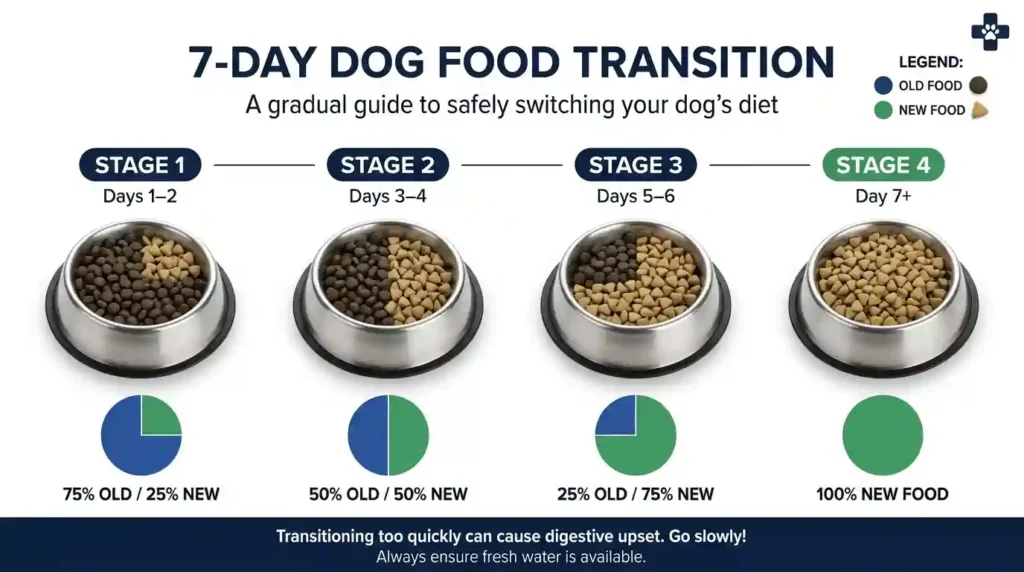
10.7 How to Transition Your Dog to Purina Dog Chow
Seven-Day Food Transition Schedule
| Days | Old Food | New Dog Chow |
| 1–2 | 75% | 25% |
| 3–4 | 50% | 50% |
| 5–6 | 25% | 75% |
| 7 onward | 0% | 100% |
Purina recommends allowing approximately seven to ten days for transition.
Adjust quantities for differences in calorie density.
Signs Your Dog Is Adjusting Well
Normal appetite, stable energy, comfortable digestion, and consistent stool quality are encouraging.
Mild short-term digestive variation can occur.
Digestive Problems During Transition
Persistent vomiting, diarrhea, bloating, or refusal to eat may indicate an issue requiring evaluation.
Do not force a rapid transition when significant symptoms occur.
10.8 Mixing Purina Dog Chow With Other Foods
Can You Mix Purina Dog Chow With Wet Dog Food?
Yes. Dry and wet foods can be combined when both are appropriate for the dog.
Wet food may increase meal moisture and palatability.
Calculating Daily Calories When Mixing Dry and Wet Food
Suppose a dog requires 800 kcal daily.
If wet food contributes 200 kcal, the remaining 600 kcal must come from dry food and any other calorie sources.
Using Complete Adult at 405 kcal per cup, 600 kcal is approximately 1.48 cups.
How Much Can Come From Treats and Food Toppers?
A common practical guideline is to keep treats and nutritionally unbalanced extras below approximately 10% of total daily calories.
This helps preserve the nutritional balance of the primary diet.
Can You Mix Dog Chow With Other Dog Food Brands?
Yes, when the combined diet remains appropriate.
However, unnecessary mixing can make it harder to identify dietary intolerances.
Avoiding Nutritional Imbalance When Adding Homemade Food
Large amounts of unbalanced homemade food can dilute essential nutrient intake.
Owners feeding substantial homemade portions should consult a veterinary nutrition specialist.
10.9 What to Monitor During the First 30 Days on Purina Dog Chow
Week 1: Appetite, Stool Quality, and Digestive Adjustment
Record food intake, appetite, stool consistency, and any digestive discomfort.
Keep meal timing and treats consistent.
Week 2: Energy Levels and Food Tolerance
Observe activity, food acceptance, and whether digestive symptoms are resolving.
Week 3: Skin, Coat, and Weight Monitoring
Monitor itching, skin changes, body weight, and visible coat condition.
Short-term observations should not be treated as proof that food caused a particular health outcome.
Week 4: Body Condition and Overall Health Assessment
Review body condition, appetite, stool quality, energy, and weight trends.
Consult a veterinarian if concerns remain.
Printable 30-Day Dog Food Monitoring Checklist
| Observation | What to Record |
| Daily food amount | Cups or grams |
| Appetite | Normal, reduced, increased |
| Stool consistency | Normal, soft, hard |
| Digestive symptoms | Vomiting, diarrhea, gas |
| Energy | Normal or unusual |
| Skin and coat | Itching, redness, changes |
| Weight | Weekly measurement |
| Other notes | Treats, medication, illness |
10.10 When to Stop Feeding Dog Chow and Consult a Veterinarian
Seek veterinary advice if a dog develops persistent digestive symptoms, unexplained weight loss, severe itching, or other concerning changes.
Repeated vomiting, bloody diarrhea, collapse, marked lethargy, or breathing difficulty require prompt or urgent veterinary care.
11. Purina Dog Chow Storage, Shelf Life, and Freshness
11.1 How to Store Purina Dog Chow Dry Food Properly
Store unopened and opened kibble in a cool, dry location away from sunlight, heat, moisture, and pests.
Keep the bag closed securely.
Avoid storing dog food in garages or outdoor locations exposed to extreme temperatures.
11.2 How Long Does an Opened Bag of Dog Chow Stay Fresh?
Freshness depends on storage conditions, packaging, and the product’s best-by date.
Once opened, exposure to oxygen and moisture can gradually affect food quality.
Follow manufacturer instructions and avoid keeping bags open unnecessarily.
11.3 Should You Keep Dog Chow in Its Original Bag or an Airtight Container?
Keeping the original bag is useful because it preserves lot numbers and product information.
If using an airtight container, placing the original bag inside can help protect the food while retaining its traceability information.
Clean and dry the container before adding a new bag.
11.4 How to Store Opened Purina Dog Chow Wet Food
Refrigerate unused wet food promptly in a covered container.
Maintain refrigeration at 40°F (4°C) or below.
Follow the product’s handling instructions and do not leave opened wet food at room temperature for prolonged periods.
11.5 Understanding Best-By Dates and Lot Numbers
The best-by date indicates the period during which the manufacturer expects the unopened food to retain its intended quality under appropriate storage.
The lot number identifies a production batch.
Both are important when investigating a product problem or recall.
11.6 Signs That Purina Dog Chow May Be Spoiled or Contaminated
Warning signs include rancid odors, visible mold, insects, moisture damage, and unusual discoloration.
Do not feed food from swollen, leaking, or damaged cans.
11.7 Does Buying Larger Bags Affect Food Freshness?
Large bags often reduce cost per pound.
However, they may remain open longer, increasing exposure to air and moisture.
Choose bag sizes that match your dog’s consumption rate and your storage conditions.
12. Purina Dog Chow Customer Reviews and Real-World Experiences
12.1 What Dog Owners Like About Purina Dog Chow
Positive feedback commonly emphasizes affordability, convenience, familiar flavors, and the ability to purchase large bags.
Owners of multiple dogs may particularly appreciate the budget-friendly price.
Some customers report good food acceptance and consistent stool quality.
These observations are individual experiences, not controlled proof of nutritional superiority.
12.2 Most Common Customer Complaints
Complaints may include digestive changes, picky eating, disliked ingredients, or concerns about artificial colors.
Some customers also express dissatisfaction with changes in bag appearance or formula availability.
A complaint about one product does not automatically apply to every Dog Chow recipe.
12.3 Taste and Palatability
Palatability depends on flavor, aroma, texture, ingredient composition, and individual preference.
Dog Chow provides several flavor and texture options.
A dog that refuses one variety may accept another, although persistent appetite loss warrants veterinary assessment.
12.4 Digestibility and Stool Quality
Normal stool consistency can be a useful practical indicator of feeding tolerance.
However, stool appearance alone does not measure complete nutrient digestibility.
Persistent diarrhea, constipation, or weight loss requires further investigation.
12.5 Customer Experiences With Dog Chow High Protein
Some owners choose High Protein because of its greater guaranteed protein concentration and higher energy content.
Others prefer Complete Adult because it meets their dog’s needs at a potentially lower price.
These preferences should not replace nutritional assessment.
12.6 Product Reliability and Consistency
Long-term users often value consistent availability and familiar feeding routines.
However, packaging, ingredients, and product assortment may change.
Owners should periodically review labels rather than assuming a formula has remained unchanged.
12.7 Overall Customer Satisfaction
Dog Chow appeals strongly to budget-conscious owners.
Its reputation is more divided among ingredient-focused reviewers.
The most useful customer feedback concerns the exact current recipe and provides specific observations rather than broad statements that all Dog Chow foods are good or bad.
13. Purina Dog Chow Pricing and Value for Money
13.1 How Much Does Purina Dog Chow Cost?
Dog Chow is positioned as an economical commercial dog food.
Prices vary according to bag size, retailer, location, promotion, and formulation.
Larger bags generally have lower prices per pound.
Current prices should be checked before purchasing.
13.2 Purina Dog Chow Price per Pound
Price per pound is calculated by dividing the bag price by its weight.
For example, a hypothetical 40-pound bag costing $36 would cost $0.90 per pound.
This is an illustrative price, not a verified current retail offer.
13.3 Purina Dog Chow Cost per 1,000 Calories
Why Price per Pound Can Be Misleading
Foods with different calorie densities may require different daily serving amounts.
The cheaper bag is not always the cheapest food per calorie.
How to Calculate Cost per 1,000 kcal
Complete Adult Chicken Flavor contains approximately 3,469 kcal/kg, equivalent to around 1,574 kcal per pound.
Using the hypothetical $0.90-per-pound price:
Cost per 1,000 kcal = $0.90 ÷ 1,574 × 1,000 = approximately $0.57.
Dog Chow Complete Adult vs. High Protein: Calorie-Adjusted Cost
Assume hypothetical prices of $0.90 per pound for Complete Adult and $1.20 per pound for High Protein Chicken.
| Formula | Illustrative Price per Pound | Approx. kcal per Pound | Cost per 1,000 kcal |
| Complete Adult Chicken | $0.90 | 1,574 | $0.57 |
| High Protein Chicken | $1.20 | 1,668 | $0.72 |
These are example prices for demonstrating the calculation, not verified retail quotes.
Is Dog Chow Cheaper to Feed Than Purina ONE?
Dog Chow is usually positioned below Purina ONE in retail pricing.
However, exact daily cost depends on the current prices and calorie densities of the compared products.
13.4 Daily and Monthly Feeding Costs
Estimated Daily Feeding Cost by Dog Weight
Using the hypothetical Complete Adult cost of $0.57 per 1,000 kcal:
| Example Daily Calories | Approximate Daily Cost |
| 300 kcal | $0.17 |
| 500 kcal | $0.29 |
| 800 kcal | $0.46 |
| 1,100 kcal | $0.63 |
| 1,500 kcal | $0.86 |
Estimated Monthly Feeding Costs for Small, Medium, and Large Dogs
| Illustrative Dog Category | Daily Calories | Estimated Monthly Cost |
| Small dog | 300 | $5.13 |
| Medium dog | 800 | $13.68 |
| Large dog | 1,100 | $18.81 |
| Very large dog | 1,500 | $25.65 |
These costs are mathematical examples based on assumed pricing and energy requirements. They exclude taxes, treats, delivery charges, and waste.
13.5 Cost Comparison of Dog Chow Formulas
Complete Adult is generally the most straightforward economy-oriented option.
High Protein may cost more per pound, but its greater calorie density can partially offset the difference in required serving size.
The best value depends on the dog’s nutritional needs rather than price alone.
13.6 Purina Dog Chow vs. Fresh Dog Food Cost
Fresh dog food typically has higher moisture content and different storage and processing costs.
It also often carries a higher retail price per calorie.
However, comparison requires examining actual caloric density, serving size, and nutritional adequacy.
For an example of a refrigerated food alternative, see Is Freshpet Good for Dogs.
Owners interested in prepared meals can also explore is just food for dogs good for another approach to canine nutrition.
13.7 Does Higher Protein Mean Better Value?
Not necessarily.
A healthy adult dog needs adequate digestible protein, not simply the highest number printed on a bag.
Higher-protein foods can be useful in selected circumstances, but their value depends on total nutrient balance, energy density, and the dog.
13.8 Is Purina Dog Chow Worth the Money?
For healthy adult dogs whose nutritional requirements match its formulas, Dog Chow can provide good value.
Its main advantages are affordable complete nutrition and accessibility.
Owners seeking specialized medical diets or different ingredient profiles may benefit from more expensive alternatives.
14. Purina Dog Chow vs. Other Dog Food Brands
14.1 Purina Dog Chow vs. Purina ONE
Ingredient Quality
Purina ONE frequently emphasizes named animal proteins more prominently.
Dog Chow relies heavily on economical grain and rendered animal ingredients.
However, ingredient appearance alone cannot establish which finished food performs better nutritionally.
Nutritional Value
Both brands provide complete and balanced adult formulas.
Purina ONE offers additional specialized features in selected products.
Price and Affordability
Dog Chow is generally less expensive.
Purina ONE may offer a middle ground for owners willing to spend more.
Overall Comparison
Choose Dog Chow when budget is a primary consideration and the dog tolerates it well.
Choose Purina ONE when its specific ingredients or nutritional features better match the dog’s needs.
14.2 Purina Dog Chow vs. Purina Pro Plan
Protein and Fat Content
Pro Plan includes standard, high-protein, performance, and specialized formulas.
Dog Chow offers fewer distinct nutritional categories.
Ingredient Differences
Pro Plan recipes commonly emphasize more targeted ingredients and features.
Dog Chow’s major focus remains economical complete nutrition.
Specialized Nutrition
Pro Plan has a much broader selection for sensitive digestion, sport, growth, aging, and veterinary therapeutic needs.
Cost and Value
Pro Plan generally costs more.
The additional expense may be justified when the dog requires particular nutritional features.
14.3 Purina Dog Chow vs. IAMS
IAMS offers mainstream complete dog food for different life stages and breed sizes.
Both brands use animal ingredients, grains, fats, vitamins, and minerals.
IAMS may offer a different ingredient balance or feeding profile depending on the recipe.
The better choice depends on calories, nutritional adequacy, tolerance, and cost.
14.4 Purina Dog Chow vs. Diamond Naturals
Diamond Naturals often emphasizes selected animal proteins and added nutritional ingredients.
Dog Chow focuses more strongly on economy pricing.
For additional context, our detailed review Is Diamond Naturals a Good Dog Food examines its ingredients and nutritional positioning.
You can also explore Is Diamond Dog Food Good for a wider comparison of Diamond’s product ranges.
14.5 Purina Dog Chow vs. Generic Store-Brand Dog Food
Store-brand dog foods can vary substantially in manufacturer expertise and ingredient quality.
Dog Chow benefits from the established research and manufacturing infrastructure of Nestlé Purina.
However, a particular store-brand formula may offer better value or a more appropriate nutrient profile.
For another budget-focused example, see is pure balance dog food good.
14.6 Purina Dog Chow vs. Other Purina Product Lines
Purina Beneful
Beneful emphasizes everyday feeding with varied flavors and textures.
Dog Chow is generally more economy-oriented.
Our article Is Beneful a Good Dog Food provides a closer evaluation.
Purina Pro Plan Veterinary Diets
Pro Plan Veterinary Diets are intended for clinical nutritional management.
Dog Chow should not replace a prescribed therapeutic diet without veterinary approval.
Purina Moist & Meaty
Moist & Meaty is a semi-moist food with a soft, chewy texture.
It may appeal to dogs that prefer a different feeding experience.
Purina Beyond (Historical Comparison)
Purina Beyond emphasized selected natural ingredients and different recipe approaches.
However, Beyond is discontinued in the United States as of this review.
14.7 Which Brand Offers the Best Budget Nutrition?
The best value depends on the dog’s requirements, not simply the brand or price.
Dog Chow, Purina ONE, IAMS, and other appropriately formulated foods can all be worth evaluating.
Owners with highly active dogs may also consider specialized alternatives such as those discussed in is black gold dog food good and Is Next Level dog food good.
Another affordable mainstream option is examined in Pedigree a good dog food.
For premium and veterinary-oriented comparisons, our review is hills a good dog food offers additional context.
15. Purina Dog Chow Sustainability and Ethical Considerations
15.1 Environmental Impact of Dog Food Manufacturing
Dog food manufacturing uses energy, water, agricultural materials, and packaging.
Dry kibble is generally shelf-stable and can have practical storage and transportation advantages over refrigerated foods.
However, environmental impacts vary according to ingredient sourcing, production methods, and supply chains.
15.2 Ingredient Sourcing and Supply Chain Practices
Purina describes supplier controls and manufacturing oversight.
The use of grains and rendered animal ingredients may influence resource use differently from recipes emphasizing large quantities of fresh meat.
However, these factors do not by themselves establish a complete environmental ranking.
15.3 Animal Testing and Feeding Research Ethics
Animal feeding studies can provide valuable evidence about nutritional adequacy and long-term health.
Ethical considerations include animal welfare, study design, housing conditions, veterinary oversight, and the necessity of testing.
Purina conducts nutritional research, but individual studies should be evaluated according to their methods.
15.4 Packaging and Sustainability Considerations
Dog food packaging helps protect products from contamination, oxygen, and moisture.
Larger bags may reduce packaging per pound of food but can increase waste if the contents spoil before use.
Consumers should balance storage practicality, product freshness, and local recycling options.
16. Why Do Purina Dog Chow Reviews and Ratings Disagree?
16.1 Ingredient-Based Ratings vs. Nutritional Adequacy Ratings
Some review websites judge dog food heavily by ingredient order and the perceived quality of individual components.
Others emphasize AAFCO adequacy, manufacturer research, feeding trials, and nutritional expertise.
These approaches can produce very different scores.
16.2 Why Some Review Sites Rate Dog Chow Poorly
Ingredient-focused reviewers often criticize corn as a leading ingredient, rendered meat and bone meal, plant protein concentrates, artificial colors, and extrusion processing.
These concerns may be relevant to ingredient preferences or sourcing transparency.
However, they do not automatically establish that the finished food is nutritionally inadequate.
16.3 Why Other Reviewers Consider Dog Chow Acceptable
Other reviewers emphasize that Complete Adult is formulated to meet adult maintenance nutrient profiles.
They also consider Purina’s manufacturing scale, research infrastructure, and affordability.
From this perspective, Dog Chow can be a reasonable everyday diet for healthy adults.
16.4 How Much Weight Should You Give Customer Reviews?
Customer reviews can provide practical information about palatability, packaging, shipping, and food acceptance.
However, individual reports do not establish clinical causation or nutritional superiority.
A dog may develop diarrhea or another symptom for reasons unrelated to a new food.
16.5 How to Interpret Dog Food Ratings Objectively
Look at the criteria behind each rating.
Determine whether the score reflects ingredient preferences, laboratory testing, nutritional adequacy, manufacturer transparency, or actual clinical outcomes.
A low ingredient score is not identical to a regulatory safety finding.
Likewise, a high customer rating does not establish that a food is ideal for every dog.
17. How Purina Dog Chow Was Evaluated
17.1 Review Methodology and Evaluation Criteria
This review considers nutritional adequacy, ingredient composition, manufacturer information, research support, recall history, affordability, and suitability for different dogs.
The goal is to provide a balanced assessment rather than judge the food by marketing claims alone.
17.2 Ingredient and Label Analysis Process
Current and previously published Purina ingredient declarations were examined for representative Complete Adult and High Protein formulas.
Historical products were distinguished from currently confirmed options.
17.3 Nutritional Data and Guaranteed Analysis
Representative guaranteed analyses and calorie figures were used for comparisons.
Calculated nutrient densities were identified as label-based estimates rather than actual laboratory nutrient analyses.
17.4 Safety and Recall Record Verification
The review considered Purina’s documented recalls and relevant FDA regulatory information.
Dog Chow-specific recall claims were separated from incidents involving other Purina products.
17.5 Price and Competitor Comparison Method
Prices used in worked examples were explicitly hypothetical.
Comparisons were based on cost per pound, calorie density, and nutritional category.
Actual prices should be checked through current retailers.
17.6 Research Sources and Veterinary References
The evaluation considers Purina product-label information, AAFCO nutritional principles, WSAVA manufacturer-selection guidance, and FDA food safety information.
Veterinary nutritional principles were used to distinguish general adult feeding from situations requiring clinical dietary management.
17.7 Review Limitations and Editorial Transparency
This article does not represent an independent laboratory test or controlled feeding trial.
The editorial rating is qualitative.
Product labels, availability, prices, and manufacturing information may change after publication.
The review is educational and does not replace individualized veterinary advice.
18. Frequently Asked Questions About Purina Dog Chow
18.1 Is Purina Dog Chow Grain-Free?
No, standard Dog Chow dry formulas are grain-inclusive and commonly contain corn or wheat.
18.2 Is Purina Dog Chow Made in the USA?
Yes, Purina states that Dog Chow is manufactured in its U.S. facilities.
18.3 Does Purina Dog Chow Contain Artificial Colors?
Some formulas do, including the reviewed Complete Adult Chicken Flavor and High Protein recipes.
18.4 Is Purina Dog Chow Suitable for Daily Feeding?
Yes, appropriate complete and balanced formulas can be fed daily to healthy adult dogs.
18.5 What Is the Difference Between Chicken and Beef Dog Chow?
The main difference involves the specific recipe and flavor ingredients; both should be compared using their current labels.
18.6 Can You Switch Directly From Another Dog Food to Dog Chow?
A gradual transition over approximately seven to ten days is generally preferable.
18.7 Where Can You Buy Purina Dog Chow?
Dog Chow is sold through U.S. retailers including Walmart, Target, Chewy, grocery stores, and other pet food sellers.
Is Purina Dog Chow Good for Dogs?
Yes, Dog Chow can be a suitable affordable food for many healthy adult dogs.
Is Dog Chow a Good Dog Food?
It can provide complete adult maintenance nutrition, although its ingredient profile differs from premium brands.
Is Purina Dog Chow Good for Puppies?
Standard adult Dog Chow is not intended for puppy growth; choose an appropriate puppy formula.
Does Purina Dog Chow Use Real Meat?
Some recipes contain chicken, beef, or other named meats, alongside rendered animal ingredients.
Is Corn in Purina Dog Chow Bad for Dogs?
No, properly processed corn can contribute useful nutrients in a balanced diet.
Is Purina Dog Chow High Protein Better?
Not necessarily; higher protein may suit some dogs but is not automatically superior for every adult.
Is Purina Dog Chow Safe for Long-Term Feeding?
It can be appropriate for long-term feeding when matched to a healthy adult dog’s requirements.
Does Purina Dog Chow Cause Allergies?
Individual dogs may react to ingredients, but the food is not universally allergenic.
Has Purina Dog Chow Ever Been Recalled?
No confirmed Dog Chow-specific recall was identified in the records reviewed through October 2026.
Is Purina Dog Chow Better Than Purina ONE?
Dog Chow generally costs less, while Purina ONE offers different ingredient profiles and nutritional features.
Is Purina Dog Chow Better Than Pedigree?
Neither is automatically better; compare the exact recipes and the dog’s needs.
How Many Calories Are in Purina Dog Chow?
The reviewed Complete Adult Chicken Flavor has approximately 405 calories per cup, while High Protein Chicken has approximately 431.
Can Senior Dogs Eat Purina Dog Chow?
Some healthy seniors can eat appropriate adult Dog Chow formulas, depending on their health and nutritional needs.
Can You Mix Purina Dog Chow With Wet Food?
Yes, provided the combined diet remains appropriate and total calories are controlled.
Is Purina Dog Chow Worth the Price?
For budget-conscious owners of healthy adult dogs, it can offer good value.
19. Final Verdict: Is Purina Dog Chow Worth Buying?
Purina Dog Chow is worth considering as an affordable everyday food for many healthy adult dogs.
Its main strengths include complete adult maintenance nutrition, widespread availability, and the manufacturing infrastructure of Nestlé Purina PetCare.
Complete Adult provides economical everyday feeding, while High Protein offers a greater guaranteed protein and fat concentration.
However, the brand relies heavily on corn, plant protein concentrates, and rendered animal ingredients in certain recipes. Some formulas also contain artificial colors, and the product range is less specialized than Purina ONE or Pro Plan.
These characteristics do not make Dog Chow universally unhealthy.
The most important question is whether the exact formula provides suitable nutrition for your individual dog.
Overall editorial rating: 3.9/5 — a practical budget dog food with clear nutritional strengths and ingredient-related limitations.
20. Final Thoughts
So, is Purina Dog Chow good? For many healthy adult dogs, yes. It offers affordable, complete and balanced nutrition backed by an established manufacturer with significant nutritional research and quality-control resources. Although its ingredients may not appeal to owners seeking premium animal-protein formulations, corn, by-products, and other economical ingredients are not automatically signs of poor nutrition.
The best choice depends on your dog’s age, weight, activity level, medical needs, and tolerance. Check the current product label, compare calories and nutrient guarantees, and ask your veterinarian when specialized feeding is necessary.
For more practical comparisons, explore our Dog Food Brand Reviews and browse Dog Behavior and Training for broader dog care guidance. A well-informed feeding decision can help support your dog’s long-term health while keeping costs manageable.