


Is Moist and Meaty good for dogs? Purina Moist & Meaty can be a suitable everyday food for many healthy adult dogs, particularly those that prefer soft, chewy meals over traditional crunchy kibble. Manufactured by Nestlé Purina PetCare, this semi-moist dog food offers convenient individual pouches, several appealing flavors, and formulas designed to meet AAFCO nutritional requirements for adult maintenance. Its soft texture can also make feeding easier for certain picky eaters and older dogs with chewing difficulties.
However, Purina Moist & Meaty has some important drawbacks. Several recipes contain high-fructose corn syrup, corn syrup, soy flour, soy grits, artificial colors, and preservatives such as ethoxyquin. These ingredients raise reasonable questions about nutritional preferences, ingredient transparency, and suitability for dogs with diabetes or other medical conditions. The food also contains more moisture than conventional dry kibble but less than typical canned dog food.
This comprehensive review examines Purina Moist & Meaty’s ingredients, sugar content, nutrition, recall history, manufacturing standards, popular recipes, feeding recommendations, and overall value. You’ll also discover whether it is suitable for puppies, seniors, overweight dogs, and dogs with sensitive digestion—and when another food may be a better choice.
Table of Contents
- Is Moist and Meaty Good for Dogs? Quick Overview
- Purina Moist & Meaty Brand History and Manufacturing
- Purina Moist & Meaty Product Range and Recipes
- Purina Moist & Meaty Dog Food Ingredients Analysis
- Purina Moist & Meaty Nutritional Analysis
- Purina Moist & Meaty Safety, Recalls, and Quality Control
- Is Purina Moist & Meaty Good for Different Dogs?
- Purina Moist & Meaty Taste, Texture, and Feeding Experience
- How to Feed Purina Moist & Meaty Correctly
- What to Monitor During the First 30 Days on Purina Moist & Meaty
- Purina Moist & Meaty Storage, Shelf Life, and Freshness
- Purina Moist & Meaty Customer Reviews and Real-World Experiences
- Purina Moist & Meaty Pricing and Value for Money
- Purina Moist & Meaty vs. Other Dog Foods
- Purina Moist & Meaty Sustainability and Ethical Considerations
- Why Do Purina Moist & Meaty Reviews and Ratings Disagree?
- How Purina Moist & Meaty Was Evaluated
- Frequently Asked Questions About Purina Moist & Meaty
- Final Verdict: Is Purina Moist & Meaty Worth Buying?
- Final Thoughts
1. Is Moist and Meaty Good for Dogs? Quick Overview
1.1 Is Purina Moist & Meaty a Good Dog Food? Quick Verdict
Purina Moist & Meaty is a nutritionally complete adult dog food with convenient packaging and high palatability, but its ingredients may not be ideal for every dog.
Its strongest advantages include a soft, chewy texture, easy portioning, shelf-stable packaging, and established manufacturing support from Nestlé Purina PetCare.
Representative recipes, including Steak Flavor, Chopped Burger, With Real Chicken, and Burger with Cheddar Cheese Flavor, carry nutritional adequacy statements indicating that they are formulated to meet AAFCO Dog Food Nutrient Profiles for maintenance of adult dogs.
That is an important distinction. A food can have an ingredient list that some owners dislike while still being formulated to supply the essential nutrients required for adult maintenance.
However, several Moist & Meaty formulas contain added sugars, concentrated soy ingredients, artificial colors, and chemical preservatives.
These ingredients may be unsuitable for owners seeking a less processed diet or for dogs requiring carefully controlled dietary carbohydrate intake.
For a healthy adult dog that tolerates the ingredients, Moist & Meaty can be a reasonable option. For a dog with diabetes, chronic pancreatitis, significant food sensitivities, or specialized medical requirements, a veterinary-selected diet is generally preferable.
Our broader Dog Food resources explain how nutritional adequacy, ingredients, calories, and individual health needs should guide feeding decisions.
1.2 What Is Purina Moist & Meaty Dog Food?
Purina Moist & Meaty is a commercial semi-moist dog food manufactured by Nestlé Purina PetCare.
Unlike traditional dry kibble, it contains enough moisture and texture-modifying ingredients to remain soft and chewy.
Unlike canned wet food, it is sold primarily in individually sealed, shelf-stable pouches rather than metal cans or trays.
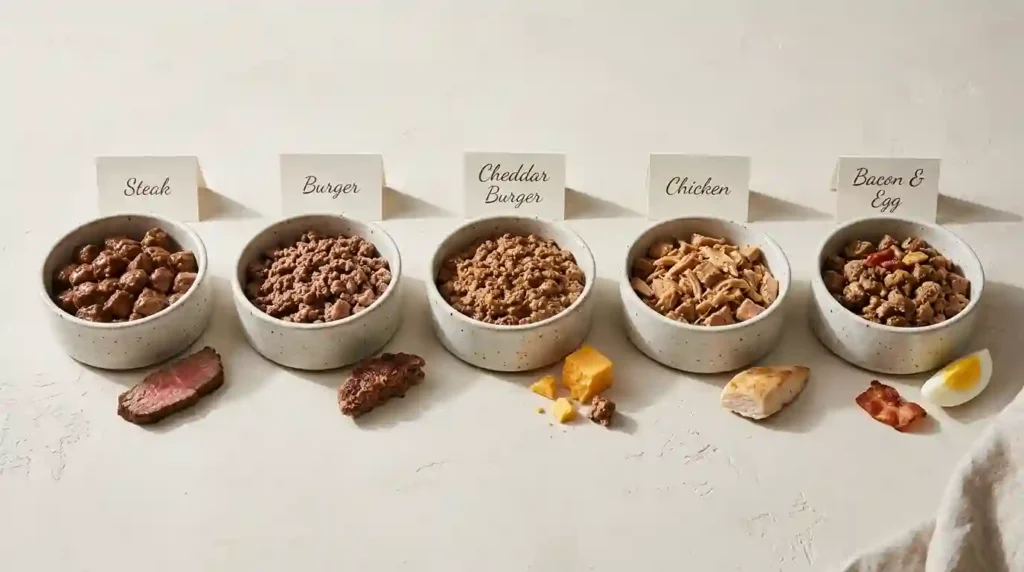
Commonly reviewed recipes include Steak Flavor, Chopped Burger, Burger with Cheddar Cheese Flavor, and With Real Chicken.
The brand also offers a Rise & Shine Bacon & Egg Flavor formula.
Some older product records include a High Protein With Real Chicken & Beef recipe, although its current U.S. availability should be verified.
Moist & Meaty is marketed primarily for adult dogs and may be used as a complete meal when the exact product’s nutritional adequacy statement supports that use.
1.3 Purina Moist & Meaty at a Glance
| Feature | Purina Moist & Meaty |
| Manufacturer | Nestlé Purina PetCare |
| Parent company | Nestlé |
| Food category | Semi-moist dog food |
| Typical texture | Soft and chewy |
| Packaging | Individually sealed pouches |
| Main life stage | Adult maintenance |
| Standard crude protein | 18% minimum in representative recipes |
| Standard crude fat | 7% minimum |
| Maximum moisture | Typically 33–34% |
| Calories | Approximately 462–479 kcal per standard pouch in reviewed formulas |
| Common animal ingredients | Beef by-products, meat by-products, chicken, beef |
| Common plant ingredients | Soy flour, soy grits, wheat flour |
| Added sugars | High-fructose corn syrup and corn syrup in reviewed recipes |
| Preservatives | Sorbic acid, calcium propionate, ethoxyquin in reviewed labels |
| Special advantage | Convenient, shelf-stable soft food |
| Main limitation | Added sugars and less ingredient-focused formulation |
| Overall suitability | Many healthy adult dogs |
The nutrition figures are based on published manufacturer label documents. Always check the current package because formulas and labeling may change.
1.4 Overall Purina Moist & Meaty Dog Food Rating
Our editorial assessment considers nutritional adequacy, ingredient composition, manufacturing transparency, convenience, cost, and suitability for different dogs.
| Evaluation Factor | Editorial Rating |
| Adult nutritional adequacy | 4/5 |
| Ingredient quality and transparency | 2.5/5 |
| Texture and palatability | 4.5/5 |
| Convenience and packaging | 4.5/5 |
| Manufacturing expertise | 4/5 |
| Formula variety | 3.5/5 |
| Affordability | 3.5/5 |
| Specialized medical suitability | 2/5 |
| Overall editorial rating | 3.5/5 |
This rating is an editorial judgment rather than an independently validated laboratory or veterinary clinical score.
Moist & Meaty earns favorable consideration for convenience and adult nutritional adequacy, while added sugars and limited ingredient transparency reduce its overall assessment.
1.5 Key Features and Benefits of Purina Moist & Meaty
The food’s most noticeable advantage is its soft, chewy texture.
Some dogs that refuse crunchy kibble find semi-moist pieces easier to eat.
Individual pouches also make portioning, travel, and meal preparation convenient.
Because the food is shelf-stable before opening, it does not require the same refrigeration arrangements as fresh or refrigerated pet foods.
Selected formulas provide complete adult maintenance nutrition, allowing them to serve as primary meals rather than merely treats.
However, a convenient food should still be evaluated through its ingredients, calories, and nutritional purpose.
1.6 Pros and Cons of Purina Moist & Meaty Dog Food
| Pros | Cons |
| Soft, chewy texture | Added high-fructose corn syrup in reviewed recipes |
| Convenient individual pouches | Contains concentrated soy ingredients |
| No refrigeration needed before opening | Some formulas include artificial colors |
| Suitable for some picky eaters | Uses preservatives to maintain shelf stability |
| Several flavors | Not intended for puppy growth in reviewed formulas |
| Adult maintenance nutritional adequacy | Not a veterinary therapeutic diet |
| Easy to use as a topper | Can be expensive compared with conventional kibble per calorie |
| More moisture than dry kibble | Less moisture than canned food |
| Established manufacturer | Limited published product-specific digestibility information |
Purina Moist & Meaty is best evaluated as a convenient semi-moist adult food rather than automatically classified as healthier or less healthy than every dry or wet alternative.
2. Purina Moist & Meaty Brand History and Manufacturing
2.1 History and Background of Purina Moist & Meaty
Purina has a long history in commercial animal nutrition, tracing its roots to the Ralston Purina Company.
In 2001, Nestlé acquired Ralston Purina and incorporated its pet food operations into Nestlé Purina PetCare.
Moist & Meaty became one of Purina’s distinctive product lines because it offers an intermediate texture between dry kibble and canned wet food.
The brand’s approach focuses on delivering soft pieces with sufficient shelf stability to avoid refrigeration before opening.
Although its exact original launch date is not consistently established in available product documentation, it has been marketed in the United States for many years.
2.2 Who Owns and Makes Purina Moist & Meaty Dog Food?
Purina Moist & Meaty is manufactured by Nestlé Purina PetCare, headquartered in St. Louis, Missouri.
The company also produces Purina Pro Plan, Purina ONE, Dog Chow, Beneful, and several other pet food brands.
Although these products share a manufacturer, their nutritional goals and ingredient compositions differ.
For a broader examination of the company’s research, manufacturing practices, and product lines, read our article on is purina good for dogs.
2.3 Where Is Purina Moist & Meaty Manufactured?
Moist & Meaty product labels identify Nestlé Purina PetCare Company in St. Louis, Missouri, as the manufacturer.
Purina operates an extensive U.S. manufacturing network and states that most of the pet food it sells domestically is made in the United States.
However, the corporate address on a package does not identify the specific production facility.
Similarly, domestic manufacturing does not establish that every ingredient originates in the United States.
For exact facility or ingredient-origin information, contact Purina using the product name and lot number.
2.4 Manufacturing Facilities and Ingredient Sourcing
Purina reports owning manufacturing facilities and maintaining quality assurance procedures across its production network.
Moist & Meaty ingredients may include beef by-products, chicken, soy flour, soy grits, wheat flour, fats, corn syrup, vitamins, and minerals.
These ingredients have different nutritional and manufacturing functions.
Animal tissues and soy ingredients contribute protein, while fats supply concentrated energy.
Carbohydrates, humectants, preservatives, and packaging help create the finished product’s distinctive texture and storage characteristics.
Ingredient sourcing should be assessed through manufacturer specifications and quality controls rather than assumed from ingredient names alone.
2.5 How Purina Moist & Meaty Dog Food Is Made
Moist & Meaty belongs to the category of semi-moist commercial dog food.
Its production differs from both conventional dry kibble and high-moisture canned diets.
Semi-Moist Dog Food Manufacturing Process
Semi-moist food manufacturing generally involves preparing animal and plant ingredients, mixing nutritional components, controlling moisture, applying heat or other processing steps, and forming the mixture into soft pieces.
Manufacturers must balance ingredient functionality, microbial safety, nutritional adequacy, and palatability.
The exact proprietary processing sequence for Moist & Meaty is not fully described in the public product labels.
Therefore, it should not be assumed that every recipe undergoes precisely the same processing conditions.
How Moist & Meaty Maintains Its Soft Texture
Moist & Meaty uses water and texture-modifying ingredients to maintain a softer consistency than conventional kibble.
Reviewed labels contain components such as high-fructose corn syrup, corn syrup, wheat flour, and other functional ingredients.
Humectants help control the relationship between moisture and texture.
The food remains pliable even while packaged for room-temperature storage.
Why Moist & Meaty Does Not Require Refrigeration Before Opening
Commercial shelf stability depends on several factors, including moisture availability, preservatives, processing, packaging, and potentially acidity.
A properly sealed package protects the finished food from environmental contamination and excessive moisture exchange.
However, shelf stability before opening does not mean that opened food should remain exposed indefinitely.
Water Activity and Shelf Stability in Purina Moist & Meaty
What Is Water Activity in Semi-Moist Dog Food?
Water activity, abbreviated as aw, measures how much water is available for biological and chemical processes.
It differs from simply measuring the total percentage of water in a food.
Microorganisms require available water to multiply, and reducing water activity can help inhibit their growth.
Water Activity vs. Moisture Percentage
A product can contain a substantial amount of water while having reduced water activity.
For example, two foods with similar moisture percentages may have different microbial growth potential because their ingredients bind water differently.
Moist & Meaty labels generally list a maximum moisture content of approximately 33–34%.
However, the manufacturer does not routinely publish a product-specific water activity value on the consumer label.
Therefore, its exact water activity should not be invented.
How Humectants Restrict Microbial Growth
Humectants bind water and reduce its availability.
Sugars and other water-binding ingredients can contribute to this effect in semi-moist foods.
However, humectants alone do not guarantee food safety.
Shelf stability depends on the complete formulation and manufacturing process.
How Acidity and Packaging Support Shelf Stability
Acidity can influence the growth of certain microorganisms.
Ingredients such as phosphoric acid and preservatives may contribute to overall product stability.
Sealed packaging also reduces exposure to environmental contamination.
The interaction of these controls helps explain how semi-moist food can remain shelf-stable despite containing more water than traditional kibble.
2.6 Purina Manufacturing Quality Control and Testing Standards
Purina describes ingredient checks, manufacturing controls, laboratory testing, and finished-product monitoring across its manufacturing network.
These systems aim to reduce the risk of contamination, nutrient inconsistencies, and packaging defects.
However, company-wide quality-control statistics are not equivalent to public proof that every Moist & Meaty batch has undergone every conceivable laboratory test.
2.7 Manufacturing Reliability and Product Consistency
Product consistency involves maintaining reliable texture, ingredient composition, nutritional values, and packaging quality.
Moist & Meaty’s individual pouches may help preserve consistency before opening.
Nevertheless, changes in smell, texture, visible contamination, or damaged packaging should be taken seriously.
Owners should retain lot numbers when reporting suspected problems.
2.8 Purina’s Nutritional Research and Feeding Practices
Purina employs animal nutrition professionals and conducts nutritional research.
Its broader research includes digestion, metabolism, body condition, and long-term pet health.
This scientific infrastructure is a meaningful advantage.
However, the existence of company-wide feeding research does not prove that every Moist & Meaty recipe has independently passed an AAFCO feeding trial or demonstrated a specific clinical benefit.
3. Purina Moist & Meaty Product Range and Recipes
Purina’s current U.S. product catalog includes several Moist & Meaty flavors.
The comparisons below use published manufacturer labels, including some older label documents. Current formulations and availability should always be confirmed before purchase.
3.1 Purina Moist & Meaty Burger With Cheddar Cheese Flavor
Burger with Cheddar Cheese Flavor is one of the established Moist & Meaty recipes.
Its published ingredient list begins with meat by-product, soy flour, soy grits, high-fructose corn syrup, and wheat flour.
It also contains cheese powder, which contributes to the cheddar cheese flavor.
The reviewed label guarantees at least 18% crude protein and 7% crude fat, with a maximum moisture content of 33%.
Its published calorie declaration is approximately 479 kcal per standard pouch.
Best suited for: Healthy adult dogs that enjoy soft, savory flavors and tolerate the ingredients.
Main drawback: Added sugars, soy ingredients, and artificial coloring agents.
3.2 Purina Moist & Meaty Steak Flavor
Steak Flavor is designed to provide a savory soft-food eating experience.
The reviewed label lists beef by-product, soy flour, soy grits, high-fructose corn syrup, and water among its first five ingredients.
It also contains beef, wheat flour, corn syrup, and selected preservatives.
The published guaranteed analysis includes 18% minimum crude protein, 7% minimum crude fat, and 33% maximum moisture.
Calorie content is approximately 474 kcal per standard pouch.
Best suited for: Adult dogs that prefer beef-flavored semi-moist food.
3.3 Purina Moist & Meaty Chopped Burger
Chopped Burger provides another beef-oriented soft-food option.
Its published formulation includes beef by-product, soy flour, soy grits, high-fructose corn syrup, water, and wheat flour.
It carries an adult maintenance nutritional adequacy statement.
Its published calorie figure is approximately 474 kcal per standard pouch.
The ingredient profile is similar to Steak Flavor, although flavoring and formulation details differ.
Best suited for: Dogs that enjoy soft beef-style pieces.
3.4 Purina Moist & Meaty With Real Chicken
With Real Chicken differs from several other recipes because chicken appears first on its published ingredient list.
The remaining leading ingredients include soy flour, soy grits, high-fructose corn syrup, and wheat flour.
Its nutritional analysis lists at least 18% crude protein, 7% crude fat, and a maximum of 33% moisture.
The published calorie declaration is approximately 462 kcal per standard pouch.
Best suited for: Healthy adult dogs whose owners prefer a formula listing chicken first.
However, the presence of chicken as the first ingredient does not prove that the finished food contains more digestible animal protein than every competing recipe.
3.5 Purina Moist & Meaty High Protein Recipes
A published label exists for Moist & Meaty High Protein With Real Chicken & Beef.
The reviewed historical formula contains at least 20% crude protein and 8% crude fat.
That compares with 18% protein and 7% fat in the standard recipes reviewed above.
Its ingredient list includes meat by-product, soy flour, soy grits, high-fructose corn syrup, chicken, beef, and soy protein isolate.
The published calorie declaration is approximately 482 kcal per standard pouch.
However, the High Protein recipe was not identified in the current official U.S. Moist & Meaty product listing during this review.
It should therefore be treated as a historical or availability-unconfirmed formula rather than an assured current purchasing option.
3.6 Other Purina Moist & Meaty Flavors and Varieties
Purina also lists Rise & Shine Awaken Bacon & Egg Flavor.
Its published label includes meat by-product, soy flour, soy grits, high-fructose corn syrup, wheat flour, bacon, and dried egg product.
The formula guarantees 18% crude protein and 7% crude fat, with a maximum moisture level of 34%.
Its published calorie figure is approximately 475 kcal per standard pouch.
Individual flavors should be selected based on suitability and tolerance, not because words such as bacon, steak, or burger necessarily indicate a larger amount of those ingredients.
3.7 Purina Moist & Meaty Recipe Comparison
Differences in Ingredients and Protein Sources
With Real Chicken lists chicken first on its reviewed label.
Steak Flavor and Chopped Burger emphasize beef by-products.
Burger with Cheddar Cheese Flavor uses meat by-products and includes cheese powder.
Rise & Shine contains bacon and dried egg product farther down the ingredient list.
Protein, Fat, and Moisture Differences
| Formula | Protein Minimum | Fat Minimum | Fiber Maximum | Moisture Maximum |
| Steak Flavor | 18% | 7% | 3% | 33% |
| Chopped Burger | 18% | 7% | 3% | 33% |
| Burger with Cheddar Cheese | 18% | 7% | 3% | 33% |
| With Real Chicken | 18% | 7% | 3% | 33% |
| Rise & Shine Bacon & Egg | 18% | 7% | 3% | 34% |
| High Protein Chicken & Beef (historical label) | 20% | 8% | 3% | 33% |
These are label guarantees, not exact laboratory-measured nutrient compositions.
Calories per Pouch and Serving
| Formula | Approximate kcal/kg | Approximate kcal per Standard Pouch |
| With Real Chicken | 2,716 | 462 |
| Steak Flavor | 2,790 | 474 |
| Chopped Burger | 2,790 | 474 |
| Rise & Shine Bacon & Egg | 2,797 | 475 |
| Burger with Cheddar Cheese | 2,816 | 479 |
| High Protein Chicken & Beef (historical label) | 2,837 | 482 |
These values correspond to published manufacturer label documents and should be checked against current packages.
Flavor, Texture, and Palatability Differences
The recipes share a generally soft, chewy texture.
Flavor and aroma differences may influence how readily a dog accepts each formula.
However, a particular dog’s preference cannot be predicted from product names alone.
3.8 Purina Moist & Meaty Product Formats and Packaging
Individual Pouches and Package Sizes
Moist & Meaty is sold in sealed pouches, often grouped into multipacks.
A commonly published standard pouch weight is approximately 6 ounces, or 170 grams.
Package sizes and configurations vary by retailer.
Semi-Moist Dog Food vs. Dry Kibble
Dry kibble normally contains substantially less moisture and is crunchy.
Semi-moist food has a softer texture and relies on different moisture and preservation controls.
Both formats can supply complete nutrition when properly formulated.
Semi-Moist Dog Food vs. Canned Wet Food
Canned dog food commonly contains much more water.
Semi-moist food is usually softer than dry kibble but more concentrated in calories per gram than many canned diets.
Canned products also generally require refrigeration after opening.
3.9 Which Purina Moist & Meaty Recipe Is Best?
For a healthy adult dog, the best recipe depends on ingredient tolerance, preferred flavor, and current availability.
With Real Chicken may appeal to owners who prefer a named animal protein first on the ingredient list.
Steak Flavor and Chopped Burger may appeal to dogs that prefer beef-oriented flavors.
Burger with Cheddar Cheese Flavor provides another taste option.
However, none can be declared universally superior based on flavor or first ingredient alone.
3.10 Purina Moist & Meaty Formula and Packaging Changes
Can Purina Change Moist & Meaty Ingredients Without Renaming the Product?
Yes. Manufacturers may update formulations while retaining recognizable product names.
The current package should take priority over older online reviews.
How to Compare Old and New Ingredient Lists
Compare animal proteins, soy ingredients, added sugars, preservatives, colorants, and other components relevant to your dog.
Changes in ingredient order can indicate formulation adjustments but do not disclose exact ingredient quantities.
How to Check Changes in Calories and Guaranteed Analysis
Review crude protein, crude fat, fiber, moisture, and calories per pouch.
A calorie change may require a corresponding feeding adjustment.
How to Identify Discontinued or Reformulated Recipes
Check the official Purina catalog and current retailer listings.
Do not rely solely on older review sites that may continue displaying discontinued formulas.
What to Do if Your Dog Reacts to a Formula Change
Keep the packaging and record the lot number.
Consult a veterinarian if digestive upset, itching, or other significant symptoms develop.
A suspected ingredient reaction should be investigated rather than assumed.
4. Purina Moist & Meaty Dog Food Ingredients Analysis
4.1 What Ingredients Are in Purina Moist & Meaty?
Purina Moist & Meaty contains combinations of animal ingredients, soy products, wheat flour, added sugars, fats, preservatives, vitamins, and minerals.
The exact formula varies by flavor.
Unlike many premium dog foods that emphasize fresh meat or selected limited ingredients, Moist & Meaty uses ingredients serving both nutritional and functional manufacturing purposes.
For example, high-fructose corn syrup and corn syrup contribute carbohydrates and may help with moisture management and texture.
Soy flour and soy grits contribute plant protein and other nutritional components.
Preservatives support shelf stability.
The finished food must be evaluated as a complete formulation rather than only through individual ingredients.
4.2 First Five Ingredients Breakdown
Ingredient Order and Nutritional Contribution
Pet food ingredients are generally listed in descending order of predominance by weight before processing.
The first five ingredients can identify major components but do not reveal exact quantities.
For Steak Flavor, the reviewed leading ingredients are:
| Ingredient | Primary Role |
| Beef by-product | Animal protein and nutrients |
| Soy flour | Plant protein and other nutrients |
| Soy grits | Protein and carbohydrate contribution |
| High-fructose corn syrup | Carbohydrates and functional properties |
| Water | Moisture and processing |
The presence of both animal and plant protein sources means total crude protein cannot be interpreted as animal protein alone.
Recipe-Specific Ingredient Differences
With Real Chicken lists chicken first.
Burger with Cheddar Cheese Flavor lists meat by-product first.
Steak Flavor and Chopped Burger use beef by-product as a major ingredient.
Despite differences in their leading ingredients, the standard recipes have similar guaranteed protein and fat levels.
4.3 Animal Protein Sources and Meat Ingredients
Beef and Beef By-Products
Beef by-products may contain permitted animal tissues other than ordinary skeletal muscle meat.
These tissues can contribute protein and micronutrients.
Their nutritional value depends on sourcing, composition, processing, and digestibility.
Chicken and Other Animal Proteins
The With Real Chicken recipe lists chicken as the first ingredient.
Other formulas may contain chicken, beef, bacon, or dried egg products.
These ingredients supply different amino acid profiles and nutritional components.
Named vs. Unnamed Animal Ingredients
An ingredient such as chicken identifies a specific animal source.
A more general term such as meat by-product provides less specific information about the species.
This distinction matters particularly for dogs with diagnosed allergies.
Are Animal By-Products Bad for Dogs?
No. Properly processed animal by-products can be nutritious.
Organ tissues may provide vitamins, minerals, and amino acids.
However, ingredient quality and digestibility should still be evaluated.
4.4 Soy Ingredients and Plant-Based Proteins
Soy Grits and Soy Flour
Soy flour and soy grits are prominent ingredients in Moist & Meaty recipes.
They provide plant-derived protein and other nutrients.
Soy can be included in nutritionally adequate dog food when appropriately processed and balanced.
Why Soy Is Used in Semi-Moist Dog Food
Soy ingredients can contribute to protein content, texture, binding, and manufacturing characteristics.
Their functional properties are useful in processed foods.
However, soy is also a potential allergen for individual dogs.
Plant Protein vs. Animal Protein
Animal and plant proteins differ in amino acid composition and digestibility.
A food’s protein quality depends on the combined formulation.
The crude protein percentage does not reveal the percentage originating from beef, chicken, or soy.
4.5 Carbohydrate Sources and Grain Ingredients
Wheat, Corn, and Other Carbohydrates
Reviewed Moist & Meaty recipes contain wheat flour and corn-derived sweeteners.
These ingredients provide energy and influence texture.
Carbohydrates can be part of an appropriate canine diet, but individual sources have different nutritional characteristics.
Are Carbohydrate Ingredients Just Fillers?
Not necessarily.
A carbohydrate ingredient may provide usable calories or serve a manufacturing function.
However, added sugars offer fewer essential micronutrients than many whole-food carbohydrate sources.
That distinction is relevant when evaluating nutritional value.
4.6 Sugar Content in Purina Moist & Meaty
Sugar is one of the most important considerations in this review because several formulas list high-fructose corn syrup among their first few ingredients.
High-Fructose Corn Syrup and Other Added Sugars
Published Moist & Meaty ingredient lists include both high-fructose corn syrup and corn syrup.
These ingredients provide readily digestible carbohydrates and contribute to the food’s functional characteristics.
Their presence does not automatically mean the product is toxic or nutritionally inadequate.
However, they may make the food less attractive for owners seeking diets without added sugars.
Why Sugar Is Added to Semi-Moist Dog Food
Sugars can influence sweetness, texture, moisture retention, and product stability.
In semi-moist food, functional ingredients help create a soft consistency that remains stable in sealed packaging.
However, the presence of sugar should be evaluated in the context of the entire nutritional formulation.
Does Purina Moist & Meaty Disclose Its Total Sugar Content?
The reviewed consumer labels list added sugars in the ingredient declarations.
However, they do not provide a guaranteed total sugar value in grams per pouch.
The exact quantity of high-fructose corn syrup is not disclosed through ingredient order alone.
Therefore, no reliable exact sugar-per-pouch figure can be calculated from the available standard label information.
High-Fructose Corn Syrup vs. Total Carbohydrates
High-fructose corn syrup is a specific source of sugars.
Total carbohydrate content also includes starches and other carbohydrate components.
A food may contain substantial carbohydrates even when its added sugar content is relatively low.
Conversely, the presence of added sugars does not establish the total carbohydrate percentage.
Can You Calculate Sugar Grams From the Guaranteed Analysis?
No.
Standard guaranteed analyses generally provide minimum crude protein and fat, maximum fiber and moisture, and selected additional nutrients.
These figures do not identify total sugars.
Carbohydrate-by-difference calculations also cannot isolate added sugars from starches and other carbohydrates.
How to Request Typical Sugar and Carbohydrate Values From Purina
Contact Purina and identify the exact recipe.
Ask for typical values for total sugars, starch, carbohydrate content, and metabolizable energy.
Request measurements on an as-fed basis or per 1,000 kcal to make comparisons easier.
Does Added Sugar Make Moist & Meaty Less Nutritious?
Added sugars provide energy but comparatively little essential protein, vitamins, or minerals.
Their presence does not automatically negate a food’s complete and balanced nutritional status.
Nevertheless, owners may reasonably prefer foods that provide energy through different ingredients.
Dogs with diabetes or specialized carbohydrate-management requirements should receive veterinary nutritional guidance.
4.7 Fats, Oils, and Flavor Enhancers
Reviewed formulas contain animal fat, beef fat, soybean oil, or vegetable oil.
These ingredients supply energy and fatty acids.
Natural steak flavor and cheese powder appear in selected recipes.
Flavor ingredients can improve acceptance, but palatability alone is not a measure of nutritional quality.
4.8 Preservatives and Shelf-Stabilizing Ingredients
Ethoxyquin and Other Preservatives
Published Moist & Meaty labels list ethoxyquin, sorbic acid, and calcium propionate.
Ethoxyquin is an antioxidant preservative that has attracted debate among pet owners and reviewers.
Sorbic acid and calcium propionate help inhibit certain forms of spoilage.
The health implications of a preservative depend on its chemical identity, actual concentration, exposure, and applicable regulations.
A label listing a preservative is not itself evidence of unsafe exposure.
Humectants and Moisture Retention
Humectants help retain softness while controlling water availability.
Ingredients such as syrups may contribute to these properties.
Moisture retention is important because semi-moist food must remain palatable and shelf-stable.
4.9 Artificial Colors and Other Food Additives
Reviewed Moist & Meaty labels include artificial colors such as Red 40, Yellow 5, Yellow 6, and Blue 1.
Artificial colors mainly influence appearance rather than supplying essential nutrients.
Some owners prefer to avoid them.
Their presence should be assessed through relevant safety standards rather than generalized claims of toxicity.
4.10 Added Vitamins, Minerals, and Nutritional Supplements
Moist & Meaty recipes contain vitamin and mineral premixes designed to support complete nutrition.
Examples include vitamin A, vitamin D3, vitamin E, niacin, thiamine, riboflavin, biotin, zinc sulfate, iron compounds, copper sulfate, and selenium sources.
Other ingredients may include DL-methionine and choline chloride.
These nutrients support metabolism, tissue maintenance, and normal physiological processes.
4.11 Controversial Ingredients and Potential Concerns
Genetically Modified Crop Ingredients
Soy and corn ingredients may originate from genetically modified crops.
Genetic modification alone does not establish that an ingredient is harmful.
The relevant considerations are the specific ingredient, composition, and safety evidence.
Pesticide Residue Concerns
Agricultural ingredients may be exposed to pesticides or herbicides.
However, the presence of soy or corn does not prove that the final product contains unsafe residue levels.
Meaningful assessment requires actual testing and exposure information.
Ingredient Splitting
Ingredient splitting occurs when related components appear separately in a formulation.
For example, soy flour, soy grits, and soy protein isolate may all contribute to the total amount of soy-derived ingredients.
This can make it difficult for consumers to estimate the overall contribution of soy.
Synthetic Additives
Synthetic vitamins, preservatives, and colorants have different functions.
Their presence should not automatically be interpreted as evidence of inadequate nutrition or unsafe manufacturing.
Nevertheless, owners may prefer formulas with fewer added colorants or different preservation systems.
4.12 What Nutritional Ingredients Are Missing or Limited?
Moist & Meaty labels do not prominently emphasize ingredients such as fish oil, probiotics, glucosamine, or chondroitin in the representative formulas reviewed.
However, the absence of those ingredients does not automatically mean the food lacks essential nutrients.
Not every complete dog food requires added probiotics or joint supplements.
The more meaningful question is whether the formula meets essential nutritional requirements for its intended life stage.
4.13 Understanding Purina Moist & Meaty Meat and Flavor Claims
What Does “With Real Chicken” Mean on Dog Food Labels?
A “with chicken” claim generally indicates that chicken is included under applicable ingredient-content labeling requirements.
It does not necessarily mean the entire recipe consists primarily of chicken.
“With Beef” vs. “Beef Flavor”: What’s the Difference?
A “with beef” claim indicates the inclusion of beef according to relevant labeling standards.
A “beef flavor” claim focuses on detectable beef-related flavor rather than a particular minimum meat proportion.
Understanding AAFCO’s 3% Ingredient Rule
Under widely used AAFCO labeling conventions, a “with” claim generally requires at least 3% of the named ingredient.
The exact labeling context matters.
A flavor claim follows different rules.
Does a Meat-First Ingredient Guarantee Better Nutrition?
No.
Ingredient order is useful, but a meat-first claim does not independently measure amino acid balance, digestibility, or nutrient adequacy.
Fresh meat contains substantial water, making comparisons with concentrated ingredients complicated.
How to Verify Meat Claims Against the Ingredient List
Read the complete ingredient declaration.
Identify all animal protein sources, plant protein concentrates, and added carbohydrates.
When the ingredient information is insufficient, request more detailed nutrient data from the manufacturer.
4.14 Overall Purina Moist & Meaty Ingredient Quality Assessment
Purina Moist & Meaty uses ingredients capable of contributing to complete adult nutrition.
Its major disadvantages are the prominent use of added sugars, multiple soy ingredients, artificial colors, and preservatives in representative recipes.
These characteristics do not establish that the food is unsafe for every healthy dog.
However, they make the brand less appealing for owners prioritizing simpler ingredient lists or minimizing added sugars.

5. Purina Moist & Meaty Nutritional Analysis
5.1 Purina Moist & Meaty Guaranteed Analysis Explained
Crude Protein Content
The standard representative formulas reviewed guarantee at least 18% crude protein.
The historical High Protein Chicken & Beef formula guarantees at least 20%.
These values represent minimum crude protein percentages on an as-fed basis.
They do not directly measure protein digestibility or the proportion originating from animal ingredients.
Crude Fat Content
Most standard formulas guarantee at least 7% crude fat.
The historical High Protein formula lists at least 8%.
Dietary fat supplies energy and essential fatty acids.
Crude Fiber Content
The reviewed formulas list a maximum of 3% crude fiber.
Crude fiber is a laboratory measurement and should not be confused with total dietary fiber.
Moisture Content
Most reviewed formulas list a maximum moisture content of 33%.
Rise & Shine lists a maximum of 34%.
These values help explain the food’s soft texture and why its nutrient percentages should not be directly compared with dry kibble without accounting for moisture.
5.2 Macronutrient Profile of Purina Moist & Meaty
Protein-to-Fat Ratio
Standard formulas list 18% minimum crude protein and 7% minimum crude fat.
Using those guarantees produces a nominal protein-to-fat relationship of 18:7.
However, these minimum guarantees are not exact measured nutrient values, so the true ratio may differ.
Estimated Carbohydrate Content
Carbohydrate content is not directly guaranteed on the reviewed labels.
Some independent reviewers estimate that the food derives a substantial proportion of its dry matter from carbohydrates.
However, estimates based only on guaranteed nutrient minimums and maximums can be inaccurate.
A precise assessment requires a typical nutrient analysis, including measured moisture, protein, fat, fiber, and ash.
Calorie Breakdown by Protein, Fat, and Carbohydrates
Calories come from protein, fat, and digestible carbohydrates.
Fat provides more calories per gram than protein or carbohydrate.
The exact caloric contribution of each macronutrient cannot be confidently determined from a standard guaranteed analysis alone.
5.3 Dry Matter vs. As-Fed Nutritional Analysis
Dry matter analysis removes the effect of water.
For example, using the 18% minimum protein guarantee and 33% maximum moisture declaration gives an illustrative dry-matter protein figure of approximately 26.9%.
The calculation is:
18 ÷ (100 − 33) × 100 = approximately 26.9%.
However, this is not an actual tested dry-matter protein result because the calculation combines label guarantees rather than measured values.
The same principle applies to fat and fiber.
5.4 Calories per Pouch and Caloric Density
The published standard formulas generally provide approximately 462–479 calories per pouch.
This makes a full pouch a substantial amount of energy, particularly for small dogs.
Owners should not assume one pouch equals one meal for every dog.
For a small dog requiring only a few hundred calories daily, feeding an entire pouch in addition to regular kibble could result in significant overfeeding.
5.5 Does Purina Moist & Meaty Help Keep Dogs Hydrated?
How Much Water Does Semi-Moist Dog Food Provide?
Moist & Meaty contains more moisture than conventional dry kibble.
Its labels allow up to approximately 33–34% moisture.
However, a maximum moisture declaration does not specify the exact water content of each production batch.
Moist & Meaty vs. Dry Kibble vs. Canned Food Moisture Comparison
| Food Type | Typical Moisture Characteristics |
| Dry kibble | Often approximately 10–12% moisture |
| Purina Moist & Meaty | Up to approximately 33–34% on reviewed labels |
| Canned wet food | Often approximately 75–78% moisture |
Moist & Meaty falls between traditional dry kibble and canned wet food.
Does Semi-Moist Food Reduce a Dog’s Drinking Water Needs?
Dietary water contributes to total daily fluid intake.
However, dogs must still have access to clean drinking water.
Do not intentionally restrict water because a food contains more moisture.
Is Moist & Meaty Suitable for Dogs That Drink Very Little Water?
It may contribute more dietary water than dry kibble.
However, unusually low drinking behavior can have different explanations.
If hydration is a concern, consult a veterinarian rather than assuming semi-moist food will solve the problem.
When a Higher-Moisture Diet May Be More Appropriate
A veterinarian may recommend greater dietary moisture for certain urinary or other health concerns.
Canned diets generally provide more water than semi-moist foods.
The appropriate choice depends on the medical situation.
5.6 Nutritional Comparison of Moist & Meaty Recipes
The standard recipes have similar guaranteed protein and fat concentrations.
Their major differences involve animal ingredients, flavoring components, and caloric density.
With Real Chicken lists chicken first.
Steak Flavor and Chopped Burger emphasize beef by-products.
Burger with Cheddar Cheese Flavor includes cheese powder.
The historical High Protein recipe has a higher guaranteed protein percentage.
5.7 Purina Moist & Meaty Nutrients per 1,000 Calories
Why Nutrient Density Matters More Than Percentages Alone
A percentage describes nutrient concentration by weight.
But dogs eat food to meet calorie needs.
Comparing nutrients per 1,000 kcal can provide a more useful view of how different foods supply nutrition relative to energy.
Protein Grams per 1,000 kcal
Using label minimum protein percentages and published metabolizable energy:
| Formula | Calculated Minimum Protein per 1,000 kcal |
| With Real Chicken | 66.3 g |
| Steak Flavor | 64.5 g |
| Chopped Burger | 64.5 g |
| Burger with Cheddar Cheese | 63.9 g |
| Rise & Shine Bacon & Egg | 64.4 g |
| High Protein Chicken & Beef, historical label | 70.5 g |
These are mathematical estimates derived from label guarantees, not independently measured typical protein values.
Fat Grams per 1,000 kcal
| Formula | Calculated Minimum Fat per 1,000 kcal |
| With Real Chicken | 25.8 g |
| Steak Flavor | 25.1 g |
| Chopped Burger | 25.1 g |
| Burger with Cheddar Cheese | 24.9 g |
| Rise & Shine Bacon & Egg | 25.0 g |
| High Protein Chicken & Beef, historical label | 28.2 g |
These figures are useful for illustrating energy-standardized comparisons but do not establish actual batch-level fat content.
Calcium and Phosphorus per 1,000 kcal
The reviewed standard labels do not provide the complete typical calcium and phosphorus data needed for a reliable comparison per 1,000 kcal.
Therefore, numerical values should not be invented.
Owners can request a typical nutrient analysis from Purina.
This is especially important when evaluating diets for growth, reproduction, or medical conditions.
Comparing Moist & Meaty With Dry Kibble on an Equal-Calorie Basis
A fair comparison uses the same amount of energy from each product.
For example, compare 1,000 kcal of Moist & Meaty with 1,000 kcal of dry kibble rather than comparing equal weights.
This accounts for differences in water content and calorie density.
Which Recipe Provides the Best Nutritional Value?
The answer depends on the dog’s individual requirements.
The standard formulas provide similar guaranteed macronutrients.
With Real Chicken may appeal to owners preferring a named animal protein first.
However, no recipe should be declared nutritionally superior solely because of its name or first ingredient.
5.8 Purina Moist & Meaty High Protein Nutritional Analysis
How High Protein Differs From Standard Recipes
The historical High Protein Chicken & Beef formula lists 20% minimum protein and 8% minimum fat.
Standard recipes generally list 18% and 7%.
The difference is measurable but relatively modest.
Does Higher Protein Mean Better Nutrition?
Not automatically.
More protein is useful only when it contributes appropriately to the dog’s total nutritional requirements.
The source, digestibility, amino acid balance, and energy concentration also matter.
5.9 Protein Digestibility and Nutrient Bioavailability
Digestibility describes how much of a nutrient can be absorbed through the gastrointestinal tract.
Bioavailability describes how much of an absorbed nutrient can be used by the body.
Moist & Meaty includes animal and plant proteins.
Its total protein guarantee does not reveal their individual digestibility.
Product-specific digestibility testing would provide more meaningful evidence.
5.10 Micronutrients and Functional Ingredients
Moist & Meaty contains added vitamins, minerals, and essential amino acid supplements.
These help support adult maintenance adequacy.
However, the reviewed formulas are not prominently marketed as specialized probiotic, joint-support, or prescription diets.
A food does not need every possible functional ingredient to provide complete nutrition.
5.11 Does Purina Moist & Meaty Meet AAFCO Nutritional Standards?
Yes, representative reviewed recipes carry statements identifying them as formulated to meet AAFCO Dog Food Nutrient Profiles for adult maintenance.
AAFCO Adult Maintenance Requirements
AAFCO nutrient profiles describe established nutritional levels for different life stages.
Adult maintenance requirements differ from those for growth and reproduction.
Complete and Balanced Nutrition
A complete and balanced food is intended to provide all essential nutrients for its labeled life stage when fed appropriately.
For an authoritative explanation, read the FDA’s guidance on complete and balanced pet food.
Formulation-Based Adequacy vs. Feeding Trials
A formulation-based statement means the recipe is designed to meet the relevant nutrient profile.
A feeding-trial statement indicates that feeding tests using recognized procedures substantiate adequacy.
The reviewed Moist & Meaty labels use formulation-based adequacy statements.
Company-wide feeding research should not be mistaken for proof of an individual recipe’s feeding-trial status.
5.12 Is Purina Moist & Meaty Nutritionally Adequate for Everyday Feeding?
For healthy adult dogs, the reviewed complete and balanced formulas can provide everyday nutrition.
However, nutritional adequacy does not mean every dog will tolerate the food or that it is optimal for every medical situation.
The exact formula should be matched to the dog’s age, health, calorie requirements, and ingredient tolerance.
6. Purina Moist & Meaty Safety, Recalls, and Quality Control
6.1 Purina Moist & Meaty Dog Food Recall History
No confirmed Moist & Meaty-specific recall was identified in the public recall records reviewed through October 2026.
This is a favorable finding.
However, the absence of an identified recall should not be interpreted as a guarantee that every pouch has always been free of defects.
6.2 Purina Brand Recalls vs. Moist & Meaty-Specific Recalls
Nestlé Purina PetCare has recalled selected products from other food lines.
For example, historical recalls have involved Purina ONE Beyond, selected Beneful and Pro Plan wet products, and Pro Plan Veterinary Diets.
These incidents should not automatically be classified as Moist & Meaty recalls.
A recall must be evaluated according to its exact product, affected lots, and stated reason.
6.3 Potential Food Safety and Ingredient Concerns
High-Fructose Corn Syrup and Added Sugar
Added sugars are a legitimate nutritional consideration, especially for dogs requiring controlled carbohydrate intake.
However, their presence does not independently establish food contamination or toxicity.
Synthetic Preservatives and Artificial Colors
The reviewed formulas include preservatives and artificial colors.
Their use should be considered in the context of concentration, permitted applications, and available safety evidence.
Owners who prefer to avoid certain additives may select another complete diet.
Food Contamination and Manufacturing Risks
Potential manufacturing and handling risks include bacterial contamination, nutrient imbalances, packaging defects, and inappropriate storage.
These hazards are relevant to all commercial pet foods.
6.4 How Processing and Preservatives Affect Food Safety
Semi-moist foods require preservation controls because their moisture characteristics differ from dry kibble.
Preservatives, packaging, processing, and moisture management work together to support shelf stability.
However, no preservation system can make damaged or improperly stored food safe indefinitely.
6.5 Purina Moist & Meaty Manufacturing Quality Assurance
Purina describes extensive quality assurance procedures, ingredient specifications, and manufacturing testing.
Its infrastructure is a positive consideration.
Nevertheless, manufacturer-reported testing should not be treated as independent proof that every possible hazard has been eliminated.
6.6 Does Purina Meet WSAVA Nutritional Evaluation Guidelines?
Qualified Veterinary Nutritionists
Purina employs veterinarians and animal nutrition professionals.
Their expertise supports formulation and nutritional research.
Nutritional Research and Feeding Trials
Purina conducts pet nutrition research.
However, the available Moist & Meaty labels use formulation-based nutritional adequacy statements.
Manufacturing Transparency
Purina provides product labels, ingredient information, and company manufacturing details.
Some information may require direct requests.
WSAVA provides questions for evaluating manufacturers but does not officially approve dog food brands.
Purina Moist & Meaty Nutrient Transparency Checklist
What Nutritional Information Is Missing From the Standard Label?
Commonly unavailable details include exact total sugar content, starch concentration, complete typical nutrient analysis, digestibility, and product-specific water activity.
How to Request a Complete Typical Nutrient Analysis
Contact Purina with the exact recipe name.
Request typical protein, fat, carbohydrate, calcium, phosphorus, sodium, and other relevant nutrient values.
Ask for results per 1,000 kcal when possible.
Does Purina Provide Product-Specific Digestibility Information?
Product-specific digestibility data are not presented on the standard consumer labels reviewed.
Owners may request additional information directly.
Which Moist & Meaty Recipes Have Feeding Trial Evidence?
The reviewed formulas carry formulation-based adequacy statements.
A product-specific feeding trial should not be claimed unless Purina provides documentation supporting it.
What Questions Should You Ask Purina Before Choosing a Formula?
Ask who formulates the food, whether typical nutrient analyses are available, what feeding evidence exists, how the recipe is quality-controlled, and whether the formula has changed recently.
6.7 FDA Recall Records and Regulatory Oversight
The FDA regulates animal food safety in the United States.
Manufacturers must comply with applicable requirements governing food safety, labeling, and manufacturing practices.
In 2024, the FDA investigated reports of illnesses allegedly associated with various Purina pet foods.
The agency did not establish a consistent causal link between those reports and Purina foods.
However, reports of individual animal illness should still be investigated appropriately.
6.8 Is Purina Moist & Meaty Safe for Long-Term Feeding?
For many healthy adult dogs, a suitable complete and balanced Moist & Meaty formula can be fed long-term.
However, the presence of added sugars, soy ingredients, and preservatives may make some owners prefer an alternative.
Dogs with diabetes or other medical conditions need individualized dietary advice.
6.9 How to Report a Purina Moist & Meaty Food Safety Problem
Signs of a Suspected Product Quality Problem
Potential warning signs include unusual odor, mold, damaged packaging, leakage, or foreign material.
A dog becoming ill after eating a food should also prompt appropriate assessment.
Where to Find the Lot Number, UPC, and Best-By Date
Check the pouch and outer package.
Photograph the printed information and retain the packaging.
How to Contact Purina Customer Support
Use Purina’s official customer support channels.
Provide the formula name, package size, lot code, purchase information, and a description of the problem.
How to Submit a Pet Food Complaint to the FDA
The FDA accepts reports about suspected pet food problems.
Useful supporting information includes product identifiers, feeding history, clinical signs, veterinary records, and remaining product samples.
What to Do With a Suspected Contaminated Pouch
Stop feeding the suspected product.
Keep it securely away from pets and children while seeking guidance about testing or disposal.
When to Seek Immediate Veterinary Care
Repeated vomiting, bloody diarrhea, seizures, collapse, difficulty breathing, severe lethargy, or other serious symptoms require prompt veterinary attention.
7. Is Purina Moist & Meaty Good for Different Dogs?
7.1 Which Dogs Is Purina Moist & Meaty Best Suited For?
Moist & Meaty is most suitable for healthy adult dogs that tolerate its ingredients and prefer a soft texture.
It may also be convenient for owners who want individually portioned food or occasional food toppers.
7.2 Is Purina Moist & Meaty Good for Healthy Adult Dogs?
Yes, when the exact formula is complete and balanced for adult maintenance.
However, owners should monitor weight, stool quality, appetite, and overall health.
7.3 Is Purina Moist & Meaty Good for Puppies?
Standard Moist & Meaty formulas reviewed are intended for adult maintenance, not puppy growth.
Puppy Nutritional Requirements
Puppies need appropriate energy, essential amino acids, calcium, phosphorus, and other nutrients.
Large-breed puppies have additional skeletal growth considerations.
Adult Maintenance vs. Growth Formulas
Adult maintenance and growth diets are not interchangeable.
Choose a food labeled for growth when feeding a puppy.
7.4 Is Purina Moist & Meaty Good for Senior Dogs?
Some healthy senior dogs may find its soft texture convenient.
Soft Texture and Chewing Comfort
Older dogs with missing teeth or mild chewing difficulties may prefer softer food.
However, dental pain and oral disease still require veterinary evaluation.
Nutritional Considerations for Aging Dogs
Senior dogs may have changing calorie and protein requirements.
Some need specialized diets because of kidney disease, obesity, or other conditions.
7.5 Is Purina Moist & Meaty Good for Picky Eaters?
Its soft texture and savory flavors may appeal to some picky eaters.
However, persistent refusal to eat should not automatically be treated as a taste preference.
Dental pain, gastrointestinal disease, and other illnesses can also reduce appetite.
7.6 Is Purina Moist & Meaty Good for Dogs With Dental Problems?
Is Soft Dog Food Easier to Chew?
Soft food can be easier for dogs with chewing difficulties.
However, the cause of discomfort should be diagnosed.
Does Semi-Moist Food Affect Dental Health?
Ordinary semi-moist food does not substitute for dental care.
Regular toothbrushing and veterinary dental assessments remain important.
7.7 Is Purina Moist & Meaty Good for Active Dogs?
Healthy active adult dogs may be able to eat the food when portions meet their calorie requirements.
However, highly active working dogs may benefit from specially formulated performance diets.
7.8 Is Purina Moist & Meaty Good for Overweight Dogs?
It can contribute to an overweight dog’s calorie intake, but portion control is essential.
Calories and Weight Management
A full standard pouch provides approximately 462–479 calories in the reviewed formulas.
This can be a substantial portion of a small dog’s daily energy needs.
Portion Control and Weight Gain Risks
Weight gain occurs when calorie intake consistently exceeds expenditure.
The presence of sugar does not independently establish how much weight a dog will gain.
Total calories and body condition matter.
7.9 Is Purina Moist & Meaty Good for Dogs With Sensitive Stomachs?
Some dogs tolerate it well, while others may react to ingredients or abrupt transitions.
Digestive Tolerance
Ingredient tolerance varies between dogs.
A gradual transition may help reduce digestive upset.
Common Signs of Gastrointestinal Upset
Possible symptoms include vomiting, diarrhea, flatulence, and loose stools.
Persistent symptoms should be evaluated by a veterinarian.
7.10 Is Purina Moist & Meaty Good for Dogs With Food Allergies?
The reviewed recipes contain multiple protein and carbohydrate ingredients.
They are not intended as diagnostic hypoallergenic diets.
Soy and Other Potential Allergens
Soy, beef, chicken, wheat, and other proteins may be relevant allergens for individual dogs.
The exact ingredient declaration must be checked.
Ingredient Restrictions and Food Intolerance
Dogs with diagnosed food allergies may need a veterinary hydrolyzed protein diet or a controlled elimination diet.
Regular retail formulas should not be assumed suitable simply because they have a different flavor.
7.11 Is Purina Moist & Meaty Good for Dogs With Medical Conditions?
Is Purina Moist & Meaty Safe for Diabetic Dogs?
Moist & Meaty is generally not the first food to choose for a dog with diabetes without veterinary guidance.
Several recipes contain added sugars.
However, the appropriate diabetic diet depends on the individual dog’s condition, medication, body weight, and total nutrient requirements.
Added Sugars and Blood Glucose Management
Dietary carbohydrates can influence post-meal blood glucose.
The exact sugar content of Moist & Meaty is not disclosed in the standard reviewed labels.
That makes it difficult to evaluate its suitability for an individual diabetic dog without additional information.
Why Consistent Feeding Matters for Dogs Receiving Insulin
Dogs receiving insulin need consistent feeding schedules and carefully coordinated treatment.
Changes in food, portions, or appetite can affect blood glucose management.
Owners should work with the treating veterinarian before changing diets.
Can Dogs With Pancreatitis Eat Purina Moist & Meaty?
Some dogs with pancreatitis require controlled dietary fat intake.
Moist & Meaty is not marketed as a therapeutic low-fat diet.
Therefore, it should not replace a veterinarian-prescribed feeding plan.
Is Moist & Meaty Suitable for Dogs With Kidney Disease?
Dogs with chronic kidney disease may require controlled phosphorus, sodium, and other nutrients.
Standard Moist & Meaty is not a veterinary kidney diet.
Can Dogs With Heart Disease Eat Moist & Meaty?
Some dogs with heart disease require individualized sodium or other nutritional management.
The standard consumer label does not provide enough information to determine suitability for every cardiac patient.
When a Veterinary Therapeutic Diet Is More Appropriate
Veterinary therapeutic diets are preferable when a diagnosed condition requires precise nutrient control.
Consult a veterinarian before replacing a prescribed diet.
7.12 Is Purina Moist & Meaty Good for Pregnant and Nursing Dogs?
The reviewed formulas are intended for adult maintenance.
Nutritional Requirements During Canine Pregnancy
Pregnant dogs require appropriate nutrient balance and increasing energy during later pregnancy.
A suitable growth-and-reproduction diet should be selected.
Increased Energy and Protein Needs During Lactation
Lactating dogs may require several times their normal maintenance calorie intake, depending on litter size and nursing stage.
Is an Adult Maintenance Formula Suitable for Reproduction?
Not automatically.
Adult maintenance foods may not meet the higher nutritional requirements of pregnancy and lactation.
How to Check the AAFCO Growth and Reproduction Statement
Examine the nutritional adequacy statement for wording indicating growth and reproduction or all life stages.
When Veterinary Nutritional Guidance Is Necessary
Consult a veterinarian when feeding pregnant or nursing dogs, particularly if body condition is poor or medical complications occur.
7.13 Which Dogs Should Avoid Purina Moist & Meaty?
Dogs with diabetes, diagnosed food allergies, certain gastrointestinal disorders, kidney disease, or other medical conditions may require alternatives.
Growing puppies and pregnant or nursing dogs should not receive standard adult-maintenance-only formulas as their sole diet.
8. Purina Moist & Meaty Taste, Texture, and Feeding Experience
8.1 Why Do Dogs Like Purina Moist & Meaty?
Dogs may enjoy Moist & Meaty because of its soft texture, aroma, flavoring ingredients, and eating experience.
However, palatability varies.
8.2 Flavor Variety and Food Acceptance
Different flavors provide options for dogs that prefer beef, chicken, or other taste profiles.
An individual dog’s acceptance depends on its preferences and health.
8.3 Soft and Chewy Texture vs. Traditional Kibble
Semi-moist pieces require less crunching than dry kibble.
This may appeal to dogs with chewing preferences or certain oral limitations.
8.4 Ease of Serving and Everyday Convenience
Individual pouches simplify handling and portioning.
They may be convenient during travel, boarding, or routine feeding.
However, a pouch should not automatically be considered an appropriate single meal for every dog.
8.5 Long-Term Palatability and Food Acceptance
Some dogs continue eating the same food enthusiastically for years.
Others become selective.
Changes in appetite should be evaluated in context, especially when accompanied by illness or weight loss.
8.6 Does Purina Moist & Meaty Encourage Picky Eating?
A highly palatable food may encourage some dogs to prefer it over less appealing alternatives.
However, picky eating can also be influenced by learned feeding patterns, excessive treats, and underlying health conditions.
8.7 Practical Advantages and Disadvantages of Individual Pouches
Individual pouches help with convenience, travel, and portion management.
However, they generate more packaging waste than many larger food bags.
They may also cost more per calorie than conventional dry kibble.
9. How to Feed Purina Moist & Meaty Correctly
9.1 Can Purina Moist & Meaty Be Fed as a Complete Meal?
Yes, the reviewed adult-maintenance formulas can serve as complete meals for healthy adult dogs.
Complete and Balanced Meals vs. Supplemental Foods
Complete and balanced foods are designed to provide essential nutrients for their labeled life stage.
Treats and supplemental foods may not provide adequate nutrition when fed alone.
9.2 Using Purina Moist & Meaty as a Topper, Treat, or Training Reward
Can You Use Purina Moist & Meaty as a Food Topper?
Yes.
Small quantities can be added to dry kibble to increase flavor variety.
Can Purina Moist & Meaty Be Used as a Treat?
Yes, it can be used in controlled portions.
How Much of a Dog’s Daily Calories Can Come From Treats?
A common guideline is to keep nutritionally unbalanced treats and extras below approximately 10% of daily calories.
However, a complete and balanced Moist & Meaty formula can also contribute to the nutritionally balanced portion of the diet when appropriately combined.
Calculating Moist & Meaty Calories When Used as a Topper
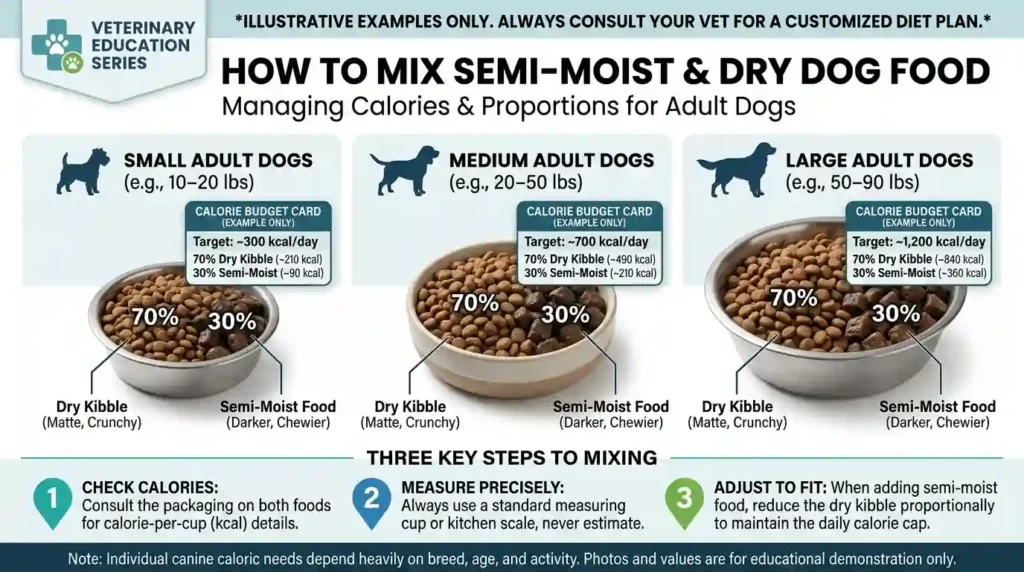
If a pouch contains 474 kcal, one-quarter contains approximately 119 kcal.
That amount should be included in the dog’s daily calorie budget.
Using Small Pieces of Moist & Meaty as Training Rewards
Small pieces can be used as rewards during training.
However, repeated rewards can contribute meaningful calories.
For additional information about positive reinforcement and daily routines, explore Dog Behavior and Training.
How to Reduce Kibble Portions When Adding Moist & Meaty
Calculate the calories supplied by the topper.
Subtract that amount from the dog’s other food allowance.
Use the kibble’s calorie declaration to determine the appropriate reduction.
9.3 How Much Purina Moist & Meaty Should You Feed Daily?
Follow the feeding instructions for the exact formula.
The amount depends on weight, activity, body condition, and calorie requirements.
9.4 Purina Moist & Meaty Feeding Chart by Dog Weight
The following table reflects the published Steak Flavor feeding guide.
| Adult Dog Weight | Recommended Daily Pouches |
| 3–12 lb | 1/3–1 |
| 13–20 lb | 1–1½ |
| 21–35 lb | 1½–2 |
| 36–50 lb | 2–2⅔ |
| 51–75 lb | 2⅔–3½ |
| 76–100 lb | 3½–4¼ |
| Over 100 lb | 4¼ plus ¼ pouch per additional 10 lb |
These are manufacturer guidelines for average adult dogs with normal activity.
Individual requirements may differ substantially.
9.5 How to Calculate Calories When Mixing With Dry Kibble
Suppose a dog needs 800 kcal per day.
If half a Steak Flavor pouch provides approximately 237 kcal, the remaining 563 kcal must come from other foods.
If the kibble supplies 400 kcal per cup, approximately 1.41 cups would provide 563 kcal.
9.6 Can You Mix Moist & Meaty With Wet Dog Food?
Yes, provided the total diet remains appropriate and calorie intake is controlled.
However, combining multiple complete foods does not automatically improve nutrition.
9.7 Example Daily Calorie Budget for Small, Medium, and Large Dogs
| Example Daily Calories | Moist & Meaty Calories | Remaining Calories |
| Small dog: 300 kcal | 75 | 225 |
| Medium dog: 800 kcal | 200 | 600 |
| Large dog: 1,200 kcal | 300 | 900 |
These are educational examples, not recommended amounts for specific body weights.
9.8 How to Transition Your Dog to Purina Moist & Meaty
Seven-Day Dog Food Transition Schedule
| Days | Old Food | New Food |
| 1–2 | 75% | 25% |
| 3–4 | 50% | 50% |
| 5–6 | 25% | 75% |
| 7 onward | 0% | 100% |
Adjust for differences in calorie density.
Some sensitive dogs may require seven to ten days or longer.
Signs of Good Digestive Tolerance
Normal appetite, stable stool quality, comfortable digestion, and consistent activity are positive signs.
When to Slow Down or Stop the Transition
Slow the transition if mild digestive upset develops.
Seek veterinary care for persistent vomiting, severe diarrhea, lethargy, or other concerning symptoms.
9.9 Common Feeding Mistakes to Avoid
Common mistakes include feeding entire pouches as extra snacks, ignoring calories, switching abruptly, and using an adult-maintenance formula for puppies.
Another mistake is assuming that a complete food is automatically appropriate for every medical condition.
10. What to Monitor During the First 30 Days on Purina Moist & Meaty
10.1 Week 1: Appetite, Stool Quality, and Digestive Adjustment
Monitor appetite, stool consistency, vomiting, and general comfort.
Record food amounts and any digestive changes.
10.2 Week 2: Food Tolerance and Energy Levels
Observe whether the dog is eating consistently and maintaining normal activity.
Persistent digestive symptoms require evaluation.
10.3 Week 3: Weight, Skin, and Coat Monitoring
Track body weight, itching, coat condition, and other visible changes.
However, short-term observations cannot prove that a particular food caused an improvement or problem.
10.4 Week 4: Body Condition and Overall Health Assessment
Review weight trends, appetite, stool quality, and energy.
The goal is to determine whether the food appears suitable for the dog’s ongoing needs.
10.5 Warning Signs That Require Veterinary Attention
Repeated vomiting, bloody diarrhea, severe lethargy, collapse, breathing difficulty, or significant appetite loss should prompt veterinary care.
10.6 Printable 30-Day Dog Food Monitoring Checklist
| Observation | What to Record |
| Daily portion | Pouches or grams |
| Appetite | Normal, reduced, increased |
| Stool quality | Normal, soft, hard |
| Vomiting | Yes or no |
| Energy level | Normal or unusual |
| Skin and coat | Itching, redness, changes |
| Weight | Weekly measurement |
| Other notes | Treats, medication, illness |
11. Purina Moist & Meaty Storage, Shelf Life, and Freshness
11.1 How to Store Unopened Purina Moist & Meaty Pouches
Store unopened pouches in a cool, dry environment.
Keep them away from direct sunlight, excessive heat, and moisture.
11.2 Does Purina Moist & Meaty Need Refrigeration?
Unopened shelf-stable pouches generally do not require refrigeration.
Once opened, follow package instructions for prompt use and storage.
11.3 How Long Does Moist & Meaty Last Once Opened?
The safest approach is to serve opened food promptly.
If keeping leftovers, follow manufacturer instructions and refrigerate when necessary.
Do not assume an opened pouch remains shelf-stable under the same conditions as an unopened pouch.
11.4 How Humectants and Packaging Help Maintain Freshness
Humectants influence water availability and texture.
Sealed packaging helps protect the food from contamination.
Both contribute to the product’s storage characteristics.
11.5 Best-By Dates and Storage Recommendations
Check the best-by date before feeding.
Keep the original packaging or photograph its information.
11.6 Signs That Purina Moist & Meaty May Be Spoiled
Potential signs include mold, unusual odor, discoloration, leakage, damaged seals, or unexpected texture changes.
Do not feed suspicious food.
11.7 Are Individual Pouches Better for Portion Control and Freshness?
Individual pouches can reduce repeated exposure of the entire food supply to air.
However, they also generate additional packaging waste.
Their convenience should be weighed against cost and environmental considerations.
12. Purina Moist & Meaty Customer Reviews and Real-World Experiences
12.1 What Dog Owners Like About Purina Moist & Meaty
Positive customer feedback often emphasizes the soft texture, ease of serving, and dogs’ willingness to eat the food.
12.2 Most Common Customer Complaints
Complaints may involve ingredients, packaging, price, digestive tolerance, or individual flavor preferences.
12.3 Customer Experiences With Flavor and Palatability
Some dogs prefer semi-moist food to crunchy kibble.
However, palatability varies between individuals.
12.4 Digestibility and Stool Quality Feedback
Owners may report changes in stool quality when switching foods.
However, customer reports do not establish clinical digestibility or causation.
12.5 Real-World Shelter Feeding Experiences
Some competitor reviews describe shelter-based feeding experiences.
These reports can illustrate practical feeding considerations but are anecdotal.
Initial Food Acceptance
Food acceptance may be influenced by aroma, texture, and an animal’s previous diet.
Daily Feeding Observations
Shelter caregivers may monitor appetite, meal completion, and stool consistency.
Reported Health and Behavioral Changes
Behavioral or health changes cannot be attributed confidently to a food without appropriate controls and medical evaluation.
12.6 Long-Term Customer Feedback
Long-term users may value consistent product availability and feeding routines.
However, individual experiences cannot prove that the food is optimal for every dog.
12.7 Product Reliability and Consistency
Owners should periodically inspect packaging and verify current labels.
Changes in product appearance or availability may result from reformulation or supply differences.
12.8 Overall Customer Satisfaction
Moist & Meaty appeals to owners seeking convenience and soft texture.
Ingredient-focused reviewers may assess it less favorably because of added sugars and preservatives.
Both perspectives should be considered.
13. Purina Moist & Meaty Pricing and Value for Money
13.1 How Much Does Purina Moist & Meaty Cost?
Pricing varies by retailer, package size, region, and promotions.
Individual pouches may cost more per calorie than larger bags of dry kibble.
13.2 Price per Pouch and Package
Calculate price per pouch by dividing total package cost by the number of pouches.
For example, a hypothetical 12-pouch package costing $14 would cost approximately $1.17 per pouch.
This is an illustrative price, not a verified current retail offer.
13.3 Cost per Serving and per 1,000 Calories
Using a hypothetical $1.17 pouch price and 474 kcal per pouch:
Cost per 1,000 kcal is approximately $2.47.
This calculation is useful when comparing foods with different moisture contents.
13.4 Estimated Daily and Monthly Feeding Costs
| Daily Calorie Requirement | Illustrative Daily Cost | Illustrative Monthly Cost |
| 300 kcal | $0.74 | $22.23 |
| 600 kcal | $1.48 | $44.46 |
| 900 kcal | $2.22 | $66.69 |
| 1,200 kcal | $2.96 | $88.92 |
These examples use the hypothetical price above and assume all calories come from Moist & Meaty.
Actual feeding amounts and retail prices will differ.
13.5 Purina Moist & Meaty vs. Dry Kibble Cost
Dry kibble is often less expensive per calorie.
For example, if dry kibble costs $1 per 1,000 kcal, feeding 900 kcal daily would cost approximately $27 per month.
At the hypothetical Moist & Meaty cost above, the same energy would cost more.
13.6 Purina Moist & Meaty vs. Canned Wet Dog Food Cost
Canned wet food often contains substantially more moisture.
Its cost per calorie depends on formula, can size, and retailer.
A fair comparison should use calories rather than weight or container count alone.
13.7 Hidden Costs of Feeding Semi-Moist Dog Food
Potential hidden costs include higher price per calorie, additional packaging waste, and the need to manage multiple pouches daily.
13.8 Where to Buy Purina Moist & Meaty
Purina Moist & Meaty is commonly sold through major U.S. retailers, including Walmart, Amazon, Chewy, and grocery stores.
Check current availability and packaging before purchasing.
13.9 Is Purina Moist & Meaty Worth the Money?
Moist & Meaty may be worth the cost for owners who prioritize convenience and soft texture.
However, ordinary dry kibble may offer better economic value for many healthy dogs.
14. Purina Moist & Meaty vs. Other Dog Foods
14.1 Purina Moist & Meaty vs. Freshpet
Ingredient Quality and Processing
Freshpet emphasizes refrigerated prepared dog food.
Moist & Meaty is shelf-stable and semi-moist.
Their ingredient choices and processing methods differ.
Moisture, Nutrition, and Texture
Freshpet products generally contain more moisture than Moist & Meaty.
Both can provide complete nutrition when appropriately formulated.
Storage and Convenience
Moist & Meaty does not require refrigeration before opening.
Freshpet requires refrigerated storage.
Price and Overall Value
Freshpet is often positioned at a higher price point.
For a closer comparison, read Is Freshpet Good for Dogs.
14.2 Purina Moist & Meaty vs. Purina Pro Plan Wet Food
Purina Pro Plan wet foods offer different formulations and textures.
Some provide specialized nutritional features.
Moist & Meaty emphasizes soft, shelf-stable convenience rather than specialized veterinary nutrition.
14.3 Purina Moist & Meaty vs. Nature’s Menu
Nature’s Menu offers products positioned around different ingredient and feeding philosophies.
Availability and formulations vary by market.
Compare the actual recipe’s nutritional adequacy, storage requirements, and costs rather than assuming a brand’s marketing approach establishes superiority.
14.4 Purina Moist & Meaty vs. Mid-Range Dry Kibble
Mid-range dry foods may offer lower cost per calorie and different ingredient profiles.
Examples include Purina ONE, IAMS, and selected Diamond Naturals formulas.
Our article Is Diamond Naturals a Good Dog Food provides another comparison.
14.5 Semi-Moist vs. Wet vs. Dry Dog Food: Which Is Better?
| Factor | Semi-Moist | Wet | Dry |
| Texture | Soft and chewy | Very soft | Crunchy |
| Moisture | Moderate | High | Low |
| Refrigeration before opening | Usually unnecessary | Usually unnecessary for sealed cans | Unnecessary |
| Cost per calorie | Often moderate | Often higher | Often lower |
| Feeding convenience | Individual pouches | Cans or trays | Bags and scoops |
| Suitability | Depends on formula | Depends on formula | Depends on formula |
No format is universally best.
14.6 Best Alternatives to Purina Moist & Meaty
Alternatives for Dogs That Prefer Soft Food
Options include suitable canned foods, refrigerated complete diets, and moistened dry kibble.
Our review is just food for dogs good examines another prepared-food approach.
Alternatives for Owners Seeking Different Ingredients
Owners seeking different protein or carbohydrate sources may consider limited ingredient or other complete diets.
For example, is natural balance dog food good explores another ingredient-focused brand.
Affordable Complete and Balanced Alternatives
Budget-conscious owners may consider Dog Chow, Beneful, Pedigree, Pure Balance, or other appropriate formulas.
Our reviews of is purina dog chow good, Is Beneful a Good Dog Food, and Pedigree a good dog food provide further comparisons.
For other mainstream alternatives, explore Is Diamond Dog Food Good and is pure balance dog food good.
Owners evaluating premium or veterinary-oriented foods can read is hills a good dog food.
For higher-energy feeding options, see is black gold dog food good and Is Next Level dog food good.
15. Purina Moist & Meaty Sustainability and Ethical Considerations
15.1 Environmental Impact of Semi-Moist Dog Food Manufacturing
Commercial pet food production uses agricultural ingredients, water, energy, packaging, and transportation.
Semi-moist food has different processing and storage characteristics from dry or refrigerated diets.
However, environmental impact cannot be determined from moisture content alone.
15.2 Ingredient Sourcing and Supply Chain Practices
Purina describes supplier standards and manufacturing controls.
Ingredient sourcing can influence environmental and ethical outcomes.
However, specific sustainability claims should be supported by measurable evidence.
15.3 Individual Pouch Packaging and Waste
Individual pouches improve convenience but create more packaging units.
Local recycling acceptance varies according to materials and municipal systems.
15.4 Animal Welfare and Feeding Research Ethics
Animal feeding research can provide information about nutrition and health.
Ethical considerations include study design, animal welfare, veterinary oversight, and the necessity of testing.
15.5 Purina’s Sustainability and Social Responsibility Initiatives
Purina participates in broader corporate sustainability programs.
However, company-wide initiatives should not automatically be interpreted as product-specific environmental achievements.
16. Why Do Purina Moist & Meaty Reviews and Ratings Disagree?
16.1 Ingredient-Based Ratings vs. Nutritional Adequacy Ratings
Some reviewers emphasize ingredient lists and processing methods.
Others place greater weight on AAFCO nutritional adequacy, manufacturer research, and practical feeding outcomes.
These different methodologies can produce substantially different scores.
16.2 Why Some Review Sites Rate Moist & Meaty Poorly
Ingredient-focused reviewers commonly criticize high-fructose corn syrup, soy ingredients, artificial colors, preservatives, and processing.
These concerns may be important to consumers.
However, they should not be confused with an official regulatory finding that the food is unsafe.
16.3 Why Other Reviewers Give Moist & Meaty Positive Ratings
Other reviewers emphasize complete adult maintenance nutrition, manufacturing expertise, affordability, convenience, and customer satisfaction.
From this perspective, the product can be a reasonable choice for healthy adults.
16.4 How Much Weight Should You Give Customer Reviews?
Customer reviews can provide information about food acceptance, packaging, and practical use.
However, individual reports do not establish clinical benefits or causal relationships.
16.5 How to Evaluate Dog Food Ratings Objectively
Look at the criteria behind the score.
Determine whether it reflects ingredient preferences, nutritional adequacy, safety records, customer ratings, or independent testing.
A high score does not guarantee suitability for every dog, and a low ingredient score does not automatically prove a food is dangerous.
17. How Purina Moist & Meaty Was Evaluated
17.1 Review Methodology and Evaluation Criteria
This review considers manufacturer information, nutritional adequacy, ingredients, calorie density, processing, safety history, practical feeding, and cost.
17.2 Ingredient and Label Analysis Process
Representative Purina product labels were examined for ingredients and nutritional characteristics.
Older formulations were distinguished from current availability where possible.
17.3 Nutritional Data and Guaranteed Analysis
Published guaranteed analyses and metabolizable energy values were used.
Calculated nutrient densities were identified as estimates rather than laboratory measurements.
17.4 Recall and Food Safety Verification
Recall discussions distinguish Moist & Meaty-specific records from broader Purina brand recalls.
17.5 Price and Competitor Comparison Method
Price calculations are illustrative because actual retail prices vary.
Comparisons focus on calories and nutritional purpose.
17.6 Research Sources and Veterinary References
The evaluation draws on established nutritional principles, manufacturer labels, FDA pet food information, AAFCO adequacy concepts, and WSAVA manufacturer-selection guidance.
17.7 Review Limitations and Editorial Transparency
This article does not represent independent laboratory testing or a controlled feeding trial.
The editorial rating is qualitative.
Nutrient labels, ingredients, availability, and prices can change.
The review is educational and does not replace individualized veterinary advice.
18. Frequently Asked Questions About Purina Moist & Meaty
18.1 Is Purina Moist & Meaty Grain-Free?
No, the reviewed formulas contain wheat flour and other grain-derived ingredients.
18.2 Is Purina Moist & Meaty Made in the USA?
Purina manufactures most U.S.-market pet foods domestically, but verify the exact product if manufacturing origin matters.
18.3 Does Purina Moist & Meaty Contain Real Meat?
Yes, reviewed recipes include ingredients such as chicken, beef, and animal by-products.
18.4 Is Purina Moist & Meaty the Same as Canned Dog Food?
No, it is a semi-moist food with lower moisture than typical canned diets.
18.5 Does Purina Moist & Meaty Contain Artificial Preservatives?
Reviewed labels include preservatives such as ethoxyquin, sorbic acid, and calcium propionate.
18.6 Is Purina Moist & Meaty Suitable for Small-Breed Dogs?
Yes, appropriate adult formulas may suit healthy small dogs when portions are controlled.
18.7 Can You Feed Moist & Meaty Without Adding Other Food?
Yes, reviewed complete and balanced adult-maintenance formulas can serve as sole diets for suitable adult dogs.
18.8 Is Purina Moist & Meaty Better Than Regular Dry Kibble?
Not universally; each format has different texture, moisture, cost, and nutritional characteristics.
Is Purina Moist & Meaty Good for Dogs?
It can be suitable for many healthy adults, but added sugars and other ingredients may make alternatives preferable.
Is Purina Moist and Meaty Bad for Dogs?
Not inherently, although it may be unsuitable for certain medical conditions or ingredient sensitivities.
Is Purina Moist and Meaty Good for Dogs With Diabetes?
It is generally not the first choice without veterinary guidance because several recipes contain added sugars.
Can Puppies Eat Purina Moist & Meaty?
Standard adult-maintenance formulas should not be used as a puppy’s sole diet.
Is Purina Moist & Meaty Good for Senior Dogs?
Some healthy seniors may benefit from its soft texture, depending on their nutritional needs.
Does Moist & Meaty Need Refrigeration?
Unopened shelf-stable pouches generally do not, but opened food should be handled according to package instructions.
Can Moist & Meaty Be Used as Training Treats?
Yes, in small controlled portions included in the dog’s daily calorie allowance.
Does Purina Moist & Meaty Contain High-Fructose Corn Syrup?
Yes, it appears in the ingredient lists of the representative reviewed formulas.
How Much Sugar Is in Purina Moist & Meaty?
The exact total sugar quantity is not disclosed in the standard reviewed guaranteed analyses.
Has Purina Moist & Meaty Been Recalled?
No confirmed Moist & Meaty-specific recall was identified in the public records reviewed through October 2026.
Is Moist & Meaty Good for Picky Eaters?
Its soft texture and savory flavors may appeal to some picky eaters.
Is Purina Moist & Meaty Worth the Money?
It may be worth the cost for convenience and texture, although dry kibble often costs less per calorie.
19. Final Verdict: Is Purina Moist & Meaty Worth Buying?
Purina Moist & Meaty can be worth buying for healthy adult dogs that enjoy soft food and tolerate its ingredients.
Its major advantages include convenient packaging, a chewy texture, several flavors, and complete adult maintenance nutrition in the reviewed formulas.
However, it is not the strongest choice for every feeding situation.
Added sugars, soy ingredients, artificial colors, and preservatives make its ingredient profile less appealing than that of some alternatives.
The standard formulas are also not intended for growing puppies or dogs requiring specialized clinical nutrition.
The best choice depends on the dog’s individual needs.
Overall editorial verdict: 3.5/5 — a convenient, nutritionally adequate adult dog food with meaningful ingredient-related limitations.
20. Final Thoughts
So, is Moist and Meaty good for dogs? For many healthy adult dogs, it can be an acceptable everyday food. Its soft texture, individual pouches, and complete adult maintenance formulation make it a convenient option, especially for dogs that dislike crunchy kibble.
However, the presence of high-fructose corn syrup, soy ingredients, artificial colors, and preservatives deserves attention. Dogs with diabetes, food allergies, or other medical conditions may need more specialized nutrition.
Before buying, compare the current ingredient list, check the nutritional adequacy statement, review calories per pouch, and consider your dog’s health and feeding preferences. When in doubt, consult your veterinarian.
For more evidence-based comparisons and practical feeding guidance, explore our Dog Food Brand Reviews to find a formula that fits your dog’s needs and your budget.