


Summary: Dogs bark at other dogs on walks due to a complex mix of fear, anxiety, territorial instincts, frustration, and lack of proper socialization. This behavior — commonly called leash reactivity — is one of the most misunderstood and frustrating challenges dog owners face. Understanding the root causes, reading your dog’s body language, and applying science-backed training techniques can dramatically reduce or eliminate reactive barking, making walks a calming, enjoyable experience for both you and your dog.
Table of Contents
- What Is Leash Reactivity in Dogs?
- Why Dogs Bark at Other Dogs on Walks: The Core Reasons
- Reading Your Dog’s Body Language During Reactive Episodes
- The Role of the Leash in Triggering Reactive Barking
- Breeds More Prone to Leash Reactivity
- How to Stop Your Dog Barking at Other Dogs on Walks
- Common Mistakes Owners Make During Reactive Episodes
- When to Seek Professional Help
- Prevention: Raising a Non-Reactive Dog
- Frequently Asked Questions
What Is Leash Reactivity in Dogs?
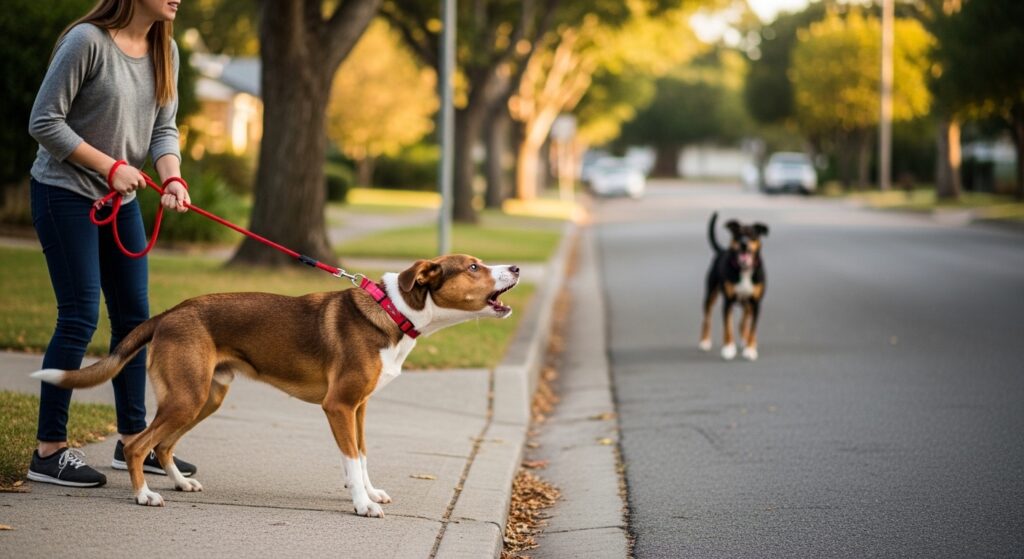
Leash reactivity refers to a dog’s exaggerated emotional and behavioral response to a stimulus — typically other dogs, people, cyclists, or vehicles — while on a leash. The most common display of leash reactivity is barking, lunging, growling, and pulling, which often escalates the moment another dog appears within the dog’s visual range.
It’s important to understand that leash reactivity is not simply “bad behavior” or disobedience. It is a deeply ingrained emotional response driven by the dog’s neurological stress system — the amygdala — being triggered into a fight-or-flight state. When a dog cannot flee due to the leash constraint, barking and lunging become the default coping mechanism.
Leash reactivity exists on a spectrum. Some dogs display mild barking that stops quickly once the trigger passes. Others exhibit intense, prolonged episodes that are difficult to interrupt. According to the American Kennel Club’s guide on dog behavior, reactive behavior is among the most commonly reported behavioral concerns by dog owners, yet it remains widely misunderstood.
The Difference Between Reactivity and Aggression
These two terms are often used interchangeably, but they describe different states. Reactivity is an emotional overreaction — often rooted in anxiety — while aggression is an intentional behavior aimed at causing harm. A reactive dog is not necessarily dangerous; it is overwhelmed. However, if reactivity goes unaddressed, it can escalate into aggression over time as the dog learns that its behavior successfully keeps other dogs away.
Why Dogs Bark at Other Dogs on Walks: The Core Reasons
Fear and Anxiety-Based Barking
Fear is the most prevalent driver of reactive barking in dogs. When a dog perceives another dog as a potential threat, the body floods with cortisol and adrenaline — the same stress hormones seen in humans experiencing panic. The dog’s sympathetic nervous system activates, and barking becomes an attempt to make the perceived threat disappear.
Dogs that bark out of fear typically display what behaviorists call “distance-increasing signals” — they want the other dog to go away. This is the opposite of the playful dog who wants to approach. Fear-based barkers often have a history of insufficient positive exposure to other dogs, particularly during the critical socialization window (3 to 14 weeks of age).
Frustration and Over-Excitement
Not all reactive barkers are afraid. A significant percentage of dogs bark out of frustration — they want to reach the other dog and cannot. This is sometimes called “frustrated greeter syndrome.” These dogs may have learned early in life that pulling toward other dogs sometimes results in getting to say hello, so the behavior becomes reinforced.
The frustration-based barker is often misidentified as aggressive or fearful. Their body language can look intense, but the underlying emotion is excitement rather than terror. Over time, however, a frustrated greeting can tip into genuine frustration-based aggression if the dog continues to be prevented from reaching its goal.
Territorial and Protective Instincts
Many dogs perceive their walking route as an extension of their home territory. When another dog enters this perceived space, the territorial drive activates. This is especially common in herding breeds (Border Collies, Australian Shepherds), guarding breeds (German Shepherds, Rottweilers), and working breeds with deeply ingrained protective instincts.
Dogs with strong protective instincts may also bark reactively when their owner is present but remain calm when alone, because they are specifically guarding their human companion. This nuance is important — it tells us the behavior has an environmental and relational trigger, not just a dog-to-dog one.
Poor or Incomplete Socialization
The socialization window in puppies — approximately 3 to 14 weeks of age — is a critical developmental period during which positive exposure to other dogs, people, sounds, and environments shapes the dog’s emotional responses for life. Puppies who miss this window, whether due to early isolation, illness, or being kept away from the world, often grow into reactive adults who simply do not know how to process the presence of other dogs.
Much like a puppy scared to go outside at night, under-socialized dogs struggle to feel safe in new environments and situations, and this vulnerability often shows up as reactive barking on leash.
Rescue dogs and dogs with unknown histories are particularly susceptible, as their early developmental experiences may have been traumatic, chaotic, or non-existent in terms of positive social exposure.
Negative Past Experiences and Trauma
A single traumatic event with another dog can rewire a dog’s threat-response system dramatically. An attack by an off-leash dog, a highly stressful interaction at a dog park, or even repeated overwhelming experiences can cause the dog’s brain to associate “other dog approaching” with “danger incoming.” This is called associative learning — and it is extremely powerful.
Dogs that have experienced trauma may generalize their fear to all dogs of a similar size, color, or movement pattern. A dog attacked by a large black Labrador may subsequently bark at all large, dark-colored dogs. This specificity in triggers gives owners and trainers important diagnostic information.
Reading Your Dog’s Body Language During Reactive Episodes
Stress Signals and Warning Signs
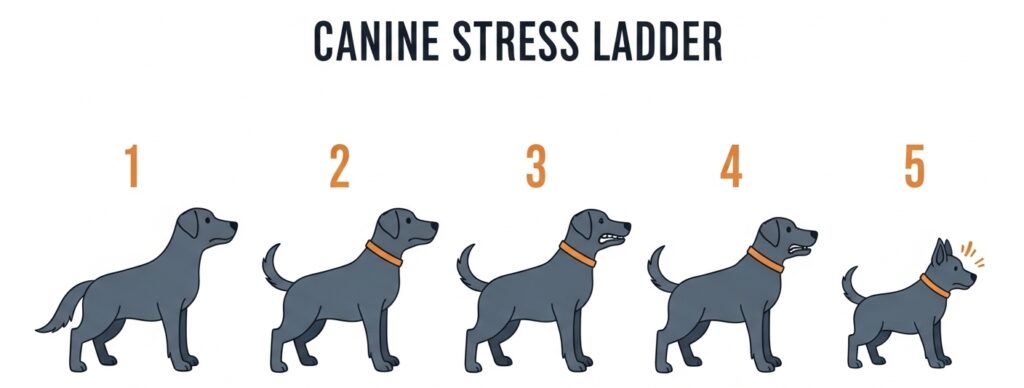
Understanding the progression of your dog’s stress response — sometimes called the “stress ladder” or “ladder of aggression” — is essential for early intervention. Signals escalate from subtle to severe:
Early Warning Signs (often missed):
- Yawning, lip licking, blinking
- Sniffing the ground suddenly (displacement behavior)
- Whale eye (showing whites of eyes)
- Stiff body posture
- Tail carried high or tucked low
Mid-Level Signals:
- Hard staring (fixed gaze toward trigger)
- Hackles raised (piloerection along the spine)
- Freezing in place
- Low growling
Escalated Response:
- Barking, lunging, snapping
- Spinning on the leash
- Inability to redirect or respond to commands
Recognizing early warning signs allows you to intervene before the dog reaches full reactivity — which is far easier than trying to de-escalate an already barking dog.
Distinguishing Fear from Aggression
A fearful dog will often try to appear smaller — crouching, tucking the tail, pulling the ears back. An aggressive dog will try to appear larger — standing tall, hackles up, tail erect. Understanding which emotion drives your dog’s barking is fundamental because the training approaches differ significantly. Fear requires confidence-building; frustration requires impulse control; aggression requires careful behavioral modification with professional guidance.
The Role of the Leash in Triggering Reactive Barking
The Leash Frustration Theory
The leash itself is a major contributing factor to reactive behavior — hence the term “leash reactivity.” Off-leash, many dogs who bark intensely at leashed dogs will approach and greet calmly. The physical constraint of the leash disrupts a dog’s natural communication and approach patterns.
Dogs typically greet each other in an arc — approaching at an angle, sniffing, circling. On a leash, this natural choreography is impossible. The dog is forced into a direct, head-on approach, which in dog body language signals a confrontation rather than a friendly greeting. This unnatural social dynamic creates tension that erupts as barking.
How Owner Tension Affects Dog Behavior
When an owner sees another dog approaching and tightens the leash preemptively, that tension travels down the leash and directly into the dog’s collar. The dog interprets this physical tightening as a signal that something threatening is incoming — and escalates accordingly. This creates a self-fulfilling prophecy: the owner tenses, the dog tenses, the dog reacts, and the owner’s belief that their dog is dangerous is reinforced.
Learning to remain calm, breathe normally, and keep a loose leash as another dog passes is one of the most impactful behavioral changes an owner can make — even before any formal training begins.
Breeds More Prone to Leash Reactivity
While any dog can develop leash reactivity regardless of breed, certain genetic predispositions make some breeds more susceptible:
High-Energy Herding Breeds: Border Collies, Australian Shepherds, and Belgian Malinois are wired to monitor movement intently. Their reactive responses to other dogs often stem from the same neurological drive that makes them excellent working dogs.
Terrier Breeds: Jack Russell Terriers, Bull Terriers, and Staffordshire Terriers were historically bred for tenacity and high prey drive, which can manifest as intense reactions to other dogs.
Guarding Breeds: Rottweilers, Dobermans, and German Shepherds have strong territorial instincts that can produce reactive barking toward perceived intruders in their territory.
Rescue Dogs and Mixed Breeds: Unknown histories and inconsistent early socialization make reactive behavior especially common in shelter and rescue populations.
That said, breed is only one factor. Individual temperament, socialization history, and owner behavior play equally significant roles in whether a dog develops reactive tendencies.
How to Stop Your Dog Barking at Other Dogs on Walks
Threshold Training and Distance Management
The “threshold” is the distance at which your dog first notices but has not yet reacted to another dog. Working below threshold — keeping your dog far enough away from the trigger that they can still think clearly and respond to you — is the foundation of all effective reactivity training.
Begin by identifying your dog’s threshold distance. For some dogs it is 50 feet; for others it may be 200 feet. Once identified, consistently keep your dog under this distance during training sessions. As the dog’s comfort increases, gradually decrease the distance over weeks and months.
Counter-Conditioning and Desensitization
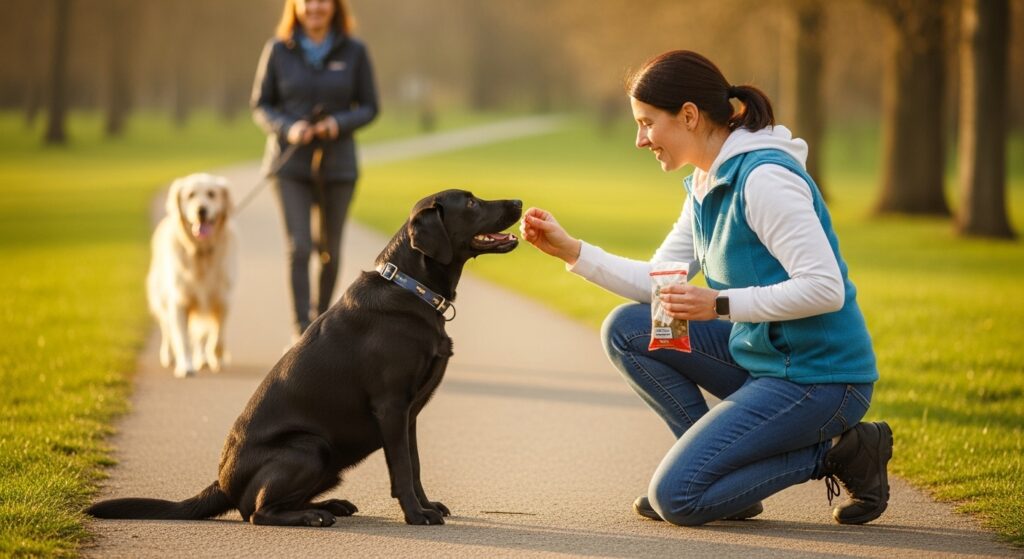
Counter-conditioning (CC) works by changing the emotional association a dog has with a trigger. Instead of “other dog = danger,” the goal is to create the response “other dog = amazing treats appear.” Each time the trigger (another dog) appears at or below threshold, immediately pair it with something the dog loves intensely — high-value food, a favorite toy, or enthusiastic praise.
Desensitization (DS) refers to gradual, controlled exposure to the trigger at increasing intensity over time. Combined (CC&DS), this approach is considered the gold standard for treating anxiety-based reactivity by certified applied animal behaviorists worldwide.
The “Look at That” (LAT) Protocol
Developed by Leslie McDevitt in her landmark book Control Unleashed, the LAT protocol teaches dogs to calmly observe their trigger and then voluntarily look back at their owner. The mechanics are simple: when your dog looks at another dog without reacting, mark the moment with a clicker or verbal marker (“yes!”) and reward immediately.
Over time, the dog learns that noticing another dog earns a reward and that looking back at you is both rewarding and calming. The dog’s nervous system begins to associate the previously threatening stimulus with calm, positive outcomes.
Positive Reinforcement Techniques
Punishment-based methods — yelling, leash corrections, shock collars — are strongly contraindicated for reactive dogs. Punishment adds to the dog’s anxiety and, critically, teaches the dog that the presence of other dogs causes bad things to happen, which deepens the reactive association rather than resolving it.
Positive reinforcement, by contrast, builds new neural pathways. The following techniques are particularly effective:
- Emergency U-Turn: Teach your dog to spin and walk the opposite direction on a verbal cue. Practice at home, reward generously, then deploy the moment a trigger appears before threshold is reached.
- “Find It” Scatter Feeding: Scatter treats on the ground as another dog passes. Sniffing is inherently calming for dogs (it activates the parasympathetic nervous system) and redirects attention downward and away from the trigger.
- Hand Targeting: Teaching your dog to touch their nose to your palm gives you an interrupter behavior that is incompatible with barking and redirects focus onto you.
Management Tools: Harnesses, Head Collars, and Muzzles
While training is the long-term solution, management tools can increase safety and reduce practice of the unwanted behavior during the training period:
- Front-clip harnesses redirect the dog’s forward momentum toward you when they lunge, making it physically easier to manage without discomfort.
- Head collars (e.g., Gentle Leader, Halti) give the owner directional control similar to how a horse’s halter works, allowing the head to be gently guided away from the trigger.
- Basket muzzles do not stop barking but provide a safety layer for dogs whose reactivity has escalated to snapping. A muzzled dog can still eat, drink, pant, and bark — and owners often feel more relaxed, which itself improves the dog’s behavior.
Common Mistakes Owners Make During Reactive Episodes
Understanding what not to do is as important as knowing what to do. The following owner behaviors reliably worsen reactivity over time:
Repeating commands the dog cannot hear. During a full reactive episode, the dog’s cortisol is so elevated that it literally cannot process commands. Shouting “sit!” repeatedly is ineffective and adds to the dog’s arousal. Instead, focus on creating distance first, then re-engage once the dog has calmed.
Punishing the bark. Punishing a dog for barking at another dog teaches the dog that bad things happen around other dogs — confirming the original threat assessment. The behavior may reduce temporarily but the underlying anxiety increases.
Allowing “flooding.” Forcing a reactive dog to stand and wait while another dog passes — hoping they will “get used to it” — is a practice called flooding. Without proper preparation and desensitization, flooding intensifies trauma rather than resolving it.
Apologizing to passers-by while ignoring the dog. In the social moment of a reactive episode, many owners turn their attention outward. Your dog needs your calm, directive attention in that moment more than any bystander does.
Avoiding all walks. Avoiding triggers entirely prevents the dog from practicing the reaction, but it also prevents any opportunity for positive association building. Controlled exposure is necessary for progress.
When to Seek Professional Help
Working with a Certified Dog Trainer
If your dog’s reactivity is intense, has been present for a long time, or involves snapping and lunging, it is strongly advised to consult a certified professional. Look for trainers with credentials from reputable organizations such as the Certification Council for Professional Dog Trainers (CCPDT) or the International Association of Animal Behavior Consultants (IAABC), and verify they use force-free, science-based methods.
Group classes are generally not appropriate for highly reactive dogs. Seek out private behavioral consultations or specialized reactivity group classes where triggers are carefully managed.
Behavioral Medication and Veterinary Support
For dogs with anxiety-based reactivity, behavioral medication prescribed by a veterinary behaviorist can be transformative. Medications like fluoxetine (Prozac), sertraline, or trazodone do not sedate dogs — they lower the neurological baseline of anxiety so the dog is capable of learning during training sessions.
Medication alone does not solve reactivity; it creates the neurological space for behavior modification to succeed. Many dogs require a combination of pharmaceutical support and structured positive training to achieve meaningful, lasting results.
Prevention: Raising a Non-Reactive Dog
The best treatment for reactive barking is prevention through proper early socialization. Just as puppy peeing on the bed reflects normal developmental behavior that can be guided with the right approach, early behavioral patterns in puppies — including how they respond to other dogs — are shaped by consistent, positive exposure during the sensitive period.
Key prevention strategies include:
- Puppy socialization classes before 14 weeks of age, in a well-run, safe environment
- Positive, low-pressure exposure to a wide variety of dogs of all sizes, ages, and energy levels
- Teaching puppies to look at you when they see other dogs — building the LAT habit from day one
- Avoiding overwhelming situations that could create a single traumatic memory
- Teaching leash manners early so the dog learns from puppyhood that seeing another dog means checking in with the owner, not pulling forward
Consistency during the first year of a dog’s life dramatically reduces the likelihood of developing leash reactivity, even in breeds with genetic predispositions.
Frequently Asked Questions
Q: Will my reactive dog ever be “cured”? Reactivity can be dramatically reduced and managed to the point where walks are pleasant and controlled. Some dogs reach a point where they appear completely non-reactive. Others require ongoing management. “Better” is a more realistic and honest goal than “cured.”
Q: My dog is fine off-leash — why does he bark on leash? This is classic leash reactivity. The leash prevents normal greeting behavior, creates tension, and constrains the flight response, all of which drive barking. Many dogs who react intensely on leash are perfectly social when off-leash.
Q: How long does it take to see improvement? With consistent training sessions 3–5 times per week, many owners notice meaningful improvement within 6–12 weeks. Deep-seated reactive patterns shaped over years may require 6–12 months of committed work.
Q: Is reactivity genetic? There is evidence that anxiety sensitivity and stress reactivity have heritable components. However, environment, socialization, and training have an enormous influence on whether genetic predispositions manifest as behavioral problems.
Q: Should I get another dog to “socialize” my reactive dog? This is generally not recommended without professional guidance. Adding a second dog to a household with a reactive dog can significantly increase tension and may worsen both dogs’ behavior without structured support.
This guide is intended for educational purposes. For dogs displaying severe reactivity, snapping, or aggression, always consult a qualified certified behaviorist or veterinary professional.