

Summary
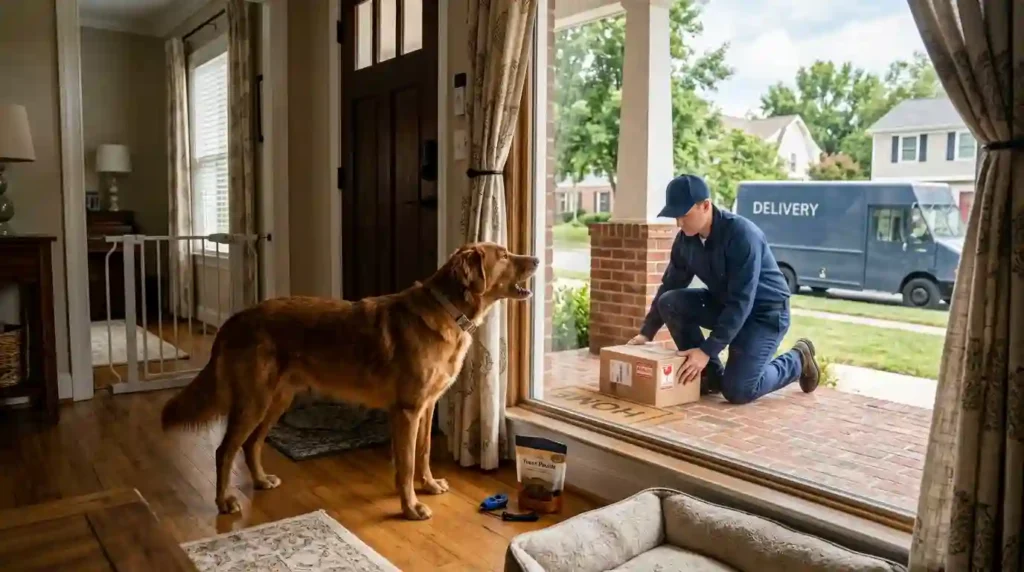
If dog barking at delivery drivers has turned every package drop-off into a noisy emergency, your dog is probably reacting to a predictable chain of sights, sounds, and consequences—not being deliberately disobedient. A delivery truck arrives, footsteps approach the front porch, a parcel appears, the dog sounds the alarm, and the unfamiliar person leaves. To the dog, barking worked. This guide explains how to interrupt that learning loop, identify fear, territorial behavior, or barrier frustration, and build a calmer delivery routine through environmental management, positive reinforcement, counterconditioning, and safe, gradual practice.
Table of Contents
- Why Dog Barking at Delivery Drivers Happens
- Is Your Dog Barking at the Package, Person, or Truck?
- How to Stop Dog Barking at Delivery Drivers
- A Practical 30-Day Training Plan
- What to Do When the Package Itself Is the Trigger
- How Long Can a Dog Be Left Outside Barking?
- Common Training Mistakes
- Delivery-Worker Safety and Owner Liability
- When to Get Professional Help
- Conclusion
- FAQs
Package delivery can create an unusually convincing story in a dog’s mind. A stranger approaches the territory, leaves an unfamiliar object near the property boundary, and disappears immediately after the dog barks. The same sequence may happen several times a week—or several times a day. That repetition can turn a small alert into an intense, learned barking habit.
The good news is that the sequence is predictable. Once you understand the trigger, antecedent, behavior, and consequence, you can change the environment and teach an alternative behavior. For more help with other vocal habits, the broader Dog Barking resource collection can help you compare territorial, attention-seeking, fear-based, and frustration-related patterns.
Why Dog Barking at Delivery Drivers Happens
The Barking Reinforcement Loop
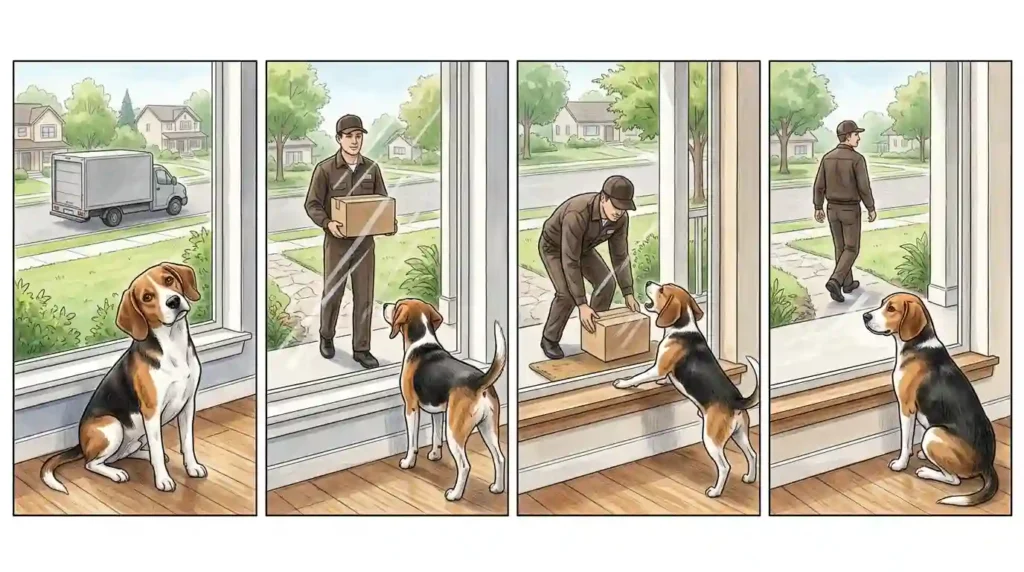
From a human perspective, the delivery driver was always going to leave after the package drop-off. From the dog’s perspective, the timing looks different:
- The delivery truck stops.
- The dog hears engine noise, a sliding door, footsteps, knocking, a doorbell, or mailbox noise.
- A stranger in a uniform approaches the front door or front porch carrying a parcel.
- The dog begins alert barking, territorial barking, growling, or fence rushing.
- The person puts down the package and leaves.
In behavior science, the driver’s arrival is an antecedent, barking is the behavior, and the driver’s departure is the consequence. When barking appears to make a perceived threat go away, it can be strengthened through negative reinforcement. “Negative” does not mean bad; it means that something the dog wanted removed—the intruder—disappeared.
Every unplanned repetition becomes behavior rehearsal. The dog practices the same response and experiences the same apparent success. This barking reinforcement explains why yelling “quiet” after the dog is already lunging at the window rarely changes the long-term pattern.
Territory, Protectiveness, and Perceived Threats
Dogs naturally notice activity near their home. Some offer one or two alert barks and settle. Others interpret a person crossing the property boundary as an invasion of territory. A uniform, a bulky parcel, direct movement toward the house, or a stranger reaching near the mailbox can produce a defensive reaction.
Territorial behavior is not always confident. Protectiveness can be mixed with fear, anxiety, stress, or a startle response. A dog may look bold while barking behind glass, but feel unsafe if the barrier opens. That distinction matters because punishment can make a worried dog feel even more threatened.
Early socialization can reduce the novelty of different people, clothing, sounds, vehicles, and objects. However, even a well-socialized dog can develop alarm barking after repeated delivery routines. Senior dogs may also become more reactive after a hearing change, vision change, pain, or cognitive change alters how they interpret a sudden arrival.
Barrier Aggression, Barrier Frustration, and the Frustrated Greeter
A window, fence, secure gate, front door, crate, baby gate, or leash can prevent contact while increasing emotional intensity. This is often described as barrier frustration or barrier aggression. Some dogs want the person to leave; others are overexcited because they want to greet them. The second type is sometimes called a frustrated greeter.
High arousal can look similar in both cases: barking, spinning, lunging, chasing along the fence, or body-slamming a door. The dog’s motivation, not just the volume, should guide behavior modification. A dog who also struggles when physically restricted may show related behavior covered in Dog Barking When Tied Up or Restrained.
Sound Sensitivity and Environmental Cues
Some dogs react before the delivery person is visible. The low rumble of a delivery truck, brakes, a van door, footsteps, knocking, the thump of a package, or the metallic sound of a mailbox can become an environmental cue. Through learning and behavior generalization, one truck may become every large vehicle, one uniform may become every person carrying a box, and one porch sound may become any unexpected noise outside.
Visual patterns can generalize, too. A dog who patrols reflective glass may react to a delivery driver, a moving shadow, or its own image. If reflections are part of the problem, Dog Barking at Reflections explains how to separate a visual trigger from a territorial one.
Is Your Dog Barking at the Package, Person, or Truck?
Effective training begins with observation. Use a pet surveillance camera if the reaction happens while you are away, or make brief notes about what occurs immediately before the first bark. Does the dog freeze at engine noise, rush to the window when the driver appears, react to the doorbell, or continue barking after only the package remains?
The following patterns can help you identify the likely emotional driver:
| Pattern | Common triggers | Typical body language | Training priority |
| Territorial or alert barking | Person crossing the property, knocking, front-door activity | Stiff posture, forward weight, hard stare, raised hackles | Visual management, place cue, counterconditioning |
| Fear-based reaction | Unfamiliar uniform, large parcel, sudden footsteps | Retreating, hiding, lowered body, growling from a distance | More distance, gradual exposure, positive association |
| Barrier frustration | Window, gate, fence, leash, closed door | Fence rushing, lunging, repeated jumping, frantic movement | Prevent rehearsal, increase impulse control, teach redirection |
| Overexcited greeting | Familiar driver or interesting visitor | Loose body, bouncing, whining, wagging, inability to settle | Self-control, sit-and-watch exercise, calm greeting routine |
| Sound sensitivity | Truck engine, brakes, mailbox, package thump | Startle response, scanning, barking before visual contact | Low-volume desensitization, familiar background sound |
| Broader anxiety or medical concern | Many unrelated noises, being left alone, sudden behavior change | Pacing, whining, inability to recover, sleep, or appetite changes | Veterinarian assessment and qualified behavior support |
Watch the whole body, not the tail alone. A wagging dog can still be tense. A stiff posture, hard stare, raised hackles, growling, snapping, or a sudden pause before lunging deserves more caution than the number of barks. Never punish a growl; it is valuable warning information that can help prevent a dog bite.
Also consider context. Barking caused by separation anxiety usually occurs when the dog is alone and may be accompanied by pacing, whining, destruction, or elimination. Boredom, restlessness, and pent-up energy can amplify a delivery reaction, but they are not always its root cause. A dog can receive plenty of physical exercise and still feel territorial or afraid.
How to Stop Dog Barking at Delivery Drivers
The most reliable plan combines management, skill training, and emotional change. Environmental management prevents more rehearsal. An obedience cue gives the dog something safe to do. Counterconditioning changes how the trigger feels. Desensitization makes the situation easier enough for learning to occur.
Step 1: Prevent Uncontrolled Rehearsal
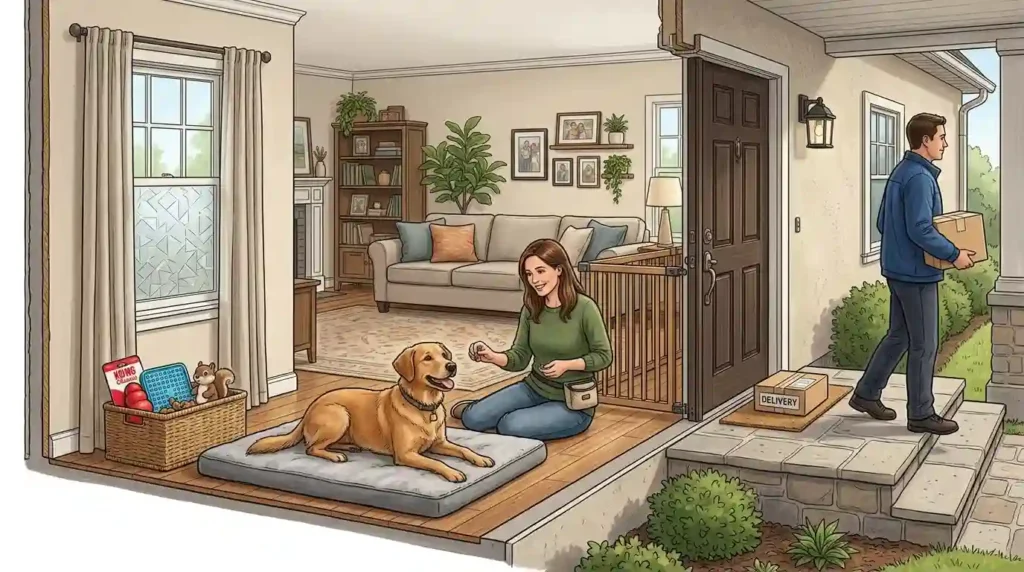
Begin with visual blocking and distance. Close blinds or curtains during common delivery hours, apply removable window film to the lower portion of front-facing glass, and move the dog bed away from the window. If the dog races a fence line, use secure, opaque fencing rather than allowing a clear view of the sidewalk or driveway.
Create two layers of safety whenever the front door may open. A baby gate can separate the entryway from the rest of the house. A back room, crate, or gated safe space can provide a second barrier. The space should be comfortable and previously associated with rest, not used as punishment after an outburst.
Mask unpredictable sounds with television, a fan, white noise, or another familiar background sound. The same principle can help in temporary environments; this guide on how to stop dog barking in a hotel room shows why reducing unfamiliar sights and hallway sounds often improves a dog’s ability to settle.
Management is not a failure. It lowers the number and intensity of barking episodes so new learning has room to take hold.
Step 2: Teach a Place Cue Away From the Door
Choose a training mat or dog bed several feet from the entry. Practice when no delivery is happening:
- Toss a high-value treat onto the mat.
- As the dog steps onto it, say your place cue once.
- Reward again while all four paws remain on the mat.
- Release the dog before it becomes restless.
- Gradually build duration, then add mild movement near the door.
Keep each short training session easy and successful. Five minutes once or twice a day is more productive than a long session that creates frustration. When the dog understands the place cue, add a quiet cue, “stay,” or a sit-and-watch exercise.
You can also teach an alternative behavior, such as toy retrieval. The dog hears a delivery cue, finds a favorite toy, and carries it to the mat. Hand targeting—touching the nose to your palm—can help move the dog away from a window without grabbing its collar. A cheerful, positive interrupter can initiate that redirection before high arousal takes over.
Dogs often respond to tiny predictive signals. A leash being picked up, for example, can become an antecedent for excitement long before a walk begins. Why Does My Dog Bark When I Pick Up the Leash offers a useful comparison for understanding how ordinary cues acquire emotional meaning.
Step 3: Build a Positive Association With Delivery Sounds
Counterconditioning pairs the trigger with something the dog values. Start below the level that produces barking.
- Play a quiet recording of truck brakes, footsteps, knocking, or a doorbell.
- The instant the dog notices the sound, deliver a high-value treat.
- Stop the treats when the sound ends.
- Repeat only a few times, then take a break.
- Increase volume or realism gradually over several sessions.
Reward timing matters. Food should arrive when the dog notices the trigger but is still able to eat, think, and turn toward you. If the dog is barking continuously, refusing food, or showing a hard stare, the setup is too difficult. Lower the volume, increase the distance, or use a less intense sound.
This is not simply bribing the dog to be quiet. The goal is a new prediction: delivery sound means calm behavior and good things, not an intruder emergency.
Step 4: Use Controlled Delivery Reenactment
Ask a friend to help with a delivery reenactment. Do not use the actual mail carrier or delivery driver as an unplanned training assistant.
Start with the helper walking at a distance while the dog remains on a leash, behind a baby gate, or on the training mat. Reward calm observation. Over multiple sessions, the helper can move closer, carry an empty box, approach the porch, touch the mailbox, knock softly, and eventually place a parcel near the door.
Change only one element at a time. If you add a uniform-like jacket, do not simultaneously increase noise, speed, and proximity. This gradual exposure is desensitization. The dog should remain aware but capable of responding to a place cue or hand target.
For a safe dog, a planned mail-carrier introduction may eventually be possible, but only if the carrier willingly participates and the dog has no bite risk. A carrier can toss a treat away from their body without reaching toward the dog. Direct hand-feeding is inappropriate for a dog displaying growling, lunging, snapping, barrier aggression, or guarding.
Step 5: Transfer the Skills to Real Deliveries
Use delivery notifications when available. Before the truck arrives, close the curtains, move the dog to its safe space, and prepare rewards. At the first engine noise or footsteps, give the place cue and reward calm behavior.
If the dog is surprised and begins barking, avoid scolding or yelling. Calmly guide it away from the trigger with the practiced cue, a treat scatter, or toy retrieval. Once the dog can think again, reinforce quiet on the mat. Consistency among family members is essential; one person allowing fence rushing can maintain the behavior rehearsal that everyone else is trying to reduce.
Step 6: Meet Physical and Mental Needs
Appropriate physical exercise can reduce restlessness and pent-up energy. Mental stimulation is equally useful. A food puzzle, food-stuffed toy, KONG, lick mat, or safe chew toy can turn the delivery window into a predictable enrichment period.
Choose enrichment before the dog escalates. Giving a food-stuffed toy at the first quiet cue is different from presenting it only after ten minutes of excessive barking. Supervise chewing, select size-appropriate equipment, and use caution with dogs that guard food.
A Practical 30-Day Training Plan
Every dog progresses at a different rate, but a structured month gives most families a useful starting framework. Severe fear or aggression may require a slower plan designed by a professional dog trainer or certified animal behavior professional.
Week 1: Management and Foundation Skills
- Install window film, close blinds, or rearrange furniture to reduce visual access.
- Establish a safe space in a back room, crate, or gated area.
- Practice the place cue and release word without delivery triggers.
- Begin hand targeting and toy retrieval.
- Record baseline details: trigger, distance, barking duration, recovery time, and body language.
The goal is not zero barking. Aim for faster redirection and a dog that can settle on its mat when the environment is quiet.
Week 2: Low-Intensity Sounds
- Introduce quiet recordings of engine noise, footsteps, knocking, and the doorbell.
- Pair each sound with a high-value treat.
- Keep sessions to three to five minutes.
- Stop before the dog becomes stressed, frustrated, or bored.
- Add a food puzzle or lick mat during predictable delivery periods.
Progress when the dog hears the sound and looks toward you instead of rushing the door.
Week 3: Visual Practice and Reenactment
- Ask a helper to walk past at a comfortable distance.
- Practice the place cue while the helper carries a box.
- Add a quiet porch approach, then a simulated package drop-off.
- Reward a relaxed body, soft gaze, and quick recovery.
- Increase only one challenge per session.
If stiff posture, raised hackles, hard staring, growling, or frantic lunging appear, increase distance immediately. Training near panic does not build self-control.
Week 4: Real-Life Generalization
- Prepare before expected deliveries.
- Use the same cue, mat, and reward sequence each time.
- Practice with different helpers, clothing, box sizes, and vehicle sounds.
- Continue preventing unsupervised window patrol.
- Reduce treat frequency slowly, only after calm behavior is reliable.
Many dogs show measurable improvement within two to six weeks, but a long-established learned barking habit may take several months. Progress is better measured by intensity and recovery than by perfect silence. A dog that gives two alert barks and moves to its bed has made meaningful progress, even if it still notices the delivery.
What to Do When the Package Itself Is the Trigger
Occasionally, the delivery person and truck are gone, but the dog continues barking at the package left outside. A large box on a familiar front porch can look and smell unusual. Wind may move a label or plastic wrapping, creating a startle response. The parcel may also carry scents associated with the delivery truck, warehouse, other animals, or strangers.
Do not open the door while the dog is rushing or lunging. Secure the dog in a back room or behind two barriers, then retrieve the package. Once indoors, let the dog observe from a comfortable distance. Pair calm looking with treats, but do not force an approach or push the parcel toward a fearful dog.
You can practice with clean, empty boxes when no delivery has occurred. Place one far away, reward calm behavior, and remove it. Across short sessions, change the box’s position or size. This creates a positive association with a novel object without the intensity of a real truck, doorbell, and stranger arriving together.
If the dog guards the package, snaps when someone approaches it, or attempts to bite, stop the exercise and contact a qualified professional. Resource guarding and territorial behavior can overlap, but they require a safety-first plan rather than casual exposure.
How Long Can a Dog Be Left Outside Barking?
There is no universal safe or acceptable number of minutes. Local noise ordinances vary, but welfare should come before waiting for a legal limit. Persistent outdoor barking can indicate fear, territorial arousal, loneliness, discomfort, boredom, separation anxiety, heat, cold, pain, or an immediate environmental trigger.
If a dog is outside barking at a delivery truck, mail carrier, package, or passerby, bring it inside as soon as you can do so safely. Do not leave the dog at a fence or secure gate to “bark it out.” That allows more barking reinforcement, increases stress, and can progress from fence rushing to chasing if the dog escapes.
Check water, weather, physical comfort, and the surrounding area. If the barking begins suddenly or the dog cannot settle after returning indoors, consult a veterinarian to rule out a medical cause. Repeated outdoor barking also creates conflict with neighbors and may expose the dog to property damage or escape risks.
Common Training Mistakes
Yelling, Scolding, or Harsh Punishment
To a highly aroused dog, yelling may sound like the owner has joined the alarm. Physical punishment can increase fear and suppress warning signals without changing the motivation to defend territory. A dog that stops growling but remains afraid may proceed to snapping or biting with less warning.
Waiting Until the Dog Is Fully Reactive
Once the dog is lunging, barking continuously, and unable to eat, learning is limited. Intervene at the earliest sign: ears lifting at engine noise, a pause at footsteps, or movement toward the window. Reward calm attention before the explosion.
Opening the Door During Fence Rushing or Lunging
Never rely on a verbal quiet cue as the only safety measure. Use secure containment before opening the door. A dog can slip through a narrow gap faster than a person can react, creating a risk of chasing, a dog attack, or a collision with the delivery worker.
Forcing a Greeting
Being friendly with dogs does not require a delivery worker to meet yours. A forced introduction can intensify fear, and owner’s tension on the leash can increase arousal. Use distance and controlled setups; protect the worker’s right to complete the delivery without contact.
Inconsistent Consequences
If barking sometimes leads to attention, access to the porch, or an exciting greeting, the behavior can persist. Everyone in the home should use the same place cue, safe-space routine, and reward timing.
Removing Management Too Soon
Blinds, window film, baby gates, and familiar background sound should remain in place while training develops. Calm behavior in three practice sessions does not mean the habit is gone. Gradually test easier real-life situations rather than returning immediately to unrestricted window access.
Delivery-Worker Safety and Owner Liability
Delivery-worker safety is not an abstract concern. According to the USPS National Dog Bite Awareness Campaign, dog attacks on postal workers fell to just over 5,200 incidents nationwide in 2025. Even a dog that has never bitten can react differently when a uniformed stranger approaches its territory carrying a parcel.
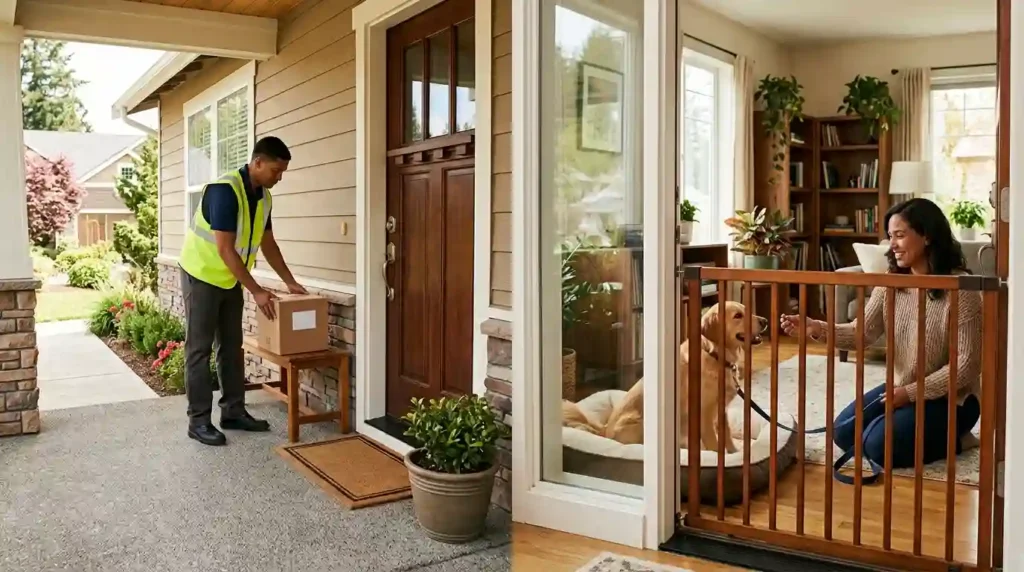
Use secure containment before opening the door. Keep the dog inside, behind a reliable fence, in another room, or on a leash controlled by an adult. Do not allow a child to take mail directly from a carrier while the family dog is present; the dog may interpret the exchange as threatening. Make sure latches work, gates cannot be pushed open, and packages can be placed without the driver entering the dog’s space.
Dog-bite prevention protects the worker, the dog, and the owner. A bite or knockdown can lead to serious injury, interrupted deliveries, insurance claims, medical expenses, legal disputes, and owner liability. Laws differ by state and municipality, so anyone involved in an incident should contact the appropriate insurer and obtain local legal advice rather than relying on a general internet answer.
Supervision is necessary even when a dog appears calm. Warning signs can escalate from a stiff posture and hard stare to growling, lunging, snapping, and biting within seconds. Never test whether a dog “really means it” by allowing the worker to approach.
When to Get Professional Help
Contact a professional promptly if the dog has bitten, attempted to bite, snapped, redirected aggression toward a household member, broken a window, damaged a door, escaped the property, or cannot recover after the trigger leaves. Reactions that spread from delivery workers to all visitors, vehicles, or outdoor sounds also warrant help.
A certified professional dog trainer with behavior experience, such as a CPDT-KA, can help with foundation skills and a structured plan. A certified applied animal behaviorist (CAAB) or veterinary behaviorist may be appropriate for severe fear, anxiety, aggression, or complex behavior generalization. Verify that the professional uses humane, evidence-based methods and understands counterconditioning and desensitization.
Start with a veterinarian when barking begins suddenly, increases in a senior dog, or appears with pain, sleep changes, disorientation, hearing or vision loss, pacing, whining, appetite changes, or separation anxiety. Medication may sometimes reduce anxiety enough for learning to occur, but only a veterinarian should diagnose a condition or prescribe it.
Until the assessment, prioritize management: visual blocking, secure containment, supervision, and no direct contact with delivery workers. Safety does not have to wait for training progress.
Conclusion
A dog barking at delivery packages left outside is usually responding to a chain of meaningful events: an unfamiliar truck, a stranger approaching the territory, unusual sounds near the front door, a parcel appearing, and the person leaving immediately after the alarm. That sequence can reinforce territorial barking, fear, barrier frustration, or an overexcited greeting until it becomes a powerful habit.
The solution is not a louder correction. Prevent uncontrolled rehearsal, block unnecessary sights and sounds, teach a dependable place cue, reward calm behavior early, and use counterconditioning with gradual exposure. Keep delivery workers physically separated from the dog, and involve a veterinarian or qualified behavior professional when aggression, medical change, or severe anxiety is present.
Progress may begin with something small: the dog hears the truck and looks at you, gives two barks instead of twenty, or moves to its bed before the package reaches the porch. Reinforce those moments. With safe management and consistent practice, the delivery routine can become predictable without becoming a household emergency.
FAQs
Why does my dog bark at packages?
The box may look or smell unfamiliar, move in the wind, or remain associated with the driver and truck that your dog perceived as a threat.
How to stop a dog from barking at delivery trucks?
Block the view, begin training at low-intensity truck sounds, reward calm attention, and teach a place cue away from the window or door.
How do I get my dog to stop barking at the mailman?
Prevent daily rehearsal, pair the mail carrier’s arrival with high-value treats, and practice an alternative behavior such as going to a mat.
Why do dogs bark at mail trucks?
Mail trucks are noisy, predictable cues that signal a stranger is about to approach the dog’s territory, creating alert, fear, or excited barking.
Why do dogs dislike mail carriers?
Carriers repeatedly approach, carry unusual objects, and leave after barking starts, which can make the dog view them as recurring intruders.
Is it normal for dogs to bark at the mailman?
One or two alert barks can be normal; prolonged barking, lunging, growling, or inability to recover should be managed and trained.
Why do dogs chase delivery drivers?
Chasing can grow from territorial behavior, fear, predatory movement response, or a reinforced pattern in which pursuing makes the person leave.
How many mailmen get bitten by dogs every year?
USPS reported just over 5,200 dog attacks on postal workers nationwide in 2025; the figure includes dog-related attacks, not only confirmed bites.
Can a mailman sue for a dog bite?
Potentially, depending on state law and the facts. Owners should notify their insurer and obtain local legal advice after any bite or injury.