

Summary
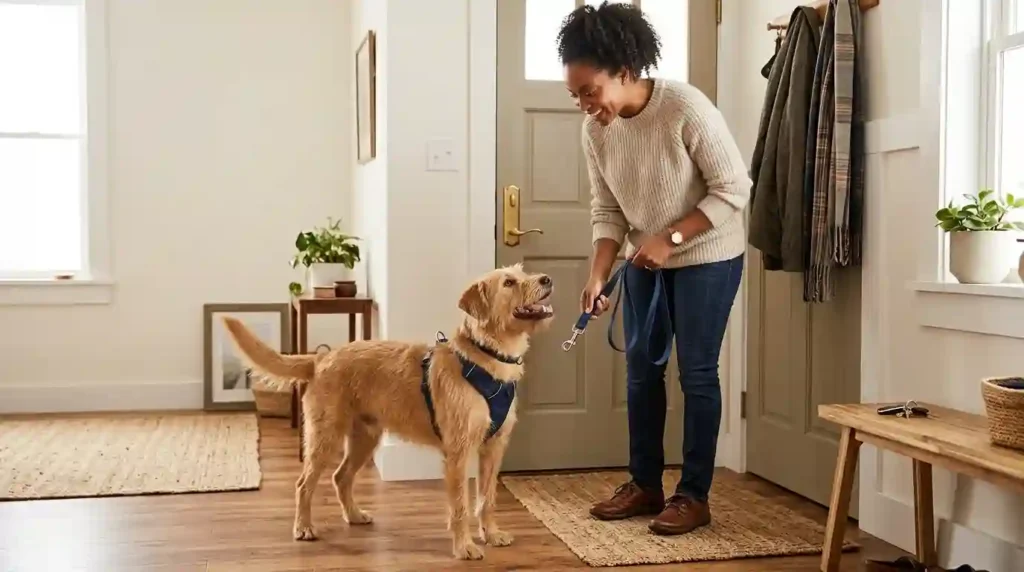
If you keep asking, “why does my dog bark when I pick up the leash?”, the simplest answer is that the leash has become a powerful predictor. It tells your dog that a rewarding dog walk, fascinating smells, movement, and time with you are about to begin. That learned association can produce excitement, anticipation, frustration, or—less commonly—anxiety and fear. The barking is communication, not proof that your dog is stubborn or “bad.”
The good news is that you can change the pattern. By separating the leash cue from the walk, rewarding quiet choices, meeting your dog’s physical and mental needs, and progressing in small training steps, you can create a calmer pre-walk routine without taking away your dog’s joy. This guide will help you identify the emotion behind the noise and follow a practical training plan that works from the moment you touch the leash to the moment you step outside.
Table of Contents
- Why the leash triggers barking
- Excitement versus fear and leash reactivity
- How to read your dog’s body language
- A step-by-step calm-leash training plan
- Doorway training and loose-leash walking
- Helpful equipment and safety considerations
- Common training mistakes
- Expected results and when to get professional help
- Frequently asked questions
Why Does My Dog Bark When I Pick Up the Leash? The Core Reasons
The leash has become a walk cue
Dogs notice patterns that people barely register. You may think the walk starts when the front door opens, but your dog may believe it begins when you close your laptop, stand up, put on your shoes, grab your keys, reach for your coat, or touch the door handle. Each action is a cue. Together, they form a predictable cue chain that ends with outdoor stimulation.
Through repeated experience, the leash becomes a reliable walk cue: leash appears, harness goes on, door opens, and adventure begins. This is a learned association. In behavioral terms, earlier events in the sequence begin to predict later ones. Back chaining helps explain why your dog may react before you have even picked up the leash. The shoes predict the keys, the keys predict leash jingling, and the leash predicts the dog walk.
The walk is often one of the most valuable events in a dog’s day. It offers movement, sniffing, social information, fresh air, and access to an interesting environment. That expectation can create intense anticipation. Barking is one way the emotional and physical energy spills out.
Excitement can turn into over-arousal
A little excitement is normal. A dog who approaches with a loose body and wagging tail is not necessarily experiencing a behavior problem. Trouble begins when excitement becomes overexcitement, over-arousal, or overstimulation. At that point, the dog may bark, whine, jump, spin, circle, grab the leash, rush the door, or ignore familiar cues.
Every dog has an arousal threshold. Below that threshold, the dog remains in a learning zone and can respond to a sit, hand target, or eye contact cue. Above it, the dog may have an inability to listen—not because the dog has forgotten the training, but because the emotional state is temporarily overpowering thoughtful behavior.
Trigger stacking can push the dog over that threshold. Imagine a young, high-energy dog who missed a morning outing, watched a squirrel through the window, heard a delivery at the door, and then saw the leash. Each event adds arousal. The leash may be the final trigger, even though it is not the only cause.
Barking may make the walk happen faster
Dogs repeat behavior that works. If barking causes you to talk, hurry, clip on the leash, or open the door, your dog may learn that noise speeds up the process. What began as spontaneous excitement can develop into demand barking or attention-seeking behavior.
This does not mean your dog is manipulating you in a calculated way. The consequence simply reinforces the behavior. Barking is followed by attention or movement, so barking becomes more likely next time. Reward timing matters: if the door opens during a bark, the bark may be reinforced; if movement begins after a quiet pause, calm behavior becomes valuable instead.
Frustration can build during restraint and delay
Some dogs are excited about going out but frustrated by the steps between seeing the leash and reaching the sidewalk. They may dislike standing still for the harness, waiting while you find your phone, or being held back at the doorway threshold. That frustration can appear as barking, leash mouthing, leash biting, pulling, or lunging toward the door.
Dogs also have an opposition reflex: pressure in one direction can prompt them to push or pull in the other. A tight collar or constant backward tension may increase resistance. This is one reason physical restraint and dragging a dog into position often make the pre-walk scene more chaotic.
Anxiety or fear may be involved
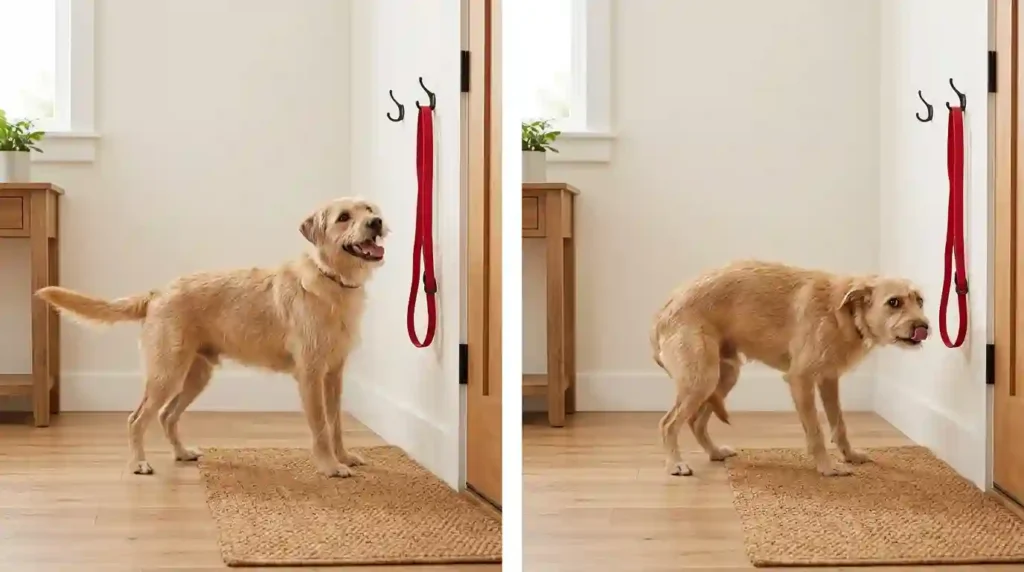
Not every dog barking at the leash is celebrating. A dog may have anxiety about traffic, unfamiliar people, other dogs, bad weather, a painful harness, or a previous frightening walk. Fear is especially likely if the dog moves away from the equipment, freezes, hides, lowers the body, tucks the tail, pins the ears, refuses treats, or shows the whites of the eyes.
The distinction matters. A dog barking from joyful anticipation needs help regulating excitement. A fearful dog needs safety, trigger management, gradual exposure, and possibly professional assessment. Forcing the equipment onto a frightened dog or using flooding—overwhelming exposure with no easy escape—can deepen the negative association.
Age, temperament, and unmet needs affect intensity
Puppies and dogs in adolescence often have limited self-control. High-energy breeds may need more constructive outlets, while an individual dog’s temperament can make anticipation especially intense. Lack of exercise can contribute, but physical activity is only part of the picture. A dog can be physically fit and still lack emotional control.
Mental stimulation, canine enrichment, scent work, and problem-solving are often as important as running. A short sniffing game may lower nervous energy more effectively than frantic play that raises arousal further. The goal is not to exhaust your dog into compliance; it is to help the dog reach a state in which learning is possible.
Is It Pre-Walk Excitement or Leash Reactivity?
These issues can overlap, but they are not identical. Pre-walk excitement happens before departure and is triggered by preparation cues. Leash reactivity usually appears outside when the dog sees a trigger, such as another dog, a person, a bicycle, or a moving vehicle. Reactive behavior can include barking, growling, pulling, lunging, freezing, or frantic attempts to create or reduce distance.
Use context and body language rather than the volume of the bark alone.
| What you observe | More consistent with excitement | More consistent with anxiety or fear |
| Movement | Bouncy, wiggly, jumping or spinning toward the door | Retreating, freezing, crouching, pacing, or escape attempts |
| Face | Soft eyes, relaxed mouth | Wide eyes, hard stare, lip licking, closed tense mouth |
| Response to food | Usually takes high-value treats | May refuse food when over threshold |
| Direction | Moves toward the leash and the doorway | Avoids leash, harness, owner or door |
| Outdoors | Settles after the walk begins | Becomes more worried around specific triggers |
A dog can show mixed emotions. Excitement and anxiety can exist together, and frustration may appear when the leash limits access to something desirable. Keep brief notes about what happens before, during, and after the barking. A behavior diary can reveal whether the main trigger is leash handling, the harness, the door handle, a particular route, another dog, or the delay before leaving.
For a broader explanation of barking that occurs specifically because movement is restricted, see Dog Barking When Tied Up or Restrained. The ASPCA’s overview of common barking motivations is also useful when the leash is only one of several situations in which your dog vocalizes.
How to Solve “Why Does My Dog Bark When I Pick Up the Leash?” Step by Step
Step 1: Identify every part of the pre-walk routine
Before changing the behavior, list the events that happen before a normal walk. Include subtle actions such as putting on shoes, picking up keys, filling a treat pouch, touching the harness, moving toward the door, or saying “walk.” Then observe which cue produces the first sign of arousal.
Start training at that first sign, not after the dog is already barking and spinning. If touching your shoes makes the dog lift its head, but the leash causes an explosion, begin with the shoes. Working below the arousal threshold keeps the dog in the learning zone.
Step 2: Break the prediction with practice without walking
Desensitization means exposing the dog to a mild version of a trigger at an intensity the dog can handle. Habituation occurs when repeated, uneventful exposure makes the stimulus less important. For this problem, repeated leash handling should sometimes lead to nothing at all.
Several times a day, pick up the leash and put it down. Touch the harness, then make coffee. Carry the leash to another room, then sit down. Clip it on for a few seconds after a walk, remove it, and continue your day. This out-of-context practice weakens the old prediction that every leash movement means an immediate exit.
Use very short training sessions. Five calm repetitions are better than 30 repetitions that cause barking. If the dog reacts, make the next repetition easier: increase the distance from the leash, move more slowly, or practice after the dog has already exercised. Repeated leash clipping should look boring and safe, not like a test the dog can fail.
Routine variation and cue-sequence disruption help, too. Put on your coat without leaving. Pick up your keys before dinner. Move the leash when the dog is resting. The purpose is not to confuse or tease your dog; it is to reduce the rigid connection between a cue and immediate access to the outdoors.
Step 3: Reinforce the first moment of calm
Decide what behavior will earn the next step. At first, your criterion may be as simple as four paws on the floor or one second without barking. Pick up the leash. If the dog remains quiet, mark that instant with a clicker or a calm word such as “yes,” then provide a high-value treat, gentle praise, or movement toward the door.
Movement reward is especially powerful because the dog already wants the walk. Calm behavior makes the process continue; barking makes it pause. If barking starts, avoid scolding or repeating commands. Quietly use one of three options:
- Freeze and wait for a brief pause.
- Put the leash down and reset.
- Walk away for a few seconds before trying an easier repetition.
This is not punishment. Pausing the routine simply prevents barking from producing the desired outcome. The instant the dog offers a manageable alternative, training resumes.
Step 4: Teach an alternative behavior
“Stop barking” tells a dog what not to do. An alternative behavior explains what will work instead. Choose something simple that your dog already knows:
- Sit while the leash is lifted.
- Touch your palm with the nose using a hand target.
- Offer eye contact for one second.
- Stand on a mat with four paws on the floor.
- Perform a short leash retrieval.
An incompatible behavior can be particularly helpful. A dog cannot bark continuously while gently holding the leash in its mouth, and a dog anchored in a reinforced sit-stay is less able to jump at your hands. However, do not ask for a long, rigid stay from a dog who is barely below threshold. Keep the task achievable.
Build impulse-control training away from walk time. Practice waiting for a food bowl, settling on a mat, leaving a toy, and taking treats gently. These games develop self-control and emotional control without loading the lesson with the intense expectation of a walk.
Step 5: Attach the equipment calmly
Prepare yourself first. Put on your shoes and coat, gather your keys, and place anything you need by the door before involving the dog. This reduces the waiting period in which over-arousal can build.
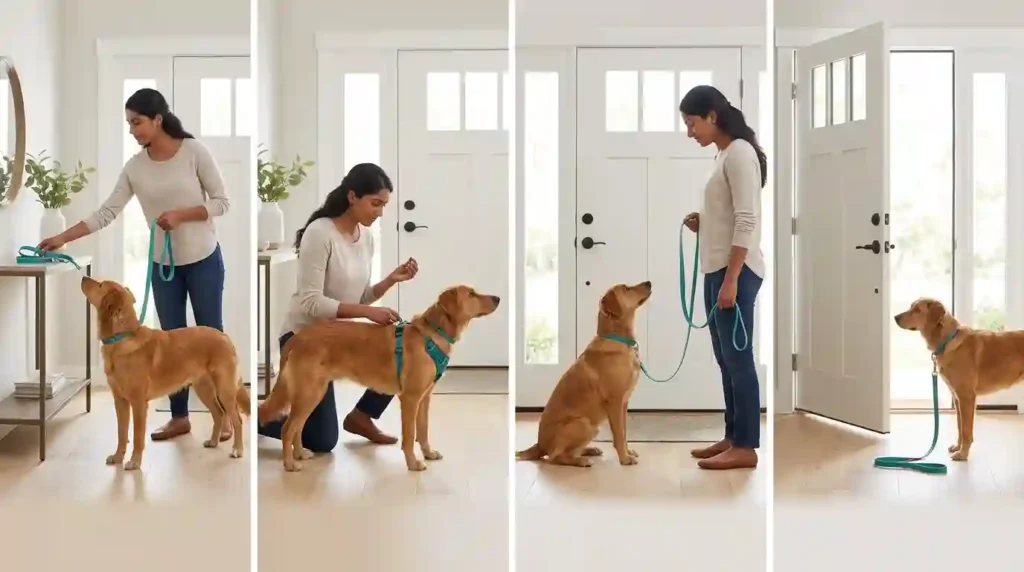
For calm leash attachment, approach only while the dog is reasonably composed. If the dog jumps when you bend down, straighten up and pause. Try again when four paws return to the floor. Work slowly enough to succeed but without turning the process into a lengthy contest.
If the dog avoids the harness or collar, check fit and comfort. Look for rubbing, pinching, matting, or sensitivity around the neck, shoulders, ears, and back. Sudden resistance to equipment can indicate pain and deserves veterinary attention.
Step 6: Add a pre-walk pause at the door
Once the leash is attached, move to doorway training. Ask for a brief sit or calm stand before touching the door handle. Open the door an inch. If the dog surges, use closing the door as a neutral reset. Open it again when the leash is loose and the dog is able to respond.
Do not demand perfection. A one-second pause may be enough at first. Gradually build toward waiting while the door opens, responding to a release cue, and walking through without door rushing or bolting. This doorway threshold practice improves safety as well as manners.
Step 7: Meet needs without adding more chaos
For some dogs, a gentle pre-walk exercise takes the edge off. Try two to five minutes of scent work, scattered food in a safe room, a simple enrichment toy, or easy problem-solving. Sniffing and licking can be regulated; a lick mat may occupy the dog while you prepare.
Avoid intense fetch or wrestling immediately before training if it leaves your dog more activated. The best pre-walk exercise produces focus, not exhaustion. High-energy dogs still need appropriate physical activity, but more exercise is not a substitute for teaching calm behavior.
Step 8: Practice loose-leash walking indoors
Before facing outdoor distractions, practice a few steps in a low-distraction environment. Reward the dog for following your movement while the leash hangs loosely. Stop when the leash tightens; move again when slack returns. This teaches that pulling stops progress while a loose leash keeps the walk moving.
Then practice in a hallway, driveway, or quiet section of the yard. Add distractions gradually. If the dog begins pulling, barking, or lunging, create distance and lower the difficulty. Successful gradual exposure is more useful than forcing the dog through an environment where learning is impossible.
Equipment That Can Help—and What It Cannot Do
Equipment should support safety and clear communication, not replace reinforcement-based training.
Standard leash
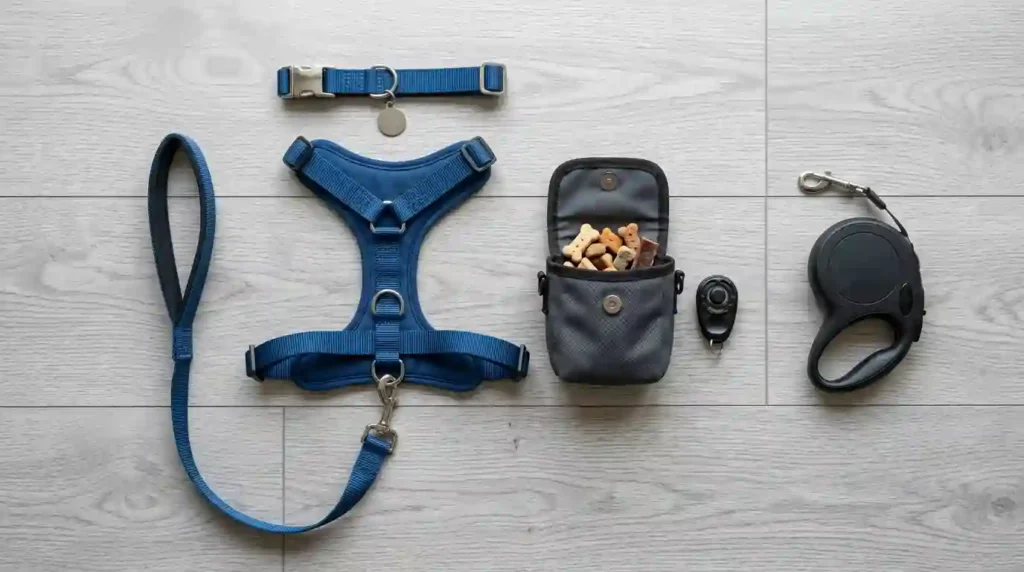
A fixed six-foot leash is a practical choice for most training. It provides a consistent boundary and enough room for comfortable movement. A retractable leash can create changing limits and near-constant tension, which may encourage pulling. Its thin cord and long range can also become a safety hazard near roads, dogs, or cyclists.
Harness or collar
A well-fitted harness can reduce pressure on the neck. A front-clip harness may help redirect a strong dog, but fit is essential: it should not restrict normal shoulder movement or rub behind the legs. A comfortable collar may be suitable for identification and for dogs who already walk calmly.
Head halter
A head halter can provide additional control for a large or powerful dog, but it requires careful conditioning. Pair it with treats through gradual exposure, use a backup attachment when appropriate, and never jerk the leash. Abrupt force can injure the neck.
No tool automatically changes the learned association behind leash barking. The leash, harness, or collar must become part of a predictable pattern of calm behavior, positive reinforcement, and safe movement.
Common Mistakes That Make Leash Barking Worse
Waiting until the dog is already over the threshold
Training after the barking, jumping, spinning, and leash-grabbing have peaked is inefficient. Start with the earliest cue and use small training steps. If the dog cannot take food or respond to a familiar cue, reduce the intensity.
Moving faster when barking begins
Rushing to attach the leash can reinforce demand barking. Slow down, pause, and let a quiet moment earn progress. Consistency matters: if barking works on busy mornings, the dog will continue trying it.
Adding excitement with your own behavior
A high-pitched voice, repeated promises of a walk, fast movement, and dramatic leash jingling can increase anticipation. Keep your breathing, voice, and movements neutral during training. You do not need to act cold; calm praise is enough.
Using scolding, yelling, or harsh punishment
Noise added to noise rarely teaches calm behavior. Scolding may sound like you are joining the barking, while yelling, leash corrections, or physical restraint can increase stress and damage trust. Ignoring demand barking is useful only when paired with clear reinforcement for the behavior you want.
Asking for too much stillness
A dog does not need to look sedated before every walk. The realistic goal is functional calm: the dog can keep four paws down, allow safe attachment, respond to a simple cue, and move through the door without dragging you. Expecting a long stay from an excited puppy may create frustration.
Treating all barking as the same problem
Pre-walk anticipation, frustration under restraint, alarm barking, fear, and leash reactivity have different triggers. If your dog also reacts to mirrors or windows, the guide to Dog Barking at Reflections explains another visually triggered pattern. For a broader collection of context-specific guides, browse the Dog Barking resource section.
How Long Does Training Usually Take?
Some dogs show a small improvement within several short training sessions. A well-established habit usually takes days or weeks of consistent practice, and intense over-arousal may require longer. Progress is rarely perfectly linear. The dog may succeed when the household is quiet and struggle when you are late, guests are present, or the weather has limited exercise.
Measure useful changes rather than waiting for instant silence. Is the first bark occurring later in the cue chain? Can the dog recover faster? Can you lift the leash without jumping? Can the dog pause at the door? These are meaningful signs that the emotional response and habit are changing.
Practice two to five minutes at a time, one to three times daily, when possible. Stop while the dog is successful. If there is no improvement after several weeks, reassess your timing, the trigger intensity, equipment comfort, and the possibility of fear or pain.
When to Contact a Veterinarian or Dog Trainer
Arrange a veterinary examination if the behavior starts suddenly, the dog resists touch, yelps during leash or harness attachment, changes gait, scratches at equipment, or shows other changes in appetite, sleep, mobility, or mood. Pain can make ordinary handling feel threatening.
A qualified, reward-based dog trainer can help when the dog is difficult to handle safely, the household cannot identify the trigger, or the training plan stalls. Seek more specialized behavioral support if barking is accompanied by intense fear, repeated lunging, snapping, biting, redirected aggression, panic, or an inability to recover after the trigger disappears.
Choose a professional who uses positive reinforcement, explains a clear behavior-modification plan, and avoids flooding, intimidation, and pain-based punishment. Management is not a failure. Creating distance, choosing quiet walking times, using barriers, and preventing rehearsal protect both learning and safety.
The same principles can help in unfamiliar environments, where noise and disrupted routines often increase arousal. If travel is part of the problem, learn how to stop dog barking in a hotel room without escalating stress.
Conclusion
Your dog most likely barks when you pick up the leash because the object predicts something highly rewarding. The sight and sound of the leash activate a well-practiced cue chain involving expectation, excitement, and sometimes frustration. For other dogs, worried body language reveals anxiety, fear, discomfort, or a negative association with equipment or the outdoor environment.
The solution is not to eliminate enthusiasm. It is to make enthusiasm manageable. Identify the earliest walk cue, practice repeated leash handling without leaving, reinforce brief moments of calm, teach an easy alternative behavior, and build a safe doorway routine. Pair these exercises with appropriate physical activity, mental stimulation, patience, and consistent reward timing.
When calm behavior reliably makes the walk move forward, your dog learns a new pattern: the leash can appear without chaos, quiet choices work, and the adventure begins when both of you are ready.
Frequently Asked Questions
Why does my dog bark when on a leash?
Excitement, frustration, fear, or leash reactivity can cause barking. Look at the trigger and body language to identify which emotion is driving it.
How to get a dog to stop barking and pulling on leash?
Pause when barking or pulling begins, reward calm attention and leash slack, and practice first in a low-distraction environment before adding triggers.
What is the command to tell a dog to stop barking?
“Quiet” is common, but the word matters less than teaching it with consistent reward timing: mark and reward the moment the barking stops.
What do vets recommend to stop barking?
Veterinarians generally start by ruling out pain or illness, then recommend trigger management and reward-based behavior training suited to the cause.
What words do dogs love to hear the most?
Dogs often respond warmly to words linked with rewards, such as “walk,” “outside,” “treat,” “play,” their name, and familiar praise.
What are the signs of an unhappy dog?
Watch for withdrawal, appetite or sleep changes, low energy, avoidance, tense body language, persistent whining, or loss of interest in favorite activities.