
Summary
What do Dobermans eat? Most Doberman Pinschers thrive on a complete and balanced large-breed dog food containing digestible animal protein, controlled calcium and phosphorus, healthy fats, useful carbohydrates, and sufficient calories for their activity level. Growing puppies should eat a large-breed puppy formula divided into three or four meals, while healthy adults generally do well with two measured meals per day.
An adult Doberman may need approximately 1,200–2,300 calories daily, but body weight, age, metabolism, physical activity, health status, and spay or neuter status can move the requirement outside that range. The amount in cups depends on the food’s calorie density, so a kitchen scale and the calorie content statement are more reliable than filling a bowl by eye.
Nutrition is particularly important for this athletic, deep-chested breed. A thoughtful feeding plan should support controlled puppy growth, lean muscle, heart health, joint health, digestive comfort, and a healthy body condition while reducing avoidable risks such as overfeeding and rapid eating.
Table of Contents
- What Do Dobermans Eat? The Simple Answer
- Why Doberman Nutrition Requires Care
- What Makes a Good Food for a Doberman?
- What Do Dobermans Eat at Each Life Stage?
- How Much Should a Doberman Eat?
- How Much to Feed a Doberman Puppy
- How Often Should a Doberman Eat?
- Dry, Wet, Fresh, or Raw Food
- Grain-Inclusive or Grain-Free Food
- Feeding to Support Doberman Health
- Safe Human Foods and Foods to Avoid
- Helpful Amazon Feeding Products
- How to Change and Store Doberman Food
- Conclusion
- Frequently Asked Questions
What Do Dobermans Eat? The Simple Answer
A Doberman Pinscher should eat food formulated to supply all essential nutrients in the correct amounts and ratios. For most owners, the practical choice is commercial dog food carrying a nutritional adequacy statement for the appropriate life stage.
Suitable options include:
- Large-breed puppy food
- Large-breed adult dog food
- Senior dog food
- Complete dry dog food
- Complete wet or canned food
- Mixed wet-and-dry feeding
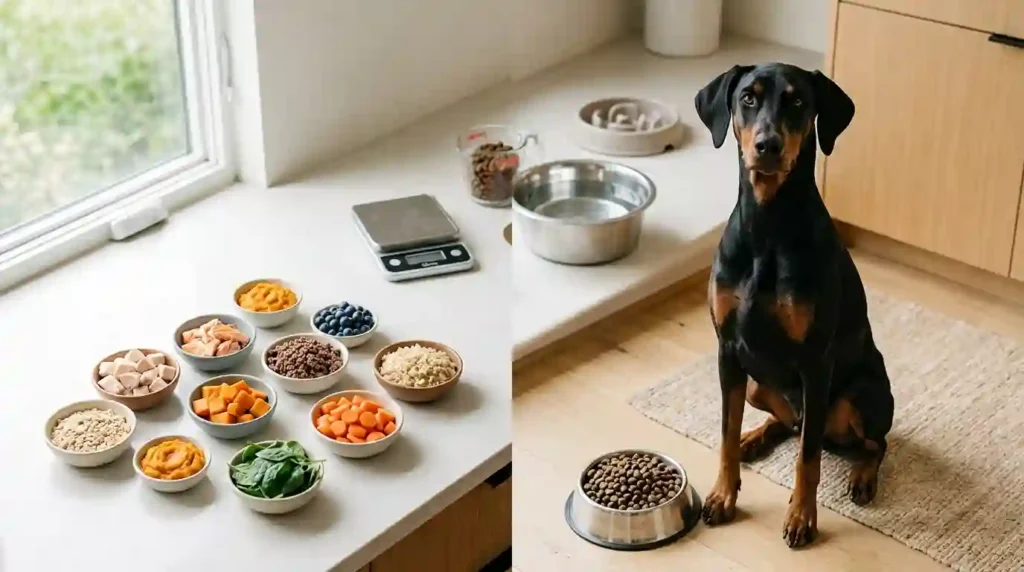
- Commercial fresh dog food
- Properly formulated dehydrated food
- A veterinary therapeutic diet
- A home-cooked diet developed by a veterinary nutritionist
The word “complete” means the food supplies all required nutrients. “Balanced” means those nutrients are present in appropriate proportions. Meat, rice, vegetables, or supplements may sound wholesome individually, but casually combining them does not guarantee a complete and balanced diet.
A Doberman is a medium-to-large working dog with a muscular frame, high energy level, and considerable capacity for physical activity. Food must provide enough energy for that lifestyle without encouraging uncontrolled growth in puppies or excess body fat in adults.
The dog’s behavior around food is not a precise measure of nutritional need. Persistent hunger, begging, counter-surfing, and excitement at mealtime may reflect habit, reinforcement, boredom, or genuine energy requirements. Owners managing food-related manners can learn more from the Dog psychology section.
Why Doberman Nutrition Requires Care
Dobermans are powerful, agile guard dogs developed for active work. Whether a dog participates in obedience, tracking, hiking, protection sports, or family activities, nutrition contributes to stamina, muscle maintenance, recovery, and overall health.
At the same time, Dobermans have breed-related concerns that make careless feeding particularly risky.
Rapid puppy growth
Doberman puppies can grow from small, awkward youngsters into 60- to 100-pound adults. Their skeleton, joints, muscles, and connective tissues must develop together at a controlled rate.
Excess calories do not create a larger or stronger adult. They can accelerate weight gain and place unnecessary strain on developing bones and joints. Large-breed puppy food is designed to support growth without providing uncontrolled energy or inappropriate mineral levels.
The practical goal is steady growth and a lean body condition—not maximum growth as quickly as possible.
Athletic muscle without unnecessary bulk
High-quality protein supports muscle development, tissue repair, essential amino-acid intake, and immune function. An active Doberman needs enough protein to maintain lean muscle, but protein percentage alone does not determine quality.
Digestibility, amino-acid balance, calorie density, ingredient sourcing, and the total formulation matter. A food with an impressive protein claim can still be unsuitable if its calories, minerals, or fat content do not fit the individual dog.
A guide about Dog Food for Pitbulls may also discuss muscular breeds, but a Doberman’s large-breed growth pattern, deep chest, and cardiac risks require their own feeding strategy.
Deep chest and bloat risk
The Doberman’s deep chest is associated with an increased risk of gastric dilatation-volvulus, or GDV. In this emergency, the stomach expands with food, fluid, or gas and may rotate, restricting blood flow.
Possible signs include:
- A distended abdomen
- Repeated nonproductive retching
- Drooling or excessive salivation
- Restlessness
- Stretching or inability to get comfortable
- Rapid breathing
- Weakness
- Collapse
- Shock
GDV requires immediate emergency treatment. Do not wait to see whether symptoms settle.
Common management recommendations include feeding two or more smaller meals instead of one large meal, discouraging rapid eating, avoiding elevated food bowls unless medically necessary, and avoiding vigorous exercise immediately around meals. These steps cannot eliminate risk.
PetMD identifies Dobermans as a deep-chested breed at increased risk and emphasizes that GDV requires immediate veterinary intervention.
Owners can also ask their veterinarian about prophylactic gastropexy. This procedure secures the stomach to reduce the risk of twisting, although the stomach can still dilate.
Heart health
Dobermans are genetically predisposed to dilated cardiomyopathy, commonly called DCM. This disease weakens the heart muscle and can progress before obvious symptoms appear.
No over-the-counter ingredient can prevent inherited DCM. Taurine, L-carnitine, omega-3 fatty acids, or a “heart-health” label should not replace cardiac screening or veterinary care.
A dog with reduced stamina, coughing, weakness, fainting, rapid breathing, or unexplained weight loss should be examined. Owners may be referred to a veterinary cardiologist for an echocardiogram, Holter monitoring, and other testing.
Joint and mobility concerns
Hip dysplasia and other orthopedic problems may affect Dobermans. Controlled growth, healthy weight, appropriate physical activity, and muscle maintenance support long-term mobility.
Glucosamine, chondroitin, and fish oil are common joint-support ingredients, but supplements are not substitutes for weight control or medical treatment.
What Makes a Good Food for a Doberman?
The healthiest choice is not necessarily the most expensive food or the recipe with the longest ingredient list. Look for evidence of nutritional adequacy, strong formulation practices, reliable quality control, and suitability for the individual dog.
Confirm AAFCO nutritional adequacy
Locate the nutritional adequacy statement on the package. It should indicate whether the food is complete and balanced for growth, adult maintenance, reproduction, or all life stages.
The AAFCO Dog Food Nutrient Profiles help manufacturers substantiate nutritional claims. AAFCO does not approve individual brands, so “AAFCO-approved” is imprecise language. The label may instead state that the food is formulated to meet an AAFCO nutrient profile or that feeding tests substantiate its adequacy.
The authoritative AAFCO guide to selecting pet food explains why owners should consider species, life stage, physical condition, the nutritional adequacy statement, and feeding directions.
Food labeled for intermittent or supplemental feeding should not serve as the primary diet unless a veterinarian has directed its use.
For more help interpreting commercial formulas, visit the Dog Foods resource section.
Choose digestible animal protein
A Doberman diet should include sufficient high-quality animal protein. Common sources include:
- Chicken
- Turkey
- Beef
- Lamb
- Duck
- Fish
- Salmon
- Whitefish
- Egg
Whole meat can be nutritious, but a clearly identified meat meal can also provide concentrated protein because much of its water has been removed. An ingredient’s position on the list does not describe the complete amino-acid profile or prove the quality of the finished food.
Avoid assuming that an unnamed meat by-product automatically makes a food unsafe. By-products can include nutrient-rich organs. Transparency, processing standards, nutritional analysis, and manufacturer quality control are more meaningful than fear-based ingredient marketing.
Supply appropriate healthy fat
Fat supplies concentrated energy, supports palatability, and helps with the absorption of vitamins A, D, E, and K. It also provides essential fatty acids for the skin, coat, brain, and normal inflammatory response.
Useful sources may include:
- Fish oil
- Chicken fat
- Flaxseed
- Marine oils supplying EPA and DHA
- Other identified animal or plant oils
Omega-3 and omega-6 fatty acids both have nutritional roles. More is not always better, however. Excess fat can add calories quickly and may be inappropriate for a dog with pancreatitis or another fat-sensitive condition.
Include useful carbohydrates and fiber
Dogs can digest properly prepared carbohydrates, which may provide energy, dietary fiber, and essential nutrients. Common ingredients include:
- Brown rice
- Oat or oatmeal
- Barley
- Whole wheat
- Sweet potato
- Pumpkin
- Chickpea
- Carrot
- Spinach
- Butternut squash
- Blueberry
Complex carbohydrates can help fuel an active lifestyle. Fiber supports digestive health, stool consistency, satiety, and beneficial intestinal microorganisms.
Corn, wheat, and soy are not automatically “fillers.” They can supply nutrients when properly processed and included in a balanced formulation. A food should be judged by its nutritional evidence and the dog’s response rather than one fashionable ingredient rule.
Balance calcium and phosphorus
Calcium and phosphorus are particularly important during puppy growth. Too much calcium can be as undesirable as too little, especially in a large-breed puppy.
Do not add calcium powder, bone meal, or mineral supplements to a complete large-breed puppy formula unless a veterinarian or veterinary nutritionist has prescribed a specific amount.
Vitamin D also supports calcium and phosphorus metabolism. Because excess vitamin D can be dangerous, supplementation should never be improvised.
Support skin and coat health
Dobermans have a short coat that can make dryness, hair loss, or skin irritation easy to notice. Protein, essential fatty acids, zinc, vitamins, and adequate calories contribute to healthy skin and coat.
Itchy skin, recurrent ear infection, excessive licking, dull coat, or patchy hair loss may result from parasites, environmental allergies, infection, endocrine disease, or food allergy. Changing brands repeatedly without diagnosing the cause can delay effective treatment.
Evaluate the manufacturer
A responsible manufacturer should be able to explain:
- Who formulates the food
- What nutrition credentials those professionals hold
- Where the food is produced
- How ingredients and finished products are tested
- Whether feeding trials or digestibility studies are performed
- How quality-control failures are handled
- How calorie and nutrient information can be obtained
- How the company communicates a dog food recall
Brands commonly discussed for Dobermans include Purina Pro Plan, Royal Canin, Hill’s Science Diet, Blue Buffalo, Diamond Naturals, Orijen, Wellness CORE, IAMS, Nutro, Ollie, and The Farmer’s Dog. These names are examples, not automatic recommendations. Product lines and formulas differ within every brand.
What Do Dobermans Eat at Each Life Stage?
Life-stage nutrition allows a Doberman to receive the nutrient and calorie balance appropriate for growth, adult maintenance, or aging.
Weaning puppies
Newborn puppies receive their mother’s milk. If nursing is impossible or inadequate, a veterinarian may recommend canine milk replacer. Cow’s milk and improvised homemade formulas are not suitable substitutes.
Weaning usually starts gradually at approximately three to four weeks. A complete large-breed puppy food can be softened with warm water or milk replacer to create puppy mush. The liquid is reduced over time until the puppies eat solid food.
A puppy that is weak, cold, unable to nurse, or failing to gain weight requires prompt veterinary attention.
Growing Doberman puppies
What to feed a Doberman puppy is one of the most important decisions an owner makes. Choose a large-breed puppy formula with:
- Complete growth-stage nutrition
- Controlled calcium and phosphorus
- Digestible animal protein
- Appropriate calorie density
- DHA for brain and vision development
- Healthy fat
- Essential vitamins and minerals
Dobermans grow rapidly, but their food should encourage controlled growth. Avoid adding meat, calcium, bone meal, or supplements in quantities that unbalance the commercial diet.
Puppies generally stay on large-breed growth food until approximately 15–18 months, although the ideal transition depends on development and the manufacturer’s instructions. Some may not reach full physical maturity until closer to 18–24 months.
The Dogs Breeds Feed collection can help owners compare growth requirements across dogs of different adult sizes.
Adult Dobermans
A large-breed adult formula should maintain lean muscle, healthy weight, stamina, digestion, joint function, and coat quality. Most healthy adults eat two measured meals per day.
A working dog completing demanding daily exercise may need a performance diet with greater calorie density. A family companion with moderate activity will usually need fewer calories, even if both dogs weigh the same.
Senior Dobermans
Many Dobermans enter their senior years around age seven or eight, but food should not be changed solely because of a birthday.
A senior diet may provide:
- Fewer calories for a slower metabolism
- Digestible protein to limit muscle loss
- Omega-3 fatty acids
- Controlled minerals
- Dietary fiber
- Antioxidants
- Joint-supporting nutrients
- Greater palatability
Senior dogs with kidney, heart, digestive, or endocrine disease may need a specialized formula. A lower protein diet is not automatically appropriate for every older dog; adequate protein can help preserve muscle.
How Much Should a Doberman Eat?
There is no single correct number of cups. An adult may eat three cups of a calorie-dense formula or six cups of a less concentrated product while receiving similar energy.
General adult calorie guide
The table below provides broad starting ranges for healthy, moderately active adults. It is not a substitute for an individualized recommendation.
| Adult body weight | Approximate daily calories | Example amount at 400 kcal per cup |
| 60 pounds | 1,200–1,500 kcal | 3–3.75 cups |
| 70 pounds | 1,350–1,700 kcal | 3.4–4.25 cups |
| 80 pounds | 1,500–1,900 kcal | 3.75–4.75 cups |
| 90 pounds | 1,650–2,100 kcal | 4.1–5.25 cups |
| 100 pounds | 1,800–2,300 kcal | 4.5–5.75 cups |
A highly active working Doberman may need more. An older, sedentary, recently neutered, or weight-prone dog may need less.
Convert calories into cups or grams
Use this formula:
Daily cups = daily calorie requirement ÷ calories per cup
For example, suppose an 80-pound Doberman needs 1,700 calories per day and its food supplies 400 calories per cup:
1,700 ÷ 400 = 4.25 cups per day
Divide that amount between two meals:
4.25 ÷ 2 = approximately 2.1 cups per meal
A kitchen scale provides better precision. Weigh one level cup of the food in grams, then calculate the gram amount corresponding to the daily calorie target.
Start with the package guideline
Check whether the food package guideline refers to current body weight, expected adult weight, or ideal weight. Puppy charts often use expected mature weight, while adult charts generally use current or target weight.
Determine whether the listed amount is the daily total. Owners sometimes mistakenly feed the entire daily quantity at every meal.
Assess body condition
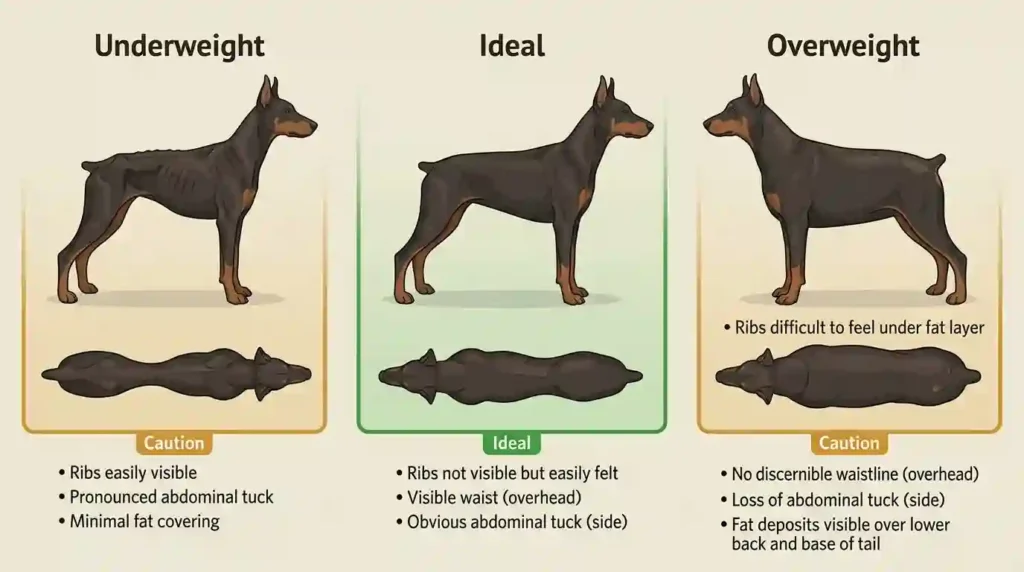
A healthy Doberman should usually have:
- Ribs that can be felt without pressing hard
- A visible waist when viewed from above
- An abdominal tuck behind the rib cage
- Defined muscle without excessive bulk
- Stable energy and weight
A visible final rib can be normal in a lean Doberman, but the spine, hips, and multiple ribs should not be sharply prominent.
If ribs are difficult to feel and the waist disappears, calorie intake may be too high. Reduced stamina and fat around the abdomen are additional signs of overfeeding.
Unexplained weight loss, poor muscle development, persistent hunger, low energy, or a suddenly prominent spine requires veterinary evaluation. Increasing food without investigating the cause could mask a medical problem.
Compared with the serving calculations in guides about the best dog food for labradors, Doberman portions may look similar. The important difference is that calories should follow the individual dog’s activity and condition—not the expected portion for another breed.
Count treats and toppers
Treats should generally provide no more than about 10% of daily calories. Bone broth, food toppers, cheese, training rewards, dental chews, and table food all count.
Use part of the normal kibble ration during training when possible. Dobermans often respond well to food reinforcement, and small rewards can support mental stimulation without adding excessive calories.
How Much to Feed a Doberman Puppy
How much to feed a Doberman puppy depends on its age, current weight, expected adult size, activity, and the food’s calories per cup. A universal cup chart cannot account for differences between formulas.
Typical puppy meal frequency
| Puppy age | Typical meals per day |
| 8–12 weeks | 4 meals |
| 3–6 months | 3 meals |
| 6–12 months | 2–3 meals |
| 12–18 months | 2 meals |
| Adult | 2 meals |
Use the large-breed puppy food’s feeding chart, then divide its daily amount by the number of meals.
For example, if the label recommends 1,600 calories per day and the food contains 400 calories per cup:
1,600 ÷ 400 = 4 cups daily
For four meals:
4 ÷ 4 = 1 cup per meal
This is only an example. Do not use 1,600 calories unless it matches the puppy’s food label, growth, and veterinary feeding plan.
Monitor growth weekly
Weigh young puppies every week and record the result. Growth should be steady, with ribs that are easy to feel and a visible waist developing as the puppy matures.
Overfeeding a puppy can cause:
- Excessive weight gain
- Loss of waist definition
- Stress on developing joints
- Loose stool
- Reduced mobility
- Increased bloat risk from overly large meals
Underfeeding may lead to poor weight gain, reduced energy, a dull coat, visible ribs and spine, or inadequate muscle development.
Do not feed extra calories simply to produce a larger European Doberman or a more imposing adult. Genetics—not forced feeding—determine mature structure.
For comparison, Dog Food for German Shepherds involves similar large-breed growth concerns, including the importance of controlled calories and balanced minerals.
How Often Should a Doberman Eat?
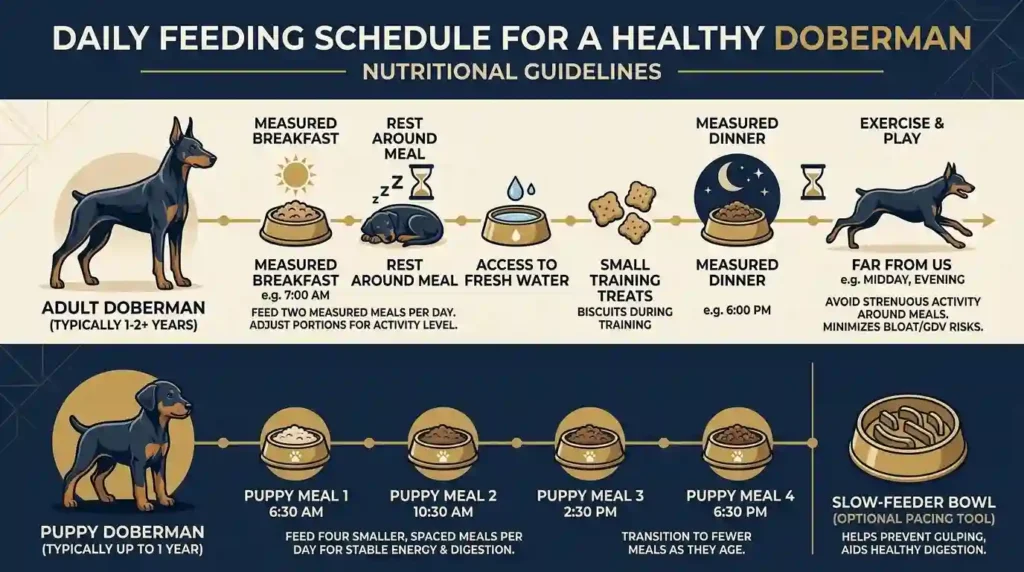
Most healthy adult Dobermans should receive two measured meals per day rather than one large meal. Puppies require three or four smaller meals.
A structured mealtime routine makes it easier to:
- Monitor appetite
- Track calorie intake
- Recognize illness
- Control treats
- Prevent accidental overfeeding
- Support predictable bathroom habits
- Discourage all-day grazing
Free feeding is usually unsuitable because it hides how much the dog consumes and makes appetite changes harder to notice.
Avoid intense running, rough play, agility, or other strenuous exercise directly before and after meals. Calm walks for toileting are different from vigorous activity.
A slow-feeder bowl may help a rapid eater take longer to finish. It cannot prevent GDV, so use it as a pacing tool rather than a medical guarantee.
Dry, Wet, Fresh, or Raw Food
The food format matters less than nutritional adequacy, calorie control, safety, digestibility, and the dog’s response.
Dry dog food
Kibble is convenient, economical, easy to store, and simple to measure. Large-breed formulas may contain targeted mineral levels and nutrients for joints and heart function.
Ordinary kibble does not replace toothbrushing. Although chewing may provide some abrasion, only appropriately evaluated dental diets are formulated specifically for plaque or tartar control.
Wet dog food
Wet or canned food supplies more moisture and may be easier for a dog with reduced appetite or dental discomfort. It can also increase palatability for selective eaters.
Wet food is not necessarily lower in calories. Read the calories per can, tray, pouch, or 100 grams. Refrigerate leftovers according to the package directions.
Mixed feeding
Mixed feeding combines kibble with wet or fresh food. It may provide additional moisture and flavor while preserving the convenience of dry food.
Calculate the calories from both foods. Adding a full wet portion to a full kibble ration can cause rapid weight gain.
Fresh dog food
Commercial fresh food often contains recognizable meat, vegetables, and grains. Some services provide pre-portioned meals based on weight and activity.
Confirm that the recipe is complete and balanced for the correct life stage. “Fresh,” “natural,” and “human-grade” are not substitutes for nutritional adequacy or sound quality control.
Dehydrated food
Dehydrated products can be nutrient-dense and may require added water. Follow rehydration instructions and calculate calories carefully because a small dry volume may supply substantial energy.
Home-cooked food
A home-prepared diet can be successful when formulated by a board-certified veterinary nutritionist. Random recipes built from chicken, beef, pasta, vegetables, and supplements commonly lack calcium, essential fatty acids, vitamins, or trace minerals.
Ingredient substitutions can unbalance an otherwise appropriate recipe, so follow professional instructions precisely.
Raw diet
Raw meat, organs, eggs, or bones may carry harmful bacteria and parasites. Raw bones also create risks of broken teeth, choking, intestinal obstruction, and gastrointestinal injury.
A raw diet can be nutritionally deficient or excessive even when it contains many ingredients. Consult a veterinarian or veterinary nutritionist before considering one, particularly if children, older adults, pregnant people, or immunocompromised individuals live in the home.
Grain-Inclusive or Grain-Free Food
Dobermans do not automatically need grain-free food. Brown rice, oatmeal, barley, wheat, and corn can provide digestible energy, fiber, essential fatty acids, protein, vitamins, and minerals.
Grain-free recipes commonly replace grain with potato, peas, lentils, or chickpeas. They are not necessarily lower in carbohydrates or calories.
Because Dobermans already have a genetic predisposition to DCM, diet decisions should be made carefully. Grain-free diets—particularly certain formulations rich in pulses—have raised concerns about possible diet-associated DCM, although the relationship is complex and continues to be studied.
Do not add taurine or L-carnitine as a substitute for selecting a well-formulated food or completing cardiac screening. If your Doberman has DCM, a veterinary cardiologist and veterinarian should coordinate the dietary plan.
A true food allergy is more commonly associated with a protein than with grain as a category. If a dog has itchy skin, recurrent ear infection, diarrhea, vomiting, or excessive gas, a veterinarian may recommend a controlled elimination diet or hydrolyzed formula.
Feeding to Support Doberman Health
Dilated cardiomyopathy
Food cannot eliminate the inherited risk of DCM. The most responsible plan includes a complete diet from a reputable manufacturer, healthy body condition, regular veterinary care, and breed-appropriate cardiac screening.
Reduced sodium, taurine, L-carnitine, EPA, DHA, or other nutrients may be part of a prescribed cardiac diet. Do not impose sodium restrictions or supplements without professional guidance.
Gastric dilatation-volvulus
Offer two or more smaller meals, discourage gulping, avoid unnecessary elevated bowls, and separate strenuous exercise from mealtimes. Discuss prophylactic gastropexy with your veterinarian.
A swollen abdomen, repeated retching, drooling, anxiety, weakness, or collapse is an emergency.
Hip dysplasia and joint strain
Controlled puppy growth and lifelong weight management are more important than relying on a single joint ingredient. Maintain muscle through appropriate exercise and adequate protein.
Glucosamine, chondroitin, and omega-3 fatty acids may support joint health in selected dogs, but dosing and product quality should be reviewed with a veterinarian.
Pancreatitis
Pancreatitis may cause vomiting, nausea, abdominal pain, lethargy, and loss of appetite. Dogs with a history of pancreatitis may need a controlled-fat veterinary diet.
Avoid fatty meat, rich gravy, bacon, and sudden high-fat meals.
Hypothyroidism
Hypothyroidism can contribute to weight gain, lethargy, skin problems, ear infections, and a brittle or thinning coat. Reducing food will not correct an underactive thyroid.
A veterinarian can diagnose the condition through examination and blood testing. Treatment and calorie adjustment may both be necessary.
Sensitive stomach
A sensitive stomach may involve diarrhea, excessive gas, vomiting, or inconsistent stool, but the phrase is not a diagnosis. Parasites, infection, pancreatitis, food intolerance, rapid eating, or abrupt dietary changes can cause similar symptoms.
A limited-ingredient or specialized formula may help some dogs after other causes have been considered. Persistent gastrointestinal signs or unexplained weight loss require veterinary evaluation.
Dental health
Brush the teeth regularly with dog toothpaste and arrange professional dental care when recommended. Bad breath, bleeding gums, loose teeth, dropped food, or chewing on one side can indicate dental disease.
Ordinary dry food should not be viewed as complete dental protection.
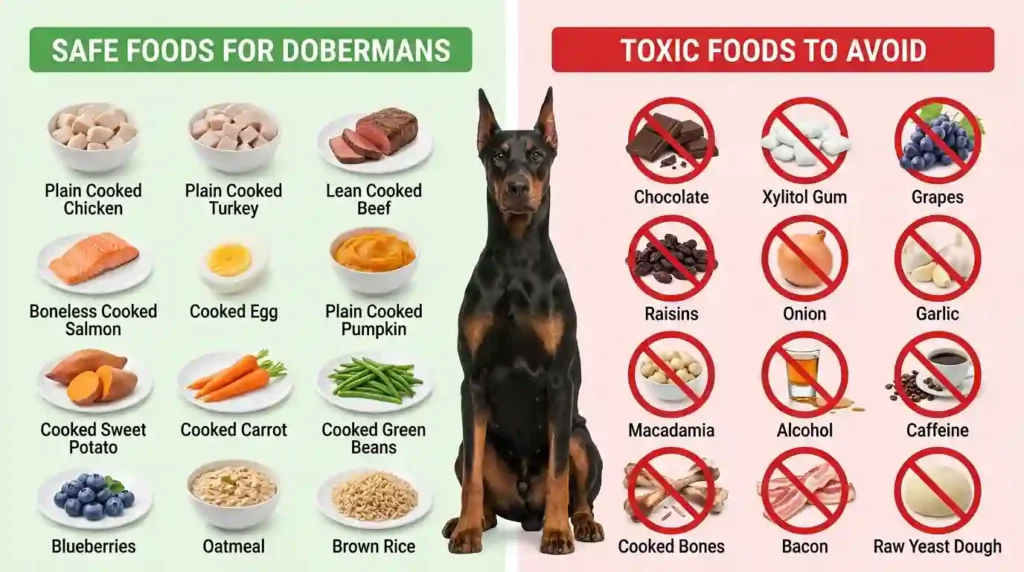
Safe Human Foods and Foods to Avoid
Small portions of plain food may be used as treats if they fit within the calorie allowance.
Potential options include:
- Plain cooked chicken or turkey
- Plain lean beef
- Cooked boneless salmon
- Cooked egg
- Plain pumpkin
- Cooked sweet potato
- Carrot
- Green bean
- Blueberry
- Plain oatmeal
- Plain brown rice
Remove bones, skin, excessive fat, seeds, pits, sauces, and seasoning. Introduce new foods gradually and cut them into manageable pieces.
Dogs should not receive:
- Chocolate
- Xylitol
- Grapes or raisins
- Onion or garlic
- Macadamia nuts
- Alcohol
- Caffeine
- Raw yeast dough
- Cooked bones
- Moldy food
- Excessive sodium
- Added sugar or syrup
- Fatty table scraps
An accidental exposure to a suspected toxin requires immediate veterinary or animal poison-control guidance. Do not induce vomiting unless a professional instructs you.
Owners comparing dog-safe foods across breeds may also find What Do Beagles Eat useful. Remember that a Doberman’s larger calorie allowance does not make toxic food safer.
Smaller breeds require the same ingredient safety with very different portion sizes, as shown in What Do Chihuahuas Eat and What Do Dachshunds Eat.
Helpful Amazon Feeding Products
These well-known tools can make portioning, slower eating, storage, and dental care easier. Amazon availability, sellers, and customer reviews change, so confirm the current listing before ordering.
Etekcity digital kitchen scale
The Etekcity Food Kitchen Scale measures food in grams and ounces and includes a tare function. It can provide more consistent portions than estimating with a scoop.
Outward Hound large slow-feeder bowl
The Outward Hound Fun Feeder Slo Bowl, large 4-cup size is designed for medium-to-large dogs and may help extend mealtime for a rapid eater. Supervise initial use and confirm that the bowl suits your Doberman’s muzzle and serving size.
A slow feeder does not prevent GDV. Continue using smaller meals and follow your veterinarian’s bloat-risk recommendations.
IRIS USA airtight pet-food container
The IRIS USA airtight pet-food storage container uses a sealed lid and snap-lock latch to help keep moisture and humidity away from stored food. Keep kibble in its original bag inside the container so the lot information remains available.
Virbac C.E.T. oral-hygiene kit
The Virbac C.E.T. Oral Hygiene Kit for Dogs includes dog-formulated toothpaste and brushing tools. Introduce brushing gradually and never substitute human toothpaste.
These products support good routines but do not replace complete nutrition, veterinary care, or emergency treatment.
How to Change and Store Doberman Food
Transition over seven to ten days
An abrupt change can produce diarrhea, vomiting, gas, or refusal to eat. Unless a veterinarian recommends an immediate switch, use a gradual transition:
| Transition period | Old food | New food |
| Days 1–2 | 75% | 25% |
| Days 3–4 | 50% | 50% |
| Days 5–6 | 25% | 75% |
| Day 7 onward | 0% | 100% |
Sensitive dogs may need a slower 10- to 14-day transition. If symptoms are severe, persistent, or accompanied by pain, lethargy, or blood, contact a veterinarian.
Store dry food correctly
Keep dry food in its original bag and place the bag inside a clean, sealed container. Store it in a cool, dry area away from sunlight and heat.
Do not pour new kibble over old crumbs. Oils and residue can become rancid, so wash and dry the container between bags.
Handle wet and fresh food safely
Refrigerate opened canned or fresh food promptly and follow the manufacturer’s instructions for use after opening. Wash food bowls after meals and refresh the water bowl daily.
Discard food that smells rancid, appears moldy, has damaged packaging, or has been stored improperly.
Conclusion
Dobermans should eat complete and balanced food appropriate for their life stage, size, health, and energy expenditure. A strong feeding plan includes digestible animal protein, appropriate healthy fat, controlled calcium and phosphorus, useful fiber, essential fatty acids, vitamins, minerals, and sufficient water.
Puppies need a large-breed growth formula and three or four smaller meals. Healthy adults usually do well with two measured meals, while seniors may need adjusted calories, digestibility, or therapeutic nutrition.
The number of cups is less important than the calories those cups contain. Use the package guideline as a starting point, calculate calories per cup, weigh portions, count treats, and monitor ribs, waist, weight, muscle, and stamina.
Finally, remember that nutrition supports health but cannot erase genetic risks. Thoughtful feeding should work alongside exercise, mental stimulation, veterinary examinations, cardiac screening, joint care, dental care, and an emergency plan for signs of GDV.
Frequently Asked Questions
What do Doberman Pinschers eat?
They should eat complete and balanced large-breed food matched to puppy growth, adult maintenance, senior needs, or a diagnosed medical condition.
How much should a Doberman eat?
Many adults need approximately 1,200–2,300 calories daily, but weight, activity, metabolism, neuter status, health, and calorie density affect the amount.
How much to feed a Doberman puppy?
Use the large-breed puppy food chart for age and expected adult weight, then divide the daily total among three or four meals.
What should I feed a Doberman puppy?
Choose complete large-breed puppy food with controlled calcium and phosphorus, digestible protein, appropriate calories, healthy fat, and DHA.
How often should a Doberman puppy eat?
Puppies usually need four meals at 8–12 weeks, three meals from about 3–6 months, and two or three meals later in growth.
How often should an adult Doberman eat?
Most healthy adults should eat two measured meals per day rather than one large meal or unrestricted free feeding.
What is the best dry food for a Doberman?
Select a complete large-breed formula with reliable quality control, an appropriate life-stage statement, digestible protein, and clear calorie information.
Should Dobermans eat grain-free food?
Not routinely. Discuss grain-free diets with a veterinarian because Dobermans already have a genetic predisposition to dilated cardiomyopathy.
Can Dobermans eat raw food?
Raw diets carry bacterial, nutritional, dental, choking, and obstruction risks. Seek advice from a veterinarian or veterinary nutritionist first.
How can I reduce bloat risk?
Feed smaller divided meals, discourage rapid eating, avoid unnecessary elevated bowls, separate strenuous exercise from meals, and discuss gastropexy with your veterinarian.
Can Dobermans eat chicken?
Yes, plain cooked chicken can be a treat or dog-food ingredient unless the dog has a diagnosed sensitivity or allergy.
What foods are poisonous to Dobermans?
Avoid chocolate, xylitol, grapes, raisins, onion, garlic, macadamia nuts, alcohol, caffeine, and raw yeast dough.
How do I know whether my Doberman is overweight?
The ribs should be easy to feel, with a visible waist from above and an abdominal tuck from the side.
When should a Doberman switch to adult food?
Many switch from large-breed puppy food around 15–18 months, but growth, body condition, and the product’s instructions should guide timing.