


Is Redford a good dog food? Yes, Redford Naturals can be a good choice for many healthy dogs, particularly owners looking for meat-first recipes, grain-inclusive or grain-free options, and nutritional variety at a competitive price. Sold through Pet Supplies Plus, the brand offers dry kibble, canned food, limited-ingredient diets, and formulas for different life stages. Several recipes feature chicken, salmon, or other identifiable animal proteins as leading ingredients, alongside added omega fatty acids, taurine, probiotics, and essential vitamins and minerals.
However, an appealing ingredient list does not automatically make a dog food nutritionally superior. Redford Naturals has some unanswered questions about third-party manufacturing transparency, publicly available nutritional research, and formula-specific feeding trials. Its grain-free recipes also deserve careful consideration because of ongoing scientific investigation into certain dietary formulations and canine dilated cardiomyopathy (DCM).
This Redford Naturals dog food review examines ingredients, nutritional adequacy, popular recipes, recalls, safety, customer feedback, and real feeding costs. You’ll learn which formulas are worth considering, which dogs may need alternatives, and how to evaluate whether Redford Naturals is the right food for your dog.
Review updated: November 2026. Product formulations, prices, availability, and safety information can change. The specific food package should always take precedence over older online descriptions.
Table of Contents
- Is Redford Naturals a Good Dog Food? Quick Overview
- About Redford Naturals: Brand Background & Reputation
- Redford Naturals Dog Food Product Lines & Formulas
- Redford Naturals Freeze-Dried Dog Food: Benefits, Differences & Safety
- Best Redford Naturals Dog Food Recipes Reviewed
- Redford Naturals Dog Food Ingredients Analysis
- Redford Naturals Nutritional Profile & Scientific Analysis
- Is Redford Naturals Good for Different Types of Dogs?
- Redford Naturals Grain-Free vs. Grain-Inclusive Dog Food
- Redford Naturals Dog Food Safety & Recall History
- Redford Naturals Taste, Palatability & Digestibility
- How to Store Redford Naturals Dog Food Safely
- Redford Naturals Customer Reviews & Real-World Experiences
- Redford Naturals Price, Affordability & Value
- Redford Naturals vs. Other Dog Food Brands
- Redford Naturals Sustainability & Ethical Considerations
- How We Evaluate and Rate Redford Naturals Dog Food
- Frequently Asked Questions About Redford Naturals
- Final Verdict: Should You Buy Redford Naturals Dog Food?
1. Is Redford Naturals a Good Dog Food? Quick Overview
1.1 Is Redford Naturals Good Quality Dog Food? Quick Verdict
Redford Naturals is a good potential option for healthy dogs when the chosen formula meets their nutritional requirements and is well tolerated.
Its main strengths include recognizable animal protein sources, multiple recipe choices, grain-inclusive options, and formulations labeled as complete and balanced for particular life stages.
For example, Redford Naturals Chicken & Brown Rice lists chicken as its first ingredient, while the Large Breed Puppy Salmon & Brown Rice recipe provides DHA and an AAFCO nutritional adequacy statement covering large-size dog growth.
However, Redford Naturals is not automatically the best choice for every dog. A healthy adult with no dietary restrictions may do well on a regular recipe, while a dog with confirmed food allergies, pancreatitis, kidney disease, or another medical condition may require a veterinarian-directed diet.
Quick recommendation: Consider Redford Naturals if its ingredients, life-stage suitability, nutrient profile, and price match your dog’s needs. Give additional consideration to grain-inclusive formulas when there is no medical reason to avoid grains.
1.2 Redford Naturals Dog Food Review Summary
| Feature | Details |
| Brand | Redford Naturals |
| Brand type | Pet retailer’s private-label brand |
| Retailer | Pet Supplies Plus |
| Introduced | Around 2016 |
| Country of production | United States, according to product labeling |
| Ingredient sourcing | US and imported ingredients |
| Main products | Dry food, wet food, limited-ingredient diets, treats |
| Protein sources | Chicken, salmon, beef, lamb, duck, and others |
| Grain-inclusive formulas | Yes |
| Grain-free formulas | Yes |
| Limited-ingredient diets | Yes |
| Puppy formulas | Yes |
| Large-breed formulas | Yes |
| AAFCO nutritional adequacy | Varies by exact recipe and label |
| Manufacturer identity | Not consistently disclosed across current public product information |
| Verified Redford-specific recall found | None identified in the public records reviewed |
| Main concern | Limited independent research and manufacturing transparency |
| Overall assessment | Good, with some unanswered questions |
1.3 Overall Redford Naturals Dog Food Rating
Provisional editorial rating: 4 out of 5 stars.
This is a qualitative editorial assessment, not a laboratory-tested score, veterinary certification, or guarantee of health outcomes.
| Evaluation Category | Editorial Assessment |
| Ingredient composition | Good |
| Nutritional adequacy information | Good for reviewed formulas |
| Product selection | Very good |
| Manufacturing transparency | Needs improvement |
| Research and feeding-trial disclosure | Limited publicly verifiable information |
| Affordability | Good value relative to many specialty brands |
| Overall | 4/5 — Good, with qualifications |
The rating reflects the strengths of several reviewed formulas while recognizing that ingredient quality alone cannot establish digestibility, safety, or long-term performance.
1.4 Redford Naturals Pros and Cons
| Pros | Cons |
| Named animal proteins in many formulas | Limited information about current manufacturing contractors |
| Grain-inclusive and grain-free choices | Some grain-free recipes contain substantial pulse ingredients |
| Limited-ingredient options | Retail LID foods are not necessarily suitable for allergy diagnosis |
| Puppy, adult, senior, and breed-size options | Formula-specific feeding-trial evidence is not always publicly available |
| Added omega fatty acids and other nutrients | Benefits of some functional ingredients are not independently established |
| Multiple recipes with AAFCO adequacy statements | Some older product reviews reference recipes that may no longer be sold |
| US-made product positioning | Some ingredients are imported |
| Competitive pricing in many categories | Availability is concentrated through Pet Supplies Plus |
1.5 Who Should Consider Redford Naturals Dog Food?
Redford Naturals may appeal to owners looking for a grain-inclusive kibble with chicken or salmon, a limited-ingredient recipe, a large-breed growth formula, or an alternative to larger national pet-food brands.
It can also be worth considering for dogs that have demonstrated good digestive tolerance and maintain a healthy body condition on a particular Redford recipe.
For broader advice about choosing commercially prepared diets, explore our Dog Food resource section.
2. About Redford Naturals: Brand Background & Reputation
2.1 What Is Redford Naturals Dog Food?
Redford Naturals is a pet-food brand associated with Pet Supplies Plus, a US pet retail chain.
Its recipes emphasize animal protein, selected grains or grain alternatives, and added nutrients intended to support normal canine health.
The product range includes foods with different nutritional purposes rather than a single universal formulation.
2.2 Who Owns Redford Naturals Dog Food?
Redford Naturals is a private-label brand of Pet Supplies Plus.
A private-label arrangement means the retailer controls or markets the brand, while product manufacturing may be handled by a separate company.
Brand ownership should not be confused with ownership of every manufacturing facility.
2.3 Redford Naturals Brand History
Redford Naturals appeared in Pet Supplies Plus stores around 2016.
The brand expanded beyond basic dry dog food into additional recipes, life-stage options, limited-ingredient formulas, canned foods, and pet treats.
Product names and formulations have changed over time, making publication dates important when comparing older online reviews.
2.4 Who Actually Manufactures Redford Naturals Dog Food?
Pet Supplies Plus Ownership vs. Third-Party Manufacturing
Pet Supplies Plus is the retailer behind Redford Naturals, but the company operating the production facility may be different.
Third-party manufacturing is common in the pet-food industry and is not inherently a quality problem.
The more important questions involve manufacturing expertise, product specifications, safety procedures, and accountability.
Is the Actual Manufacturing Company Publicly Disclosed?
Some independent publications have identified CJ Foods in Kansas as a manufacturer associated with Redford Naturals.
However, current public information does not conclusively establish that CJ Foods manufactures every Redford Naturals product or currently handles each recipe.
Therefore, it would be inaccurate to identify CJ Foods as the confirmed manufacturer of the entire current line.
Where Is Redford Naturals Dog Food Manufactured?
Current retailer listings describe numerous Redford Naturals dry recipes as made in the United States using US and imported ingredients.
This does not mean every ingredient is sourced domestically or that all products are manufactured at the same facility.
How to Verify Manufacturing Information on the Food Label
Read the package for wording such as “manufactured by,” “manufactured for,” or “distributed by.”
Contact Pet Supplies Plus with the product name, UPC, and lot number if the manufacturing relationship is unclear.
2.5 Ingredient Sourcing and Supply Chain Transparency
Redford Naturals uses ingredients such as chicken, salmon, turkey meal, brown rice, oatmeal, flaxseed, fish oil, and selected vegetables.
The geographic origin of individual ingredients is not always detailed publicly.
Ingredient sourcing is important, but country of origin alone does not establish nutritional superiority.
Supplier qualifications, traceability, contaminant testing, and finished-product verification are equally important.
2.6 Manufacturing Standards, Quality Control and Product Testing
Responsible commercial dog-food production should include controls for raw ingredients, microorganisms, nutritional consistency, packaging integrity, and shelf life.
Because complete facility-specific quality assurance documentation for every Redford recipe was not independently available, this review cannot confirm the exact testing frequency or procedures used for each production batch.
Owners who want that information should request it from the retailer or manufacturer.
2.7 Animal Testing and Nutritional Research Practices
Published information about Redford-specific feeding trials and peer-reviewed nutritional research is limited.
This does not prove that feeding trials have never been conducted.
It means the publicly accessible evidence is insufficient to make a strong claim about their scope or results.
AAFCO feeding trials are different from unrelated laboratory animal experiments or invasive medical testing. They evaluate whether a diet supports animals under defined nutritional protocols.
2.8 Does Redford Naturals Meet WSAVA Pet Food Selection Guidelines?
The World Small Animal Veterinary Association (WSAVA) provides criteria for evaluating pet-food manufacturers.
These focus on professional expertise, product formulation, research, testing, nutritional adequacy, and transparency.
Does Redford Naturals Employ Qualified Veterinary Nutritionists?
Public retailer descriptions reference nutritional expertise, but the names, qualifications, and employment status of the professionals responsible for each formula are not consistently available.
A manufacturer should ideally explain who formulates its foods and what qualifications those individuals hold.
Does the Manufacturer Conduct Feeding Trials?
Some Redford Naturals products state that they are formulated to meet AAFCO nutrient profiles.
That statement does not, by itself, establish that the particular recipe passed an AAFCO feeding trial.
What Published Nutritional Research Supports Redford Naturals?
Formula-specific, peer-reviewed research was not clearly identifiable from the accessible information reviewed.
Claims about digestion, joints, and heart health should therefore be evaluated against the actual ingredient amounts and available scientific evidence.
Can the Manufacturer Provide Complete Nutrient Analyses?
Consumers should ask for typical nutrient values, not merely the guaranteed minimum and maximum percentages.
Calcium, phosphorus, amino acids, fatty acids, and calorie-based nutrient concentrations are especially useful.
Is Redford Naturals WSAVA Approved or Certified?
No official WSAVA brand certification exists. WSAVA does not approve or certify individual dog-food brands.
Its guidance provides a framework for consumers and veterinary professionals.
For authoritative guidance, consult the WSAVA Global Nutrition Guidelines.
2.9 Questions to Ask Redford Naturals About Manufacturing and Nutrition
Before purchasing a formula for long-term feeding, consider asking:
- Who manufactures this exact recipe, and where?
- Who formulated the food, and what are their qualifications?
- Was nutritional adequacy established through formulation or feeding trials?
- Can the company provide typical calcium, phosphorus, amino-acid, and fatty-acid values?
- What contaminant and microbial testing is performed?
- Have the ingredients or nutrient levels changed recently?
- What research supports advertised functional benefits?
Clear, specific answers are stronger evidence of transparency than broad phrases such as “premium” or “natural.”
3. Redford Naturals Dog Food Product Lines & Formulas
3.1 Redford Naturals Dry Dog Food
Dry kibble represents a major portion of the Redford Naturals lineup.
Redford Naturals Grain-Inclusive Recipes
Grain-inclusive recipes include combinations such as Chicken & Brown Rice, Salmon & Brown Rice, Lamb & Brown Rice, and certain oatmeal-based limited-ingredient foods.
These provide carbohydrates through ingredients such as brown rice, oatmeal, barley, and rice bran.
Redford Naturals Grain-Free Recipes
Grain-free recipes replace traditional grains with ingredients such as potatoes, sweet potatoes, peas, lentils, or tapioca.
Examples found in product listings include Grain-Free Puppy Salmon & Potato and Limited Ingredient Grain-Free Salmon & Sweet Potato.
Grain-free does not mean carbohydrate-free or necessarily healthier.
Redford Naturals Limited Ingredient Diet Recipes
The brand offers limited-ingredient formulas intended to simplify protein and carbohydrate selection.
A currently listed example is Whole Grain Limited Ingredient Diet Duck & Oatmeal.
Despite the name, a limited-ingredient product can still contain multiple nutrient supplements, flavoring components, and other ingredients.
3.2 Redford Naturals Wet and Canned Dog Food
Redford Naturals has also offered canned and stew-style dog foods.
Redford Naturals Beef & Vegetables Recipe
Beef & Vegetables is discussed in independent reviews as a meat-focused wet-food option.
Confirm current availability and the exact AAFCO statement before purchasing.
Redford Naturals Chicken Recipes
The brand has marketed chicken-based canned and stew recipes.
Check whether the specific product is an adult-maintenance food, growth diet, all-life-stages food, or supplemental product.
Redford Naturals Salmon Recipes
Some older product and review references mention salmon-based wet recipes.
Because several Redford Naturals salmon products are cat foods, make sure any listing is explicitly labeled for dogs.
3.3 Redford Naturals Freeze-Dried Raw Dog Food
Freeze-dried foods and treats require careful product identification.
Some online references describe freeze-dried Redford Naturals products, but not every such product is a complete dog-food recipe.
Redford Naturals Freeze-Dried Raw Salmon Recipe
A freeze-dried raw salmon product appears in competitor discussions, but a currently available, complete Redford Naturals dog-food recipe under that exact name could not be independently confirmed.
Do not confuse freeze-dried cat food, single-ingredient dog treats, and nutritionally complete dog food.
3.4 Redford Naturals Puppy, Adult and Senior Dog Food
Redford Naturals offers food for different stages of life.
Puppy formulations may include higher concentrations of selected nutrients necessary for growth, such as DHA.
Adult formulas emphasize maintenance requirements.
Senior-labeled foods may differ in calories or functional ingredients, but “senior” is not a standardized AAFCO nutritional life stage. Evaluate the actual recipe rather than relying solely on the name.
3.5 Redford Naturals Large Breed Dog Food
Large-breed products include adult formulas and recipes intended for growing large-size dogs.
The currently listed Large Breed Puppy Salmon & Brown Rice is a useful example because its AAFCO statement specifically includes growth of large-size dogs.
3.6 Are All Redford Naturals Recipes Still Available in 2026?
Current Redford Naturals Dog Food Formulas
Recent retail listings include Chicken & Brown Rice, Salmon & Brown Rice, Large Breed Puppy Salmon & Brown Rice, Grain-Free Puppy Salmon & Potato, and Whole Grain Limited Ingredient Duck & Oatmeal.
Availability depends on the store, package size, and inventory.
Older or Discontinued Recipes Mentioned in Reviews
Some reviews mention Salmon & Quinoa, Freeze-Dried Raw Salmon, and older grain-free combinations without providing evidence that those exact recipes remain available in the current US retail catalog.
These should be treated as historical or unverified product references until current listings can be confirmed.
Recent Ingredient and Nutritional Label Changes
Manufacturers may update ingredients, package descriptions, nutrient guarantees, and feeding directions.
One currently available product description may not match every older version of a recipe.
How to Verify the Exact Recipe Before Purchasing
Confirm the complete product name, target species, intended life stage, UPC, package size, ingredients, and nutritional adequacy statement.
3.7 Redford Naturals Product Range Comparison Chart
| Recipe | Food Type | Main Feature | Availability Evidence |
| Chicken & Brown Rice | Dry | Grain-inclusive, chicken-first | Current listing |
| Salmon & Brown Rice | Dry | Grain-inclusive, salmon-first | Current listing |
| Large Breed Puppy Salmon & Brown Rice | Dry | Large-breed growth | Current listing |
| Grain-Free Puppy Salmon & Potato | Dry | Grain-free puppy recipe | Current listing |
| Whole Grain LID Duck & Oatmeal | Dry | Duck-based limited-ingredient formula | Current listing |
| Grain-Free LID Salmon & Sweet Potato | Dry | Grain-free limited-ingredient formula | Current listing |
| Beef & Vegetables | Wet | Meat-based stew | Historical/reviewed listing |
| Salmon & Quinoa | Varies by older review | Salmon recipe | Current status unconfirmed |
| Freeze-Dried Raw Salmon | Freeze-dried | Raw-style product | Complete dog-food status unconfirmed |

4. Redford Naturals Freeze-Dried Dog Food: Benefits, Differences & Safety
4.1 What Is Redford Naturals Freeze-Dried Dog Food?
Freeze-drying removes much of a food’s moisture under low-temperature, low-pressure conditions.
The resulting food is lightweight and can retain many characteristics of its ingredients.
However, the term “freeze-dried” describes processing, not nutritional completeness or microbiological safety.
4.2 Freeze-Dried Raw vs. Freeze-Dried Coated Kibble
How Freeze-Dried Raw Dog Food Is Made
Raw ingredients may be frozen and placed under vacuum so that ice is removed by sublimation.
The finished product has substantially reduced moisture.
Unless additional effective pathogen-control steps are used, freeze-drying alone does not reliably eliminate harmful bacteria.
How Freeze-Dried Coating Differs From Raw Food Pieces
Freeze-dried-coated kibble is generally conventional kibble with a coating or addition that has undergone freeze-drying.
Its safety characteristics depend on how both components were manufactured and treated.
A coating is not the same as a full raw-food recipe.
4.3 Does Freeze-Drying Preserve Nutritional Quality?
Freeze-drying can preserve some heat-sensitive characteristics, but nutritional value depends on ingredient quality, processing conditions, storage, and final formulation.
Freeze-dried food is not automatically superior to cooked or extruded kibble.
4.4 Is Redford Naturals Freeze-Dried Food Complete and Balanced?
Only if the specific product’s label supports that claim.
A freeze-dried treat or food topper should not replace a complete daily diet unless the manufacturer explicitly provides an appropriate nutritional adequacy statement.
4.5 Can Freeze-Dried Pet Food Contain Harmful Bacteria?
Yes. Raw animal-derived pet foods may contain pathogens.
Salmonella and Other Microbial Contamination Risks
Potential pathogens include Salmonella and Listeria monocytogenes.
Dogs may become ill or shed bacteria that expose people and other animals.
Why Freeze-Drying Does Not Automatically Eliminate Pathogens
Removing water inhibits microbial growth but does not necessarily destroy organisms already present.
Specific validated pathogen-reduction procedures are required to establish stronger safety assurances.
4.6 How to Handle Freeze-Dried Dog Food Safely
Wash hands after handling raw-style pet food, clean preparation surfaces, follow package storage instructions, and prevent contact with human food.
Households with young children, older adults, pregnant individuals, or immunocompromised people should be particularly cautious about raw-food exposure.
4.7 Is Freeze-Dried Redford Naturals Worth the Extra Cost?
That depends on its nutritional purpose, safety controls, palatability, and the dog’s needs.
For most healthy dogs, a properly formulated complete cooked diet is a practical alternative without the additional risks associated with untreated raw animal ingredients.
5. Best Redford Naturals Dog Food Recipes Reviewed
5.1 Redford Naturals Chicken & Brown Rice Recipe
Chicken & Brown Rice is among the most straightforward Redford Naturals formulas to evaluate.
Its label identifies chicken as the leading ingredient, followed by other animal proteins and grains.
Recent product information provides:
- Crude protein: 24% minimum
- Crude fat: 14% minimum
- Crude fiber: 4% maximum
- Moisture: 12% maximum
- Energy: approximately 407 kcal/cup
The listed formulation includes additional nutrients such as taurine, omega fatty acids, and probiotics.
Best suited for: Dogs whose life-stage needs match the current adequacy statement and who tolerate chicken and grains.
Considerations: Chicken is not appropriate for dogs with a confirmed chicken allergy, and the product is not a therapeutic diet.
5.2 Redford Naturals Large Breed Chicken & Brown Rice Recipe
This recipe targets larger dogs and includes nutrients associated with normal joint and musculoskeletal function.
Current listing information indicates approximately 24% minimum protein, 14% minimum fat, and 407 kcal per cup.
Despite the “adult” positioning in some retail descriptions, published adequacy statements for certain listings include all life stages and growth of large-size dogs.
Because online descriptions can conflict, verify the specific bag before feeding it to a growing puppy.
Best suited for: Large dogs requiring an appropriate complete diet.
Considerations: Body condition, calorie intake, and actual mineral concentrations matter more than the “large breed” wording alone.
5.3 Redford Naturals Salmon & Quinoa Recipe
Salmon & Quinoa appears in older editorial comparisons.
Salmon can contribute animal protein and long-chain omega-3 fatty acids, while quinoa provides carbohydrates and additional nutrients.
However, the exact recipe’s current US availability and complete contemporary nutrient analysis could not be confirmed.
Verdict: A historical review reference, not a verified current recommendation.
5.4 Redford Naturals Grain-Free Chicken & Potato Recipe
This grain-free formula is discussed in older Redford reviews.
Chicken and chicken meal can contribute animal protein, while potatoes and other plant ingredients supply carbohydrates.
The absence of grain does not establish a nutritional advantage.
Verdict: Evaluate the latest recipe label and grain-free formulation before buying.
5.5 Redford Naturals Grain-Free Salmon & Potato Recipe
Salmon & Potato is another recipe found in competitor reviews.
Its appeal comes from salmon-derived protein and fats, but grain-free formulations require careful evaluation of their overall ingredient proportions.
Some recipes also include additional fish or poultry proteins.
Verdict: Potentially interesting for owners seeking fish-based food, but current composition and availability must be verified.
5.6 Redford Naturals Grain-Free Salmon Recipe
Several Redford recipes use salmon, and names can be easily confused.
A grain-free salmon product is not necessarily the same as Salmon & Brown Rice or a limited-ingredient Salmon & Sweet Potato formula.
For a current salmon-based limited-ingredient option, look at the exact Salmon & Sweet Potato label rather than relying on older generic “Grain-Free Salmon” references.
5.7 Redford Naturals Grain-Free Chicken Recipe
Some indexed “Grain-Free Chicken” Redford reviews refer to cat food rather than dog food.
That distinction is critical.
A cat-food formula should never be reviewed or recommended as a dog-food recipe without confirmation of its intended species.
5.8 Redford Naturals Beef & Vegetables Recipe
The Beef & Vegetables wet recipe is discussed as a meat-focused stew.
Wet foods can offer higher moisture intake and different textures than kibble.
However, current pricing, ingredients, and availability need confirmation before treating the product as an active recommendation.
5.9 Redford Naturals Freeze-Dried Raw Salmon Recipe
Freeze-dried salmon products may be available in treat or other pet-food formats.
A current complete-and-balanced dog food under this exact name was not verified.
Verdict: Do not use as a primary diet without a confirmed nutritional adequacy statement.
5.10 Best Redford Naturals Recipes: Side-by-Side Comparison
Ingredients and Protein Sources
Choose the animal proteins your dog tolerates and examine the complete ingredient list.
Guaranteed Nutritional Analysis
Compare guaranteed nutrient values alongside calorie density and moisture.
Life-Stage Suitability
Check whether a product is suitable for adult maintenance, growth, large-size dog growth, or all life stages.
Price and Overall Value
Evaluate daily feeding cost, nutritional adequacy, and availability rather than bag price alone.
Among the current verifiable products, Chicken & Brown Rice provides a useful everyday comparison point, Large Breed Puppy Salmon & Brown Rice is designed around growth requirements, and Duck & Oatmeal offers an alternative animal-protein profile.
6. Redford Naturals Dog Food Ingredients Analysis
6.1 Are Redford Naturals Ingredients High Quality?
Many Redford Naturals recipes contain recognizable animal proteins such as chicken, salmon, duck, or turkey meal.
This is a positive feature, but ingredient names do not establish the precise digestibility or biological value of the final diet.
Nutritional adequacy, formulation expertise, and product testing remain essential.
6.2 Primary Animal Protein Sources
Chicken and Chicken Meal
Chicken provides protein and essential amino acids.
Chicken meal is a concentrated ingredient made from processed chicken tissues with much of their moisture removed.
A meal ingredient is not automatically inferior to fresh meat.
Turkey Meal
Turkey meal is used in certain salmon-based Redford recipes.
It provides concentrated animal-derived nutrients, so those formulas should not be described as single-animal-protein salmon diets.
Salmon and Fish-Based Proteins
Salmon and fish meals can contribute protein and omega-3 fatty acids.
Redford formulas may also contain herring meal or menhaden fish meal.
Fish oil is especially relevant as a source of EPA and DHA.
Beef and Other Animal Proteins
Beef, lamb, duck, and venison have appeared in Redford recipes.
Their suitability depends on the individual dog’s requirements and tolerance.
Novel proteins are only truly novel in an allergy investigation if the dog has not previously been exposed to them.
6.3 Carbohydrate and Fiber Sources
Brown Rice and Other Whole Grains
Brown rice, oatmeal, barley, and related grains provide carbohydrates and other nutrients.
Grains are not inherently harmful to dogs.
Potatoes and Sweet Potatoes
These supply carbohydrates and can contribute dietary fiber.
Their nutritional significance depends on how much is included in the formulation.
Peas and Legumes
Peas, lentils, chickpeas, and derived ingredients such as pea protein are present in some grain-free foods.
These ingredients are not automatically toxic, but high proportions of pulse ingredients have been an area of scientific interest in diet-associated DCM investigations.
Quinoa and Alternative Carbohydrates
Quinoa, tapioca, and similar ingredients may replace or supplement traditional grains.
Their presence alone does not determine a food’s quality.
6.4 Animal Fats, Fish Oil and Omega Fatty Acids
Chicken fat provides energy and linoleic acid, an omega-6 fatty acid.
Fish oil can supply omega-3 fatty acids such as EPA and DHA.
Flaxseed provides alpha-linolenic acid (ALA), a plant-based omega-3 fatty acid.
The conversion of ALA into EPA and DHA in dogs is limited, so these sources should not be treated as nutritionally identical.
6.5 Fruits, Vegetables and Functional Ingredients
Redford formulas may contain blueberries, spinach, carrots, pumpkin, tomato pomace, flaxseed, and other plant ingredients.
These can provide fiber, antioxidants, or selected micronutrients.
However, ingredients appearing far down a list may be included in relatively small quantities.
A food containing blueberries does not automatically deliver a clinically meaningful antioxidant benefit.
6.6 Vitamins, Minerals and Nutritional Supplements
Commercial diets contain added micronutrients to help achieve nutritional completeness.
Relevant nutrients include calcium, phosphorus, potassium, zinc, iron, copper, manganese, selenium, and vitamins A, D, E, and B-complex vitamins.
Some recipes also contain chelated mineral compounds, which bind minerals to organic molecules.
The benefits of individual forms depend on the complete formula and their bioavailability.
6.7 Probiotics, Prebiotics and Digestive Support Ingredients
Several Redford Naturals labels declare Bacillus coagulans and prebiotic ingredients such as fructooligosaccharides.
These are intended to support the intestinal microbial environment.
However, probiotic effectiveness depends on the strain, viable quantity, manufacturing conditions, and the specific benefit being investigated.
6.8 Do Redford Naturals Functional Ingredients Actually Work?
Probiotic Strains and Colony-Forming Units (CFU)
Certain Redford labels declare 80 million CFU per pound of Bacillus coagulans.
CFU measures viable microorganisms, but the number alone does not prove a digestive-health outcome.
Glucosamine and Chondroitin: Label Claims vs. Clinical Evidence
Some recipes contain glucosamine and chondroitin sulfate.
For example, Chicken & Brown Rice listings declare minimum amounts of 700 mg/kg glucosamine and 600 mg/kg chondroitin.
These ingredients are associated with cartilage and joint-support products, but evidence for treating joint disease is mixed, and ordinary food concentrations should not be equated with proven therapeutic doses.
Taurine and L-Carnitine in Redford Naturals
Taurine is involved in several physiological processes, including cardiac function.
L-carnitine is involved in fatty-acid metabolism.
Their presence on a label does not establish that the recipe prevents heart disease.
Antioxidants and Omega Fatty Acid Benefits
Vitamins, omega fatty acids, and selected plant compounds support normal biological functions.
Claims about improvements in skin, coat, immunity, or cognition should be supported by evidence relevant to the finished product and effective nutrient quantities.
Are the Added Quantities Clinically Meaningful?
Not every declared ingredient is supplied in a dose shown to produce a specific clinical outcome.
The most useful questions concern actual intake per calorie, the form of the ingredient, and supporting research.
6.9 Controversial, Questionable and Low-Quality Ingredients
Ingredients that sometimes attract criticism include pea protein, rice bran, tomato pomace, or refined starches.
Such ingredients may be nutritionally useful in appropriate formulations.
For example, rice bran can contribute fiber and other nutrients, while tomato pomace is a fiber source.
Ingredient splitting can complicate interpretation when related ingredients appear separately.
Nevertheless, the presence of an unfamiliar or highly processed ingredient does not prove that a food is nutritionally deficient or unsafe.
6.10 Artificial Colors, Flavors and Preservatives
Redford Naturals frequently markets its food as free from artificial colors, flavors, and preservatives.
Some recipes use mixed tocopherols, citric acid, or rosemary extract in preservation-related roles.
Check the exact formula because ingredient lists and labeling claims can change.
6.11 Ingredient Transparency and Overall Quality Assessment
Redford Naturals performs reasonably well in presenting identifiable animal proteins and detailed guaranteed analyses for many products.
Its largest transparency gap is not necessarily ingredient naming. It is the limited publicly accessible information about current manufacturing partners, formula-specific research, and complete typical nutrient analyses.

7. Redford Naturals Nutritional Profile & Scientific Analysis
7.1 Redford Naturals Guaranteed Analysis Explained
A guaranteed analysis typically lists minimum protein and fat percentages and maximum fiber and moisture percentages.
Some Redford labels also declare calcium, phosphorus, taurine, DHA, omega fatty acids, and selected functional ingredients.
These declarations are not the same as typical laboratory analysis values.
7.2 Crude Protein Content and Protein Quality
The reviewed Chicken & Brown Rice recipe lists a 24% crude protein minimum.
Large Breed Puppy Salmon & Brown Rice lists a 25% minimum, while Grain-Free Puppy Salmon & Potato lists 30%.
Higher protein is not automatically better.
Protein digestibility, amino-acid balance, overall calorie intake, and the dog’s life stage are more meaningful.
7.3 Crude Fat Content and Nutritional Balance
Fat contributes concentrated energy and essential fatty acids.
Some reviewed Redford formulas contain 14% minimum crude fat, while Grain-Free Puppy Salmon & Potato lists 15%.
A dog requiring a restricted-fat diet may need a more specialized formula.
7.4 Carbohydrate Content and Macronutrient Distribution
Carbohydrates provide digestible energy and may influence the food’s texture and processing.
Because most pet-food labels do not require carbohydrate percentages, exact values are not available from the basic guaranteed analysis alone.
Estimated carbohydrates should be labeled as estimates.
7.5 Crude Fiber and Digestibility
Several reviewed dry recipes list crude fiber maximums around 4%.
The crude fiber value does not describe every dietary fiber component or determine food digestibility.
Individual stool quality and actual digestibility testing provide additional information.
7.6 Omega Fatty Acids, Vitamins and Minerals
The reviewed formulas declare varying amounts of omega-3 and omega-6 fatty acids.
They also include micronutrients necessary for maintaining normal body functions.
An optimal balance depends on the complete diet and the dog’s nutritional needs.
7.7 Calorie Density and Energy Requirements
Calorie density affects how much food a dog needs.
A 400-calorie-per-cup recipe may require different portion sizes from a food containing 350 calories per cup.
Dogs that are sedentary, overweight, very active, pregnant, or growing may require different amounts of energy.
7.8 Nutritional Differences Between Dry and Wet Recipes
Wet dog food usually contains substantially more water than dry kibble.
Consequently, a canned food containing 8% protein by weight cannot be directly compared with dry kibble containing 24% protein without accounting for moisture.
7.9 How to Compare Redford Naturals Nutrition on a Dry-Matter Basis
Guaranteed Analysis vs. Typical Nutritional Values
Guaranteed analysis values describe minimums and maximums, while typical analyses estimate or measure actual nutrient concentrations.
Typical laboratory values are preferable for precise comparisons.
Why Dry and Wet Food Percentages Are Not Directly Comparable
Removing moisture from the calculation makes nutrient concentrations more comparable.
Comparing Protein and Fat per 1,000 Calories
Calorie-based comparison helps determine how much of a nutrient a dog receives relative to energy intake.
How to Calculate Carbohydrates Without Misleading Results
A conventional estimate subtracts moisture, protein, fat, fiber, and ash from 100%.
However, using mixed guaranteed minimum and maximum values can generate inaccurate figures. Request typical analysis data when possible.
7.10 Does Redford Naturals Meet AAFCO Nutritional Standards?
Several currently listed Redford recipes have statements indicating formulation to meet AAFCO Dog Food Nutrient Profiles.
Formulated to Meet AAFCO Nutrient Profiles vs. Animal Feeding Trials
Formulation and feeding trials are different methods of substantiating nutritional adequacy.
One should not be described as the other.
What the AAFCO Nutritional Adequacy Statement Actually Means
It indicates the species and life stages for which the product is intended to provide complete and balanced nutrition.
AAFCO does not individually approve dog-food brands.
How to Verify the Life Stage Supported by Each Recipe
Read the full adequacy statement, especially whether it includes or excludes growth of large-size dogs.
7.11 Redford Naturals Nutritional Strengths and Limitations
The brand’s strengths include multiple recipe types, declared life-stage nutrition, and substantial guaranteed-analysis information.
Its limitations include insufficient publicly available formula-specific digestibility studies and some online product-information inconsistencies.
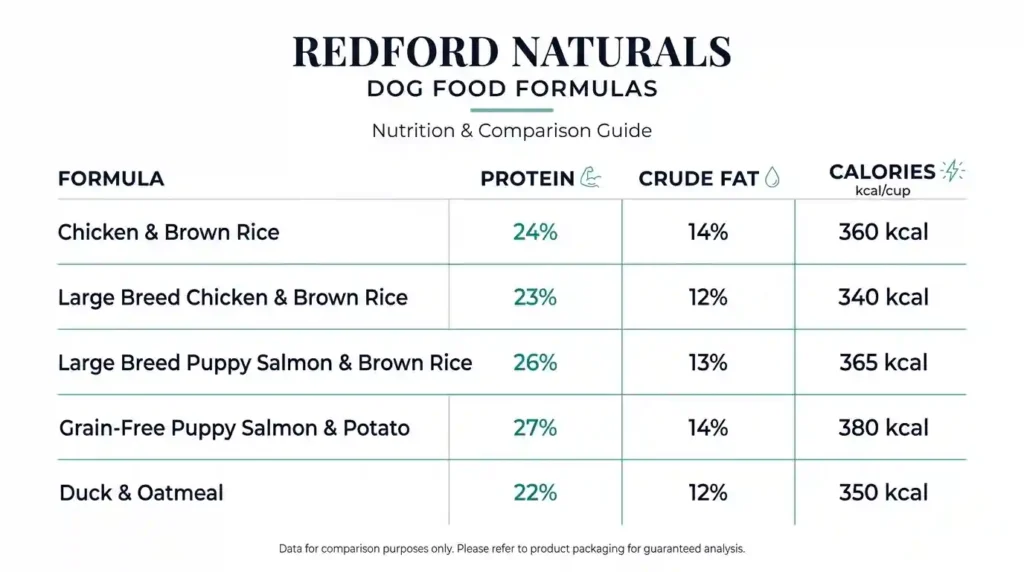
7.12 Redford Naturals Detailed Nutrition Comparison Chart
| Formula | Protein Min. | Fat Min. | Fiber Max. | Calories/Cup |
| Chicken & Brown Rice | 24% | 14% | 4% | 407 |
| Large Breed Chicken & Brown Rice | 24% | 14% | 4% | 407 |
| Large Breed Puppy Salmon & Brown Rice | 25% | 14% | 4% | 408 |
| Grain-Free Puppy Salmon & Potato | 30% | 15% | 4% | 372 |
| Whole Grain LID Duck & Oatmeal | 27% | 14% | 4% | 380 |
Figures represent manufacturer-published label guarantees and calculated energy values from reviewed listings. They are not independently laboratory-verified typical analyses.
8. Is Redford Naturals Good for Different Types of Dogs?
8.1 Is Redford Naturals Good for Puppies?
Yes, appropriately labeled Redford Naturals puppy food may be suitable for healthy growing dogs.
The product must provide adequate energy and nutrients for growth.
8.2 Is Redford Naturals Good for Adult Dogs?
Many Redford recipes are designed for adult dogs or all life stages.
Check daily calories, nutrient adequacy, and body condition.
8.3 Is Redford Naturals Good for Senior Dogs?
Some senior dogs may do well on an adult formula, while others need a different calorie level, protein profile, or therapeutic diet.
Age alone does not determine the ideal food.
8.4 Is Redford Naturals Good for Small Breeds?
Small-breed formulas may offer smaller kibble pieces and feeding guidelines suited to smaller dogs.
They can be practical for dogs with smaller mouths.
8.5 Is Redford Naturals Good for Large Breed Dogs?
Large breeds can benefit from foods providing appropriate calories, protein, and minerals.
For adults, maintaining a lean body condition is particularly important for mobility.
8.6 Is Redford Naturals Appropriate for Large-Breed Puppy Growth?
Understanding AAFCO Large-Size Dog Growth Statements
AAFCO distinguishes foods appropriate for growth of dogs expected to weigh 70 pounds or more as adults.
Calcium, Phosphorus and Calorie Requirements
Rapid growth requires appropriate mineral intake without excessive calories.
Redford Naturals Large Breed Puppy Formula Analysis
Large Breed Puppy Salmon & Brown Rice lists approximately:
- 25% minimum protein
- 14% minimum fat
- 1.3% minimum calcium
- 1.1% minimum phosphorus
- 408 kcal per cup
Its published nutritional adequacy statement includes growth of large-size dogs.
However, a detailed mineral assessment should use typical calcium and phosphorus values, not just label minimums.
Why Some All-Life-Stages Formulas Exclude Large-Breed Growth
An all-life-stages label can contain wording excluding growth of large-size dogs.
Always read the full statement rather than assuming every all-life-stages product is appropriate.
8.7 Is Redford Naturals Good for Active and Working Dogs?
Active dogs may require more calories and different macronutrient proportions than sedentary pets.
Choose based on total energy requirements and actual nutritional composition.
8.8 Is Redford Naturals Good for Dogs With Sensitive Stomachs?
Some dogs may tolerate Redford recipes well.
However, recurring vomiting, diarrhea, or gastrointestinal discomfort should prompt veterinary evaluation rather than repeated unsupervised food changes.
8.9 Are Redford Naturals Limited Ingredient Diets Good for Food Allergies?
Single Animal Protein vs. Truly Limited Ingredients
A recipe advertised as single-source animal protein can still contain various plant ingredients, oils, and other components.
Food Allergies vs. Food Intolerances
Food allergies involve an immune response, while intolerance does not necessarily involve the immune system.
Why Limited Ingredient Does Not Always Mean Hypoallergenic
Retail limited-ingredient foods may contain undeclared cross-contact from manufacturing processes.
They are not automatically suitable for strict diagnostic elimination trials.
Hydrolyzed Protein Diets and Veterinary Elimination Trials
Veterinarians may recommend hydrolyzed or carefully controlled novel-protein diets for food-allergy investigation.
These should not be replaced by ordinary limited-ingredient foods without professional guidance.
8.10 Is Redford Naturals Good for Picky Eaters?
Several flavors and textures may appeal to selective dogs.
Food acceptance varies by individual, and unexplained appetite loss should not be ignored.
8.11 Which Dogs Should Avoid Certain Redford Naturals Formulas?
Dogs with confirmed food allergies, pancreatitis, kidney disease, urinary disorders, or other medically managed nutritional needs may require a different formula.
Grain-free diets should be discussed with a veterinarian when heart-health concerns exist.
8.12 How to Choose the Right Redford Naturals Formula for Your Dog
Start with life stage, expected adult size, health status, activity, and nutritional adequacy.
Then compare ingredient tolerance, calories, product availability, and cost.
The best food is the one that meets nutritional needs and supports long-term well-being—not necessarily the recipe with the longest ingredient list.
9. Redford Naturals Grain-Free vs. Grain-Inclusive Dog Food
9.1 Does Redford Naturals Offer Grain-Free Dog Food?
Yes. Redford Naturals has offered several grain-free foods, including puppy and limited-ingredient recipes.
9.2 Redford Naturals Grain-Free Formula Ingredients
Depending on the recipe, grain-free Redford food may contain salmon, poultry meal, potatoes, peas, lentils, tapioca, and other ingredients.
Some grain-free diets contain concentrated plant-protein ingredients.
9.3 Benefits and Limitations of Grain-Inclusive Recipes
Whole grains can supply carbohydrates, fiber, and nutrients.
For most healthy dogs, there is no established reason to avoid all grains.
Grain-inclusive formulas may provide a straightforward option when there is no diagnosed grain-related dietary problem.
9.4 Peas, Potatoes and Legumes in Grain-Free Dog Food
Peas, lentils, and related pulses are used in many grain-free diets.
Their inclusion alone does not prove that a food causes heart disease.
Ingredient proportions, overall formulation, and other factors may be relevant.
9.5 Grain-Free Dog Food and Dilated Cardiomyopathy (DCM) Concerns
The US Food and Drug Administration has investigated reports of nonhereditary DCM associated with certain diets.
Many reported diets contained pulses high in their ingredient lists.
However, the FDA has not identified a single definitive dietary cause, and reports have included both grain-free and grain-containing diets.
This evidence does not justify declaring every Redford grain-free formula unsafe.
9.6 Does Added Taurine Make Redford Naturals Safer for Heart Health?
What Is Taurine and Why Is It Added to Dog Food?
Taurine is involved in several physiological processes, including normal cardiac function.
Can Taurine Prevent Diet-Associated DCM?
Added taurine does not prove that a particular diet prevents DCM.
The condition can involve genetics, nutrition, and other factors.
What the FDA Has and Has Not Established About Grain-Free Diets
The FDA has reported associations and continues to investigate possible mechanisms.
It has not established that all grain-free dog foods cause DCM or that taurine supplementation eliminates potential dietary concerns.
Why Ingredient Proportions May Matter More Than Grain-Free Labels
Some grain-containing diets also use large quantities of pulse ingredients.
The complete formulation matters more than the presence or absence of the words “grain-free.”
9.7 Which Redford Naturals Formula Is Better: Grain-Free or Grain-Inclusive?
For most healthy dogs without a specific medical need to avoid grains, a suitable grain-inclusive Redford formula is a reasonable starting point.
A grain-free product should be selected for a clear reason rather than assuming that removing grains improves health.
10. Redford Naturals Dog Food Safety & Recall History
10.1 Has Redford Naturals Dog Food Ever Been Recalled?
No confirmed Redford Naturals dog-food recall was identified in the publicly accessible FDA and independent recall resources reviewed for this article.
That is not a guarantee that every historical incident has been captured or that future recalls cannot occur.
10.2 Redford Naturals Dog Food Recall History and Timeline
The checked recall sources did not provide a substantiated Redford-specific recall event to include in a dated timeline.
Some online articles refer to historical concerns without identifying an official recall notice, affected product lots, or a government record.
Unverified claims should not be represented as confirmed recalls.
10.3 Reasons for Reported Recalls and Safety Concerns
Pet-food recalls can involve bacterial contamination, excessive nutrients, foreign materials, or labeling errors.
These are general examples of possible recall causes, not documented reasons for a Redford recall.
10.4 Manufacturing and Food Safety Standards
Redford Naturals is marketed as a US-made product line using domestic and imported ingredients.
However, complete manufacturer-specific testing procedures for every formula were not independently available.
10.5 Ingredient Safety and Food Processing Concerns
Dry kibble is commonly produced using extrusion and thermal processing.
Processing can influence nutrient availability and pathogen risk, but the term “ultra-processed” alone does not establish nutritional inadequacy.
Likewise, potential concerns about pesticide residues, glyphosate, or heavy metals cannot be assigned to Redford products without reliable product-specific test results.
10.6 How to Check Current Redford Naturals Recall Alerts
Check official FDA animal-food recall information, retailer notices, and communications identifying affected products.
Verify the lot number and package information instead of relying on an alarming headline.
10.7 How to Report a Suspected Redford Naturals Food Safety Problem
Finding the Lot Number, UPC and Best-By Date
Locate these identifiers on the product packaging.
Gathering Product Packaging and Veterinary Records
Retain the bag or can, purchase receipt, photographs, and relevant veterinary information.
Reporting a Suspected Pet Food Problem to the FDA
Submit details through the FDA’s animal-food complaint reporting process.
Contacting Pet Supplies Plus About a Potentially Defective Product
Provide the store with the product identifiers and a clear explanation of the concern.
If your dog develops severe vomiting, bloody diarrhea, collapse, or other serious symptoms, obtain veterinary care promptly.
11. Redford Naturals Taste, Palatability & Digestibility
11.1 Do Dogs Like the Taste of Redford Naturals?
Many retailer reviews report that dogs accept the food well, although experiences vary.
Taste preferences cannot be predicted reliably from ingredient lists.
11.2 Redford Naturals Flavor Variety
Recipes include chicken, salmon, duck, lamb, beef, and other proteins.
However, not every flavor is available in every formula type.
11.3 Kibble Size, Shape and Texture
Small-breed formulas may contain smaller pieces, while other products use standard kibble dimensions.
Dogs with dental problems or chewing difficulties may need a different texture.
11.4 Is Redford Naturals Easy for Dogs to Digest?
Digestibility depends on processing, ingredient composition, and the individual dog.
A healthy stool pattern is a useful observation but not a direct laboratory measure of nutrient absorption.
11.5 Stool Quality and Digestive Tolerance
Monitor stool consistency, appetite, gas, and other digestive changes.
Persistent abnormalities deserve veterinary assessment.
11.6 How to Transition Your Dog to Redford Naturals
A gradual transition over approximately 7–10 days is a common approach.
| Transition Days | Previous Food | Redford Naturals |
| 1–2 | 75% | 25% |
| 3–4 | 50% | 50% |
| 5–6 | 25% | 75% |
| 7–10 | 0% | 100% |
This is a general schedule. Dogs with sensitive digestion may require individualized guidance.
11.7 Can You Mix Redford Naturals With Other Dog Foods?
Yes, provided the total diet remains nutritionally suitable and the calorie contribution of each food is considered.
Mixing products without calculating portions can unintentionally increase energy intake.
11.8 30-Day Redford Naturals Feeding Observation Checklist
Monitoring Stool Quality and Digestive Changes
Record any ongoing diarrhea, unusual gas, vomiting, or changes in stool consistency.
Tracking Weight and Body Condition Score
Monitor weight and body condition regularly.
Observing Skin, Coat and Appetite Changes
Track appetite, skin irritation, coat condition, and general activity.
When Digestive Symptoms Require Veterinary Attention
Repeated vomiting, persistent diarrhea, blood in stool, lethargy, or dehydration are reasons to seek veterinary advice.
How to Decide Whether to Continue or Change Formulas
Evaluate symptoms, veterinary findings, feeding amounts, and the dog’s medical history.
Do not use an observation checklist as a substitute for diagnosing an allergy or disease.

12. How to Store Redford Naturals Dog Food Safely
12.1 How Long Does Redford Naturals Stay Fresh After Opening?
Freshness depends on the product, packaging, fat content, and storage environment.
Follow the product’s best-by and storage instructions rather than assuming that every open bag has the same shelf life.
12.2 Proper Storage for Dry Kibble
Store dry food in a cool, dry area away from direct sunlight and moisture.
Keeping the original bag inside a clean, sealed container helps preserve label information.
12.3 How to Refrigerate Opened Wet Dog Food
Transfer or cover leftover wet food as directed and refrigerate promptly.
Maintain a refrigerator temperature of 40°F or below.
12.4 Storage and Handling Requirements for Freeze-Dried Recipes
Follow the specific product instructions.
Raw-style products deserve additional hygiene precautions, particularly around food preparation areas and vulnerable household members.
12.5 How to Read Expiration Dates and Lot Numbers
Best-by dates indicate the manufacturer’s intended period of product quality under appropriate storage conditions.
Lot numbers are essential for identifying production batches when reporting a problem.
12.6 Signs of Spoiled or Contaminated Dog Food
Potential warning signs include mold, unexpected moisture, unusual odor, damaged packaging, pest activity, or visible foreign material.
Stop using suspicious food.
12.7 Cleaning Feeding Bowls, Scoops and Storage Containers
Clean and dry food bowls and utensils regularly.
Before refilling a storage container, remove old food residue and wash and dry the container.

13. Redford Naturals Customer Reviews & Real-World Experiences
13.1 What Do Dog Owners Say About Redford Naturals?
Retailer reviews offer insight into product acceptance, price satisfaction, and common concerns.
For example, currently indexed Pet Supplies Plus review data show favorable average scores for some recipes, including Large Breed Puppy Salmon & Brown Rice.
However, ratings vary by product, sample size, and time.
13.2 Common Positive Customer Feedback
Positive reviews commonly discuss food acceptance, ingredient preferences, and perceived value.
These are useful consumer observations, not clinical proof that the food improves a particular health condition.
13.3 Common Complaints and Negative Reviews
Complaints can include refusal to eat, digestive changes, availability issues, or dissatisfaction with particular formulas.
A complaint does not automatically establish a manufacturing defect or causal relationship with illness.
13.4 Long-Term Customer Experiences
Long-term reports can describe how dogs tolerate a formula over time.
However, diet, genetics, exercise, veterinary care, and other factors can all influence a dog’s health.
13.5 Independent Dog Food Reviewers’ Ratings
Dog Food Advisor’s June 2026 Redford Naturals dry-food review rates its evaluated product line highly, reporting an average five-star assessment.
Other review sites use different systems and may emphasize ingredient safety, processing, or carbohydrate estimates.
These ratings should not be treated as interchangeable with veterinary feeding-trial results.
13.6 Overall Customer Satisfaction and Brand Reliability
The brand appears to have a positive reputation among many retailer customers.
Its reliability assessment would be stronger with greater manufacturing transparency and more publicly available product-specific scientific research.
14. Redford Naturals Price, Affordability & Value
14.1 How Much Does Redford Naturals Dog Food Cost?
Prices vary by formula, bag size, store, region, and promotion.
As a November 2026 example, a 28-pound Chicken & Brown Rice bag appeared in US retail listings at approximately $59.98 before some promotional discounts.
That example should not be treated as a permanent nationwide price.
14.2 Dry vs. Wet Redford Naturals Price Comparison
Dry food is often less expensive per calorie than wet food.
Wet food contains more water, which can be beneficial for moisture intake but makes simple price-per-pound comparisons misleading.
14.3 How Much Does Redford Naturals Cost per 1,000 Calories?
Price per Pound vs. Price per Calorie
A 28-pound bag at $59.98 costs approximately $2.14 per pound.
Using Chicken & Brown Rice’s published energy value of 3,700 kcal/kg, the same bag provides approximately 47,000 kcal.
Its illustrative cost is approximately $1.28 per 1,000 kcal.
Estimated Monthly Feeding Costs for Small, Medium and Large Dogs
| Illustrative Daily Energy From Food | Approx. 30-Day Cost |
| 700 kcal | $26.80 |
| 1,000 kcal | $38.30 |
| 1,500 kcal | $57.40 |
These calculations are budgeting examples, not feeding recommendations by breed or weight.
How Formula Calorie Density Changes Feeding Costs
A lower-calorie formula may require a larger serving volume.
Comparisons should use calories and nutritional suitability, not just bag weight.
Large Bags, Promotions and Long-Term Value
Large bags and store promotions may reduce the cost per pound.
However, food freshness and the dog’s actual consumption rate should also influence buying decisions.
14.4 Is Redford Naturals Worth the Money?
Redford Naturals offers a reasonable value proposition for many owners wanting meat-first recipes and multiple dietary choices.
Its value becomes less compelling if the chosen recipe fails to meet the dog’s needs or requires expensive supplements or additional dietary management.
14.5 Where Can You Buy Redford Naturals Dog Food?
Redford Naturals is associated primarily with Pet Supplies Plus retail locations and the retailer’s online ordering services.
Availability may depend on your local store.
15. Redford Naturals vs. Other Dog Food Brands
15.1 Redford Naturals vs. Blue Buffalo
Both brands offer dry foods with named animal proteins, grain-inclusive formulas, and grain-free options.
However, product lines differ considerably in ingredients, research disclosures, calories, and price.
Compare equivalent life-stage recipes rather than entire brands.
15.2 Redford Naturals vs. Taste of the Wild
Taste of the Wild is known for distinctive animal-protein combinations and grain-free varieties.
Redford Naturals offers both grain-inclusive and grain-free options.
The best choice depends on formulation evidence, ingredient tolerance, nutritional adequacy, and price.
15.3 Redford Naturals vs. Victor Dog Food
Victor markets formulas for different energy requirements and feeding situations.
For active dogs, assess actual protein, fat, and calorie values rather than relying on performance-related marketing terms.
15.4 Redford Naturals vs. Fresh Dog Food Brands
Fresh-food options may offer different textures and ingredient formats but usually require refrigeration or freezing and can cost more.
Owners exploring these alternatives can read Is Freshpet Good for Dogs and is just food for dogs good.
Check whether the specific product is nutritionally complete for your dog’s life stage.
15.5 Ingredient Quality, Nutrition and Price Comparison
| Brand | Main Consideration | Potential Limitation |
| Redford Naturals | Meat-first recipes and multiple formula options | Limited public research transparency |
| Blue Buffalo | Broad product selection | Formula-specific comparisons needed |
| Taste of the Wild | Multiple animal-protein options | Grain-free formulation considerations |
| Victor | Several activity-focused diets | Verify exact energy and nutrient requirements |
| Purina Pro Plan | Extensive specialized offerings | Some formulas cost more |
| Hill’s Science Diet | Veterinary nutrition emphasis | Price and recipe suitability vary |
| Freshpet | Refrigerated food format | Storage and cost considerations |
This is a category-level comparison, not a controlled nutritional ranking.
For more detailed information about competing brands, see our guides on whether Diamond dog food is good, whether Diamond Naturals is a good dog food, and whether Black Gold dog food is good.
15.6 Best Alternatives to Redford Naturals Dog Food
The most appropriate alternative depends on the reason for switching.
For greater access to published nutritional research and specialized diets, consider comparing Purina Pro Plan or Hill’s Science Diet. Our guides discuss whether Purina Pro Plan is a good dog food and whether Hill’s is a good dog food.
For different retail ingredient profiles, compare Natural Balance dog food, Next Level dog food, and Pure Balance dog food.
If budget is a major consideration, other lines worth researching include Beneful, Pedigree, and Purina Dog Chow.
For context on Purina’s overall portfolio, see is Purina good for dogs, while is Moist & Meaty good for dogs explores another food format.
Puppy owners should compare growth-appropriate diets specifically. See our Purina Puppy Chow review for a separate discussion of puppy nutrition.
16. Redford Naturals Sustainability & Ethical Considerations
16.1 Redford Naturals Ingredient Sourcing and Sustainability
Ingredient sourcing can affect transportation emissions, resource use, and overall environmental impact.
However, verified product-specific lifecycle information is not sufficiently available to quantify Redford Naturals’ environmental performance.
16.2 Environmental Impact of Manufacturing
Pet-food manufacturing uses water, energy, packaging, and transportation.
A US-made label does not establish that a product has a lower overall environmental footprint.
16.3 Ethical Sourcing and Animal Welfare Practices
Animal welfare and responsible ingredient sourcing are important purchasing considerations.
Specific supplier certifications or independently audited welfare standards should be verified before making strong claims.
16.4 Corporate Social Responsibility and Community Initiatives
Pet Supplies Plus operates a national retail network and participates in various community-oriented retail activities.
Those activities do not directly establish the nutritional quality of Redford Naturals food.
17. How We Evaluate and Rate Redford Naturals Dog Food
17.1 Ingredient Quality Assessment
This review examines ingredient labels, recognizable animal protein sources, carbohydrate ingredients, and functional additions.
Ingredient order is considered useful but insufficient to determine overall quality.
17.2 Nutritional Analysis and Recipe Comparison
Manufacturer-published guaranteed analyses and calorie values were used to compare selected formulas.
No independent laboratory testing was conducted for this article.
17.3 Ingredient Safety and Processing Evaluation
The review distinguishes genuine safety risks from unsupported conclusions based solely on ingredient names or processing methods.
17.4 Manufacturing Quality and Recall History Assessment
Public manufacturing disclosures and identifiable recall information were considered.
The absence of a verified recall does not guarantee future safety.
17.5 Palatability, Digestibility and Customer Feedback
Retailer reviews and independent editorial assessments were considered as supplementary information.
They are not substitutes for controlled digestibility or feeding studies.
17.6 Price-to-Nutrition Value Assessment
Illustrative feeding costs were calculated using verifiable product calorie information and a representative retail price.
17.7 Scientific Evidence, Data Sources and Review Limitations
The principal limitations are unavailable complete typical nutrient analyses for every product, incomplete public disclosure of current contract manufacturing, and a lack of easily accessible formula-specific research.
These limitations should be addressed before claiming that Redford Naturals is scientifically superior to competing foods.
17.8 How the Final Redford Naturals Rating Is Calculated
The provisional 4/5 editorial rating reflects a qualitative combination of ingredient composition, nutritional adequacy information, product selection, transparency, and value.
It is not an independently validated quantitative scoring system.
The rating would need reassessment if meaningful new evidence emerges about product testing, research, manufacturing, or safety.
18. Frequently Asked Questions About Redford Naturals
18.1 Is Redford Naturals the Same as Redford Dog Food?
Yes, Redford dog food generally refers to the Redford Naturals pet-food brand sold through Pet Supplies Plus.
18.2 Is Redford Naturals a Premium Dog Food Brand?
Redford Naturals is marketed as premium or natural dog food, but those terms do not independently establish nutritional superiority.
18.3 Is Redford Naturals a Pet Supplies Plus Exclusive Brand?
Yes, Redford Naturals is a private-label brand associated with Pet Supplies Plus.
18.4 Can You Feed Redford Naturals Every Day?
Yes, if the specific formula is complete and balanced for your dog’s life stage and meets their individual nutritional needs.
18.5 Can Dogs Switch Between Different Redford Naturals Recipes?
Yes, but gradual transitions help reduce the likelihood of digestive upset.
18.6 Does Redford Naturals Make Both Dog and Cat Food?
Yes, the brand has offered food products for both dogs and cats, which should not be used interchangeably.
19. Final Verdict: Should You Buy Redford Naturals Dog Food?
19.1 Main Advantages of Redford Naturals
Redford Naturals offers recognizable animal proteins, multiple formula types, growth and adult options, and reasonable affordability in several product categories.
19.2 Important Drawbacks to Consider
The main limitations are incomplete public manufacturing transparency, limited formula-specific research disclosures, availability restrictions, and concerns requiring careful evaluation of some grain-free formulations.
19.3 Who Should Consider Redford Naturals?
It can be a good choice for healthy dogs whose owners want a meat-first formula, appreciate varied recipe options, and can purchase the brand conveniently.
19.4 When to Choose an Alternative Dog Food
Consider alternatives when a dog needs a veterinary therapeutic diet, has confirmed ingredient allergies, requires a special nutrient profile, or does not tolerate the selected recipe.
19.5 Final Recommendation — Final Thoughts
Is Redford Naturals a good dog food? Yes, many of its recipes appear to offer reasonable nutritional value, recognizable animal proteins, and useful options for dogs at different life stages. Grain-inclusive recipes such as Chicken & Brown Rice are practical starting points for owners who don’t have a specific reason to avoid grains.
However, the quality of any dog food depends on more than the first ingredient. Manufacturing transparency, nutritional adequacy, research, ingredient tolerance, and appropriate feeding portions should all influence your decision.
Before choosing Redford Naturals, check the current product label and discuss any medical or dietary concerns with your veterinarian. Monitor your dog’s weight, appetite, digestion, and overall condition after changing foods.
For more comparisons and practical guidance, explore our Dog Food Brand Reviews and the wider Dog Behavior and Training resource library.