
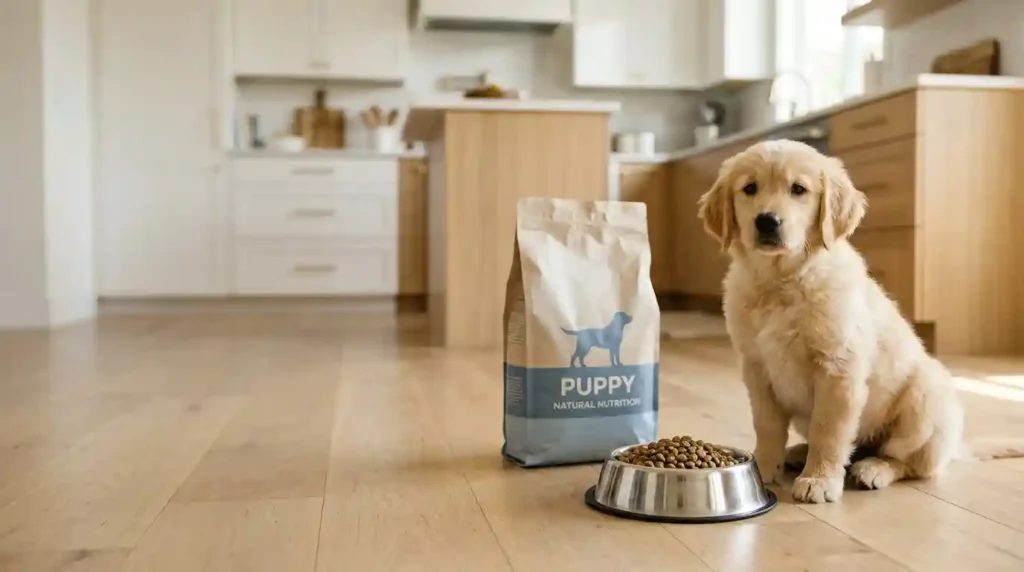

Is Purina Puppy Chow good for puppies? Yes, Purina Puppy Chow can be a good, affordable food for many healthy growing puppies. Its dry formulas are designed to provide complete and balanced nutrition, including protein for developing muscles, DHA for brain and vision development, calcium and phosphorus for growing bones, and vitamins and minerals for overall health. Manufactured by Nestlé Purina PetCare, the brand benefits from an established pet-food research and manufacturing infrastructure. However, that doesn’t mean every puppy will thrive on every Puppy Chow recipe.
There are important trade-offs. Many Puppy Chow formulas rely heavily on corn and other grains, contain animal by-product meals and plant-derived protein, and include artificial coloring. These ingredients aren’t automatically unsafe, but they deserve closer examination when comparing nutritional quality and ingredient preferences.
This comprehensive Purina Puppy Chow review explains what’s actually in the food, how its nutritional values compare, whether it’s appropriate for large breeds, what owners should know about recalls, and whether spending more on alternatives like Purina ONE or Pro Plan is worthwhile. You’ll also find practical feeding instructions, cost comparisons, and advice for choosing the best formula for your puppy.
Table of Contents
- Is Purina Puppy Chow Good for Puppies? Quick Overview
- What Is Purina Puppy Chow? Brand Background & Reputation
- Purina Puppy Chow Product Lines & Formula Comparison
- Purina Puppy Chow Ingredients Analysis
- Purina Puppy Chow Nutritional Profile & Guaranteed Analysis
- Is Purina Puppy Chow Complete and Balanced for Growing Puppies?
- Is Purina Puppy Chow Good for Different Types of Puppies?
- Purina Puppy Chow Safety, Recalls & Quality Concerns
- What Do Veterinarians, Experts & Puppy Owners Say?
- Purina Puppy Chow Price, Affordability & Value
- Purina Puppy Chow vs. Other Puppy Food Brands
- How to Feed Purina Puppy Chow Properly
- How to Store Purina Puppy Chow Safely
- Purina Puppy Chow Sustainability & Ethical Considerations
- How We Evaluated Purina Puppy Chow Dog Food
- Frequently Asked Questions About Purina Puppy Chow
- Final Verdict: Should You Feed Your Puppy Purina Puppy Chow?
1. Is Purina Puppy Chow Good for Puppies? Quick Overview
1.1 Is Purina Puppy Chow a Good Dog Food? Quick Verdict
Purina Puppy Chow is a reasonable budget-friendly puppy food for many healthy puppies when the selected formula meets their nutritional needs.
The biggest advantage is that it provides growth-stage nutrition without requiring the price of a premium specialty diet.
Puppy Chow isn’t simply adult kibble in a different package. Its formulations contain nutrients intended to support the rapid physical development puppies undergo during their first months of life.
Nevertheless, ingredient preferences, medical requirements, digestive tolerance, and appropriate portion sizes should influence the decision.
A puppy eating an affordable, nutritionally adequate diet in suitable amounts may do better than one eating an expensive food in unsuitable portions.
1.2 Purina Puppy Chow Review Summary
| Feature | Assessment |
| Manufacturer | Nestlé Purina PetCare |
| Brand introduction | 1963 |
| Primary purpose | Growth-stage dog nutrition |
| Main product format | Dry kibble |
| Grain-free | No |
| Protein | 27.5% minimum in three reviewed dry formulas |
| Fat | 10–12% minimum, depending on recipe |
| DHA | Included in reviewed formulas |
| Calcium and phosphorus | Included for skeletal development |
| Artificial colors | Present in reviewed dry recipes |
| Animal by-products | Present |
| AAFCO nutritional adequacy | Yes, on reviewed dry-food labels |
| Large-breed option | Available |
| Price positioning | Budget-oriented |
| Best suited for | Healthy growing puppies without specific dietary restrictions |
Figures reflect manufacturer product information and the reviewed US label documents. Always check the specific package because formulations can change.
1.3 Overall Purina Puppy Chow Dog Food Rating
Editorial assessment: 3.8 out of 5 — Good budget puppy food.
This is an editorial assessment of the brand’s suitability and value, not a laboratory-tested nutritional score or a veterinary certification.
| Evaluation Area | Editorial Score |
| Growth-stage nutritional suitability | 4.5/5 |
| Manufacturer expertise and quality systems | 4/5 |
| Variety and specialized choices | 3/5 |
| Ingredient formulation and transparency | 3.5/5 |
| Budget accessibility and value | 4/5 |
| Overall | 3.8/5 |
The strongest factors are its growth-focused formulation, accessible pricing category, and established manufacturer.
The limitations are a relatively narrow range of specialized choices and an ingredient approach that may not appeal to owners seeking certain exclusions or alternative protein sources.
1.4 Purina Puppy Chow Pros and Cons
| Pros | Cons |
| Formulated for growing puppies | Corn is prominent in several recipes |
| Nutritionally adequate according to reviewed labels | Includes animal by-product meal |
| Contains DHA | Includes artificial food coloring |
| Provides protein and essential minerals | Contains common dietary allergens |
| Established manufacturer | Limited specialized digestive or allergy diets |
| Available in large bags | Not ideal for every medical condition |
| Large-breed formula available | Product labels must be checked individually |
| Generally budget-friendly | Fewer specialty options than premium lines |
1.5 Who Should Consider Purina Puppy Chow?
Puppy Chow makes the most sense for owners looking for affordable, nutritionally complete puppy kibble without needing a therapeutic or highly specialized formula.
It may suit a healthy small- or medium-breed puppy, an owner feeding multiple puppies, or a large-breed puppy receiving an appropriately labeled growth formula.
Owners seeking more specialized diets can explore the wider Dog Food guides before deciding.
2. What Is Purina Puppy Chow? Brand Background & Reputation
2.1 What Is Purina Puppy Chow Dog Food?
Purina Puppy Chow is a line of dog foods developed to meet the nutritional requirements of growing puppies.
Its formulas contain a mixture of animal-derived ingredients, grain-based ingredients, added vitamins, minerals, fats, and other nutrients.
Unlike maintenance diets formulated primarily for adult dogs, puppy food must support processes such as rapid skeletal growth, muscle development, immune-system maturation, and changes in energy requirements.
2.2 Who Owns and Manufactures Purina Puppy Chow?
Purina Puppy Chow belongs to Nestlé Purina PetCare, a subsidiary of Nestlé.
The company’s headquarters are in St. Louis, Missouri, and it manufactures numerous pet-food brands, including Purina ONE, Purina Pro Plan, Dog Chow, and Beneful.
The manufacturing and research resources of a large company are relevant advantages. However, each recipe should still be evaluated individually rather than assuming that every food sold by Purina has identical quality or nutritional characteristics.
2.3 Purina Puppy Chow Brand History
Purina introduced Puppy Chow in 1963, recognizing that growing puppies need different nutritional proportions from adult dogs.
Over the following decades, formulations evolved to include additional nutrients associated with early development, such as DHA.
The current Puppy Chow range emphasizes accessible nutrition for growing dogs, whereas the company’s Pro Plan line offers a broader selection of specialized diets.
2.4 Where Is Purina Puppy Chow Made?
Purina states that Puppy Chow is manufactured in Purina-owned facilities in the United States.
That statement describes the manufacturing of the food, not necessarily the country of origin of every individual ingredient.
Owners specifically concerned about ingredient origins should request information for the exact product and production batch.
2.5 Ingredient Sourcing and Manufacturing Locations
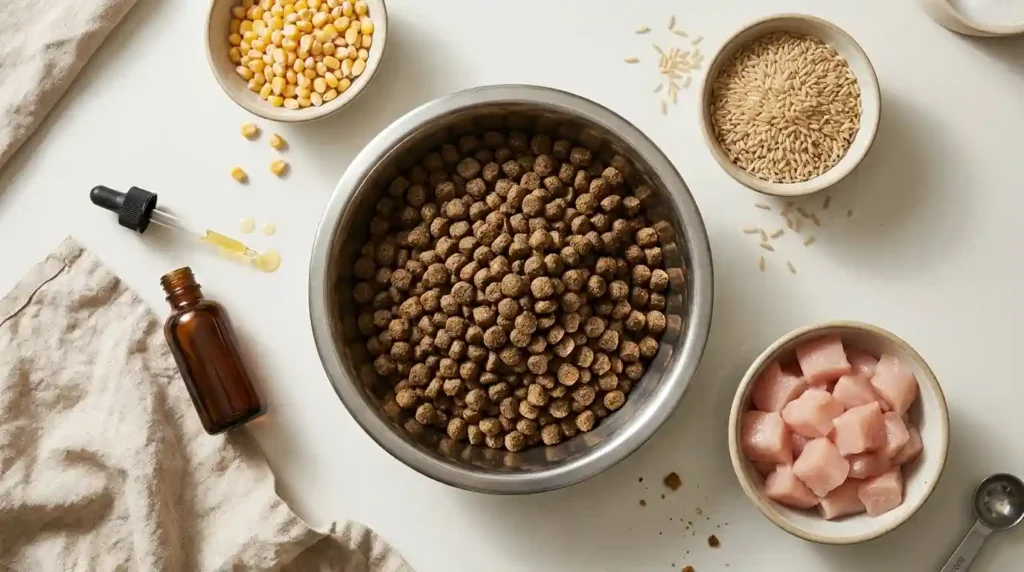
Puppy Chow recipes use ingredients such as corn, rice, wheat, soy, chicken, poultry by-product meal, animal fat, fish oil, and added micronutrients.
Ingredient suppliers and manufacturing processes can vary by recipe. A brand-wide claim that every ingredient comes from the United States should not be assumed without documentation.
Traceability, supplier verification, and finished-product testing are more meaningful than a package’s visual presentation alone.
2.6 Manufacturing Standards, Testing and Quality Control
Purina describes extensive safety and quality checks across its manufacturing operations.
Relevant controls can include raw-material inspection, nutrient verification, microbial testing, equipment sanitation, packaging integrity, and batch tracking.
These systems reduce risks but cannot completely eliminate the possibility of manufacturing errors or recalls.
2.7 Manufacturer Transparency and Nutritional Research
An established research department is a positive factor, but it is important to distinguish research performed by Purina generally from studies directly demonstrating benefits for Puppy Chow Complete or another individual recipe.
A published study involving one Purina formula does not automatically establish that every recipe produces the same results.
Consumers should evaluate manufacturer expertise, actual product information, feeding evidence, and the nutritional needs of their own puppies.
2.8 Questions to Ask Purina Before Choosing Puppy Chow
Who Formulates Purina Puppy Chow Recipes?
Ask whether the recipe was developed with qualified animal nutritionists, food scientists, and veterinary nutrition specialists.
Can Purina Provide Typical Nutrient Analyses?
Request the typical calcium, phosphorus, protein, fat, and energy values of the exact formula. These may be more useful than the guaranteed minimum and maximum figures.
What Quality and Finished-Product Testing Is Performed?
Ask how ingredient specifications and final nutritional values are verified, and what steps are taken to monitor contamination risks.
What Published Research Supports the Formula’s Claims?
Ask whether studies support the specific formulation or a broader nutritional principle.
These questions are especially valuable for owners comparing several products at different price points.
3. Purina Puppy Chow Product Lines & Formula Comparison
Purina Puppy Chow has offered several dry and wet products, but availability changes over time. The current US product catalog prominently lists three dry-food varieties and training treats.
3.1 Purina Puppy Chow Complete with Real Chicken & Rice
Puppy Chow Complete is the primary everyday puppy formula.
Its reviewed label lists whole grain corn, chicken by-product meal, corn protein meal, animal fat, and soybean meal among the leading ingredients.
It also includes chicken, fish oil, vitamins, minerals, and amino acid supplements.
Key nutritional figures:
- Crude protein: 27.5% minimum
- Crude fat: 12% minimum
- Crude fiber: 5% maximum
- DHA: 0.05% minimum
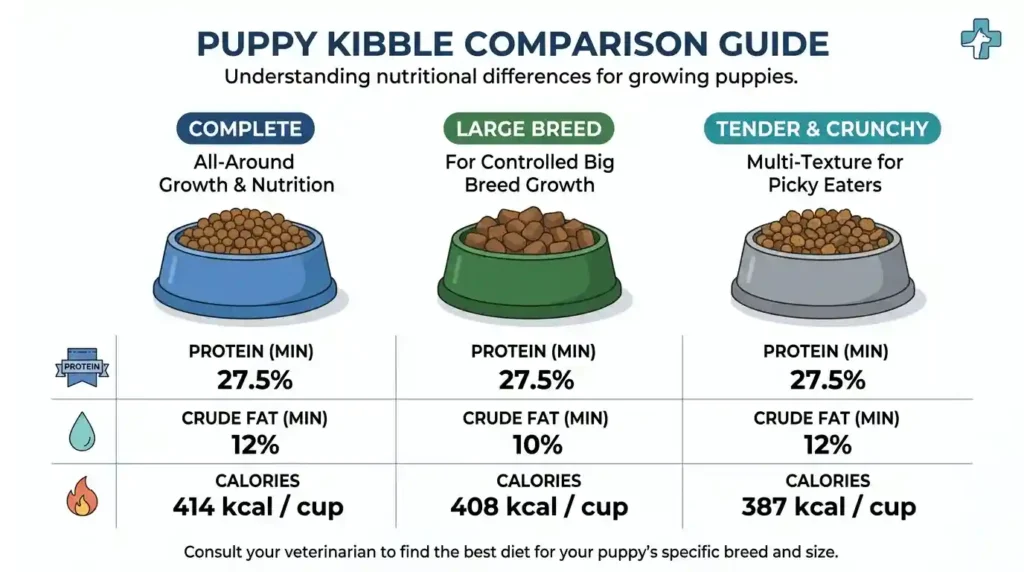
- Calorie content: approximately 414 kcal per cup
The reviewed AAFCO statement identifies the formula as suitable for all life stages, including growth of large-size dogs.
Nevertheless, feeding amounts and a puppy’s body condition remain important.
3.2 Purina Puppy Chow Large Breed with Real Chicken
Large Breed is developed for puppies expected to grow into substantially larger adult dogs.
The reviewed formula has 27.5% minimum protein and 10% minimum fat, compared with 12% minimum fat in Complete.
Its published calorie figure is approximately 408 kcal per cup.
Large-breed growth requires particularly careful energy and mineral management because excessive calorie intake and rapid weight gain can create orthopedic concerns.
Purina’s Large Breed product is labeled for growth of large-size dogs. Its feeding instructions also state that the product is not appropriate for pregnant or lactating females.
3.3 Purina Puppy Chow Tender & Crunchy with Real Beef & Rice
Tender & Crunchy combines crunchy kibble with softer, meaty-textured pieces.
It is marketed toward puppies that may prefer variety in texture.
The reviewed label lists 27.5% minimum protein, 12% minimum fat, and 4% maximum crude fiber.
Its manufacturer-listed energy value is approximately 387 kcal per cup.
The presence of beef does not make this a single-protein beef diet. The recipe also contains poultry-derived ingredients and other protein sources.
3.4 Purina Puppy Chow Wet Food Varieties
Older Puppy Chow product ranges included Classic Ground wet-food recipes.
However, Purina’s US wet Puppy Chow catalog showed no active listed products during this review. The following are historical varieties, not confirmed current purchasing recommendations.
Classic Ground with Real Beef
This canned recipe was promoted as a moisture-rich puppy food made with beef and added nutrients.
Some retailers now identify the product as discontinued.
Classic Ground with Real Chicken
The chicken version offered a soft pâté-like consistency and was intended for growing puppies.
It should not be assumed available simply because historical product pages remain indexed.
Classic Ground with Real Lamb
Lamb was another variation in the older wet-food range. Its current US availability could not be confirmed.
For puppies needing wet food, choose a currently available product with an appropriate growth-stage nutritional adequacy statement.
3.5 Purina Puppy Chow Training Treats
Purina also lists Puppy Chow training treats.
These are supplemental rewards rather than a substitute for complete puppy food.
Use small portions and account for their calories in the daily feeding plan, particularly during frequent training sessions.
3.6 Purina Puppy Chow Formula Comparison Chart
| Feature | Complete | Large Breed | Tender & Crunchy |
| Protein, minimum | 27.5% | 27.5% | 27.5% |
| Fat, minimum | 12% | 10% | 12% |
| Fiber, maximum | 5% | 5% | 4% |
| DHA, minimum | 0.05% | 0.05% | 0.05% |
| Calcium, minimum | 1.1% | 1.1% | 1.1% |
| Phosphorus, minimum | 0.9% | 0.9% | 0.9% |
| Calories per cup | 414 | 408 | 387 |
| Main positioning | General growth | Large-breed growth | Texture variety |
Manufacturer figures from reviewed US labels and product pages; nutritional percentages are guaranteed values, not necessarily typical laboratory results.
3.7 Recent Recipe and Ingredient Label Changes
How to Compare Older and Current Puppy Chow Ingredient Lists
Look for differences in ingredient names, ordering, fat sources, and nutritional statements.
For example, an older Complete label uses the term corn gluten meal, while a later label uses corn protein meal. Different documents also identify different fat descriptions.
A wording change does not automatically mean the recipe became better or worse.
Why Website Ingredients May Differ From Packaging
A website may display an updated formula while retailers still sell stock manufactured under an earlier label.
Ingredient lists can also differ by region or product variant.
How to Verify Formula Codes and Label Revision Dates
Compare the complete product name, UPC, package code, ingredient list, nutritional statement, and best-by information.
Contact the manufacturer when important information differs.
3.8 Available Bag Sizes and Product Availability
Complete is listed in several sizes, including 4-, 15-, 30-, and 36-pound bags. Tender & Crunchy is listed in 15- and 30-pound bags, while Large Breed has been listed in a 30-pound format.
Actual availability varies among Walmart, Chewy, grocery stores, farm-supply retailers, and other sellers.
Buying the largest bag is not always economical when a small puppy consumes food slowly and freshness becomes a concern.
4. Purina Puppy Chow Ingredients Analysis
4.1 What Ingredients Are in Purina Puppy Chow?
Puppy Chow combines grain-based ingredients, animal protein sources, added fats, vitamins, minerals, and functional nutrients.
Its ingredient formulation differs from premium foods built primarily around several named animal-meat ingredients.
That difference may matter to owners who prefer more animal-derived ingredients, but the ingredient list alone cannot determine complete nutritional quality.
4.2 First Five Ingredients Explained
The reviewed Puppy Chow Complete label identifies these leading ingredients:
| Ingredient | Main Nutritional Function |
| Whole grain corn | Carbohydrates, some protein, energy |
| Chicken by-product meal | Concentrated animal-derived protein and nutrients |
| Corn protein meal | Concentrated plant protein |
| Animal fat preserved with mixed tocopherols | Energy and fatty acids |
| Soybean meal | Plant protein and other nutrients |
Ingredients are generally ordered by weight before processing.
That ordering does not reveal the exact percentage of animal protein or the digestibility of the finished formula.
4.3 Corn as the First Ingredient: Is It Good for Puppies?
Corn is often described as a filler, but that description is oversimplified.
Properly processed corn can provide digestible carbohydrates, essential fatty acids, and useful nutrients. It is not inherently toxic or nutritionally worthless.
The more relevant questions are whether the entire food is nutritionally balanced, whether the puppy digests it successfully, and whether its energy density supports healthy growth.
However, corn being first in the ingredient list means the formulation relies substantially on grain-derived material.
Owners wanting a meat-first recipe may prefer another product.
4.4 Chicken and Other Animal Protein Sources
Chicken provides animal protein and essential amino acids used for muscle development and tissue maintenance.
Puppy Chow Complete includes chicken, but chicken is not necessarily its largest ingredient.
Protein in the finished food also comes from chicken by-product meal, corn protein meal, soybean meal, and other sources.
Crude protein percentage does not reveal how much protein is animal-derived.
The biological value and digestibility of the combined protein sources are important when evaluating a formula.
4.5 Chicken By-Product Meal and Animal By-Products
Chicken by-product meal can contain nutritious poultry tissues such as certain organs.
Organ tissues may supply protein, vitamins, and minerals.
Animal by-products are not automatically inferior or unsafe simply because they are not conventional muscle meat.
The critical factors are ingredient specifications, processing quality, contamination control, and nutrient composition.
An ingredient’s name should not replace evidence about its quality.
4.6 Plant-Based Proteins and Ingredient Splitting
Puppy Chow uses ingredients including corn protein meal and soybean meal.
These contribute protein and amino acids to the total guaranteed analysis.
Ingredient splitting is a term used when related ingredients appear separately in an ingredient list. This can make interpretation less straightforward, although it does not establish wrongdoing.
To assess the contribution of animal-derived protein accurately, more detailed formulation information would be required.
4.7 Grains, Carbohydrates and Common Filler Concerns
Grains such as corn, wheat, rice, and barley can provide energy and other nutrients.
Puppies require adequate energy for growth, but the amount and source should be evaluated alongside protein, fat, vitamins, minerals, and total calories.
Grain-free food is not inherently healthier for every puppy.
Grain intolerance is also different from a confirmed food allergy, which requires appropriate diagnostic assessment.
4.8 Fats, Oils and Essential Fatty Acids
Dietary fat supplies concentrated energy and contributes to skin health, cell function, and nutrient absorption.
Puppy Chow formulas include animal fat, and some contain soybean oil and fish oil.
Linoleic acid is an essential omega-6 fatty acid.
Fish oil can contribute long-chain omega-3 fatty acids such as DHA and EPA.
The exact fatty-acid profile depends on the formula and should be confirmed when a puppy needs a specific nutritional target.
4.9 Artificial Colors, Preservatives and Food Additives
The reviewed dry formulas contain artificial coloring, including combinations of Red 40, Yellow 5, Yellow 6, and Blue 2.
These dyes serve an appearance-related function rather than a demonstrated nutritional need for puppies.
Their inclusion is a legitimate reason for owners to prefer a simpler ingredient list, although the presence of an approved color additive does not by itself establish that the food is unsafe.
Mixed tocopherols, forms of vitamin E, are used to help preserve fats.
Different additives have different functions and safety profiles; they should not be treated as one interchangeable category.
4.10 Anonymous Meat Ingredients and Ingredient Transparency
Ingredients labeled animal fat or meat and bone meal provide less immediate information about their animal sources than specifically named ingredients.
This is particularly relevant for puppies with suspected or confirmed dietary reactions.
However, an ingredient being less specific does not prove that it is contaminated or nutritionally inadequate.
Ask the manufacturer for sourcing clarification when needed.
4.11 Controversial and Potentially Harmful Ingredients
Some Puppy Chow labels include garlic oil, menadione sodium bisulfite complex, and artificial colors.
These ingredients often generate concern in online dog-food discussions.
Their presence should be considered according to their actual form, concentration, regulatory context, and the finished food’s safety data.
For example, garlic can be harmful to dogs in sufficient amounts, but a small amount of garlic-derived flavoring in a formulated diet is not equivalent to feeding garlic cloves.
There is insufficient evidence from the reviewed label alone to conclude that the finished Puppy Chow product causes garlic toxicity.
The same principle applies to other additives: do not infer clinical harm solely from an unfamiliar ingredient name.
4.12 Complete Purina Puppy Chow Ingredient List Breakdown
The ingredient list for the reviewed Complete formula includes:
- Primary grain and protein ingredients: whole grain corn, chicken by-product meal, corn protein meal, soybean meal, barley, ground rice, and chicken.
- Fat and flavor ingredients: preserved animal fat, egg and chicken flavor, poultry and pork digest, fish oil, and soybean oil.
- Mineral sources: calcium carbonate, mono- and dicalcium phosphate, potassium chloride, zinc sulfate, ferrous sulfate, and other trace mineral compounds.
- Vitamin and functional additions: vitamins A, D, E, B-group vitamins, choline, DHA-containing ingredients, lysine, methionine, and vitamin C compounds.
- Other additives: approved coloring agents and garlic oil.
Not every ingredient in the semantic discussion applies to every Puppy Chow formula. For example, Tender & Crunchy contains meat and bone meal and glycerin, while the Complete recipe has a different ingredient composition.
4.13 Understanding Purina Puppy Chow Marketing Claims
What Does “Made With Real Chicken” Actually Mean?
It means chicken is included as an ingredient, not necessarily that chicken is the first or largest ingredient.
Does More Protein Automatically Mean Better Puppy Food?
No. Amino-acid balance, digestibility, calorie intake, and overall nutritional adequacy matter more than chasing the highest protein percentage.
Are Premium Ingredients More Important Than Nutritional Balance?
A premium ingredient list can be appealing, but it cannot compensate for a diet that fails to provide appropriate nutrition.
How to Separate Marketing Claims From Measurable Nutrition
Check the AAFCO statement, guaranteed analysis, caloric content, manufacturer’s nutritional expertise, and individual puppy response.
5. Purina Puppy Chow Nutritional Profile & Guaranteed Analysis
5.1 Purina Puppy Chow Nutritional Breakdown
The nutrient profile is more important than the visual appeal of a package.
Complete and Tender & Crunchy both list minimum crude protein of 27.5% and minimum crude fat of 12%. Large Breed has the same minimum protein level but a lower fat minimum of 10%.
These numbers help owners compare products, but they represent label guarantees rather than exact typical values.
5.2 Crude Protein Content and Protein Quality
Protein supports developing muscles, enzymes, hormones, immune function, and tissue maintenance.
Puppy Chow provides protein through a combination of animal and plant ingredients.
The 27.5% crude protein minimum is not the same as a measure of protein digestibility or amino-acid quality.
A properly formulated mixture can meet nutritional requirements without relying exclusively on meat.
5.3 Crude Fat Content and Energy Requirements
Fat supplies more energy per gram than protein or carbohydrate.
The lower minimum fat listed for Large Breed helps distinguish it from Complete, but feeding quantity and total calories are still important.
Some puppies need higher energy intake because of their developmental stage, while excessive calories can contribute to unhealthy weight gain.
5.4 Carbohydrate and Estimated Starch Content
Puppy Chow contains grain and plant ingredients that contribute carbohydrate.
Carbohydrates are not listed as a required guaranteed-analysis percentage on most US dog-food labels.
They are sometimes estimated using a calculation that subtracts moisture, protein, fat, fiber, and ash from 100%.
However, a reliable calculation requires suitable analytical values. Simply subtracting mixed minimums and maximums from the label can produce a misleading estimate.
5.5 Crude Fiber and Digestive Health
The reviewed dry formulas list maximum crude fiber values of 4–5%.
Fiber affects stool formation, intestinal transit, and the movement of material through the digestive tract.
A higher fiber number is not automatically better. Digestive tolerance depends on fiber type, food formulation, health status, and the individual dog.
5.6 Vitamins, Minerals and Essential Nutrients
Growing puppies need appropriate quantities of calcium, phosphorus, iron, zinc, vitamin A, vitamin D, vitamin E, B vitamins, and other nutrients.
These nutrients support blood formation, neurological activity, vision, immunity, metabolism, and tissue development.
More is not always better. Excess supplementation can disturb the balance of a complete commercial diet.
5.7 DHA and Puppy Brain Development
Docosahexaenoic acid, or DHA, is a long-chain omega-3 fatty acid associated with neurological and retinal development.
The reviewed Puppy Chow dry-food labels declare a minimum DHA level of 0.05%.
DHA is one component of nutrition supporting normal development. Its presence does not guarantee superior intelligence or behavior.
5.8 Calcium, Phosphorus and Healthy Bone Growth
Calcium and phosphorus are essential for skeletal development.
The reviewed dry formulas list minimum calcium of 1.1% and minimum phosphorus of 0.9%.
The important issue is whether the actual mineral intake is appropriate for the puppy’s energy intake and expected adult size.
Why Calcium-to-Phosphorus Ratio Alone Is Not Enough
The ratio matters, but it doesn’t reveal the total quantity of either mineral.
Two diets with similar ratios may deliver different amounts of calcium per calorie.
How to Compare Calcium and Phosphorus per 1,000 kcal
The calculation is:
Mineral grams per 1,000 kcal = mineral grams per kilogram ÷ kcal per kilogram × 1,000.
For illustration, the Complete label’s minimum calcium value of 1.1% corresponds to 11 grams per kilogram. With 3,597 kcal per kilogram, that gives a label-minimum-based estimate of approximately 3.1 grams per 1,000 kcal.
This is not the product’s verified typical calcium concentration. Request actual analytical values, including calcium maximum where relevant, before assessing large-breed growth suitability in detail.
Why Controlled Mineral Intake Matters for Large-Breed Puppies
Large-breed puppies are especially sensitive to inappropriate energy and mineral intake during growth.
Feeding a growth diet with the correct nutritional adequacy statement and maintaining a lean body condition are important preventive measures.
5.9 Calories per Cup and Calorie Density
| Puppy Chow Formula | Manufacturer-Listed Calories |
| Complete | 414 kcal/cup |
| Large Breed | 408 kcal/cup |
| Tender & Crunchy | 387 kcal/cup |
Even similar-looking products can provide different amounts of energy per measuring cup.
A puppy eating three cups of Complete receives approximately 1,242 calories from that food, before treats and toppings.
That does not mean three cups is the appropriate serving for every puppy.
5.10 Nutritional Strengths and Potential Deficiencies
The reviewed products declare nutrients relevant to puppy development and include AAFCO nutritional adequacy statements.
That supports their suitability as complete diets for the labeled life stages.
A lower editorial ingredient score is not evidence that the food is nutritionally deficient.
Without independent complete nutrient analysis, it would be inaccurate to diagnose particular vitamin or mineral deficiencies from the ingredient list.
5.11 Guaranteed Analysis and Dry-Matter Nutrient Comparison
Dry-matter comparisons help remove the effect of water content when comparing foods.
For example, using Complete’s 27.5% minimum protein and 12% maximum moisture:
27.5 ÷ 88 × 100 = approximately 31.3% protein on a calculated dry-matter basis.
Because guaranteed analysis uses minimum and maximum values, this is only a label-based estimate.
A precise comparison between different foods should use typical laboratory nutrient analyses and, ideally, nutrient values per calorie.
6. Is Purina Puppy Chow Complete and Balanced for Growing Puppies?
6.1 Does Purina Puppy Chow Meet AAFCO Nutritional Standards?
The reviewed Puppy Chow Complete and Large Breed labels state that the foods are formulated to meet AAFCO Dog Food Nutrient Profiles for their specified life stages, including large-size dog growth.
That is an important positive finding.
However, AAFCO itself does not approve, certify, or individually endorse dog-food brands.
A nutritional adequacy statement describes the diet’s intended nutritional purpose and the basis for its adequacy claim.
6.2 Understanding Puppy Growth and Life-Stage Requirements
A young puppy’s needs differ from those of an adult dog.
Growth demands adequate energy, essential amino acids, fatty acids, vitamins, and minerals.
Very small puppies may have relatively high energy needs for their size, while large puppies benefit from carefully controlled growth.
The appropriate food also depends on pregnancy and lactation when feeding breeding females.
6.3 AAFCO Feeding Trials vs. Nutrient Profile Formulation
Two common approaches to supporting a nutritional adequacy statement are:
- Formulation: The food is developed to meet established nutrient profiles.
- Feeding trials: The food is evaluated through feeding tests following relevant protocols.
The reviewed Puppy Chow Complete label uses formulation-based language.
That statement should not be misrepresented as proof that this exact recipe passed an AAFCO feeding trial.
Both methods have strengths and limitations, and neither replaces veterinary judgment for a puppy with special needs.
6.4 Is Purina Puppy Chow WSAVA-Aligned?
Purina has resources relevant to several manufacturer-evaluation criteria, including nutritional expertise, manufacturing systems, and product research.
However, the World Small Animal Veterinary Association does not certify Puppy Chow or award an official brand approval.
Its guidance helps owners assess manufacturers and food labels.
For a detailed framework, consult the WSAVA Global Nutrition Guidelines.
6.5 Is Purina Puppy Chow Nutritionally Adequate for Everyday Feeding?
For a healthy puppy whose life stage and nutritional needs match the formula’s adequacy statement, Puppy Chow can serve as the primary daily diet.
It should be provided in appropriate amounts, with fresh drinking water and routine veterinary monitoring.
A complete diet ordinarily does not need extra vitamin and mineral supplements unless a veterinarian identifies a specific reason.
7. Is Purina Puppy Chow Good for Different Types of Puppies?
7.1 Is Purina Puppy Chow Good for Small-Breed Puppies?
Many healthy small-breed puppies can eat Complete when its nutrient profile and kibble texture are appropriate.
Because small puppies have limited stomach capacity, feeding frequency and adequate daily calorie intake deserve attention.
Monitor body condition and avoid allowing a very young puppy to go unusually long without food.
7.2 Is Purina Puppy Chow Good for Medium-Breed Puppies?
Complete may be suitable for medium-breed puppies without specific health concerns.
Their feeding amount should reflect expected adult size, current age, activity, and body condition.
7.3 Is Purina Puppy Chow Good for Large-Breed Puppies?
Yes, a properly labeled Puppy Chow growth formula can be suitable for many large-breed puppies.
Purina Puppy Chow Complete vs. Large Breed Formula
Both reviewed labels include nutritional adequacy language covering growth of large-size dogs.
Large Breed is specifically positioned for larger puppies and has different fat and calorie values.
The choice should be based on actual nutritional analysis, feeding requirements, and veterinary advice rather than assuming one label is automatically superior.
Choosing Food for Large-Breed Puppies
Select a formula with appropriate large-size growth adequacy, control portions, and monitor weight regularly.
Avoid deliberately maximizing growth speed.
7.4 Is Purina Puppy Chow Good for Puppies With Sensitive Stomachs?
Some puppies tolerate Puppy Chow well, but it is not specifically designed as a therapeutic gastrointestinal diet.
If a puppy experiences recurring digestive problems, a veterinarian should assess possible causes, including parasites, infections, intolerance, and other illnesses.
7.5 Can Puppies With Food Allergies Eat Purina Puppy Chow?
Puppy Chow is not intended to function as a strict elimination diet.
Recipes may contain multiple animal and plant proteins, including ingredients associated with food reactions in susceptible animals.
A puppy with a confirmed food allergy may require a veterinarian-directed diet with carefully controlled ingredients or hydrolyzed proteins.
7.6 Is Purina Puppy Chow Suitable for Picky Eaters?
Tender & Crunchy may appeal to puppies that prefer mixed textures.
However, palatability differs between dogs, and consistently poor appetite deserves investigation rather than repeated food changes.
7.7 Which Puppies Should Avoid Purina Puppy Chow?
Puppies requiring a medically prescribed diet, strict ingredient exclusion, or specialized nutritional management may need an alternative.
Puppies with persistent digestive symptoms, unexplained weight loss, poor growth, or severe reactions should be evaluated by a veterinarian.
7.8 Is Puppy Chow Causing Digestive Problems, or Is Your Puppy Sick?
Food Transition Symptoms vs. Other Causes of Diarrhea
A sudden diet change can cause digestive upset, but diarrhea may also result from parasites, infections, scavenging, stress, or illness.
Why Vomiting and Appetite Loss Do Not Always Mean Food Intolerance
These symptoms are nonspecific and should not automatically be blamed on the latest bag of kibble.
Warning Signs That Require Prompt Veterinary Care
Repeated vomiting, bloody diarrhea, severe lethargy, a swollen abdomen, collapse, or inability to retain water warrant prompt veterinary attention.
Young puppies are especially vulnerable to dehydration.
When to Investigate Food Allergies or Other Medical Conditions
Persistent itching, recurring gastrointestinal problems, or failure to thrive may justify veterinary investigation, including a properly controlled food trial when appropriate.
8. Purina Puppy Chow Safety, Recalls & Quality Concerns
8.1 Has Purina Puppy Chow Ever Been Recalled?
Purina’s US Puppy Chow FAQ stated that no Puppy Chow products were under a current recall when checked for this review.
That does not establish a perfect lifetime recall record or guarantee there will never be a recall.
It is also important not to confuse a recall involving another Purina product line with a Puppy Chow recall.
8.2 Purina Puppy Chow Recall History and Timeline
A comprehensive historical Puppy Chow-specific recall timeline could not be independently substantiated from the accessible official records reviewed.
Therefore, this review does not invent recall events or assign unrelated Purina recalls to Puppy Chow.
Purina has recalled certain products in other lines at different times, but those events need to be identified by the exact product name, lot, date, and reason.
Before purchasing or continuing to use a potentially affected food, check the current official recall information.
8.3 Purina Puppy Chow Manufacturing and Safety Testing
Purina describes extensive quality-control practices.
Nevertheless, consumers should inspect packaging and report unusual odors, moisture, foreign material, or other product concerns.
8.4 Ingredient Processing and Food Safety Concerns
Dry kibble is typically manufactured using heat and extrusion.
Processing can improve digestibility and reduce some microbial risks, but it can also affect heat-sensitive nutrients, which formulators account for during manufacturing.
No commercial dog food should be assumed completely free of contamination risk.
8.5 How to Check Current Purina Puppy Chow Recall Alerts
Use official FDA animal-food recall information and manufacturer announcements.
Compare the exact product, flavor, package size, UPC, and lot number.
If you suspect contamination or a serious reaction, stop using the affected food, preserve the packaging, and seek veterinary advice.
9. What Do Veterinarians, Experts & Puppy Owners Say?
9.1 Do Veterinarians Recommend Purina Puppy Chow?
Some veterinarians may recommend Puppy Chow when it fits a healthy puppy’s needs and the owner’s budget.
However, recommendations vary, and there is no basis for claiming that all veterinarians prefer Puppy Chow over other brands.
Veterinary guidance should be individualized.
9.2 Independent Dog Food Reviewers’ Ratings
Review websites use different scoring systems.
Some emphasize ingredient quality and the proportion of animal-derived ingredients. Others give more weight to nutritional formulation, feeding evidence, manufacturer expertise, and cost.
For example, an ingredient-focused reviewer may rate corn-heavy kibble less favorably than a reviewer emphasizing nutritional adequacy.
These ratings are opinions produced through different methods, not equivalent veterinary certifications.
9.3 What Real Puppy Owners Say About Purina Puppy Chow
Customer reviews can help identify common themes such as palatability, stool consistency, price, and availability.
However, individual testimonials cannot determine whether a food causes or prevents a particular medical condition.
9.4 Common Positive Customer Experiences
Positive feedback commonly centers on affordability, accessibility, food acceptance, and perceived satisfactory growth.
Those observations are helpful but are not substitutes for clinical measurements or nutritional testing.
9.5 Common Complaints and Negative Reviews
Complaints may involve stool changes, ingredient preferences, food refusal, or concerns about artificial colors.
Digestive symptoms should be evaluated carefully because their timing does not necessarily establish that a diet caused them.
9.6 Stool Quality, Digestion and Food Tolerance
Healthy, consistently formed stools can be one useful sign of dietary tolerance.
However, stool quality alone does not prove that a food is nutritionally optimal.
9.7 Puppy Energy Levels, Growth and Coat Condition
A puppy doing well on a diet should generally demonstrate appropriate growth, normal activity, healthy body condition, and an overall satisfactory coat and skin condition.
No single observation is enough to assess the diet.
10. Purina Puppy Chow Price, Affordability & Value
10.1 How Much Does Purina Puppy Chow Cost?
Puppy Chow is positioned as an economical puppy-food option compared with many premium specialty diets.
Retail prices vary by seller, package size, region, promotions, and subscription discounts.
Rather than relying on a single price that may become outdated, compare the current purchase price against the total amount of food and calories provided.
10.2 Price per Pound and Price per Cup
Price per pound is simple:
Bag price ÷ bag weight = price per pound.
Price per cup requires knowing how many cups the product provides.
Two formulas can have different cup weights even if the bag weights are identical.
10.3 Cost per 1,000 Calories
Cost per 1,000 kcal gives a more meaningful comparison of food energy.
Cost per 1,000 kcal = bag price ÷ total bag calories × 1,000.
For example, a hypothetical 30-pound bag costing $40 and containing approximately 3,597 kcal/kg would provide roughly 48,950 kcal.
Its illustrative cost would be about $0.82 per 1,000 kcal.
This is a calculation example, not a verified current retail price.
10.4 Estimated Daily and Monthly Feeding Costs
Using that same hypothetical $40 bag and Complete’s approximately 414 calories per cup:
| Daily Feeding Amount | Estimated Daily Cost | Estimated 30-Day Cost |
| 1 cup | $0.34 | $10.20 |
| 2 cups | $0.68 | $20.40 |
| 3 cups | $1.02 | $30.60 |
| 4 cups | $1.36 | $40.80 |
These amounts illustrate budgeting, not recommended feeding portions. Actual costs and portion requirements vary.
10.5 Purina Puppy Chow vs. Premium Puppy Food Prices
Premium puppy foods may cost more because of ingredient selection, specialty formulations, research expenses, production methods, marketing, or distribution.
A higher price does not always indicate better nutrition for every puppy.
10.6 Is Purina Puppy Chow Worth the Money?
Yes, it can offer good value for healthy puppies whose nutritional needs are met by the selected formula.
Its primary strength is providing an accessible growth diet without the higher costs associated with many specialty products.
10.7 Where to Buy Purina Puppy Chow
Puppy Chow is commonly distributed through US grocery stores, pet retailers, general merchandise stores, and online sellers.
Check product authenticity, package condition, best-by date, and the seller’s return policy.
11. Purina Puppy Chow vs. Other Puppy Food Brands
11.1 Purina Puppy Chow vs. Purina Pro Plan Puppy
Purina Pro Plan Puppy offers more specialized recipe choices, including formulas designed for different breed sizes and sensitivities.
Puppy Chow is primarily a budget-oriented range.
Both brands are produced by Purina, but ingredient profiles, nutrient concentrations, and specific features differ.
Owners interested in the higher-tier line can read our review discussing whether Purina Pro Plan is a good dog food.
For a broader view of the manufacturer, see is Purina good for dogs.
11.2 Purina Puppy Chow vs. Purina ONE Healthy Puppy
Purina ONE Healthy Puppy is another option from the same company.
It is typically positioned above Puppy Chow in ingredient presentation and price.
Compare the actual nutrient composition, caloric content, protein sources, and puppy’s tolerance rather than assuming the higher-priced formula is always preferable.
11.3 Purina Puppy Chow vs. Other Popular Puppy Foods
Different brands emphasize different features.
| Brand or Product Line | Main Comparison Point |
| Purina Puppy Chow | Affordable growth nutrition |
| Purina ONE Healthy Puppy | Midrange Purina option |
| Purina Pro Plan Puppy | Broader specialized range |
| Hill’s Science Diet Puppy | Veterinary nutrition emphasis |
| Diamond Naturals Puppy | Alternative ingredient formulation |
| Blue Buffalo Life Protection Puppy | Different ingredient and marketing approach |
| Pedigree Puppy | Budget-oriented alternative |
| ORIJEN Puppy | More animal-ingredient-focused positioning |
These are general market distinctions, not a claim that one product is best in every situation.
For readers comparing Purina’s lower-cost adult-food lines, our guides discuss whether Purina Dog Chow is good, whether Beneful is a good dog food, and whether Moist & Meaty is good for dogs.
These adult-food reviews are for comparison and should not be treated as puppy-feeding recommendations without checking growth-stage suitability.
11.4 Ingredient Quality and Nutritional Comparison
A meaningful comparison should consider:
- Nutritional adequacy for growth
- Large-size dog growth statement where relevant
- Protein digestibility and essential amino acids
- Calories and mineral balance
- Manufacturer expertise and product testing
- Availability and price
- Individual puppy tolerance
For another manufacturer comparison, see our review of whether Hill’s is a good dog food.
11.5 Budget vs. Premium Puppy Food: Which Is Better?
A nutritionally adequate budget diet can be a sensible choice.
Premium diets may provide benefits in particular situations, such as veterinary-directed ingredient exclusions or specialized nutritional management.
Owners comparing other dry-food brands can explore whether Diamond dog food is good, whether Diamond Naturals is a good dog food, and whether Black Gold dog food is good.
Other alternatives covered in our library include Next Level dog food, Pure Balance dog food, and Pedigree dog food.
Always compare puppy-specific formulas rather than general adult products.
11.6 Best Alternatives to Purina Puppy Chow
The most appropriate alternative depends on why you’re considering switching.
For a broader specialized recipe range, compare Purina ONE Healthy Puppy and Purina Pro Plan Puppy.
For a different ingredient profile, review appropriately labeled puppy formulas from Hill’s, Diamond Naturals, or other reputable manufacturers.
For medically diagnosed food reactions, veterinary guidance is more valuable than trial-and-error brand switching.
Owners exploring less conventional food formats can also investigate whether Freshpet is good for dogs, whether JustFoodForDogs is good, or whether Natural Balance dog food is good.
Choose the exact growth-appropriate product rather than assuming every offering from a brand is suitable for puppies.
12. How to Feed Purina Puppy Chow Properly
12.1 Purina Puppy Chow Feeding Guidelines
Start with the chart on the exact product package.
Feeding instructions usually consider the puppy’s age and expected mature body weight.
Adjust based on growth, physical condition, activity, and veterinary guidance.
12.2 How Much Purina Puppy Chow Should You Feed Your Puppy?
There is no single correct number of cups for every puppy.
A very small young puppy may need a fraction of the amount required by a rapidly growing large-breed puppy.
The most useful approach is to begin with the manufacturer recommendation, divide it into suitable meals, and monitor weight and body condition.
12.3 Measuring Purina Puppy Chow in Grams vs. Cups
Why Food Weight Can Be More Accurate Than Cup Measurements
Measuring cups can produce different amounts depending on how the kibble is filled and leveled.
A kitchen scale provides a more consistent weight.
How to Use a Digital Kitchen Scale
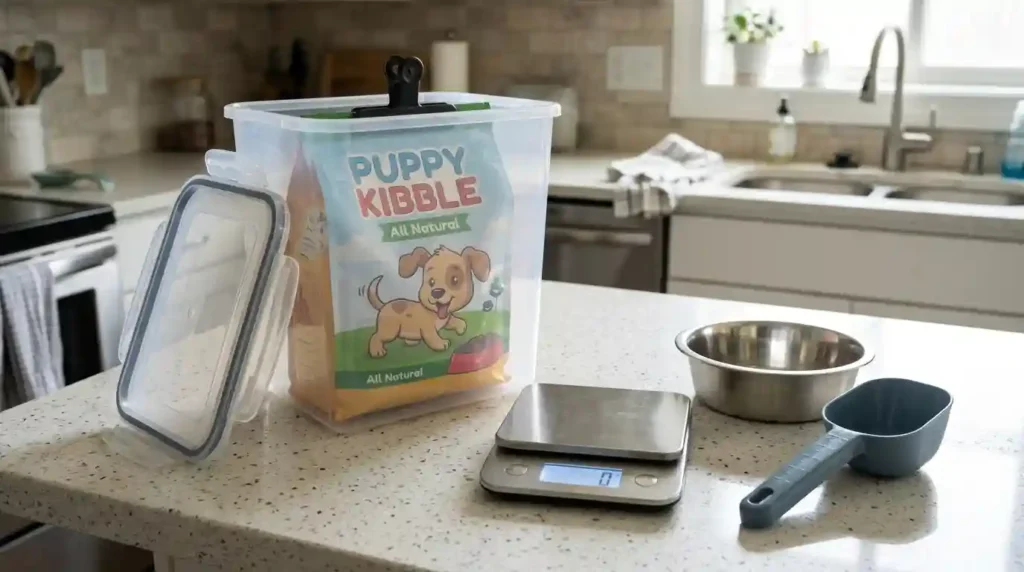
Place a bowl on the scale, reset it to zero, and add the measured amount of kibble.
Converting the Formula’s Feeding Chart Into Grams
Use the exact formula’s documented grams-per-cup value.
For example, if a food contains 110 grams per cup, a two-cup portion would weigh 220 grams.
This number is illustrative; do not assume all Puppy Chow formulas weigh 110 grams per cup.
Avoiding Accidental Overfeeding
Account for snacks, toppers, training treats, and food offered by other household members.
12.4 Feeding Frequency by Puppy Age and Weight
A general starting pattern is:
| Puppy Stage | Typical Meal Frequency |
| Early weaning | Multiple small meals or supervised access as directed |
| Young puppies after weaning | Around 3–4 meals daily |
| Older growing puppies | Around 2–3 meals daily |
| Adolescents approaching adulthood | Often 2 meals daily |
Very small breeds and puppies with health concerns may need a different schedule.
12.5 Can Young Puppies Eat Purina Puppy Chow?
When Puppies Can Start Eating Moistened Kibble
Purina’s feeding guidance describes puppies beginning to nibble on solid food at around 3–4 weeks old.
How to Soften Puppy Chow With Water
Its instructions use approximately three parts kibble to one part water for moistening.
Food should be softened to an appropriate texture and handled hygienically.
Moving From Moistened Kibble to Dry Food
As chewing ability develops, puppies may gradually transition toward dry kibble.
Feeding Considerations During Weaning
Weaning should be gradual. Young puppies also depend on appropriate maternal or veterinary-supported nutrition during early development.
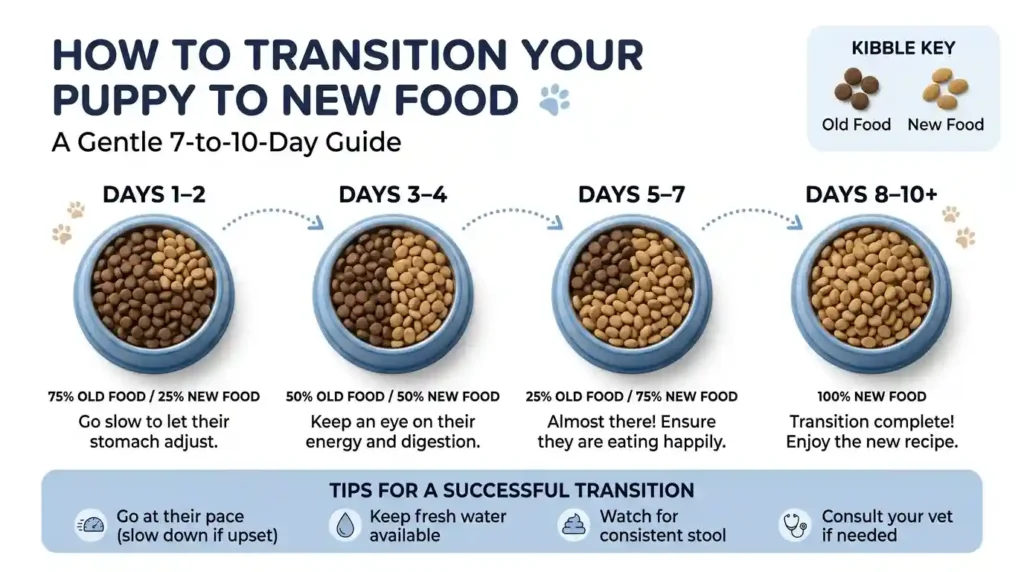
12.6 How to Transition Your Puppy to Purina Puppy Chow
Allow approximately 7–10 days to change foods unless your veterinarian recommends another approach.
| Days | Old Food | Puppy Chow |
| 1–2 | 75% | 25% |
| 3–4 | 50% | 50% |
| 5–6 | 25% | 75% |
| 7–10 | 0% | 100% |
This is an illustrative transition schedule. Slow the transition when appropriate and seek veterinary guidance if symptoms develop.
12.7 How to Monitor Stool Quality and Digestive Tolerance
Observe stool consistency, frequency, appetite, and behavior during the transition.
A temporary change may occur, but persistent diarrhea or repeated vomiting warrants attention.
12.8 What to Do if Your Puppy Develops Soft Stools
Check for sudden diet changes, excessive treats, unusual food exposure, and other symptoms.
Do not automatically assume the kibble is responsible.
Contact a veterinarian promptly if diarrhea is repeated, bloody, accompanied by vomiting, or occurs in a puppy that seems unwell.
12.9 What to Do if Your Puppy Refuses Purina Puppy Chow
Check food freshness, the puppy’s general behavior, oral discomfort, recent diet changes, and environmental stress.
Avoid prolonged food refusal in young puppies.
A veterinarian should assess persistent poor appetite.
12.10 How to Monitor Healthy Puppy Growth While Feeding Puppy Chow
Using Puppy Growth Charts by Expected Adult Size
Track weight over time rather than comparing your puppy to an unrelated breed.
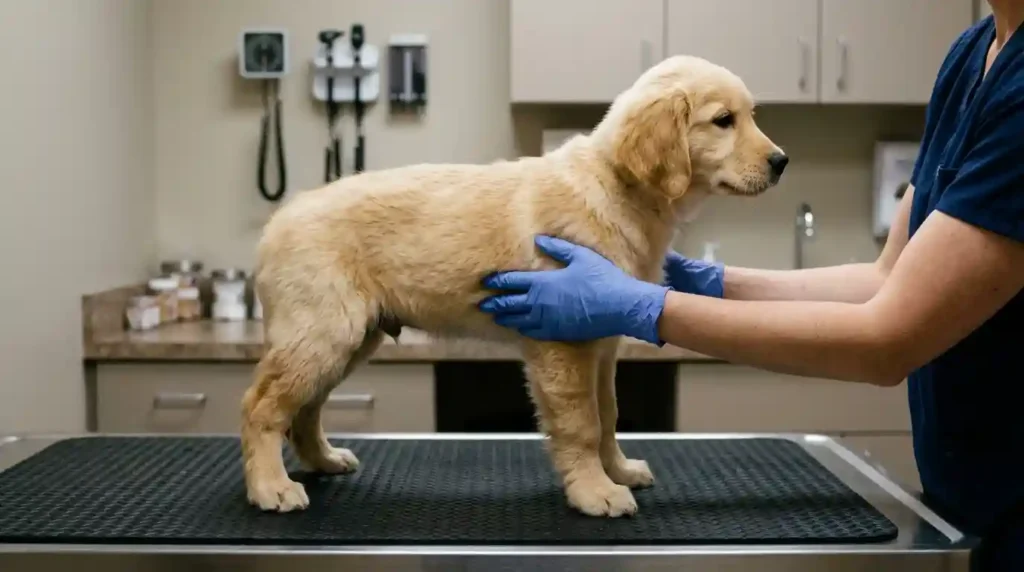
Understanding the 9-Point Body Condition Score
A veterinary body condition scoring system helps evaluate fat coverage and visible body shape.
A middle-range score is often a useful target, adjusted for breed, age, and veterinary assessment.
How Often Should You Weigh Your Growing Puppy?
Weekly or biweekly checks can be useful during rapid growth, with regular veterinary growth assessments.
When to Adjust Food Portions Based on Growth
Consider adjustments when growth patterns, body condition, appetite, or activity change.
Do not deliberately restrict essential nutrients in a growing puppy to produce a particular appearance.
12.11 Can You Mix Purina Puppy Chow With Treats and Food Toppers?
Understanding the 10% Treat Calorie Guideline
Treats and noncomplete extras should generally stay below approximately 10% of daily calorie intake.
Using Puppy Chow Kibble as Training Rewards
Portions of the puppy’s regular kibble can be reserved for training to reduce extra calorie intake.
How Toppers Affect Daily Calorie Intake
Even small amounts of calorie-dense toppers can contribute meaningfully to total energy intake.
Why Unnecessary Supplements Can Disrupt Nutritional Balance
Additional calcium or vitamin supplements may be inappropriate when the base diet is already complete.
12.12 Does a Puppy’s Food Requirement Change After Spaying or Neutering?
How Neutering Can Affect Energy Requirements
Some dogs experience changes in appetite or energy requirements after sterilization.
Adjusting Portions Without Restricting Healthy Growth
Any adjustment should preserve adequate nutrients and calories for ongoing development.
Monitoring Weight After Surgery
Track body condition and discuss concerns at follow-up veterinary visits.
12.13 When to Switch From Purina Puppy Chow to Adult Dog Food
Smaller dogs often approach nutritional maturity earlier than large or giant breeds.
A transition around 12 months may be appropriate for many dogs, while some larger breeds continue growing toward 18–24 months.
The appropriate timing depends on expected adult size, growth, health, and veterinary advice.
13. How to Store Purina Puppy Chow Safely
13.1 How Long Does Purina Puppy Chow Stay Fresh After Opening?
Freshness depends on the package, storage conditions, and manufacturer guidance.
Use the best-by date and product-specific instructions rather than assuming every opened bag stays fresh for the same number of weeks.
A large bag may be poor value if it cannot be used while maintaining acceptable freshness.
13.2 Best Storage Temperature for Dry Puppy Food
Keep dry puppy food in a cool, dry area away from direct sunlight and moisture.
The FDA recommends storage below 80°F.
13.3 Should You Keep Puppy Chow in Its Original Bag?
Yes. Keeping the original packaging makes it easier to retain the UPC, lot number, and best-by date.
The entire bag can be placed inside a clean, sealed storage container.
13.4 How to Clean Food Bowls, Scoops and Storage Containers
Wash and dry food bowls and utensils regularly.
Keep storage containers clean and dry, and remove residual crumbs and fats before adding a new bag.
13.5 Signs of Spoiled, Damaged or Contaminated Puppy Food
Warning signs may include unusual odor, moisture, visible mold, pest activity, or damaged packaging.
Stop using food that appears compromised and contact the manufacturer or veterinarian as appropriate.
13.6 Understanding Best-By Dates, Batch Codes and Packaging
The lot number identifies a production batch.
Keep the number and original packaging available in case of a complaint, recall, or investigation.
14. Purina Puppy Chow Sustainability & Ethical Considerations
14.1 Ingredient Sourcing and Sustainability
The environmental impact of dog food depends on ingredient production, transportation, manufacturing, packaging, and food waste.
Using different animal and plant ingredients can affect resource use, but ingredient names alone do not provide a complete environmental assessment.
14.2 Environmental Impact of Manufacturing
Pet-food production requires energy, water, packaging materials, and transport.
Purina publishes corporate environmental commitments, but claims about the environmental performance of Puppy Chow itself should rely on formula-specific evidence.
14.3 Corporate Responsibility and Ethical Practices
Manufacturer transparency, product safety, responsible sourcing, and accurate marketing are relevant factors.
A broad corporate sustainability program should not be presented as proof that every ingredient or package has a particular environmental benefit.
15. How We Evaluated Purina Puppy Chow Dog Food
15.1 Ingredient Quality Assessment
We considered the ingredients listed in manufacturer documents, their nutritional functions, and limitations in ingredient-list interpretation.
The review does not assume that by-products or grains are automatically unsafe.
15.2 Nutritional Analysis and Recipe Comparison
We compared manufacturer-declared protein, fat, fiber, DHA, calcium, phosphorus, and energy values for three dry formulas.
We did not conduct independent laboratory assays or feeding trials.
15.3 Ingredient Safety and Processing Evaluation
We examined potentially controversial ingredients in the context of their intended function and available information.
The presence of an additive alone was not considered proof of harm.
15.4 Recall History and Manufacturer Transparency
We considered the manufacturer’s stated recall status and publicly accessible recall information.
The absence of an identified current recall does not guarantee future safety or establish a complete historical record.
15.5 Price-to-Nutrition Value Assessment
We evaluated Puppy Chow primarily as a budget-oriented food.
Because prices change, illustrative calculations were used rather than presenting an unverified universal retail price.
15.6 How the Final Purina Puppy Chow Rating Was Determined
The 3.8/5 editorial score reflects five equally weighted qualitative categories:
- Nutritional suitability for normal growth
- Manufacturer expertise and transparency
- Variety of available formulas
- Ingredient approach and available product information
- Budget accessibility and value
This rating expresses a reasoned editorial judgment, not independent clinical proof of a product’s effectiveness.
16. Frequently Asked Questions About Purina Puppy Chow
16.1 Is Purina Puppy Chow the Same as Purina Dog Chow?
No. Puppy Chow is designed for puppy nutrition, while regular Dog Chow is primarily positioned for adult dogs.
16.2 Can Adult Dogs Eat Purina Puppy Chow?
Some Puppy Chow formulas carry all-life-stages adequacy statements, but an adult-specific diet may better suit an individual dog’s calorie needs.
16.3 Can You Mix Purina Puppy Chow With Wet Food?
Yes, provided the overall diet remains nutritionally appropriate and daily calorie intake is adjusted.
16.4 Is Purina Puppy Chow Suitable for Pregnant or Nursing Dogs?
Some formulas have reproduction-related feeding guidance, but the reviewed Large Breed label specifically states that it is not appropriate for pregnant or lactating females.
16.5 Can You Mix Purina Puppy Chow With Homemade Food?
Small amounts of safe extras may be acceptable, but substantial homemade additions can unbalance a complete puppy diet without proper formulation.
17. Final Verdict: Should You Feed Your Puppy Purina Puppy Chow?
17.1 Main Advantages of Purina Puppy Chow
Puppy Chow’s main advantages are its growth-stage nutritional formulation, accessible price category, manufacturer resources, and convenient availability.
17.2 Important Drawbacks to Consider
The ingredient lists include significant grain and plant-protein components, animal by-products, and artificial coloring. Specialized dietary options are also limited compared with some higher-tier brands.
17.3 Who Should Buy Purina Puppy Chow?
It is a practical option for many healthy puppies whose owners want affordable, complete nutrition without specialized dietary requirements.
17.4 When to Consider a Different Puppy Food
Consider another formula when your veterinarian identifies a specific need, your puppy cannot tolerate the recipe, or you prefer a different ingredient composition.
17.5 Final Recommendation — Final Thoughts
So, is Purina Puppy Chow good? For many healthy puppies, the answer is yes. It provides nutritionally adequate growth-focused food at an accessible price, with useful nutrients such as DHA, protein, calcium, and phosphorus. It is not the most specialized puppy diet, and its corn-heavy ingredient lists, animal by-products, and artificial coloring may lead some owners to prefer alternatives.
The most important decision is not whether the bag looks premium. It is whether the exact formula meets your puppy’s nutritional needs, supports appropriate growth, and is well tolerated. Begin with the package’s feeding guidelines, monitor body condition, and consult your veterinarian when health concerns arise.
For more practical nutrition advice and brand comparisons, explore our Dog Food Brand Reviews and the wider Dog Behavior and Training resource library to support your puppy’s healthy development.